

Personal Journal † Aggressive Momentum Swing Trader | Focused on Tension & Release | "keep it stupid simple" - NFA.
Learn From Me HERE! ➞
Joined May 2020
- Tweets13.6K
- Following186
- Followers47.1K
- Likes40.8K

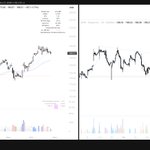


$IWM is sitting at a pretty logical spot for a potential interim bottom on the weekly chart, with a weekly pivot retest + 50week EMA support aligning with today's intraday 200day reclaim.
This is the confluence I'd want to see buyers defend aggressively here. @YousufTrades:)


Some of the most expensive trades you'll ever take begin with the words, "There's NO WAY this can go any higher/lower."
Ask me how I know.

Been cash heavy the last 2 weeks, taken exactly 2 trades since October 13th (both tiny Ls), and have been sitting on my bum ever since.
Still tracking the market daily, but outside of a few mean reversion opportunities into declining MAs + relative strength in software names like $PLTR, $RBRK, etc... I'm genuinely not seeing much that's actionable for my system just yet.
Am I doing this right?
I got much more consistent at trading when I stopped trying to get better at entries.
Sounds backward, right?
The first 2+ years, I'd obsess over the exact candle, reclaim, checklist, and tactic while completely ignoring whether the stock was actually a leader.
Sometimes I'd nail the entry and still lose, but now I spend most of my time identifying the strongest stocks in the strongest groups. The entry only comes later!!
Relative strength first, setup second, and then entry third, because a B+ entry in an A+ stock beats an A+ entry in a C stock every single time.
I wish someone had told me that sooner.
Here's why I spend so much time building my watchlist.
I'm looking for stocks that are:
- in the strongest groups.
- showing RS versus the indexes + peers.
- holding constructive weekly/daily trends.
- displaying evidence of accumulation in price + volume.
- building tight, actionable setups.
Only after identifying those names do I start thinking about entries.
> EMA crossback?
> 9EMA pullback?
> flat base b/o?
> HL setup?
> 3day flag?
> U&R setup?
> inside day setup?
> 15/30 minute pivot?
The setup comes after the stock earns a place on my watchlist.
$INTC is approaching what I'd consider one of the most important tests of its entire recent trend in the last year.
$INTC is showing an inside day + follow-through off its 200day, a pretty important inflection point after the recent breakdown. This is the first time it's been tested in over 12+ months, and it's the last major area I'd want to see buyers defend, as a decisive loss of the 200day opens the door for a retest of the support gap below.
For now, I'm watching whether buyers can establish a higher low above the 200day and begin curling back toward the psychological 100 pivot and declining daily 9/21EMAs.
Those moving averages are still overhead resistance, not confirmation of a new uptrend.
The base needs time to repair, but this is a logical area to stalk a potential reversal with risk defined against the recent swing low/200day.
Let's see what happens when earnings come out on Thursday!
Chart: $INTC.

Imagine trying to play a round of golf with 50 people standing behind you, each telling you which club to use, where to aim, and how hard to swing.
Even if you've hit that exact shot a thousand times, eventually you're going to start second-guessing yourself. hat's literally what some of y'all are doing every morning on X + Discord, and it's honestly kinda humorous.
To make you feel better, I've made this mistake maybe 10,000+ times.
Study other traders, steal the good ideas, and learn from people better than you, but when it's time to execute, you've gotta trust the playbook YOU spent years developing.
You can't expect to build conviction in your own edge when you're constantly letting somebody else take the shot for you.
Protect your focus at all costs in this environment.

Have you ever thought about how we're all watching the same strength names on here, yet everyone is trading them completely differently?
That's why I stop worrying about how somebody else is positioning and just wait for MY setup, the 1 I've studied thousands of times, know exactly where I'm wrong + have a proven edge executing.
Same stocks, different systems.
Wait for YOUR pitch and keep it stupid simple.
Here's an example on $RBRK, a strong name in a strong group. No tightness, no trade!
Chart: $RBRK.

A follower asked me recently whether I prefer buying breakouts or pullbacks, and I think my answer would've been completely different a few years ago.
Nowadays, my answer is pretty simple = whichever one the market is rewarding me for.
But there's a lot more to that answer than it sounds, and I think understanding the difference could save newer traders an unbelievable amount of money. More importantly, there's something I've learned about the relationship between breakouts & pullbacks that completely changed how I approach my entries.
This is a longer-winded writeup, but let me explain.
When we're in a choppy environment like we've experienced recently, I'm generally much more interested in buying weakness in strength rather than chasing stocks through obvious breakout pivots. You can have the most textbook setup imaginable, buy through your pivot, watch the stock move +5% in your favor, and then spend the rest of the afternoon wondering how the heck it moved back at b/e and/or took a loss.
Do that enough times and those little paper cuts start adding up. What's frustrating is that your stock selection might've been perfectly fine. You were just using an entry tactic that the environment wasn't rewarding.
That's an important distinction I've had to learn over the years. A good stock, a good setup, and a good entry aren't necessarily the same thing.
So when breakouts stop following through, I naturally start paying more attention to leaders that have already proven themselves with a Stage 1 → Stage 2 breakout and are now pulling back toward their rising 9/21EMAs or major weekly pivots. I'm still looking for the exact same characteristics... RS against the market + its peers, constructive price action (linearity), and evidence that institutions are willing to defend these areas.
But I want to make something clear because I see this misunderstood ALL the time.
A stock touching its 9EMA is not a reason for me to buy it.
I want to see how it gets there. Is volume contracting as price pulls back? Are sellers struggling to push it lower? Is it holding up better than the rest of its group? And most importantly, when price reaches that area of interest, are buyers actually showing up?
I've watched plenty of stocks bleed into their moving averages, sit near LOD for an hour, and then slice straight through support. There's a pretty big difference between a stock reaching an area where buyers "might" show up and actually seeing evidence that they're willing to defend it.
That's where my lower timeframes come into play.
Let's say I've been stalking a leader that's pulling back toward its rising daily 9EMA. Instead of trying to catch the exact bottom, I'll watch how price behaves around that level during the session. Maybe we get an aggressive flush off the open, a reclaim of VWAP, and then the first higher low begins developing on the 15/30 minute chart.
Now I've got something to work with.
If price starts reclaiming that intraday pivot, I can potentially enter with my risk against LOD or whatever technical level invalidates the setup. I'm not guessing where the bottom is anymore, because I'm letting buyers show their hand before I commit my capital.
And here's the part I wish someone had explained to me years ago.
I'm technically buying a pullback on the daily chart and a breakout on the intraday chart at the EXACT same time.
Think about that for a second...
The daily chart is showing weakness within an established uptrend, while the 15/30 minute chart is beginning to show strength as buyers reclaim control. Same stock, same opportunity, 2 completely different perspectives depending on the timeframe.
Price is fractal, and once I started understanding that relationship, I stopped obsessing over whether I was a "breakout trader" or a "pullback trader."
I'm just trying to position myself in strong stocks at areas where I can be wrong quickly and small.
Now, flip the environment.
When we're in a healthy trending market, breadth is expanding, my scans are filling up with leaders, and breakouts are actually following through, I'm MUCH more comfortable buying through major pivots.
But why?
Because I've learned that some of the strongest stocks in the market are incredibly rude. They'll spend 4-8 weeks building a big base, volume dries up, price tightens underneath a major weekly pivot, and then the stock breaks out and never gives you the pullback you were patiently waiting for.
I've missed my fair share of incredible opportunities because I was so determined to get the perfect entry that I forgot what I was actually trying to accomplish.
The goal isn't to buy the lowest possible price. The goal is to find an asymmetric opportunity where the potential upside meaningfully outweighs what I'm risking.
If a stock has spent weeks absorbing supply and is finally expanding out of a major Stage 1 base into a potential Stage 2 uptrend, I'm not going to automatically pass on it because it didn't pull back to the 9EMA first.
Sometimes paying a little more for confirmation is perfectly reasonable, assuming I can still define my risk appropriately.
That's the entire idea behind compression → expansion that I talk about so frequently. I'm looking for tension building underneath major pivots, volatility contracting, volume drying up, and eventually buyers overwhelming the available supply.
But there's another piece of this that I think matters even more than the entry itself, and it's something I wish I'd taken seriously during my first few years trading.
My own equity curve has a HUGE influence on how aggressively I'm willing to trade either setup.
I could wake up tomorrow and find 5 breakouts on my scans, but if my last several trades have been paper cuts, my positions aren't building cushion, and leaders keep failing to hold their gains, why would I suddenly start throwing meaningful capital at the market?
That's something I used to struggle with. I'd convince myself that the next setup was going to be the one that finally worked, even though the market had been telling me for days that my edge wasn't being rewarded.
Nowadays, I'm much more comfortable starting small and letting the market prove itself.
Maybe I take a pilot position in a leader pulling back into its 9EMA. If it starts working, I build some cushion. Another setup appears and that one starts working too. Suddenly I've got multiple positions behaving the way I want them to, and my equity curve is beginning to confirm what I'm seeing on the charts.
That's when I start thinking about progressively increasing exposure.
I've gone from mostly cash to heavily invested within a matter of days before, not because I woke up and decided the market was going higher, but because my trades kept working and I had actual profits to lean against.
The market earned my exposure. I didn't give it away because I felt bullish.
And the opposite is equally important. If I'm taking consecutive losses and nothing is following through, I have no problem reducing exposure and sitting on my hands until something changes.
I think this is where a lot of traders get frustrated. They'll find a strategy that works for a few months, experience a difficult stretch, and immediately assume they need to reinvent their entire system.
Sometimes that's true, but majority of the time, the problem isn't your strategy at all. You're simply trying to force an entry tactic in an environment that isn't rewarding it.
Here's something I'd encourage you to do if you've been struggling with this recently.
Go back through your last 20-30 trades and separate your breakout entries from your pullback entries. Then look at what the market was doing when you took them. Were leaders holding their moving averages? Were breakouts sticking? Were you buying through resistance in a choppy environment, or buying against support in names showing RS? And were your positions actually building cushion, or were you constantly watching green trades turn red?
You might start recognizing patterns in your own behavior that have absolutely nothing to do with your ability to identify a good stock.
I've learned an unbelievable amount about myself by doing this over the years.
And if you miss a breakout in a true leader, please don't convince yourself that you have to own it at any price. I've made that mistake more times than I'd like to admit. A stock can be up +10% from your original pivot and still be a fantastic company, but that doesn't mean it's offering a fantastic entry anymore.
If it's truly a leader, there's a good chance it'll eventually give you another opportunity. Maybe that's an inside day, a tight flag, a pullback into the rising 9/21EMAs, an EMA crossback, or another multi-day base where you can define your risk again.
I'd rather miss the first 10% of a much larger move than spend the next three weeks digging myself out of unnecessary losses because I couldn't stand watching something run without me.
So when somebody asks whether I prefer breakouts or pullbacks, I genuinely don't think there's a universal answer.
In a healthy trending market, I'm happy to buy strength as stocks expand out of major bases. In a choppy environment, I'd much rather look for weakness in established leaders and wait for buyers to prove themselves on the lower timeframes.
And regardless of which entry I take, my thought process is essentially the same. I want a leading stock in a leading group, a meaningful area of interest on the weekly/daily chart, a tight lower-timeframe execution, and a logical place to be wrong.
If my positions start working, I'll press.
If they don't, I'll back off.
I've spent the better part of 6+ years trying to become a better trader, and it's pretty funny how much of that improvement has come from simplifying things I used to make way too complicated.
I'm not trying to perfect the entry, my goal is trying to get better at recognizing when the environment, the stock, and my own equity curve are all giving me permission to take risk.
That's really what it comes down to for me.
Everything else is just an entry tactic.
My 2 cents.

I want to walk you through how a stock goes from being demoted on my watchlist, back on my radar, to being potentially actionable.
$TWLO is a great example of how I think through these setups.
On Friday, October 16th, $TWLO printed a nasty kill candle, and I immediately demoted it on my watchlist.
Strong group, but the stock's personality shifted. No reason to force something that's acting poorly. Fast forward to Wednesday, October 21st, and price gaps higher + closes back above its daily 50EMA. That got my attention again.
Then Friday, October 23rd, we get an inside day holding above the 50EMA, giving us a much tighter area to define risk. Notice how the stock had to earn its way back onto my watchlist.
Now I'm stalking a potential flush off the open followed by a VWAP reclaim + right-side curl on the lower TF chart or a break above Friday's highs as the trigger. That would give me a possible entry with risk against LOD, ideally just above the 50EMA, and invalidation if price loses that pivot.
With earnings this week, I'd be particularly careful about overnight exposure. If I built enough cushion to take trims beforehand, I might consider holding a smaller remainder through the report, but otherwise I'd reduce risk or sit it out entirely.
The lesson here is that a bad candle doesn't mean a stock is dead forever.
I demote weakness, promote improving price action, and only consider putting capital to work when the setup offers tight, asymmetric risk. Not every opportunity deserves the same size, and a tight stop doesn't automatically justify a large position, especially heading into earnings.
I currently have NO position in $TWLO.
Just sharing how I think through these opportunities in real time.
Chart: $TWLO.

I'm starting to think the 9week is a magnet for institutional demand in leading stocks.
$P is an example from today. After a roughly 70% move higher after finding support off the 50EMA, price pulls right back into its rising 9week, and almost immediately, aggressive buyers step in to defend that area.
This is exactly the type of behavior I look for when trying to identify where the strongest names are finding support.
I want to see price flush into or briefly undercut a major weekly pivot, reclaim it with conviction + give me a lower-timeframe entry where I can define risk against the swing low or another logical invalidation level.
That's how I find asymmetric opportunities in names that have already made enormous moves.
You'd be surprised how many opportunities come from watching the same handful of pivots over and over again.
Keep it stupid simple.
Chart: $P.

I've been staring at charts all weekend like a complete psychopath, and apparently one corner of the market didn't get the memo that everything is supposed to be falling apart.
$PLTR, $CRM, $RBRK, $PANW, $TWLO, $DDOG, $FROG, $SHOP + $EBAY are all names I've mentioned over the last week, and I don't think that's a coincidence.
Software is one of the very few areas in the market where I'm consistently finding names that actually interest me. I think there's a pretty valuable lesson here about how money rotates through the market.
While a lot of former leaders are breaking down, these names have been showing some pretty interesting RS, holding key pivots + attempting to build constructive structures. Money doesn't just disappear when one group starts underperforming. It often rotates into areas showing better relative strength. That's why I pay so much attention to clusters of stocks appearing on my scans.
When multiple names in the same group start acting right, I want to know WHY.
But here's where I think a lot of traders get themselves into trouble. Identifying where money is flowing doesn't automatically mean it's time to put meaningful risk on.
I can recognize software as an area of interest while simultaneously acknowledging that the broader environment still isn't rewarding my style of swing trading. Those 2 things aren't mutually exclusive.
My edge comes from positioning in leading stocks, finding tight asymmetric entries on the lower TF charts + progressively pressing when my positions start building cushion. I'm really not interested in reinventing my entire trading system just because the market has been difficult for a few weeks.
What I've been doing now is I've been watching which of these names can hold their 9week, reclaim key daily pivots & build tight bases while the rest of the market struggles. If I see a defined setup, I'm happy to take a smaller pilot and let the trade tell me whether there's an edge worth pressing. If it fails, I take my paper cut and move on.
Last week I brought up the example of how it's like fishing. If nine ponds aren't producing anything and one keeps showing signs of life, I'm going to spend my time studying that one. But that doesn't mean I'm casting every 5 minutes just because I see a few fish swimming around.
1) RS first (fish the healthy pond).
2) setup second (patience).
3) exposure LAST (execution).
A simple framework that might be helpful to you moving forward.
Long software.