

PhD in Economics, University of Barcelona. Former economist at IMF. Author: 'The economic impact of International Monetary Fund programmes' (Springer; 2016).
Lahore, Pakistan
Joined February 2013
- Tweets15.2K
- Following318
- Followers684
- Likes718





Pinned Tweet
My article 'Learning from China’s economic philosophy and policy — XVIII' points out, for instance 'Here, the role of ‘troika’ approach being adopted by China is to have a wholesome reform approach over the financial side of the economy, with obvious repercussions for the real sector, particularly in effectively implementing infrastructural, state-owned, and export-led development related reforms, and providing access to finance in a sustainable and inclusive way.'
brecorder.com/news/40449800/…

Omer Javed retweeted

Thomas Piketty and colleagues reply to a Jacobin critique of the Global Justice Report, arguing that nearly 90% of humanity can double its income while working half as many hours: jacobin.com/2026/11/piketty-…

Omer Javed retweeted
It is sad to say the least that collapse of #COP31 meetings, given no agreement was reached on a consensus document, has apparently not brought much-needed deep discussions in media, or by policymakers, in general, giving elaborate statements in the country, which is among the top-ten most climate vulnerable countries, and where a number of its cities are among one of the most affected by smog globally!
Overall as well, climate change crisis is fast-unfolding, as pointed out for instance in his address at COP31 by the director of 'Potsdam Institute for Climate Change'.
@PIK_Climate
youtu.be/ncx_zxmdwOQ?si=p3SO…
'International climate talks collapsed on Sunday without any major agreement after dozens of countries rejected a deal they saw as pandering to the fossil fuel industry.'
bloomberg.com/news/articles/…

13
Almost everyday, for many days now, I read some portion of your book. I find, above all, a sense of urgency, as if someone has put their ear to the ground, and has penned down in meaningful articulation the sounds that carry the message of 'trouble' in so many separate but yet related sounds, may that be in the realms of politics, economics, and the very everyday needs of a decent, dignified life, away from the ravaging winds of austerity, and neoliberal headwinds, that over time have set wheels into motion of fascist tendencies. Thanks for this book.
@IsabellaMWeber

Tomorrow, I’ll be talking about my new book ANTI-FASCIST ECONOMICS with @KuperSimon at #ParisAgainstOligarchy.
🔗 Register to attend in-person or online at the link below.

20
Omer Javed retweeted
Anwar Shaikh spent more than 30 years on a book that rebuilt economics from the ground up.
Clara Mattei, who worked alongside him at the New School, explains why his “real economics” is central for the Left. jacobin.com/2026/11/shaikh-e…

Omer Javed retweeted
My article 'Neoliberal and austerity policies, and climate crisis' indicates that while it is important for highly climate change crisis challenged countries, like Pakistan to receive 'grant-based finance', as reportedly sought by the Prime Minister of the country at COP31, what is also important for countries is to move away from neoliberal, and austerity policies for greater role of public sector, and financing for both reducing carbon footprint, and enhancing resilience.
pakistantoday.com.pk/2026/11…

Omer Javed retweeted
Climate finance is usually framed around how much public money can be mobilised. The more interesting question is on what terms. Public money that de-risks without sharing the reward leaves the upside with investors and the risk with citizens.
This morning at the Brazil Pavilion with @MinFazenda and @mmeioambiente for the panel "From Capital Mobilization to Fiscal Subsidy Reform" at #COP31
Tue 17 Nov | 10:15-11:15 TRT | Belém Auditorium, Brazil Pavilion, Blue Zone
More in paper with @rodrikdani on conditions attached to public investment ➡️ academic.oup.com/icc/advance…

Article 'Severe cutback in development spending' in Business recorder by renowned economist, Dr. Hafeez Pasha, rightly raises alarm on serious lack of development spending, pointing out in turn 'The Planning Commission has released estimates of federal development expenditure in the first four months of fiscal year 2026-27. The spending has been Rs 103.9 billion, equivalent to only 10.4 percent of the annual federal Public Sector Development Program (PSDP) for the year. ...This is the process of a long-term decline in the level of federal spending on development. There is need to recognise the favourable impact of public spending on infrastructure and social services on the viability and profitability of private investment. This stimulates overall the process of economic growth.'
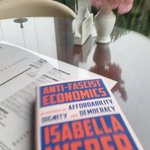
As aptly indicated her new book ' Anti-fascist economics' by @IsabellaMWeber, monetary, and fiscal austerity policies seriously hinder delivering an 'economics of essentials', and in doing so strengthens fascist tendencies, as for instance, reflected in far-right populist rheoteric, which does not allow, at least, at first dealing with the significant causes behind these problems facing masses, and that is neoliberism, and austerity.
For instance, she points out in the same book 'Central banks react to inflation by raising interest rates, cooling the economy and suppressing wage growth in an attempt to bring prices down. But when inflation originates in supply shocks to a handful of essential sectors, interest rate hikes are not only regressive but also ineffective. They cannot fix a disrupted harvest or a geopolitical energy shock… And since people can’t do without consuming essential goods, and services, reducing their income won’t do much to reduce demand in the sectors experiencing high prices either. What interest rates can do– and do do– is raise debt-servicing costs on lower-income households and the debt burden on developing countries, suppress job creation at the bottom of the labour market, and increase the cost of very investments needed to build resilience against future shocks and transition out of fossil fuel capitalism. If monetary austerity is paired with fiscal austerity, it only compounds the damage.'
@DrIkramulHaq
@Maria_Memon
@saeed_qazi
brecorder.com/news/40449216/…

Politics is about channelizing workable solutions from debates originating from public opinion, including those of the politicians, and not privatizing reward for vested interest by paving the road for them that leads to policy without filtering that which is not for the 'common good', and before that election campaign finance that travels from this vested interest on these roads.
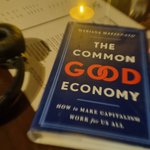
In her noted book 'The common good economy' @MazzucatoM indicated for instance 'A common good economy requires embedding economic objectives within the fabric of social relationships and rethinking how all actors - induviduals, public institutions and private firms - relate to one another. This demands removing it from notion of market failures: it must instead be about how to shape markets and the economy, putting the common good at the centre of all economic relationships. ...It moves beyond treating markets as neutral arenas for individual maximization, aiming instead to design systems that actively cultivate cooperation and shared wellbeing to make the common good possible.'
Politics may not properly deliver under economics of neoliberalism, and austerity, but as @IsabellaMWeber in her ground breaking book 'Anti-fascist economics' indicates that practice of such policies lead to perpetuating fascist tendencies, rather than delivering for the people.
For instance, she points out in the same book 'Stabilizing the prices of essentials is therefore anti-fascist economics in two mutually reinforcing ways: It directly reduces the economic insecurity and affordability crises that make ordinary people available for far-right mobilization. And it breaks the chain from supply shock to inflation to interest rate hikes and austerity that plays into the hands of the fascist threat.'
My article 'Public sector responsibility and ‘common good’' points out: 'While it is indeed important to have discussion on the need for more provinces, and administrative units, what is equally important is to revisit the role of the public sector being practiced in the country, overall, for the last four decades or so in particular, which is in line with the overall wave of neoliberal role of public sector globally during this time.'
Link to article: pakistantoday.com.pk/2026/11…
Link to programme: youtu.be/btdwoxnOMgk?si=mlas…
@SKhaqanAbbasi
@NasimZehra

1
18
Some comments (see below) on the discussion in the programme on economy (weblink: youtu.be/hz1QSf5Vijw?si=bdhh…).
My article series on China (brecorder.com/news/40432595/…) amply indicates how China's non-neoliberal, non-austeriity, and counter-cyclical policy - contrary to the standard policy precription being followed in Pakistan, over the last number of decades, both inside, and outside of International Monetary Fund (IMF) programmes, and also practiced under World Bank's development policy loans - has been instrumental in not only developing the country, but also taking significant number of people out of poverty.
Here, a highly meaningful role played by leadership, for instance through National Peoples Congress, and the State Council, was instrumental in guiding both monetary, and fiscal policies in a harmonized way, along with providing leadership to an otherwise well-employed local councils.
@Maria_Memon @ARYNEWSOFFICIAL
@arynewsud
My article 'Neoliberal and austerity policies, and climate crisis' indicates that while it is important for highly climate change crisis challenged countries, like Pakistan to receive 'grant-based finance', as reportedly sought by the Prime Minister of the country at COP31, what is also important for countries is to move away from neoliberal, and austerity policies for greater role of public sector, and financing for both reducing carbon footprint, and enhancing resilience.
pakistantoday.com.pk/2026/11…

My article 'Learning from China’s economic philosophy and policy — XVII' praises China's cautious approach, whereby gradually liberalizing capital account in terms of both foreign direct invest (FDI), and foreign portfolio investment (FPI).
Moreover, part seventeen of the article series pointed out, for instance 'Instead, Pakistan has mistakenly pursued a policy of competing for highly volatile foreign portfolio investment (FPI) by maintaining policy rates higher than necessary to keep inflation stable and predictable. Furthermore, these high rates add greater volatility to the capital account by encouraging rent-seeking carry trades. A more moderate policy rate would keep the cost of capital supportive of domestic investment and FDI, allow greater scope for counter-cyclical government policies, and foster a better balance between aggregate demand and supply-side measures.'
brecorder.com/news/40448667/…


Omer Javed retweeted

Monetary policy has gotten lazy, so the political power shift may be seen be in tariffs. Will the left give Americans back the power of the purse? My chat with @richardquest for @questCNN @CNN
Omer Javed retweeted
“To deliver affordability means stepping on toes and breaking taboos. Not least, the economists’ cartel with its aversion to rent and price controls. Not least, the health insurance industry and the pharmaceutical companies. Not least, the private-equity energy mafia. Not least, the budget and resource drain that is our distended, obsolete military. And not least, the shibboleth that interest rates are the sole domain of the Federal Reserve, to be raised—crushing housing while enriching the banks—on the empty pretext of “fighting inflation.””
James Galbraith

Omer Javed retweeted
Economics can help us protect our democracy — but only if it puts a floor under people's livelihoods and a ceiling on private wealth. That's what I told @wef's Radio Davos.
🎧 Listen wherever you get your podcasts or at the link below.

'Transcript: Can economics fight fascism? With Isabella Weber' - ft.com/content/6b969bcb-9c5c… via @FT

39