

part-time degen,full time researcher 📚 | Proudly building with @IThinkItsArt 🎨
On-chain
Joined May 2021
- Tweets191K
- Following3.3K
- Followers9.1K
- Likes22K





Pinned Tweet
We mint NFTs,we buy them,sell them & make money from them,but sometimes we need a reminder to be grateful for people who built this space,who saved this industry. The legendary men & women made this market stayworthy 🙏
This post is just a token of appreciation to all of these legends 🧡
There's a list of some of them under this post, spend some money to check it,make sure to follow all of them if you haven't yet & share others that i forgot to mention 👇


MML retweeted
The launch model that starts with a deploy button has a known extraction path. The one that starts with measured activity does not.
@zerufinance is opening Activity Markets as the product form of that inversion. Memes spawn from proof-of-activity of existing onchain communities. Verified contributors earn miner and creator rights. Traders set the price. The scarce resource is no longer attention acquired before the public or speed of the click. It is the activity already recorded on the protocols the community uses. Registration is open at the markets page.
That is the operational difference from a standard launchpad. In the usual sequence a creator deploys, early wallets secure supply, and the community arrives after the chart. Here the community and its activity exist first. The right to create the asset is earned by wallets whose history already shows contribution, not by wallets that can fund a bundle in the launch block. The trust layer that scores that history is the same one that ranks wallets for allocation: account age, funding patterns, activity consistency, cross-protocol use, and exit behavior.
The page is explicit about the sequence. Activity oracles determine who contributed. Contributors become the miner class. The market then prices the asset. Speculation stays. The order of who gets to create it changes.
If the right to launch is earned by the activity already onchain, which of your existing wallets would actually qualify as a miner rather than as a late buyer?
MML retweeted
The board is no longer a pitch deck. It is a live order book.
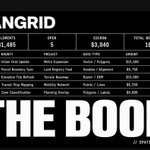
As of this morning data.vangrid.io shows $681,485 settled in USDC, 1,021 bounties, 26 bulk orders, five still open, and $3,040 currently locked in escrow. Those numbers are not network-size claims. They are the cumulative result of individual requests that were posted, filmed, accepted, and paid. Each settled amount corresponds to a specific place someone named — a reefer block at a container terminal at night, a chassis pool yard, a grocery-store service lane, a wet stretch of riverside steps, a self-storage floor, a station concourse — and to a reconstruction that was delivered after the capture was fingerprinted and the root anchored on Base.
@vangrid_io does not sell coverage of every street. It sells the fulfilment of named geometry. A requester or an agent posts the exact site and the window. A contributor nearby films the orbit. Payment settles only after the submission is accepted. The open and escrow lines on the board are the requests that have not yet cleared that step. The settled total is the requests that have. Bulk orders (the same brief repeated across multiple locations) appear as separate line items, so a single buyer can commission seven stair nosings or ten loading-bay signs without treating them as one undifferentiated dataset.
The difference from a coverage pitch is that the metric the board optimizes for is fulfilment rate and delivery time of specific orders, not the theoretical size of the contributor graph. An enterprise buyer asking “how do I know the data I need will be there when I need it” gets an answer that can be checked on the public board and on the ledger: post the bounty, the escrow locks, a person films it, the model returns, the USDC moves. If the deadline passes without an acceptable take, the funds refund. The system does not promise infinite coverage. It promises that a funded request for a named place either produces a checkable reconstruction or returns the money.
If you were evaluating a spatial-data network for procurement, would you start with the size of the contributor base or with the settled total and the open orders on the board that show which exact places are being fulfilled right now?


The launch model that starts with a deploy button has a known extraction path. The one that starts with measured activity does not.
@zerufinance is opening Activity Markets as the product form of that inversion. Memes spawn from proof-of-activity of existing onchain communities. Verified contributors earn miner and creator rights. Traders set the price. The scarce resource is no longer attention acquired before the public or speed of the click. It is the activity already recorded on the protocols the community uses. Registration is open at the markets page.
That is the operational difference from a standard launchpad. In the usual sequence a creator deploys, early wallets secure supply, and the community arrives after the chart. Here the community and its activity exist first. The right to create the asset is earned by wallets whose history already shows contribution, not by wallets that can fund a bundle in the launch block. The trust layer that scores that history is the same one that ranks wallets for allocation: account age, funding patterns, activity consistency, cross-protocol use, and exit behavior.
The page is explicit about the sequence. Activity oracles determine who contributed. Contributors become the miner class. The market then prices the asset. Speculation stays. The order of who gets to create it changes.
If the right to launch is earned by the activity already onchain, which of your existing wallets would actually qualify as a miner rather than as a late buyer?
MML retweeted

your balance becoming public market intel every time you move money is the worst part of public chains
@primus_labs confidential vault on BNB Chain lets you shield $U into encrypted $eU transfer privately and earn yield from unitas while your actual position stays hidden
privacy that still lets you use the system not hide from it
s.kaito.ai/1c1DkRo
points.primuslabs.xyz?ref=BH…


Introducing Primus Confidential Finance (dapp.primuslabs.xyz), where privacy meets transfer and yield on-chain.
We're excited to announce a collaboration between Primus @primus_labs, Unitas @UnitasLabs, and United Stables @UTechStables to launch a Confidential Finance Product on @BNBCHAIN, powered by the Fully Homomorphic Encryption (FHE) technique.
This isn't just another confidential transfer or on-chain vault. It's a new standard for how private, compliant, and capital-efficient on-chain finance can work. 🧵


The board is no longer a pitch deck. It is a live order book.
As of this morning data.vangrid.io shows $681,485 settled in USDC, 1,021 bounties, 26 bulk orders, five still open, and $3,040 currently locked in escrow. Those numbers are not network-size claims. They are the cumulative result of individual requests that were posted, filmed, accepted, and paid. Each settled amount corresponds to a specific place someone named — a reefer block at a container terminal at night, a chassis pool yard, a grocery-store service lane, a wet stretch of riverside steps, a self-storage floor, a station concourse — and to a reconstruction that was delivered after the capture was fingerprinted and the root anchored on Base.
@vangrid_io does not sell coverage of every street. It sells the fulfilment of named geometry. A requester or an agent posts the exact site and the window. A contributor nearby films the orbit. Payment settles only after the submission is accepted. The open and escrow lines on the board are the requests that have not yet cleared that step. The settled total is the requests that have. Bulk orders (the same brief repeated across multiple locations) appear as separate line items, so a single buyer can commission seven stair nosings or ten loading-bay signs without treating them as one undifferentiated dataset.
The difference from a coverage pitch is that the metric the board optimizes for is fulfilment rate and delivery time of specific orders, not the theoretical size of the contributor graph. An enterprise buyer asking “how do I know the data I need will be there when I need it” gets an answer that can be checked on the public board and on the ledger: post the bounty, the escrow locks, a person films it, the model returns, the USDC moves. If the deadline passes without an acceptable take, the funds refund. The system does not promise infinite coverage. It promises that a funded request for a named place either produces a checkable reconstruction or returns the money.
If you were evaluating a spatial-data network for procurement, would you start with the size of the contributor base or with the settled total and the open orders on the board that show which exact places are being fulfilled right now?


