

Enterprise AI — Silicon to Apps. We build and deploy complete AI systems around your business. From the infrastructure underneath to the applications your team
Palo Alto, California
Joined July 2025
- Tweets82
- Following0
- Followers3.3K
- Likes62


Pinned Tweet
The Agentic OS is here!
Today, we’re launching Origon, a foundation for agentic AI, built for the era when intelligence becomes software.
No cloud APIs. No frameworks. No glue code. LLMs, orchestration, parallel execution, memory, and tools, unified in a single platform — hosted in our global data centers to deliver private and secure AI.
Built for the full agentic lifecycle
A best in class experience for agentic operations, built as a complete hardware plus software system, not a cloud wrapper.
— Visual workflows
— Real time sessions
— Observability
— Analytics
One place to build, run, and monitor.
Human in the loop
AI human collaboration by design. Agents operate autonomously when appropriate, and partner with humans when judgment, oversight, or precision is required.
Continual learning
Agents evolve with durable memory, structured knowledge, and integrated safety guardrails, so they improve without losing control.
Connect in one click
Instant connections to Chat, Email, SIP, WhatsApp, Messenger, and hundreds of MCP integrations, all with a single click.
AI native apps
Built in apps designed from the ground up for agent human collaboration, not loosely integrated with legacy software.
Read the full announcement: origon.ai/stories/origon-is-…

Origon retweeted

Calling all AI automation builders
If you've built workflows on n8n, LangChain, or Make then we want to work with you!
Create templates on @origon, get paid, and get published in our marketplace with full credit + promotion
Interested? Repost + comment what you've built 👇🏼
Origon retweeted
I’m looking for a Motion Designer to help us scale @origon 🚀
We need someone to turn our Figma designs into promo and animations for tutorial content.
Think ElevenLabs, Linear, or Framer aesthetic.
Interested? Drop your portfolio/showreel below! 👇
WE’RE HIRING: Motion Designer (Contract —> Full-time)
We are looking for a world-class Motion Designer to help define the visual language of Origon.
The Bar: We’re inspired by the precision of Apple and Linear and the fluid, premium motion of ElevenLabs, Framer, Webflow, Base44/Wix.
If you obsess over design and motion, we want you!
The Role: turn our Figma designs into stunning motion content—think promo videos, hype snippets, and animations for high-quality tutorials.
— Figma proficiency is a must. You’ll be working directly with our UI designs to build motion assets.
— Tools: We currently use Jitter, but we’re open to After Effects, Blender, Spline, or whatever you use to achieve elite results.
How to Apply: Comment below with your showreel or a specific project you’re proud of that aligns with this aesthetic.
P.S. we are moving fast and aim to hire in the next 48 hours. We will personally review the portfolio of every person who also reposts this thread.
Your support runs on systems.
So should your AI.
Every customer question, every employee request, every supplier inquiry — they all end the same way.
Someone logs into Salesforce. Or SAP. Or Workday.
They check status, verify data, execute an action, return an answer.
We've automated the greeting.
We haven't automated the work.
That's the problem with most support AI today — it stops at conversation.
Pick one workflow. One high-volume, system-driven process your team executes daily.
Build it on Origon — and stop answering. Start executing.
1
4
1,737
Check out the full article: origon.ai/stories/beyond-the…
Book a demo: origon.ai/enterprise
6
1,544
We've heard the feedback. Configuration shouldn't be a barrier.
We're creating setup guides for every Origon tool. Starting with the most-used: Chat, Email, and SIP.
First—Chat.
One node supports four deployment modes. Public URL for instant sharing. Embedded widget for your site. Full-screen app on your domain. Or SDK for custom builds. All voice-enabled by default.
SIP.
Real-time telephony with natural interruption handling. Duplex audio. Continuous listening.
1
4
1,947
Full playlist: youtube.com/playlist?list=PL…
Let us know which tools you want covered next!

2
2,591
Origon retweeted
Docker is overkill for 90% of local dev work
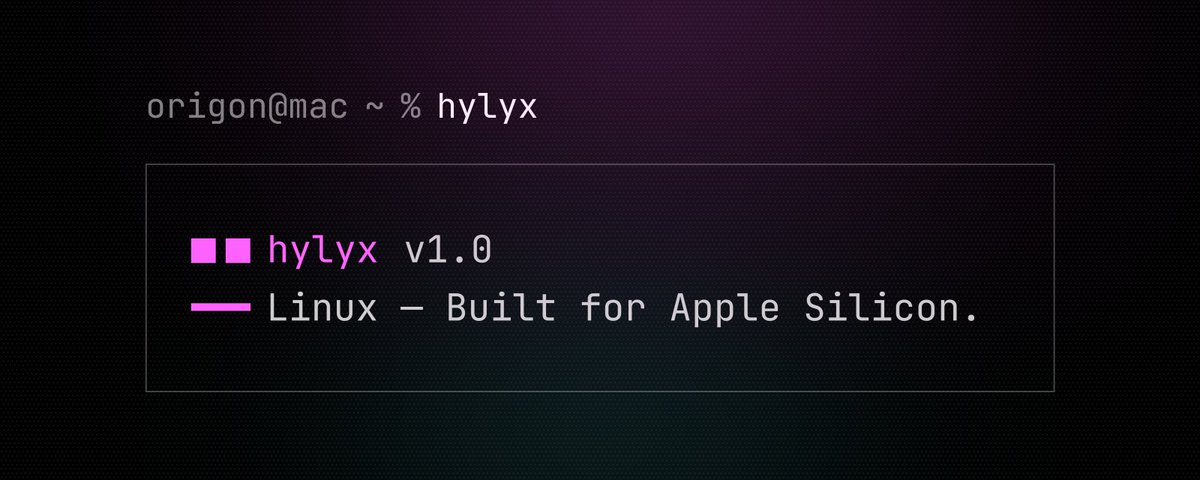
Hylyx: 78 MB Ubuntu VMs, 30-second boot on Apple Silicon
faster than Docker containers, fully open source
here's the architecture:

Origon retweeted

We had a structural problem.
Every time a customer reported call quality issues or billing discrepancies, we pulled engineers off product work.
They'd dig through CDRs, run network diagnostics, validate configurations—work that's absolutely necessary but shouldn't require senior resources.
So we built a multi-agent system on @origon that does the actual work:
→ Correlates failed calls across system logs
→ Executes billing reconciliation across payment processors
→ Runs diagnostic queries across distributed systems
→ Validates SIP configurations
Not triage. Resolution.
One week to deploy. 70-80 support interactions resolved daily. Zero human intervention.
We gave agents the same system-level access our engineers use. No surface-level chatbot responses. They execute L2/L3 diagnostics—the complex stuff.
When escalation is needed, engineers get actionable context, not ambiguous tickets.
The barrier to enterprise AI automation has collapsed. Development cycles, integration complexity, security review—we cleared all of it in under a week.
The question isn't whether this is possible. It's whether you're still planning while competitors are deploying.
What's the support bottleneck costing your team?

70-80 support tickets resolved daily. Zero human intervention. One week to production.
Typical AI support escalates everything—it lacks system access.
Samespace gave AI agents actual system access: customer databases, call logs, network diagnostics, billing APIs.
Not triage. Resolution.
L2/L3 support that previously required senior engineers.
Full story ⬇️
Origon retweeted
got asked this and it's honestly one of the most important questions about origon, so here's the answer:
we built the entire stack.
it runs on our own infrastructure (global anycast network + compute), fine-tuned models, an orchestration runtime, a knowledge engine, and voice systems.
everything operates as a single unified system, not by making API calls to third-party cloud services.
that’s why we can do sub-second agent coordination without external dependencies.

Agent frameworks exploded fast.
In demos, they deliver—until you try to run them in production.
The problem isn't that frameworks are bad. Most are thoughtfully designed. The issue is architectural. They're libraries built for orchestration, not infrastructure for long-running distributed systems.
Production agents need what frameworks don't provide:
- State persistence across sessions
- Execution that survives interruption
- Error handling with rollback semantics
- Identity, permissions, and access control
- Structured observability and audit logs
Autonomy without boundaries isn't intelligence. It's instability.
When something breaks in production, you need to know exactly what failed, where it failed, under what state, and after which decision. Without structured traces and logs, debugging becomes guesswork.
Memory isn't retrieval—it's continuity. Agents need to know what to remember, what to forget, and why.
Integrations aren't reliable by default. APIs time out, return malformed data, and partially succeed. Production requires contract validation, retries, circuit breakers, and fallback paths.
Security can't be scattered across prompts and tools. It needs to live at the system's core—a single control plane where policy is enforced consistently.
That's why we built Origon. The agentic OS for building, running, observing, and governing agents in production.
Read the full breakdown: origon.ai/stories/agent-fram…
