Too much ML to keep up with? We pick what's worth a look.
Daily picks of ML papers, repos and datasets, here on X.
The week's best by email every Monday: The Weekly ML Signal → papersdatacode.com/?utm_sour…
The full feed on Telegram → t.me/papersdatacode
Every pick, archived → papersdatacode.com/archive?u…
Selected, not collected.
New ML comes out faster than anyone can follow. We go through it and keep what's worth your time.
In Q3: 1,058 new datasets, 39 made our weekly tops.
Don't want to miss anything? Follow for daily picks, or subscribe for a free weekly email:
papersdatacode.com/?utm_sour…
9
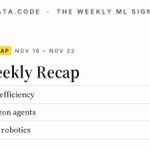
📋 ML Weekly Recap · Nov 16 – Nov 22
⚡ Trends
▸ Inference efficiency targets hidden bottlenecks with sparse routing, caching, and quantization
▸ Long-horizon interactive agents expand across games, software, web, and infrastructure benchmarks
▸ Embodied robotics increasingly leverages frozen foundation models, simulation RL, and richer datasets
🧭 TL;DR
📄 ScaleVLA: Scaling Vision-Language-Action Models to 552 Billion Parameters
Ruixi Yu, Dairu Liu, Xuchuan Chen et al.
552B frozen VLM backbone dramatically boosts robot control and data efficiency
📄 arxiv.org/abs/2611.21607
⭐ MACaQ
Practical cross-modal quantization cuts memory, time, and supports major runtimes
⭐ github.com/huawei-csl/MACaQ
💡 Frozen foundation backbones are becoming general controllers through efficient adaptation.
→ t.me/papersdatacode_digests
72
📄 Late Entry in Looped Language Models
by Ziqi Jin, Jiaxi Li et al.
Uses late entry instead of early exit: tokens run only final recurrent passes over deep context, while skipped passes are completed and verified asynchronously.
Key points:
• 5.2x exact speedup on Ouro-2.6B; +26% vs K=4 block on GSM8K
• 8.4x exact speedup at T=64 on Huginn-3.5B; +153% vs K=64 block
• 6.8x lossy speedup on Ouro-2.6B; +16.9 pts over trained early exit
In looped LMs, deep cached context is more valuable than spending the same pass budget on token-local early passes.
2
35
📄 Game2Player: Scaling Gameplay Experience for Visual Agents through Environment-Player Co-Development
by Xirui Jiang, Yuxi Chen et al.
Builds verifiable game tasks from existing web games via builder-player co-development, then trains a pixel agent from code and VLM play with progress-weighted SFT.
Key points:
• PlayerBench progress improves 14.3% to 31.2% with Game2Player-9B
• GameWorld progress rises 30.0% to 53.1% on an external benchmark
• Player reports raise correct tasks 65%→72% and solved tasks 34→46 in 20 rebuilds
Shows that jointly repairing environments through play and weighting supervision by verified progress can scale useful gameplay data for visual agents.
1
35
💻 ZhouTimeMachine/JVT
Generates videos directly in pixel space with a DiT-style transformer for unconditional, class-conditioned, and camera-controlled synthesis.
Key points:
• Supports 3 modes: unconditional, class-conditioned, camera-controlled
• Includes RGB-only and RGB-disparity joint generation on RealEstate10K
• Releases training, inference, and evaluation scripts; full training uses 8×80GB GPUs
Shows that a simple DiT-style transformer can handle pixel-space video diffusion across multiple conditioning setups.
⭐ 41 stars
1
103
📄 π^4: A Foundation Model for 4D Scene Geometry and Motion
by Yifan Wang (@yyfz321021), Weiguang Zhao et al.
A shared-backbone model that reconstructs geometry, poses, scale, tracks, and motion masks together; motion is predicted in 2D and converted to 3D via reconstructed geometry.
Key points:
• Best overall average rank across geometry benchmarks
• Competitive single- and multiview 2D/3D tracking and motion segmentation
• Uses ~0.5B params, less than half the size of most baselines
Shows that conditioning tracking on a strong frozen geometry model can unify reconstruction and motion without direct 3D motion regression.
1
39
📄 ForceHarness: Turning Force into Action and Physics for Frozen Frontier Models
by Ke Sun, Kevin Yuchen Ma et al.
Closes force control under an API-only model with self-terminating skills, then translates force traces into physical quantities the model can reason over.
Key points:
• Real robot: 90.0% vs 3.3% zero-shot success for GPT-6 Astra
• ForceBench: 87.5% vs 70.0% without force; beats 35.3% best trained
• HiddenPhys: 96.4% vs 62.1% without force; beats 59.3% best trained
Frozen frontier models can handle contact-rich manipulation well when force is exposed as closed-loop skills plus physics-level feedback, not raw sensor values.
1
31
Links:
📄 arxiv.org/abs/2611.21607
23
📄 ScaleVLA: Scaling Vision-Language-Action Models to 552 Billion Parameters
by Ruixi Yu, Dairu Liu et al.
Freezes a 552B frontier VLM and adds a trainable action DiT, using one encoder pass per action chunk instead of text reasoning at control time.
Key points:
• LIBERO-PRO: 45.1% vs 31.3% best smaller backbone
• LIBERO-Goal: 87.8% with 10 demos vs 85.6% for 2B with 50
• Real charger insertion: 9/10 vs 4/10 successes over 2B
Frontier-scale pretrained VLM representations can materially improve robot policy data efficiency, robustness, and contact-sensitive control without per-step language reasoning.
1
57
📊 swe-cowork by Tokenwave-AI (@TokenWaveai)
Contains 101 software engineering assignments on real open-source repos with workplace records, chat, and hidden-test evaluation for coding agents.
Key points:
• 101 tasks across 11 primary languages
• 2,712 total requirements; 2,217 held only by colleagues
• 2,701 F2P + 561 P2P hidden test nodes; 221 container images
Useful for benchmarking coding agents on long-horizon repo work with requirement discovery through teammate interaction.
📥 214 downloads
2
46
Links:
📄 arxiv.org/abs/2611.21003
17
📄 K2-Horizon: A Frontier Fleet of Open Source Language Models
by K2 Team, Zhengzhong Liu et al.
A fully open LLM fleet plus training data, logs, checkpoints, and code; it pairs MoVA sparse value routing with softplus gating and Uno decoding adapters.
Key points:
• 375B-A23B gets 65.3 on Toolathlon-Verified, beating GPT-5.6 Terra
• 375B-A23B scores 48.4 on SWE-Atlas-QnA, leading open-weight peers
• Uno speeds decoding by up to 2.2x without a separate draft model
Shows sparse value routing can retain dense-model quality at far lower active parameter count while a fully open release enables controlled scaling and sparsity studies.
1
2
90
💻 huawei-csl/MACaQ
Quantizes multimodal models for local inference and exports GGUF or compact checkpoints for llama.cpp, vLLM, Diffusers, and PyTorch.
Key points:
• Quantizes 122B params in 64 min using 32.5 GB device memory
• vLLM W4A4 gets 2.33× prefill and 2.58× decode vs BF16
• MACaQ-R cuts KL on Qwen3.6-35B-A3B from 0.015731 to 0.013367
Shows calibrated low-bit quantization can extend beyond LLMs to a shared workflow for text, image, video, and audio models.
⭐ 337 stars
2
3
525