
Applied Scientist @ Amazon | ex-Visiting Scholar @ UMN | ex-Ph.D, School of Computing, KAIST | ex-Amazon Applied Scientist Intern
Bellevue
Joined October 2022
- Tweets1.1K
- Following727
- Followers484
- Likes2.9K



Pinned Tweet
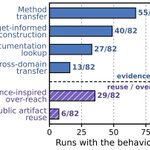
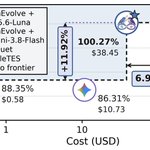
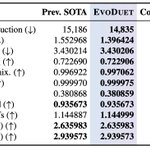
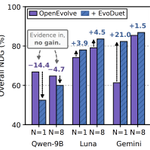
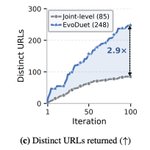
Excited to introduce 🎶 EvoDuet: co-evolving web search and task solutions to push the state of the art across 8 scientific optimization tasks.
Human–AI collaboration continues well beyond the chat window. 🤝
In Kolab, we collected 115+ hours of screen recordings from 50 professionals across 40 occupations working with AI agents on their own real-world problems.
Two things stood out:
- Frontier models struggle to predict whether people will adopt, modify, or reject an agent’s output.
- They often overestimate collaboration quality, and more workflow context doesn’t consistently help.
Really fun to be part of this one - check out the video and @shirley_ah_ 's thread below 👇

AI agents are getting better at automating long-horizon tasks. But in reality, we need agents that COLLABORATE with humans, not just complete tasks!
Introducing 🔥 Kolab: 115+ hours of human-agent collaboration in professional long-horizon workflows.
🧵

21
1,008
Can AI agents find the paper you need—and tell you when no such paper exists? 🔎
In CompLit, we test agents on how researchers actually search: with requirements that are implicit, grow across turns, or cannot be met by any existing paper.
Across all 8 arXiv domains:
- The strongest agents drop from 86–87% accuracy to 66–68% when requirements are implicit.
- When no matching paper exists, agents say so at most 53% of the time.
Really fun to be part of this one - check out @dayoon12161 's thread below 👇

📢 𝑵𝒆𝒘 𝑷𝒂𝒑𝒆𝒓!
Have you ever asked an AI to find a paper and gotten something that looked 𝘳𝘪𝘨𝘩𝘵 but wasn’t? 🤯
We find that this happens when requirements are 𝘪𝘮𝘱𝘭𝘪𝘤𝘪𝘵, when they 𝘢𝘤𝘤𝘶𝘮𝘶𝘭𝘢𝘵𝘦 across turns, and when 𝘯𝘰 𝘮𝘢𝘵𝘤𝘩𝘪𝘯𝘨 paper exists.
To evaluate these implicit, cumulative, and unmet needs, we propose 𝐂𝐨𝐦𝐩𝐋𝐢𝐭🔎, a scientific literature search benchmark covering all arXiv domains. On this benchmark, we find that search agents often find the right paper but fail to read it, or read it but still report a different paper that seems plausible but is wrong.
Why does this matter? Researchers search outward 🌱, from what they have explored toward what they have not. As a result, they state their requirements implicitly, add to them over time, and often look for something no existing paper satisfies, because they are after novelty.
We analyze the agents’ trajectories turn by turn to see where they go wrong, which can guide future improvements. Doing well on 𝐂𝐨𝐦𝐩𝐋𝐢𝐭 would be a first step toward trustworthy research agents.
Huge thanks to my mentors, co-authors, and advisor for their support! ❤️
📄 Paper: arxiv.org/abs/2610.28658
🌐 Project page: dayoon-ko.github.io/CompLit/
💻 Code: github.com/dayoon-ko/CompLit
🤗 Dataset: huggingface.co/datasets/dayo…

Can AI agents actually do research on problems nobody has solved yet? 🔭
In Into the Unknown, we give agents a real science paper + a research direction and ask them to write the follow-up paper.
Across 9 frontier agents and 15 open problems:
- None of the 135 submissions met all evaluation criteria.
- 114/135 failed integrity checks, often claiming work that was never done or reporting numbers that contradicted the recorded evidence.
Really fun to be part of this one - check out @seungonekim 's thread 👇

🧪Can AI agents take a scientific paper and write a meaningful follow-up to it?
We introduce Into the Unknown, an AI agent benchmark of 15 open scientific research problems. Each problem comes from a scientist currently or formerly at US DOE National Labs:
@LosAlamosNatLab @SandiaLabs @BerkeleyLab @AmesNatLab @PPPLab @Livermore_Lab
🔬 Calling scientists across disciplines: help build SciVeri-Bench v1.0!
After showcasing SciVeri-Bench v0.1 at the Frontier Data Summit hosted by @SnorkelAI, we’re now building v1.0 and inviting scientists from a wide range of fields to contribute scientific tasks.
🤔 What is SciVeri-Bench?
SciVeri-Bench is a deploy-first, scientist-driven benchmark for evaluating AI agents’ scientific verification capabilities on open-ended, novel scientific tasks.
🎯 Why are we building it?
- Stop to chasing maximing score in benchmark, rather we want to understand whether AI agents verify whether AI agent doing good science as domain scientist do
- Domain scientists only verify whether the science is good or bad, while agents do a lot of execution and exploration, but we really want to show that scientists can make novel discoveries
📝 How are tasks collected?
All task submissions and communication take place on OpenReview, so domain scientists can focus on proposing open-ended & novel scientific tasks and verifying agent outcomes.
🤝 What do scientists receive?
- All costs of running the agents are covered by the SciVeri-Bench team.
- Intellectual property rights to scientific discoveries made by AI agents belong to the scientist who proposed the task.
- Co-authorship on the SciVeri-Bench paper.
How can you contribute?
(1) Task Proposal: Propose a scientific task for SciVeri-Bench.
(2) Task Review: Review scientific tasks proposed by other scientists.
Interested in joining us?
👉 Sign up: forms.gle/bv9KZK6mW6ubBJXZ9
🌐 Website: sciveri-bench.com/
🙏 Huge thanks to our team, contributing scientists, advisors, and sponsor!
AI researchers: @seungonekim @jinheonbaek @yoonholeee @JiayiiGeng
Task proposers: 16 scientists who have joined so far
AI advisors: @StevenDillmann @SoojungYang2 @AkariAsai @gneubig @wellecks @dongyeopkang
Sponsor: openrefinery.ai/
We’re also looking for more sponsors and senior scientists!
Note: This work does not relate to any work conducted at Amazon

Through looping! 🔁
We introduce SanSi, a Jev-style decision model that uses latent looping to tackle multi-step reasoning without generating a single token. With a flexible budget of 1–8 loops, you control how much computation it spends on each decision.
Check out @ShuyuGan 's post!

🤔Can a small decision model think longer on hard cases without writing a single token?
💡We found that it can, by looping: running the same layers again and again before it answers, which we call System 1.5 thinking.
🤗huggingface.co/papers/2610.0…
We introduce 🔁🔁🔁 SanSi (三思, "think thrice"), a looped typed decision model: it returns a probability for each declared option and can be read after any of its 8 loops. With the same data and recipe, looping adds +13.5 points over a non-looped model of the same shape and brings the 1.4B SanSi within 1.8 points of Qwen3.5-4B, a model with 3× its parameters. ⬇️⬇️⬇️
9
681
Can AI agents verify if AI agents are doing good science?🔬
To evaluate this capability, we’re developing SciVeri-Bench, a deploy-first, scientist-driven benchmark for scientific verification on open-ended, novel scientific tasks.
We focus on three tasks:
- Scientist rubric generation
- Scientist critique generation
- Scientist taste evaluation
To build the benchmark, we introduce a Scientist-in-the-Loop harness that supports collaboration between domain scientists and AI researchers, with all communication taking place on OpenReview.
We’re grateful to have been invited to the Frontier Data Summit, where we’ll present our SciVeri-Bench poster on October 8 in San Francisco! If you’re interested in AI for Science and scientific verification, please stop by our poster to chat. We’d also love to meet for coffee if you’re attending #COLM2026! ☕
Currently, 16 scientists from 11 institutions are building SciVeri-Bench v0.1 together as we work toward v1.0. We’re looking for scientists to join as task contributors and sponsors to support the compute costs of running AI agents.
📣 We’ll post a call for task contributors here on X within the next week—stay tuned if you’re interested!
🙏 Huge thanks to our amazing team: @seungonekim,@jinheonbaek, @SoojungYang2, @yoonholeee, @JiayiiGeng, @dongyeopkang


SciVeri-Bench tests AI agents on real scientific workflows using simulators like OpenFOAM and AlphaFold, with tasks defined and scored by scientists.
Led by @passing2961, it is building evaluation infrastructure for scientific discovery. One of 25+ posters at Frontier Data Summit. frontierdatasummit.ai/
I'm happy to share that I'll be starting a new position as an Applied Scientist at Amazon!
My six months at UMN were brief but incredibly rewarding. I'm grateful to @dongyeopkang for the thoughtful guidance and to the wonderful researchers I collaborated with on AI for Science, from scientific discovery to scientific writing. I learned so much along the way.
AI for Science remains a personal research interest of mine, and I'd love to keep exchanging ideas with the community. If you share that interest, let's grab a coffee and chat! ☕️
Your paper may pass @pangram and still contain scientific slop!
I'm excited that we (1) measure these reasoning gaps and (2) offer a simple harness that outperforms our Claude Code baseline on slop reduction!
Check out @OhYerim24061 's post!

AI detectors read your sentences. We read your scientific reasoning and score its slop.
Every ICLR year, 2017–2025: papers with more our "scientific slop" got lower reviewer ratings and were rejected more often.
Calculate yours: yerimoh.github.io/scientific…

2
16
1,857
📣 Call for Scientists!
We're preparing Connect AI-Sci, a proposed ICLR 2027 workshop connecting domain scientists and AI researchers.
We welcome researchers in biology, physics, chemistry, materials science, mathematics, medicine, engineering, and related fields in one or both roles:
- Breakout participant (in person): Bring a scientific challenge and collaborate with AI researchers on a research plan and a feasible first experiment.
- Scientific reviewer (remote): Join our Program Committee to review submissions in your field. No workshop attendance required.
No prior AI research experience needed, and all perspectives welcome!
📝 Interest form: forms.gle/yU8e5sqjF58LfbnGA
🌐 Workshop website: open-galapagos.github.io/con…
👥 Organizers: @seungonekim, @jinheonbaek, @dilarafsoylu, @AdaFang_, @RuiMeng_, @ma_chang_nlp

Excited to share that two of our papers were accepted to NeurIPS2026! 🎉
- Evolution Fine-Tuning: Learning to Discover Across 371 Optimization Tasks (first author)
- Metaⁿ: Recursive Self-Improvement through Emergent Depth (second author)
Grateful to all my collaborators!

Paper 1: Evolution Fine-Tuning
Huge thanks to my coauthors @seungonekim, @mkkang_1133, @cheongalc, Zerui Chen, Seungho Han, Taehee Jung, and @dongyeopkang, across UMN, CMU, KAIST, the University of Cambridge, Hanyang University, and Amazon! 🙌
nitter.gq/passing2961/status/207…

🤔Can experience optimizing in one domain (e.g., faster kernel design) transfer to a very different domain (e.g., open mathematical conjectures)?
💡We found that this kind of cross-domain optimization is possible through Evolution Fine-Tuning (EFT).
🤗huggingface.co/papers/2606.2…
We introduce Evolution Fine-Tuning (EFT), a mid-training paradigm that teaches LLMs how to discover from evolutionary search trajectories. We train 🐦 Finch 2B–9B on the Finch Collection — 156K trajectories spanning 371 tasks — and it surpasses its base models by +10.2% on 22 held-out tasks, with emergent cross-domain transfer. ⬇️⬇️⬇️
🚀 Excited to share Meta^n: Recursive Self-Improvement through Emergent Depth, a project I’m grateful to have worked on.
What excites me most about Meta^n is that it moves beyond improving an agent’s answers to improving the process that produces them. By recursively applying a fixed meta-operation, the system builds increasingly deep layers of executable strategies—and those layers naturally develop distinct roles without being explicitly designed to do so.
A huge thank you to @zaemyung 🙏

1/ Self-improving agents refine answers, not the process that produces them. Meta^n keeps one meta-operation Ω and recurses on its input: each layer writes code that rewires the layer below. Depth emerges, and so do roles.
📄 arxiv.org/abs/2608.24735
💻 github.com/minnesotanlp/meta…

🤔Can experience optimizing in one domain (e.g., faster kernel design) transfer to a very different domain (e.g., open mathematical conjectures)?
💡We found that this kind of cross-domain optimization is possible through Evolution Fine-Tuning (EFT).
🤗huggingface.co/papers/2606.2…
We introduce Evolution Fine-Tuning (EFT), a mid-training paradigm that teaches LLMs how to discover from evolutionary search trajectories. We train 🐦 Finch 2B–9B on the Finch Collection — 156K trajectories spanning 371 tasks — and it surpasses its base models by +10.2% on 22 held-out tasks, with emergent cross-domain transfer. ⬇️⬇️⬇️
Back in 2025, after AlphaEvolve, a wave of follow-up work pushed LLM-driven discovery to state-of-the-art results on open conjectures, GPU kernels, and more — mostly split into two branches: (1) test-time search (e.g., OpenEvolve, SkyDiscover) and (2) test-time learning (e.g., ThetaEvolve, TTT-Discover).
But neither internalizes the discovery capability into the model itself: (1) test-time search never updates the model, leaving the discovery capability in the search procedure by design; (2) test-time learning does update the model via test-time RL, but only to solve a single task within one search loop — and the search strategy is discarded once that task is solved.
🚨 Calling all professionals!
If you use or are interested in using AI agents at work, please consider participating in our study. Your experience would be extremely valuable! 🤖✨
📢 Calling Professionals!
We're studying how domain experts (e.g., healthcare professionals, managers, designers) use AI agents in their work.
Participants who complete the study will receive $75 gift card.
Please fill out our participant interest form! forms.gle/J8g4Gnwc4RZaz8EK6
6
351
Our paper "RefineBench: Evaluating Refinement Capability of Language Models via Checklists" will be presented as a poster at ICLR 2026 🇧🇷 🎉
📅 Thursday, April 23 · 3:15–5:45 PM (-03)
📍 Pavilion 4, Poster P4-#5206
Beyond the paper itself, I've recently been getting into optimization and scientific discovery through search-based / learning-based evolutionary loops — so if you're working on anything in that space, I'd love to connect and chat at the poster!
#ICLR2026 #LLM #NLP
⚒️ Can LMs (especially reasoning models) effectively self-refine their responses when prompted to do so?
In our new challenging benchmark, RefineBench, we revisit this question and show that the answer is still "no"-but there is a nuance!
🤗 huggingface.co/papers/2511.2…

Excited to start as a Visiting Scholar at the University of Minnesota, working with @dongyeopkang !
During this visit, I’m interested in exploring synthetic workflow datasets for long-horizon tasks (e.g., scientific discovery, optimization, and research workflows).
Looking forward to great collaborations and discussions! 🚀
🎉 Glad to share that our paper has been accepted to #ICLR2026!
🙏 Huge thanks to my first co-author @seungonekim and all of our co-authors for the amazing collaboration!
RefineBench: Evaluating Refinement Capability of Language Models via Checklists (arxiv.org/abs/2511.22173)

🛡️ How do we evaluate generative AI safety beyond English and text-only settings?
We’re excited to share our new paper on arXiv!
🏢 Research Collaboration: KAIST, TTA, University of Seoul, Keimyung University, Selectstar, Kakao
🙏 Special thanks to the amazing first author Chae-Gyun Lim (KAIST) for leading this work, as well as to all 53 co-authors and senior collaborators who made this large-scale collaboration possible.
📄 AssurAI: Experience with Constructing Korean Socio-cultural Datasets to Discover Potential Risks of Generative AI
As generative AI rapidly evolves, robust safety evaluation is more critical than ever. However, most existing safety datasets are English-centric, text-only, and fail to reflect non-English socio-cultural risks—especially in contexts like Korean society. To address this gap, we introduce AssurAI, a publicly released Korean multimodal safety dataset.
📄 Paper: arxiv.org/abs/2511.20686
🤗 HuggingFace Dataset: huggingface.co/datasets/TTA0…
🔍 What is AssurAI?
🇰🇷 A Korean-centric dataset capturing socio-cultural safety risks
🧩 35 AI risk factors, adapted from established safety frameworks by multidisciplinary experts
🖼️🎥🔊 Multimodal coverage: text, image, video, and audio
📊 11,480 high-quality instances
🧪 How is quality ensured?
Expert-led seeding + crowdsourced scaling
Triple independent annotation
Iterative expert red-teaming loop
Our pilot study shows that AssurAI effectively exposes safety weaknesses in recent LLMs, highlighting risks that are often missed by existing English-centric resources.
We release AssurAI to support the development of safer and more reliable generative AI systems for the Korean community.
#AISafety #GenerativeAI #MultimodalAI #Dataset #KoreanAI #AIResearch

🏆 Excited to share that our RefineBench paper received the Best Paper Runner-Up Award at the MTI-LLM Workshop at NeurIPS 2025!
I’d like to express my gratitude to our first co-author @seungonekim , and to all our co-authors — @BKLEE_NANO, Minkyeong Moon, Yechan Hwang, Jong Myoung Kim, @gneubig , @wellecks, and Ho-Jin Choi. This work was only possible thanks to everyone’s insight, feedback, and hard work. Truly grateful to the whole team!

⚒️ Can LMs (especially reasoning models) effectively self-refine their responses when prompted to do so?
In our new challenging benchmark, RefineBench, we revisit this question and show that the answer is still "no"-but there is a nuance!
🤗 huggingface.co/papers/2511.2…
🎉 Excited to share that our new work is accepted to Multi-Turn Interactions in Large Language Models @ NeurIPS 2025 as a Top 1% Oral!
🎤 Oral Presentation
Sat, Dec 6 — p.m. PST
🖼️ Poster Session
Sat, Dec 6 — 3:45–4:45 p.m. PST
If you’ll be at #NeurIPS2025, I’d love to chat about multi-turn reasoning, refinement, or LM evaluation — please stop by!
More details in the TL;DR thread below — please read here 👇
⚒️ Can LMs (especially reasoning models) effectively self-refine their responses when prompted to do so?
In our new challenging benchmark, RefineBench, we revisit this question and show that the answer is still "no"-but there is a nuance!
🤗 huggingface.co/papers/2511.2…