

Defense acquisition policy | Travel | UNC | Books | Following DC policy, museums, and what's happening around the capital.
Washington DC
Joined June 2024
- Tweets335
- Following209
- Followers538
- Likes509






Pinned Tweet
My first Substack article is up.
It started with a question I couldn’t shake: when people say “cut China out” of supply chains, which part do they mean? The goods moving through them, or who controls each link?
Those are different problems with very different timelines, and policy treats them very differently. I wrote about why that gap matters.
pelledc.substack.com/p/suppl…
Nathan Pellerin retweeted

This is the correct take.🫡⬇️
Professional military officers plan based on adversary military capabilities and not delusional ideas that intelligence agencies can mind read adversary political-military intent, which are subject to the whims of dictators.

The Army’s Pacific commander says he’s planning as if China could take Taiwan next year.
Gen. Ronald Clark told a Honolulu conference that US Army Pacific has prepared the theater assuming China will have the capacity, and possibly the intent, to seize Taiwan by force in 2027. He called the “Davidson window” still valid. Under a plan called Army Ready Forward, equipment, materiel, and troops are now posted on rotation west of the International Date Line, on the island chains closest to China.
Clark named the hardest tradeoff as expensive high-end systems versus affordable ones that can be mass-produced, especially autonomous systems.
The spring US intelligence assessment says China’s leaders don’t plan an invasion in 2027 and have no fixed timeline.
“Mass-producible” comes down to what’s inside: magnets, motors, and batteries still route through China.
stripes.com/branches/army/20…

Jamie Dimon: “We all made a mistake... about China going back about 10 years.”
Ten years ago, rare earth processing, magnets and industrial equipment were treated as a market question. They only became a security question after the leverage existed.
Now it’s multi-year timelines to rebuild what took a decade to give up.

JPMorgan CEO Jamie Dimon warns that America is weakening itself and its allies by putting idealistic policies ahead of national security: “We do the dumbest things in the name of good.” 🇺🇸🇨🇳
“We need to be more realpolitik. We go around the world constantly lecturing people about their labor laws, their climate policies, and human rights.
I’m not against human rights, but it needs to be coordinated with our national security interests.
There’s a great quote from Stalin. When FDR said the Pope wouldn’t agree with something, Stalin leaned forward and asked, ‘How many divisions does the Pope have?’
That’s the game we’re in.
We do the dumbest things in the name of good that actually make us weaker and make our allies weaker.
We have to be very thoughtful about this.
And a little bit of mea culpa: We all made a mistake. All of us should have been a little more thoughtful about China going back about 10 years.”
Nathan Pellerin retweeted

My latest report is out today! New investigation finds CCP control embedded across China’s organ transplant system. We found 19 cases of transplant surgeons or center directors who are CCP members across 12 provinces. Raises serious questions about claims of reform. @ETAC_Global

Nathan Pellerin retweeted

thebureau.news/p/as-bc-moves… As B.C. Moves to Repeal Indigenous Rights Law, Secret Intelligence Spotlights Beijing’s Long Game for Canada’s Resources
‘A September 2026 gathering involving Yuen Pau Woo, Bill Morneau and Chinese officials raises new questions about Beijing’s enduring interest in Indigenous resource relationships’

The Army’s Pacific commander says he’s planning as if China could take Taiwan next year.
Gen. Ronald Clark told a Honolulu conference that US Army Pacific has prepared the theater assuming China will have the capacity, and possibly the intent, to seize Taiwan by force in 2027. He called the “Davidson window” still valid. Under a plan called Army Ready Forward, equipment, materiel, and troops are now posted on rotation west of the International Date Line, on the island chains closest to China.
Clark named the hardest tradeoff as expensive high-end systems versus affordable ones that can be mass-produced, especially autonomous systems.
The spring US intelligence assessment says China’s leaders don’t plan an invasion in 2027 and have no fixed timeline.
“Mass-producible” comes down to what’s inside: magnets, motors, and batteries still route through China.
stripes.com/branches/army/20…
The next contest between great powers is over metals you’ve never heard of.
Molybdenum goes into power plants, jet engines, and computer chips, the industries every major country is racing to build up. Its price is up more than 50 percent this year, and analysts expect a sixth straight year of shortage.
The world’s biggest producer is an American company, and it’s now digging out plans to expand a mine in Colorado.
The countries that come out ahead will be the ones with the metal in the ground and the mines already running.
bloomberg.com/news/articles/…

China’s AI valuations can correct. The industrial leverage underneath them does not.
Chinese stocks have dropped into a bear market as doubts grow over AI profitability and weak consumption. That is a financial story. It does not change the fact that Beijing still controls the bulk of rare earth refining and magnet production that sit inside the motors, sensors, and actuators the AI buildout requires.
A market rout can shrink equity values and slow capital spending. It does not rebuild processing capacity outside China or remove the licensing tools Beijing has already used on magnets, drone components, and industrial machinery. The hardware dependency remains even if the stock prices do not.
reuters.com/world/china/chin…

The EU is preparing new import curbs on China. In the same plan, it’s asking Beijing to ease exports of rare earth magnets.
Bloomberg reports Brussels could present caps or tariffs as soon as early 2027, reportedly starting with chemicals and furniture, to cut a €360 billion trade deficit. The EU can act without Beijing’s agreement. The plan also seeks easier export procedures for critical minerals and permanent magnets.
China already answered this month with an anti-dumping probe on a chemical used in dyes and pesticides.
Tariffs get announced. Export licenses get approved or delayed one case at a time.
bloomberg.com/news/articles/…

The Pentagon wants every major US base to run for 90 days without the civilian grid, outside fuel, or global supply chains.
FORTRESS adds portable nuclear reactors, large battery storage, and microgrids that disconnect bases from civilian power. It calls for stockpiles of munitions, fuel, critical minerals, and electronics sized to wartime consumption. For the most critical dependencies, it requires at least two qualified supply or production pathways.
Pentagon spokesman Sean Parnell: “Power is combat now.”
A stockpile of ore isn’t a stockpile of magnets. The reserve is only as good as the processing behind it.

FORTRESS: The Pentagon is preparing every major U.S. military base to survive 90 days without outside support — no civilian power grid, no global supply chains, no outside fuel or water.
The initiative, revealed in documents reviewed by Fox News Digital, envisions portable nuclear reactors, massive battery storage, and microgrids that can disconnect installations from civilian electricity entirely. Strategic reserves of munitions, fuel, critical minerals, and medical supplies would be stockpiled based on wartime consumption rates. Civilian factories are being pre-identified to shift to defense production during a crisis.
Pentagon chief spokesperson Sean Parnell put it bluntly: "Power is combat now. Without electricity, you lose communications, water, logistics, assembly lines and just basic military command structures."
Full story here foxnews.com/politics/inside-…

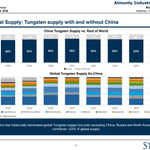
China’s share of global tungsten supply fell to 79 percent in 2025, from 85 percent in 2021. That’s still four of every five tonnes.
This chart built on USGS data, shows the rest of the world rising from 15 to 21 percent over the same four years. Vietnam, Russia, Bolivia, Rwanda, and Austria fill in most of that.
The chart counts mined supply. The leverage sits one step later, at powder and carbide. One analyst reports China’s August tungsten powder exports fell 75 percent while it pushed carbide, the value-added product.
A new mine doesn’t help a buyer who has no one to refine the ore.

China’s battery makers are answering Western trade barriers by building behind them.
CATL, BYD, Gotion, CALB, and Sungrow have announced about $90 billion in overseas deals since 2023, $52 billion in cells and $38 billion in materials, according to Climate Energy Finance. In China, a gigafactory costs about a third as much and goes up three times faster than in Europe.
Europe’s localization rules take effect next year. CATL’s German plant, which builds for Porsche and Audi, sources just under half its parts in Europe, and CATL is pushing its Chinese suppliers to follow it abroad.
A rule that counts where a plant stands doesn’t count who owns it, who supplies it, or who approves the technology transfer. Beijing does.

More M&A inc.
China’s battery makers race to invest abroad to avoid western barriers 🇨🇳
ft.com/content/36f60d90-a6f8…

The Pentagon just committed to 850 F-35s over ten years, and Lockheed is paying $7 billion of its own money to make it work.
The framework calls for 156 jets a year and covers allied orders, spare parts, and upgrade kits. Lockheed says it supports 317,000 American jobs and about $79 billion in annual economic activity.
It isn’t an order yet. Congress still has to grant multi-year authority, and that’s when pricing and schedules get fixed.

Lockheed Martin and the Pentagon have reached a preliminary 10-year agreement to produce at least 850 F-35 fighter jets.
Lockheed will invest at least $7 billion of its own funds to support production, targeting 156 jets annually.
The deal also covers international orders and aims to reduce costs and supply-chain bottlenecks.
The agreement is not yet a firm order, and its execution remains subject to congressional approval and funding.

It's imperative to control the supply chain issue in the production of these F35's- though as i've been exploring recently this is easier said than done.
xitter.cf/pelledc/status/2113223…
My first Substack article is up.
It started with a question I couldn’t shake: when people say “cut China out” of supply chains, which part do they mean? The goods moving through them, or who controls each link?
Those are different problems with very different timelines, and policy treats them very differently. I wrote about why that gap matters.
pelledc.substack.com/p/suppl…
China just restricted the machines America uses to build tunnels, mines, and drones.
Beijing already controls large parts of the global market for this equipment. The new rules, starting next month, turn that dominance into a tool that can delay or deny what US projects still need. First the materials. Then the magnets. Now the machines themselves. The leverage keeps expanding.

China is imposing export controls on more drones and machinery, as the world’s second-biggest economy flexes its industrial muscles. bloomberg.com/news/articles/…

I've addressed how difficult this is to manage in my latest piece:
xitter.cf/pelledc/status/2113223…
My first Substack article is up.
It started with a question I couldn’t shake: when people say “cut China out” of supply chains, which part do they mean? The goods moving through them, or who controls each link?
Those are different problems with very different timelines, and policy treats them very differently. I wrote about why that gap matters.
pelledc.substack.com/p/suppl…
The Pentagon is reportedly planning to put spies inside Chinese AI, biotech, and chip companies, posing as private-sector businesspeople.
The Washington Post reports, citing six people familiar with the plan, that the program would use nonofficial cover officers with no visible tie to the US government. Tom Rakusan, a 39-year CIA veteran and now a senior adviser to Deputy Defense Secretary Steve Feinberg, is overseeing it. CIA Deputy Director Michael Ellis said in September that the US is expanding collection on those same sectors.
The Pentagon denied the report.
The DIA and JSOC have tried commercial cover before, with mixed results. An officer working without embassy cover has no diplomatic immunity if caught.
washingtonpost.com/national-…

The world will need nearly 3x the lithium by 2050. The Chinese Communist Party already refines 74% of it.
It also refines 94% of battery-grade graphite and 76% of cobalt, and demand for graphite more than doubles on this chart.
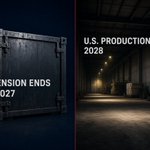
Beijing put export controls on graphite in October 2025 and suspended the expanded rules only until November 2026.
