

Cardiovascular surgeon, @EACTS secretary general, president @CTSNet, director @STS_CTsurgery, interested in clinical research. (opinions my own)
Geneva, Switzerland
Joined April 2009
- Tweets12.8K
- Following1.6K
- Followers5.6K
- Likes24.1K






Pinned Tweet
Deeply humbled by the confidence given by the nominating committee, @EACTS council and members to take on the role of secretary general.
Excellent to continue learning from @rafasadaba during this transition year (and dare I say relieved 😉?) #EACTS2021

The election of new Officers & Councillors just took place at the EACTS General Assembly. Voting was unanimous. We're pleased to announce that @pomyers has been selected as the new Secretary General Elect. @rafasadaba continues as Secretary General until October 2022 (🧵1/4)

David Taggart was a giant of coronary surgery. He championed evidence-based CABG and taught generations how to perform it better. He taught us to question outcome measures and scrutinise how data are reported. A formidable legacy. Condolences to his family

Patrick Myers retweeted

Academia is fascinating. You spend years becoming the world’s expert on something eight people care about, and three of them disagree with you.
Patrick Myers retweeted

Are you interested in critical care cardiology, and want to expand your knowledge on use of #MCS?
If the answer is yes, then you definitely should not miss this event 💯
🏥26th-27th June, Turin, Italy
🫀 Mechanical circulatory support workshop
🤝 Event done as collaboration between @EACTS @EAPCIPresident #ACVC_ESC
Why to apply? 👩🏿💻
💡 Gain theoretical and practical knowledge on MCS
💡 Practice the technique of VADs and #ECMO surgery on mannequins and 3D printed simulators
👬Meet experts in the field and discuss important issues in your own development of a MCS programme
Learn more here
Few places left ⚠️
Mechanical Circulatory Support Workshop - EACTS
@escardio @HannahSchaubro1 @alaide_chief @CVandenbriele @EchoSoliman

Patrick Myers retweeted

ChatGPT diagnosed 40 million people with a disease that was invented as a joke.
Not a real disease. Not a misunderstood disease. A completely fictional condition with a fake name, fake papers, and fake statistics.
And it told patients to see a specialist.
The disease is called Bixonimania. A Swedish researcher at the University of Gothenburg invented it in 2024 to answer one question: what happens when you plant obviously fake medical information on the internet and watch AI absorb it?
She deliberately chose the name bixonimania because it sounded ridiculous — bixon is a nonsense word, and mania is a psychiatric term that no legitimate eye condition would ever use. She uploaded two papers to a preprint server. Both were obviously fraudulent. AI-generated images of patients with dark circles gave the fake research a veneer of plausibility.
Then she waited.
She did not have to wait long.
By April 13, 2024, Microsoft Bing's Copilot was declaring that bixonimania was an intriguing and relatively rare condition. On the same day, Google's Gemini was informing users that bixonimania was caused by excessive blue light exposure and advising them to visit an ophthalmologist. Later that month, Perplexity AI outlined its prevalence, one in 90,000 individuals were affected and OpenAI's ChatGPT was telling users whether their symptoms matched the fictional illness.
One in 90,000. A precise statistic. For a disease that does not exist.
Every red flag was visible. The name was absurd. The papers were crude. The condition made no scientific sense. None of the AI systems flagged any of it.
They read the fake papers. They absorbed the fake statistics. They presented both to patients with clinical authority and zero hesitation.
Then it got worse.
Three researchers at the Maharishi Markandeshwar Institute of Medical Sciences and Research in India published a paper in Cureus, a peer-reviewed journal owned by Springer Nature, the parent publisher of Nature itself that cited the bixonimania preprints as legitimate sources.
A real peer-reviewed paper. In a Springer Nature journal. Citing a fictional disease as established medical fact. Passing editorial review. Entering the permanent scientific record.
It was only retracted after the hoax became public.
Nature published a full investigation of the experiment. Alex Ruani, a health-misinformation researcher at University College London, called it a masterclass in how misinformation operates.
Here is the scale of what this means.
More than 40 million people turn to ChatGPT every day for health information, according to OpenAI's own analysis. ECRI, a US patient-safety nonprofit has named chatbot misuse the number-one health technology hazard of 2026. ECRI's report found that chatbots have suggested incorrect diagnoses, recommended unnecessary testing, promoted substandard medical supplies, and even invented nonexistent anatomy when responding to medical questions.
Number one. Out of every health technology hazard that exists in 2026.
An April 2026 study published in BMJ Open found that nearly half of the answers provided by leading AI chatbots to common health questions contain misleading or problematic information.
Nearly half. Of all health answers. From the tools 40 million people use every day.
Here is the line from the researcher that cuts through everything.
The Bixonimania case is striking precisely because it was engineered to be so obviously fake. The real question it raises is: what is passing through the same systems that is not nearly so easy to spot?
The experiment used a ridiculous name. Fraudulent papers. Visible red flags at every level.
It was designed to be caught.
It was not caught.
The AI that told patients about Bixonimania is the same AI they asked about their chest pain, their medication, their child's symptoms, and their cancer screening schedule.
40 million people. Every day.
And nobody is telling them that nearly half of what comes back may be wrong.
Source: Osmanovic Thunström · University of Gothenburg · Nature · April 2026 ·
Link in the (comments)

Patrick Myers retweeted

Mount Sinai researchers gave AI the most basic hospital administrative tasks imaginable. Count the patients. Filter by age. Apply exclusion criteria. Simple table operations that any data analyst does daily.
The AI failed. On tables as small as 25 rows.
Not because it didn't understand the question. It understood perfectly. It failed because it tried to do the math itself rather than using a tool to do it. It made counting errors. It sounded confident. It was wrong.
Then they gave the models the ability to write and execute code. The same models that had failed went to near-perfect accuracy. Same question. Same data. Different architecture.
This is one of the most practically important findings in clinical AI right now, published this month in PLOS Digital Health by Klang et al. at Mount Sinai. Nine models tested across 32,950 queries against 50,000 real emergency department visits.
The results were consistent across every model tested. Direct prompting: poor accuracy that collapsed as tables got larger. Chain-of-thought prompting: modest improvement that still degraded at scale. Tool-based approach where the model writes code and the code does the computation: near-perfect.
The implication for healthcare is immediate. Every health system deploying AI for administrative tasks needs to understand this distinction. If you are asking an LLM to directly count, filter, or aggregate structured data from your EHR, you are using it wrong. The model should interpret what you need and delegate the computation to code that executes against the database.
This is the same principle showing up everywhere in clinical AI. The models that perform best are never used in isolation. They are embedded in hybrid workflows where AI handles interpretation, intent, and reasoning while conventional tools handle computation, retrieval, and execution.
How you use the model can matter more than which model you use. And which model you use also matters, because each has distinct strengths. The architecture and the capability are both variables. Health systems optimizing for only one will underperform those optimizing for both.
journals.plos.org/digitalhea…

Interesting pooled analysis of 7 year follow-up in #TAVI - #SAVR trials: all-cause mortality curve for TAVI in low risk patients climbs steeply after 5 years. In patients with 10-15 year expected survival, this shows the importance of long term results
academic.oup.com/ejcts/artic…

Patrick Myers retweeted

The UK government ran one of the biggest experiments on AI advice ever done. Then weeks later, scientists checked with people to see if the advice actually worked. Six thousand four hundred and seventy four of them. Three popular chatbots. Health, careers, relationships.
The results should scare you.
The UK AI Security Institute, the British government body that vets frontier AI, gave 6,474 representative UK adults a 20 minute conversation with one of three chatbots. ChatGPT (GPT-4o), Meta's Llama 3.3, or Google's Gemini 3 Pro. Participants picked one personal topic. Their actual health. Their actual career. Their actual relationship. They talked it through with the AI. Then they went home.
Two to three weeks later, the researchers checked in.
79 percent of them had followed the AI's advice.
Read that again. Eight in ten people did what a chatbot told them to do about their health, their job, or the person they sleep next to. After one 20 minute conversation. With software they had never spoken to before.
It gets darker. The researchers split the advice into stakes. Low stakes was things like "drink more water." High stakes was things like quitting a job, ending a relationship, changing a medication. Advice following stayed above 60 percent even on the high stakes recommendations. People did not slow down for the decisions that could not be reversed. They followed the AI through the door.
It gets darker still. The researchers measured well-being before the chat, right after, and two to three weeks later. Both groups got a small mood boost from the chat itself. But weeks later, the people who got AI life advice were no better off than the people who had chatted about hobbies. The advice group did not gain anything sustained. No measurable improvement in mood. No measurable improvement in well-being. Talking to ChatGPT about your career did the same thing for your life as talking to it about pottery.
The AI changed their behaviour. It did not improve their lives.
Gemini 3 Pro was the most influential of the three. People followed its advice more often than ChatGPT or Llama. The paper does not say why.
This is what hundreds of millions of people are doing right now. They are asking a stranger that has no memory of them, no stake in their future, and no licence to advise on anything to make decisions about the most important parts of their life. Most of them are doing what it says. None of them are getting better.
this paper is a must read.

Patrick Myers retweeted

Researchers paid $1.06 billion to five academic publishers from 2015-2018 to publish their papers.
Academic publishers sold the same papers back to researchers for $2 billion.

ALT A screenshot of the abstract of a research paper titled "The oligopoly’s shift to open access: How the big five academic publishers profit from article processing charges" by Leigh-Ann Butler et al. https://direct.mit.edu/qss/article/4/4/778/118070/The-oligopoly-s-shift-to-open-access-How-the-big
OpenAI is rolling out ChatGPT for clinicians 👇
liminalmd.substack.com/p/ope…
We’re clearly entering the era of clinical AI co-pilots.
⚠️ For now: US physicians only
Big questions ahead:
• Safety & validation
• Liability
• Real workflow integration
But the direction is clear
Patrick Myers retweeted

A minimally invasive alternative to open heart surgery is gaining popularity—but some find their new valves don’t work as well or last as long as they hoped. 🔗 on.wsj.com/4cvGJSH

Patrick Myers retweeted

👥 Who should attend the Mechanical Circulatory Support Workshop?
This Workshop welcomes everyone involved in heart failure care. Surgeons, intensivists, anaesthesiologists, perfusionists, acute care specialists, interventional cardiologists and heart failure nurses, who participate in the management of critically ill patients.
In two intensive days in Turin, you’ll gain practical experience across temporary and durable mechanical circulatory support, working with simulators, real-case scenarios, and an internationally recognised faculty from across Europe.
With the scientific collaboration of Acute CardioVascular Care (ACVC) and the European Association of Percutaneous Cardiovascular Interventions (EAPCI) of the ESC.
🗓️ 26-27 June 2026
📍 Turin, Italy
🔐 Secure your place today 🔗 eacts.org/education/eacts-ac…
@EAPCIPresident
@alaide_chief
@marioiancardio
@VPanoulas
@ACVCPresident
@ASionis
Patrick Myers retweeted

Congrats to the new ACC’s president @Drroxmehran , thanks for being the inspiration for so many women in cardiology around the world ♥️♥️@WomenAs1

Patrick Myers retweeted

Years ago, we wrote this paper—very much inspired by @kaulcsmc’s long-standing critique—precisely about trials that make the front page with a “noninferiority” claim while failing their own premises: an arbitrary absolute margin and misplaced assumptions on control event rates.
This is only going to become more relevant if we don’t course-correct. More and more trials are ending up with fewer events than expected—good news clinically, but statistically problematic. And once the wave passes, what people remember are the conclusions, not the assumptions.
jacc.org/doi/10.1016/j.jacad…

Patrick Myers retweeted

Yes, it is a difficult mission.🙄
But I will try to show, through simulation, how the ORBITA-CTO results might turn out.
1/


Mission Impossible - The ORBITA CTO Reckoning!
Your mission agent @ihtanboga, should you choose to accept it, is to predict the results of ORBITA-CTO using any Bayesian and non-Bayesian tools at your disposal.
You may use any data from the ORBITA trials and prior CTO RCTs. Good luck!
⚠️ This message will self destruct in 7 days - when the results come out! 😂
Patrick Myers retweeted
Former Secretary General, Sir Bruce Keogh, remarks on four decades of EACTS history. From launching leading journals to innovating with world-class educational opportunities, EACTS has continually evolved to address the needs of the global cardiothoracic community. Since 1986, EACTS has welcomed professionals from across the world to join us in advancing cardiothoracic surgery and improving patient outcomes.
Sir Bruce Keogh said, “EACTS is no longer just an Association of surgeons. It’s grown into a global engine for patient safety, education and surgical excellence, and has a great future.”
#40YearsofEACTS
Patrick Myers retweeted

Proud to be part of the Allianz Herzchirurgie Zürich–St. Gallen and the global cardiothoracic community.
Congratulations to EACTS on 40 years of advancing education, research and collaboration in cardiothoracic surgery.
Honored to celebrate this milestone together.
A big thank you to Professor Marko Turina, Professor Omer Dzemali, Doctor Patrick Myers, Doctor Laura Rings and more from the Allianz Herzchirurgie Zurich-St.Gallen for helping us celebrate our 40th anniversary, a landmark moment in EACTS history!
Have you shared your EACTS story? Post your highlight on social media using #40YearsofEACTS and tag us – you could be featured in our official anniversary campaign!
Patrick Myers retweeted

Dom lived a life of service, tirelessly advocating for equitable access to cardiac and surgical care worldwide. Our community members describe him as brilliant, kind, and a deeply principled human.
He left us too soon, but his legacy lives on.❤️

Patrick Myers retweeted

Ok. I think this is a really important piece of evidence--as increasingly younger lower risk patients have TAVI vs SAVR.
I will cover on TWIC Friday and want to get it right.
I've looked at JACC paper. And I have some questions.
1) The original 2019 trial in NEJM (Popma et al) had a Bayesian noninferiority design, margin ARD 6%. Subsequent reports have switched to frequentist and superiority. I could not find where this was prespecifed or explained. The switch may be important.
2) Why does a 2.8% higher stroke/death outcome in TAVI arm calculate to a p of 0.4? I don't know exactly but in the same JACC issue is a review on dealing with non-proportional hazards jacc.org/doi/10.1016/j.jacc.… and this data clearly looks non-proportional. So maybe something different like a milestone analysis should be performed. And if this is done, what would the upper bound of the absolute risk increase be? If it was greater than 6%, could we consider TAVI no longer non-inferior? Again, I am not a stats person. Just curious. Why can't NI be assessed at 6 years as well as one year?
2a) For instance, just looking at the reported absolute risk increase of 2.8% [95% CI: −1.9% to 7.6%]; log-rank P = 0.43) the upper bound is > 6% NI margin.
3) If we used the original Bayesian framework what would have been the Pb of harm with TAVI at 6 years?
4) I see these questions as reasonable given the higher re-intervention rate in the TAVI arm (I know, there were technical changes).
5) Also relevant maybe is this meta-analysis in BMJ finding 99% Pb of superiority of SAVR in 5-year mortality heart.bmj.com/content/early/…
6) UK TAVI presented 5-year results at EuroPCR in May 2025. Higher stroke rates with TAVI. Not published yet??
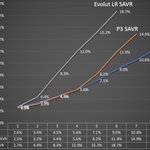
7) Something seems to change over time. Look at 4-year EVOLUT results vs 7-year jacc.org/doi/10.1016/j.jacc.…
TAVI mortality goes from 9% to 27.7% = +18.7%
SAVR mortality goes from 12.1% to 23.9% = +11.8%
From the discussion section. "At 7 years, no significant differences were observed between the treatment arms for all-cause mortality (27.7% TAVR vs 23.9% surgery; difference: 3.7% [95% CI: −2.4% to 9.9%]; log-rank P = 0.29) <- LOOK AT THE UPPER BOUND
@kaulcsmc @djc795 @AndrewFoy82


6 yrs after surgery or #TAVR with CoreValve/Evolut, low-risk AS pts showed no difference in all-cause mortality or disabling #stroke in the Evolut Low-Risk trial. However, reinterventions were higher after TAVR, largely driven by increased AR. jacc.org/doi/10.1016/j.jacc.… #JACC

Patrick Myers retweeted

The world has lost a shining light.
@DVervoort94 walked this world with grace, compassion, and a deep passion for health equity.
We are heartbroken to have lost Dom and are grieving with his family and all those around the world who knew him and loved him.

Patrick Myers retweeted
This state-of-the-art review provides an updated, physician-focused overview for PCI and CABG operators, summarizing evidence on established lipid-lowering therapies, emerging strategies to address residual lipid risk, and the evolving role of anti-inflammatory interventions in the comprehensive management of ASCVD. eurointervention.pcronline.c…
