
Software Engineer- Walmart Global Tech India Side Project Buy Voice-powered AI assistant with screen sharing https://nitter.gq/t.co/o1NVyWnLdS
Bangalore
Joined December 2014
- Tweets446
- Following666
- Followers42
- Likes61




Prashant Agarwal retweeted

If you learn AI Security Engineering, you will never be unemployed again.
Stage 1: Threat Modeling & Foundations
- Learn: OWASP Top 10 for LLMs, MITRE ATLAS, STRIDE, trust boundaries.
- Practice: Threat model a RAG chatbot and map every place untrusted text enters the system.
Stage 2: Prompt Injection & Jailbreaks
- Learn: Direct vs indirect injection, instruction hierarchy, multi-turn attacks.
- Practice: Hijack a sandboxed agent with a poisoned webpage, then patch it.
Stage 3: Insecure Output Handling
- Learn: LLM-driven XSS, SQLi, SSRF, command injection, excessive agency.
- Practice: Exploit an app that pipes model output into a shell, then fix it with strict validation.
Stage 4: RAG & Vector DB Security
- Learn: Embedding poisoning, tenant isolation, ACL-aware retrieval.
- Practice: Plant a malicious document in a knowledge base and make the bot leak another user's data.
Stage 5: Agent & Tool Security
- Learn: Least privilege, confused deputy attacks, sandboxing, scoped credentials.
- Practice: Give an agent shell and email tools, then build a permission layer that blocks dangerous chains.
Stage 6: MCP Security
- Learn: Tool poisoning, rug pulls, tool shadowing, OAuth scopes, server authentication.
- Practice: Build a malicious MCP server that exfiltrates data, then write a scanner that catches it.
Stage 7: Data Leakage & Privacy
- Learn: PII exposure, training data extraction, membership inference, DLP.
- Practice: Extract memorized strings from a fine-tuned model and measure the leakage rate.
Stage 8: Model Supply Chain
- Learn: Pickle deserialization, safetensors, model signing, AI-BOM, typosquatting.
- Practice: Craft a malicious model file that executes code on load, then build a pipeline that refuses it.
Stage 9: Adversarial ML
- Learn: Evasion, data poisoning, backdoors, model extraction.
- Practice: Backdoor a small classifier with 1% poisoned data and detect it afterward.
Stage 10: Guardrails & Runtime Enforcement
- Learn: Input/output classifiers, policy engines, deterministic checks, human-in-the-loop.
- Practice: Put a policy gateway in front of an agent that blocks risky actions before they execute.
Stage 11: Red Teaming & Evals
- Learn: garak, PyRIT, promptfoo, attack success rate, regression suites.
- Practice: Automate a red-team pipeline in CI that fails the build when a new jailbreak lands.
Stage 12: Detection, IR & Governance
- Learn: Audit logging, anomaly detection, NIST AI RMF, ISO 42001, EU AI Act.
- Practice: Write an incident response playbook for a compromised agent, then run a tabletop exercise.
Chatbots are a commodity. AI Security is the physics of trust.
The modern AI Security Engineer builds the immune system for autonomous intelligence.
Bookmark and Repost!
Prashant Agarwal retweeted

I’ve been working as an AI Engineer for ~2 years.
If you’re trying to break into AI Engineering, these are the topics I’d prioritize learning:
• RAG — Retrieval-Augmented Generation
• Embeddings & Vector Databases
• Quantization — AWQ, GPTQ, GGUF, FP16, INT8, INT4
• RAG Evaluation — RAGAS
• Model Routing & Fallbacks
• Observability — logs, metrics & traces
• MCP — Model Context Protocol
• AI Agents & Agentic Patterns
• Memory & Context Management
• Guardrails & deterministic input/output validation
• Inference Engines — vLLM, TensorRT, SGLang
• Load Balancing & Queuing
• Local vs Cloud Inference
• Backend Fundamentals & System Design
The biggest mistake I see is focusing only on prompting and calling LLM APIs.
AI Engineering is much more about building reliable, scalable systems around models.
Prashant Agarwal retweeted

Just found an excellent repo to learn Agentic RAG from scratch
It shows how to build intelligent RAG agents with:
• Query rewriting
• Memory
• Self-correction
• Multi-agent workflows
Perfect for anyone building real-world AI agents using LangGraph & LLMs
Link - github.com/GiovanniPasq/agen…

Prashant Agarwal retweeted

This book just arrived.
95% of machine learning solutions in the real world are for tabular data. Not agents, not fancy stuff.
I read the original Kaggle Book. It's one of the best resources I've always recommended people to read.
If you want to learn how to tackle the problems most companies face, this is a great book.
The new edition now covers Gen AI competitions as well!
By the way, the authors are 3 Kaggle Grandmasters. These are some of the smartest people you'll ever meet!
Here is a link to Amazon: packt.link/NxJDO

Prashant Agarwal retweeted

LangChain's Lance Martin:
"LangGraph doesn't abstract prompts and it does not abstract architecture. It's really giving you low-level infrastructure that sits underneath any of these workflows or agents"
In 32 minutes, he builds all five workflows from Anthropic's "Building Effective Agents" from scratch
The article below shows how to pause the graph for approval and resume from its last checkpoint


Prashant Agarwal retweeted

Sharing lecture videos for the **How to AI (Almost) Anything/Multimodal AI** course I taught at MIT in spring 2026.
This course became quite a hit the last time I shared it in spring 2025. Spring 2026's updated version contains updated topics on multimodal agents, reasoning, self-evolving AI, and new modalities like touch and smell. Also includes slides (not videos) of guest lectures on multimodal AI for health, design, manufacturing, cities, & transportation.
Youtube playlist: youtube.com/playlist?list=PL…
Course website and materials: mit-mi.github.io/mmai-course…
Today's AI can be applied to almost anything - from language to vision, audio, sensors, medical data, music, art, smell, and taste. This course covers the principles of AI (focusing on deep learning and foundation models), how we can apply AI to novel real-world data modalities, and multimodal AI that can process many modalities at once, such as connecting language and multimedia, music and art, sensing and actuation, and more.

Prashant Agarwal retweeted

If I had 6 months to become an Agentic AI Engineer.
I'd do this.
Stage 1: Python and LLM Foundations
Python, async, API design, Anthropic/OpenAI SDKs, tokens, embeddings, structured outputs.
Stage 2: Context Engineering
System prompts, few-shot patterns, chain-of-thought, context budgets, dynamic context assembly.
Stage 3: Tool Calling and Function Schemas
JSON schemas, Pydantic validation, retry logic, dynamic tool discovery, error recovery.
Stage 4: Agent Loop Patterns
ReAct, plan-and-execute, reflection, self-correction, max iteration limits.
Stage 5: One Agent Framework, Deeply
LangGraph state machines, nodes and edges, CrewAI roles, OpenAI Agents SDK handoffs.
Stage 6: Memory Systems
Short-term buffers, long-term vector recall, episodic summaries, context compression.
Stage 7: Agentic RAG
Hybrid search, reranking, parent document retrieval, query rewriting, citation tracking.
Stage 8: MCP and Integrations
MCP servers and clients, tool standardization, API connectors, webhooks, auth.
Stage 9: Multi-Agent Orchestration
Supervisor patterns, typed state handoffs, consensus logic, human-in-the-loop, escalation.
Stage 10: Evals and Observability
Golden datasets, trajectory evals, LLM-as-a-judge, LangSmith/Langfuse tracing, regression gates.
Stage 11: Production Deployment
Docker, CI/CD, guardrails, cost tracking, fallback chains, checkpoint and resume.
Stage 12: Public Portfolio
Ship 3 agents, publish architecture writeups, share benchmarks, record live demos.
Most people stay stuck watching tutorials.
Builders get hired.
(Bookmark & Repost !!!)
Prashant Agarwal retweeted
For people who keep asking what to build in AI Engineering.
➣ Build your own Context Assembler
(token-budgeted memory + retrieval + tools)
➣ Build your own Retrieval Stack
(chunker + BM25 + dense search + reranker)
➣ Build your own Model Router
(cost/latency/quality routing + fallbacks)
➣ Build your own Semantic Cache
(embedding similarity + hit-rate tracking)
➣ Build your own Agent Orchestrator
(deterministic state machine, no LangChain)
➣ Build your own MCP Server and Client
(raw JSON-RPC, no SDK)
➣ Build your own Multi-Agent Consensus
(weighted voting + judge + escalation)
➣ Build your own Sandboxed Tool Executor
(isolated execution + resource limits)
➣ Build your own Guardrails Middleware
(injection detection + PII redaction)
➣ Build your own Durable Workflow Engine
(checkpoint/resume, mini-Temporal)
➣ Build your own Streaming Proxy
(SSE + TTFT and ITL metrics)
➣ Build your own LLM Tracer
(OpenTelemetry-style spans for every hop)
➣ Build your own Eval Harness
(trajectory grading + CI regression gates)
➣ Build your own Prompt Registry
(versioning + A/B routing + rollback)
➣ Build your own Data Flywheel
(feedback → synthetic data → LoRA loop)
Pick 3. Build them from scratch. Document every decision.
Most people import libraries.
Builders understand what happens underneath.
Bookmark this. You'll need it.
Prashant Agarwal retweeted

Andrej Karpathy just dropped a 3.5-hour course for FREE
It covers:
- Tokenization.
- Neural network internals
- Hallucinations
- Tool use
- Reinforcement learning
- DeepSeek
Prashant Agarwal retweeted

She built 100+ agents for Anthropic and made $1.3M - and in 60 minutes leaked everything she knows at Stanford:
02:07 - her first agent for Anthropic brought her $1.3M
08:34 - agents replace a team of 50 engineers worth $200k a month
19:47 - one agent did overnight what the company planned for 5 years
after watching I launched my first agent - $7k in the first week and zero employees needed.
Save & watch - the article below is step by step how to build your first agent like hers.


Prashant Agarwal retweeted

Don't waste 2 years learning to build self-improving AI agents.
Stanford just dropped a 3 hour course on building AI agents from scratch.
• 00:00 - self-improving AI agent basics
• 1:07:24 - multi-step reasoning in AI agents
• 2:22:04 - AI agents learning from feedback
Anthropic pays $750,000/year to AI engineers who master this exact knowledge of building AI agents.
Bookmark this & watch, no matter what. It’ll be the most productive start for your week. Then read article below.


Prashant Agarwal retweeted

How do we cache prompts with LLMs?
Interview with Tanishq Singh.
This is a real interview question from a big tech company, asked to a candidate in their technical interview round. The video explains the answer in roughly 6 minutes.
00:00 Question - Prompt Caching with LLMs
00:39 Exact Query Caching
02:04 Semantic Caching
04:14 Tradeoffs
05:52 Blooper :p
AI engineering program for software engineers: aiengg.dev
#LLMs #AI #InterviewReady
Prashant Agarwal retweeted
As an AI Engineer, you must build these projects.
Systems that prove you can ship production AI.
1.) Production RAG with Citations
PDF Q&A bot that cites page numbers, implements hybrid search, reranking, and grounding.
Stack: LangGraph + SQLite-vec + cross-encoder.
2.) Cost-Optimized Model Router
System that routes queries by complexity to cheap/expensive models, tracks spend per request. Stack: LiteLLM + Prometheus + custom router.
3.) Multi-Agent Research System
Supervisor coordinates researcher, writer, fact-checker with consensus logic and human approval gates.
Stack: CrewAI + audit trail.
4.) Automated Eval Harness
Runs 100+ golden test cases before every deploy, blocks regressions, tracks quality trends.
Stack: DeepEval + RAGAS + LangSmith.
5.) Real-Time Observability Dashboard
Distributed tracing, cost per request, latency percentiles, error rates, alerting on anomalies.
Stack: OpenTelemetry + Grafana + Prometheus.
6.) Security Guardrail Middleware
Detects prompt injection, redacts PII, filters outputs, enforces rate limits, sandboxed execution.
Stack: Guardrails AI + custom rules.
7.) Local-First Development Environment
Ollama + SQLite-vec + FastAPI, zero API costs, offline testing, mirrors production architecture.
Stack: Ollama + LanceDB + Docker.
8.) Streaming Copilot UI
Real-time token streaming, optimistic UI updates, graceful degradation on latency, error recovery.
Stack: Next.js + Vercel AI SDK.
9.) Fine-Tuning Pipeline with LoRA
Dataset preparation, instruction tuning, DPO alignment, evaluation before/after, catastrophic forgetting prevention.
Stack: PEFT + Hugging Face.
10.) Multi-Tenant SaaS Agent
User isolation, per-tenant rate limiting, usage-based billing, data partitioning, audit trails.
Stack: Supabase + Stripe + LangGraph.
11.) CI/CD for AI Systems
GitHub Actions, automated testing, canary deployments, automatic rollback on quality drop, feature flags.
Stack: GitHub Actions + ArgoCD.
12.) Vector Database at Scale
Hybrid search, metadata filtering, embedding caching, index optimization, backup/recovery procedures.
Stack: Qdrant or Weaviate.
13.) Agent Memory System
Short-term buffers, long-term recall, context compression, cross-session sync, memory eviction policies.
Stack: Redis + vector DB.
14.) Production Inference Server
vLLM or SGLang deployment, KV cache optimization, continuous batching, quantization, load balancing. Stack: vLLM + Kubernetes.
15.) Human-in-the-Loop Workflow
Uncertainty detection, approval UI, pause/resume logic, validated context, full audit trail.
Stack: LangGraph + custom UI.
16.) Agentic Automation Pipeline
Webhooks, async execution, idempotency, dead-letter handling, retry logic with exponential backoff.
Stack: FastAPI + Celery.
17.) Domain-Specific Benchmark
Create eval suite for legal, medical, finance, or code. Public leaderboard, community adoption.
Stack: Custom + pytest.
18.) Open Source Contribution
Extend LangGraph, CrewAI, or LlamaIndex. Fix bug, add feature, write docs, publish benchmarks.
Stack: Your choice.
happy building...
Bookmark & Repost!
Prashant Agarwal retweeted

A Claude Code engineer just explained why most people are barely scratching what these models can do:
"There's a lot of capability overhang" - the gap between what the model can actually do and what we're using it for
His proof: ask Claude directly which Pokémon end in "aw" and it fails. Give it a code tool and let it write one line of Python, and it nails it instantly
He used the same principle to fully edit a video - transcription, cuts, color grading, UI overlays - without touching a video editor
In this 28-minute talk, Stark breaks down why "unhobbling" the model matters more than better prompting
Watch it, then read the full breakdown👇

Prashant Agarwal retweeted

Anthropic engineer at Stanford:
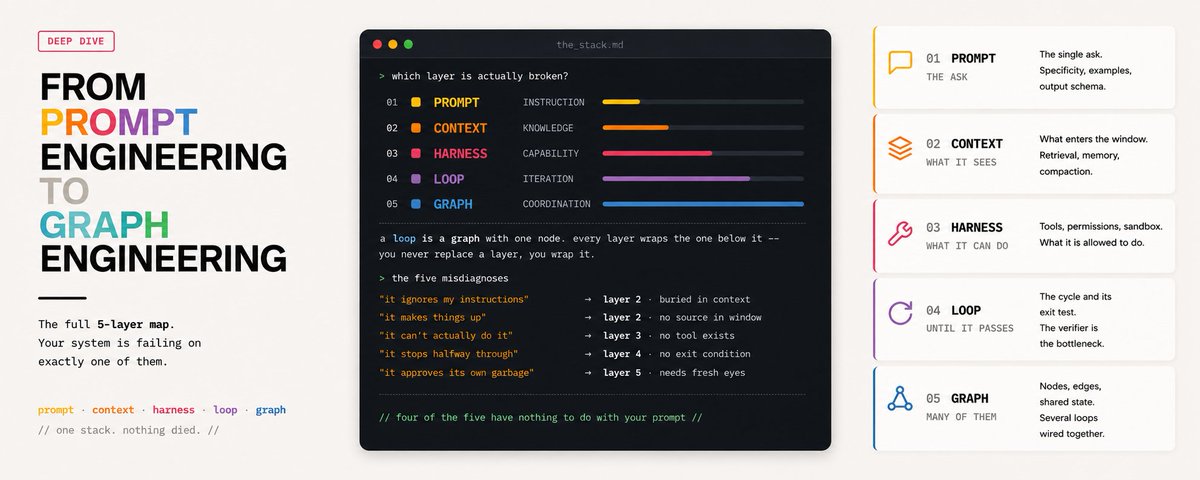
“80% of our engineers are using self-improving loops. Now everyone is building agentic graphs.”
in 1-hour Stanford lecture, Anthropic engineer reveals how Claude thinks - and why Graphs are the future.
This 1-hour watch will replace your $500 course on agentic engineering.
Watch it today, then read how to become a Graph Engineer in the article below.


Prashant Agarwal retweeted
CANCEL your weekend plans.
You NEED to:
• Build a RAG system that cites sources with page numbers
• Implement hybrid search (dense + sparse) for better retrieval
• Add reranking with cross-encoders for top-10 accuracy
• Set up chunking strategies (500 tokens, 50 overlap minimum)
• Build query expansion for better recall
• Add metadata filtering for scoped retrieval
• Implement citation grounding to prevent hallucinations
• Create an eval harness with 50+ golden test cases
• Track retrieval metrics: hit rate, MRR, NDCG
• Add fallback to web search when confidence is low
• Build query rewriting for ambiguous questions
• Implement parent document retrieval for context
• Add embedding caching to reduce latency 80%
• Use colbert or late interaction for better accuracy
• Build a RAG dashboard showing retrieval quality
• Test with adversarial queries that should return nothing
• Document your chunking strategy and why it works
• Benchmark against naive RAG and show improvement
You have way too much to do.
Bookmark & Repost.
Prashant Agarwal retweeted

Google just released a free 1-hour course on full agentic systems.
How to go from one agent to 1,000 agents running while you sleep:
07:02 - Build your first agent
13:34 - Give each agent a real skill
23:08 - Engineer the context they need
32:56 - Turn agents into graphs
54:11 - Run 1,000 agents inside autonomous loops
One agent saves you an hour.
A thousand agents replace the team you cannot afford to hire.
Most people are still learning how to prompt one chatbot.
Google is already teaching how to build entire agent systems.
Agent → Skills → Context → Graphs → Loops
Single agents are the old workflow.
Agent swarms are the new one.
This 1-hour watch is worth more than most paid agent engineering courses.
Bookmark it before everyone starts building the same thing.
Then build your first agent below


Prashant Agarwal retweeted

Interview experience : AI engineer 🫠
questions:
- Intro
- explain the last project you have worked on & what's your role
- explain your project architecture(Rag Platform)
- what is a vector DB & how does it work
- explain all components in rag
- what chunking strategies you have used & which is the best one
- Explain the process of document parsing
- explain the transformer architecture & self attention
- diff between encode & decoder use cases
- what is a prompt template
- why Lora instead of full finetuning?
- rag evaluation
- diff between chain & agent ? when would you use each of them
- how would you solve hallucinations?
- explain Langchain architecture(I didn't understand this question)
- precision@k vs recall
order of these questions isn't right & as usual couldn't recall all questions
Man there was a heck of background noise from interviewer side & i was not able to hear questions properly & asked him to repeat questions so many times.
I was shivering during interview because of cold weather lol 🤧
I wish i had given a better intro & rest went well
Prashant Agarwal retweeted
Don't waste 2 years learning to become an AI agentic engineer in 2026.
Andrew Ng, the godfather of AI, gave the complete playbook to become one from scratch.
1 hour course. Free:
• 00:00 - AI agent basics
• 12:12 - AI Agentic workflows & design patterns
• 53:27 - Practical tips for building AI agents
• 1:20:30 - self-improving AI agent loops
• 1:30:19 - multi-agent AI systems
I watched it last night.
Halfway through, I realized I could get into Anthropic in weeks, not years.
Bookmark now. Watch it. Then build your own AI agent with the guide below.
Prashant Agarwal retweeted
Knowledge graphs for representing information are unbeatable.
After this, you will never build a RAG system without knowledge graphs.
It will take you five lines of code to build a knowledge graph with your data.
I recorded a video to show you how you can do this.
I used Cognee, an open-source library that outperforms any basic vector search approach in terms of retrieval relevance. They are collaborating with me on this post.
Cognee is:
• Easy to use
• Reduces hallucinations
• Open-source
Here is a link to the repository: github.com/topoteretes/cogne…
They also offer a comprehensive platform and UI with Python notebooks you can utilize to manage your data. Here is the link:
cognee.ai/