






ptmoon retweeted

DARPA funded the development of sensors small enough to resemble grains of dust. Years later, researchers at UC Berkeley demonstrated tiny electronic implants powered by ultrasound that could communicate with nerves inside the body.
Then they developed StimDust, a device capable of stimulating a rat's nervous system and producing controlled movement in its hind leg.
These aren't concepts pulled from science fiction. The research, technology and experimental results are documented by DARPA and the University of California, Berkeley.
And they raise serious questions about where this technology is heading.
THE ORIGINAL SMART DUST PROJECT
In the late 1990s, UC Berkeley professor Kristofer Pister led research into miniature wireless sensors under DARPA funding.
The objective was to develop tiny electronic devices capable of sensing environmental conditions, processing information and communicating wirelessly.
Military applications included battlefield surveillance, equipment monitoring and distributed sensor networks.
Researchers even explored winged designs resembling falling maple seeds.
Imagine thousands of miniature sensors distributed across an area, gathering information and transmitting it to a monitoring network.
The research wasn't limited to military applications. Scientists also envisioned environmental monitoring, industrial automation and commercial sensor systems.
Read UC Berkeley's original Smart Dust project documentation: www2-bsac.eecs.berkeley.edu/…
THEN CAME NEURAL DUST.
On August 3, 2016, DARPA announced that researchers at UC Berkeley had developed implantable wireless sensors capable of recording electrical activity from nerves and muscles.
The devices were approximately a few millimeters in size and used ultrasound to receive power and transmit information.
Instead of relying on traditional batteries or radio communications, these tiny sensors used piezoelectric crystals to convert externally transmitted ultrasound into electrical energy.
DARPA described potential applications involving chronic nerve monitoring, biosensing and neuromodulation.
The initial experiments were performed in rodents.
DARPA'S OFFICIAL ANNOUNCEMENT: darpa.mil/news/2016/implanta…
THEN, IN 2018, RESEARCHERS WENT FURTHER.
UC Berkeley announced StimDust, a wireless peripheral nerve stimulator measuring just 6.5 cubic millimeters.
It weighed approximately 10 milligrams and operated using ultrasound transmitted from an external device.
Researchers surgically implanted StimDust around the sciatic nerve of a rodent.
By controlling the electrical stimulation delivered through the implant, they produced measurable movement in the animal's hind leg.
The researchers could measure stimulation activity, muscle response and the amount of force generated.
The implant demonstrated that extremely small electronic devices could receive power wirelessly and deliver controlled electrical stimulation to nerves inside a living organism.
UC BERKELEY'S 2018 ANNOUNCEMENT: news.berkeley.edu/2018/04/10…
READ THE PUBLISHED STIMDUST RESEARCH: escholarship.org/uc/item/8px…
Now think about the implications.
The documented experiment involved an implanted device, an external ultrasound transmitter and a specific peripheral nerve.
But it established an important technical capability: electrical stimulation could be delivered to a nerve through a miniature device powered and controlled wirelessly.
What happens as these devices become smaller, more sophisticated and capable of communicating with larger networks?
What protections prevent their use without informed consent?
And what happens when biosensors, neural interfaces, artificial intelligence and continuous physiological monitoring become increasingly interconnected?
There are legitimate medical applications for these technologies, including treating neurological disorders, restoring lost function and improving medical monitoring.
But the ability to interact electronically with the nervous system also demands serious discussion about privacy, cybersecurity, ownership of physiological data and individual autonomy.
At Mind Nexus, we've scanned thousands of people around the world who report unexplained frequencies, pressure, vibrations, perceived electronic interference and other unusual experiences.
We use specialized RF analysis and Non-Linear Junction Detection equipment to document anomalous frequencies around individuals, possible emissions within their environments and nonlinear harmonic responses.
Our focus is on documenting what can actually be measured and pursuing evidence-based investigation.
The public deserves to understand the technologies being developed to interact with the human body.
When electronics can communicate with the nervous system, shouldn't the right to refuse that technology be just as important as the ability to develop it?
EXPLORE THE MIND NEXUS DOCUMENT ARCHIVE
Government research, DARPA programs, patents, biosensors, neurotechnology and scientific publications: MindNexusLive.com/documents
JOIN THE MIND NEXUS EMAIL LIST
Stay informed about emerging technologies, investigations, scientific research and newly released documents.
MindNexusLive.com
PRIVATE ONE-ON-ONE SCANNING — RENO, NEVADA
Phase 1 — Scanning & Documentation
RF analysis documents anomalous frequencies around a person and possible emissions within the surrounding environment.
EDD-24XT NLJD scanning documents nonlinear harmonic responses associated with possible semiconductor-type electronic anomalies, including components that may not actively transmit.
Phase 2 — Coaching & Next Steps
May include coaching, frequency research, controlled verification, additional technical analysis, expert review and identifying qualified outside professionals.
Learn more and register: MindNexusLive.com/scans
Scanning is NOT a medical diagnosis. Our scans detect anomalous frequencies around a person and within the environment, not inside the body. Findings are for informational purposes only and can support personal investigations.
MASTERPEACE — THE PUBLISHED GHOST STUDY
Published October 5, 2026, the GHOST study followed 22 participants over 63 days of MasterPeace use with standardized EDD-24XT NLJD scanning.
At baseline, all 22 participants showed second-harmonic-dominant responses classified as "Probability Silicon."
After 63 days, researchers reported:
79% reduction in Mean Signal Intensity Score.
67% reduction in Active Signal Spots.
38% reduction in Mean Signal Intensity per Detection Site.
These are measurable changes in nonlinear harmonic responses documented before and after the 63-day period, providing additional data for continued investigation.
READ THE GHOST STUDY: actascientific.com/ASMS/pdf/…
CREATE YOUR FREE MASTERPEACE ACCOUNT:
MindNexusLive.com/masterpeac…
PETITION — STOP NON-CONSENSUAL HUMAN TESTING
Our goal is 1,000,000 signatures demanding transparency, accountability and protection of informed consent.
Stop3024.com
FOLLOW MIND NEXUS
Facebook: @MindNexusLive
Instagram: @MindNexusEvents
X: @MindNexusLive
YouTube: @MindNexusLive
Rumble: @MindNexusLive
#MindNexus #SmartDust #NeuralDust #StimDust #DARPA #UCBerkeley #Neurotechnology #Biosensors #InternetOfBodies #BrainComputerInterface #Neuromodulation #HumanRights #InformedConsent #MasterPeace #GHOSTStudy #NLJD
"It takes only a small number of true fanatics to intimidate an entire group into submission through these cascading effects."

People don't just pretend that the emperor is fully clothed: they will punish dissenters even when they privately know the emperor is naked. Why? Because they want to signal that they are genuine believers, not merely fakers bowing to social pressure. Studies find that people who conform under social pressure will criticize norm-breakers in public, but not in private. This kind of false enforcement creates the illusion of widespread, sincere support for even deeply unpopular norms. The upshot is that it takes only a small number of true fanatics to intimidate an entire group into submission through these cascading effects.
journals.uchicago.edu/doi/ab…

15
ptmoon retweeted

People don't just pretend that the emperor is fully clothed: they will punish dissenters even when they privately know the emperor is naked. Why? Because they want to signal that they are genuine believers, not merely fakers bowing to social pressure. Studies find that people who conform under social pressure will criticize norm-breakers in public, but not in private. This kind of false enforcement creates the illusion of widespread, sincere support for even deeply unpopular norms. The upshot is that it takes only a small number of true fanatics to intimidate an entire group into submission through these cascading effects.
journals.uchicago.edu/doi/ab…
ptmoon retweeted

MORATH FAREWELL
For the last decade, I’ve stood before this Board warning about the consequences of the reforms coming out of TEA.
Today, I’m pleased to mark the beginning of the end of the Morath era.
In 2016, Morath set out to make Texas number one in education.
Instead we are #1 in testing, technology, bureaucracy, data collection and less local control.
We watched the commissioner move the goalposts on accountability, strip communities of their elected representation and turn neighborhood schools into laboratories for corporate education reform.
Teachers became facilitators of scripted curriculum. Children became DATA points. Public education became a MARKETPLACE for private vendors.
For someone who preached accountability, Commissioner Morath seemed remarkably insulated from it.
In September, he told the Texas Tribune that we had no choice but to give The Agency an A.
Respectfully, Commissioner we do have a choice.
The people of Texas have spoken.
But replacing Mike Morath is not enough. We must dismantle the legacy of bad policy he leaves behind, restore local governance, protect student privacy, scrutinize TEA contracts and return academic instruction to the hands of professional educators.
Our children are not commodities. Our teachers are not delivery agents for corporate products. And our public schools are not Venture Capital opportunities.
After ten years, perhaps we can finally stop reforming education and start educating children.
Commissioner Morath, farewell.
May your departure mark the end of an experiment that Texas children never volunteered for… 👋🏼
ptmoon retweeted

Released in 1970, Crosby, Stills, Nash & Young's "Our House" is a warm, folk-rock ode to domestic bliss and peaceful everyday routines.
🎶 “I'll light the fire
You place the flowers in the vase
That you bought today
Staring at the fire
For hours and hours while I listen to you
Play your love songs all night long for me
Only for me” 🎵💕

For years now, Google has been tweaking its search formula to prop up AI and bury actual links. Now it’s rounding into its final form—and changing the internet forever.The End of Google Search—and the Internet—as We Know It
theringer.com/2026/08/04/tec…

11
Reinforcement Learning in Models
Reinforcement learning (RL) is a way for computers to learn by trying different actions and seeing which ones work best. The system learns by getting rewards when it does something good and penalties when it does something bad.
Population model:
The “agent” is the governance/control system.
The “environment” is the real population (or a high-fidelity simulation of it).
Actions are the interventions it can take (pricing changes, mobility rules, information campaigns, access restrictions, resource allocation, etc.).
Reward signal is defined by the system’s goals — lower risk scores, higher compliance, better economic or health metrics, reduced unrest, etc.
“Behavioral Adaptation: ON,” it means the model is learning and adjusting its actions in real time. It keeps trying small changes, watches how people react, and updates its approach to lower risk. This helps the system adapt faster than if it just followed a fixed set of rules.
🤖 Made with AI

11
The Technocratic Age Has Already Begun
We've spent decades arguing capitalism vs. socialism while the world quietly moved into something else. The defining trend of the 21st century is the concentration of informational, financial, technological, and institutional power into increasingly interconnected global systems.
Technocracy isn't coming. It's already here. The real question is: How much influence will ordinary citizens retain over the decisions that shape their lives?
🤖 Made with AI

11
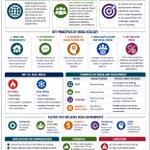
Media Ecology Theory examines how media and communication technologies shape human perception, understanding, and social organization.
Popularized by Marshall McLuhan and later expanded by Neil Postman, the theory suggests that media are not just channels of information—they are environments that influence how people think, feel, and interact.
Media ecology studies the interplay between technology, communication, and culture, revealing how shifts in media forms transform society itself.
thecommspot.com/communicatio…

12
I'm beginning to wonder whether these seemingly unrelated outages could be part of a much bigger game. Microsoft, then FAA, National Radar system and then now major Banks!
Could bad actors be creating a smokescreen with smaller, seemingly isolated disruptions while quietly infiltrating systems, exploiting vulnerabilities, and pre-positioning malicious code for something much bigger down the road?
Imagine a coordinated cyberattack that brings critical U.S. infrastructure, financial networks, and essential services to a standstill. The economic and national security consequences could be enormous.
We need to look beyond individual outages and start asking whether we're seeing isolated incidents or something more concerning.
The question isn't just how we recover from an outage. It's whether we know who's already inside our systems.

94
Democrats and the Overreach Problem. It could easily happen. The missing Trump voters. Democratic gains were heavily driven by turnout factors—as much as 60 percent of the shift. Trump dropoffs are likely to return in 2028.
open.substack.com/pub/thewel…

10
No Kings, No Votes: Democrats Move to Save Democracy From Itself jonathanturley.org/2026/11/1…

ptmoon retweeted

The Boomers inherited a civilization built on centuries of collective sacrifice, with strong families, churches, traditions, and communities. But they came of age during a cultural revolution that increasingly taught them two things: personal gratification should take precedence over inherited obligations, and dismantling those obligations was progress toward a better world.
In one direction, Edward Bernays helped lay the foundations of modern consumer culture by exploiting psychological desires, selling products as symbols of status, independence, and self-expression. We all know his famous 1929 campaign marketed cigarettes to women as "torches of freedom," that associated consumption with emancipation. The product itself was almost incidental to the point. What was important was convincing people that satisfying a manufactured desire meant a liberation from traditional norms. So, by the time the Boomers reached adulthood, advertising, television, and mass consumption had made personal gratification and self-expression central to American life, and it was everywhere.
From another direction came whats loosely called Western Marxism, the Frankfurt School, the New Left, and later critical theories that, ensemble, interpreted Western institutions through the framework of oppression and domination. So all those family structures, and religion, and traditional morality, and education, and established hierarchies etc., all became coded as oppressive and in the way of real progress. The whole frame demoralized people to consider that overcoming these institutions was the way toward emancipation and a higher level of a complete way of life for everyone.
Let’s run through the greatest hits. Antonio Gramsci explained how churches, schools, and other institutions maintained cultural hegemony. Theodor Adorno and his colleagues developed the F-scale in The Authoritarian Personality (1950), identifying rigid conventionalism, submission to authority, and sexual moralism as markers of authoritarian tendencies. Herbert Marcuse combined Freud and Marx in Eros and Civilization (1955), arguing that civilization could free itself from unnecessary repression and organize life around greater pleasure and erotic freedom. Apparently, we were going to get high and screw our way into utopia. Wilhelm Reich had pushed the sexual angle even further, linking sexual repression to authoritarian obedience and treating sexual liberation as a revolutionary force.
Second-wave feminism brought these critiques of the West into marriage, and motherhood, and the family itself. Friedan critiqued the ideal of domestic fulfillment in The Feminine Mystique (1963). Kate Millett's Sexual Politics (1970) reframed relations between men and women through, you guessed it, political domination. Shulamith Firestone's The Dialectic of Sex (1970) did the same recipe here, identifying the biological family as a foundation of sexual inequality and calling for its revolutionary transformation.
All of that reframing of the West as oppression didn't stop there. Nope. It of course extended to education, history, and Western cultural authority. Paulo Freire's Pedagogy of the Oppressed (1970 in English) promoted critical consciousness as a means of identifying and transforming oppressive social structures. And Frantz Fanon's The Wretched of the Earth (1961), endorsed by Jean-Paul Sartre, called for revolutionary liberation from colonial domination. Post colonialism is a thing too, and we'll have to cover Edward Said's Orientalism (1978) which, oh you guessed it, challenged Western representations of other societies as instruments of imperial power.
So yeah, some of these thinkers had different goals, and many opposed consumer capitalism. But they're all linked in how their ideas contributed to a broader cultural shift that reframed inherited Western institutions as bad and presented liberation from traditional authority as progress.
So, consumer culture encouraged people to put their desires first, while radical critical consciousness and social criticism offered all the moral justifications anyone needed to be demoralized and reject any inherited obligations they had to future generations. One made tradition inconvenient. The result was that the Boomers had all the reasons they needed to pursue their own comfort while believing that abandoning traditional obligations was progress for society.
Consider the disappearing family reunions, estranged siblings, and grandparents detached from their grandchildren. Nobody has to deliberately destroy the extended family. Enough people simply stop feeling responsible for maintaining it.

Something broke severely with boomers. Anecdotal, but when I was a kid we went to 1-2 Thanksgivings and Christmas every year. 1 for my mom’s side and 1 for my dad’s. 4th of July,
Memorial Day, Easter, family reunions, birthdays, you name it. Huge gatherings. I was pretty close with like 10 cousins, none of which lived very close, because there were just so many gatherings. I frequently stayed with grandparents. This was the same for virtually all my friends too.
Now this is much less common. Big holiday gatherings seem totally fragmented into smaller groups. I know people that go to like 4 thanksgivings. Not only are boomers less interested in their children and grandchildren, but they more commonly have rifts and disinterest in their siblings.
Personally, this year we’re having a small thanksgiving because the dominant Aunt on my mom’s side has gone out of her way to break up a larger gathering, because she wants “less stress.” The extended family on my dad’s side simply stopped inviting us a few years after he died and made it weird when I inquired. None of these people are bad or abnormal. It’s so strange though.
I’ve made attempts at rallying larger gatherings, but in the modern age people just ignore it or text lame excuses.
I know there are memes about weddings that are way too big and expensive, but I see more people doing ultra small weddings with only friends and close immediate family. I’ve never even heard of family being invited to a kid’s birthday party in recent years. It’s all school friends at a Dave and Busters or something. Even Grandparents aren’t involved.
I know there are plenty of exceptions to this, but the overall trend is very real and it hurts my heart.
"Lula is imposing massive cuts of tens of billions to education and health care programs: the exact opposite of the central promise of his fraudulently populist campaign." @ggreenwald

The very first thing that Lula is doing after winning the election (other than having his federal police force fire investigators who are discovering crimes of his judicial allies like Moraes) is imposing massive cuts of tens of billions to education and health care programs: the exact opposite of the central promise of his fraudulently populist campaign. Even some of his left-wing fans in Congress are enraged (even though Lula's coalition, starting with his Vice President, is with neoliberal pro-banking sectors for whom austerity is a religion, making this all totally predictable and their rage totally theatrical).
I would actually pay money to hear American left-liberal commentators like the ones below, who did segment after segment on Lula and the Brazilian election -- despite barely being able to place the country on a map -- explain what's happening and why.
30
