

High-performance Rust-based vector search engine. https://xitter.cf/t.co/362gvLXHcw
Joined December 2020
- Tweets2.5K
- Following114
- Followers13.7K
- Likes4.3K
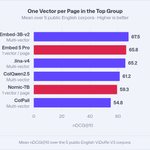

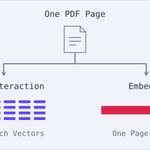


On five public ViDoRe V3 corpora, Embed 5 Pro scored 65.8 nDCG@10, ahead of ColPali, ColQwen2.5, and Jina-v4. Only ColEmbed-3B-v2 scored higher (67.5) of those we compared. Embed 5's training data isn't published, so test set overlap is possible.

Already running OCR? The recently released Rerank 5 Pro lifted nDCG@10 on the same corpora from 66.8 to 73.2.
Full breakdown by @krotenWanderung: qdrant.tech/blog/cohere-embe…

Qdrant 1.20: Ship Hybrid Search without the sparse pipeline. Turn on BM25 scoring for a full-text index, query it with your vectors in one request. Plus a code tokenizer, faster nested filters, turbo16, and turbo8. qdrant.tech/blog/qdrant-1.20…

Vector search ranks results. But who counts the filters?
Parichay Das shows how Qdrant's Facet API, payload indexes, and disjunctive faceting power accurate search sidebars.
Including a key trade-off: filtered counts ≠ relevant results.
medium.com/@parichaydas/face…
Better chunking ≠ better retrieval.
At MLOps Community Amsterdam, Qdrant's @EASzyszka explored chunking benchmarks, while Booking.com shared lessons on agent memory and source consistency.
Luca Berton's recap:
lucaberton.com/blog/mlops-co…


London Search Week, let's talk search over a pub quiz.
Join Qdrant on Nov 24, 6:30–9:30 PM GMT at Core Bar, London.
Search trivia, prizes, food & your first drink on us. Come solo or bring a team of up to 6.
Limited spots. RSVP:
luma.com/londonsearchweek_20…

Your vector collection outgrew RAM. What now?
Qdrant 1.19 lets you choose pinned, cached, or cold memory tiers per component.
Keep original vectors on disk and compressed vectors in RAM to balance memory use and search latency.
qdrant.tech/documentation/pr…

How is AI changing software development?
Qdrant's @EASzyszka joined @WeAreDevs at Agent Conf Berlin to discuss token usage, vector search, data quality, and the evolving developer workflow.
Watch the conversation:
youtube.com/watch?v=CJa6YRq-…

Which German councils are discussing wind power?
Poliscope answers in one search.
4,800 council portals, 130M points, one self-hosted Qdrant node.
Searches went from up to 20 s to 0.87 s on average with hybrid search, tenant filters, and TurboQuant.
qdrant.tech/blog/case-study-…
Qdrant retweeted

The fine folks at @qdrant_engine are doing great work with Qdrant Edge to make vector search accessible on edge devices, such as the @huggingface Reachy Mini!
Great for memories, as they show below! Check it out.

What if your robot could remember your preferences, recognize your friends, and recall past conversations?
@ShuregDenisov and I built made a Reachy Mini remember with @qdrant_engine Edge, giving it local persistent memory.
Read how we did it 👇
qdrant.tech/blog/reachy-robo…
Qdrant retweeted

very happy to see Qdrant team testing our latest late interaction retriever!


780 ms during background optimization. 4.3 ms after it finished.
Same Qdrant collection, very different search latency.
We tested 13 optimizer configurations on 1.76M vectors to understand the trade-offs between indexing, recovery time, and query performance.
Here’s what we found 👇

Read the benchmarks: qdrant.tech/documentation/pr…

Your AI agents need memory that lasts beyond a single conversation.
LangGraph supports long-term memory, allowing agents to store information and recall it across conversations. Now, you can use Qdrant as the storage layer with our new memory store integration.
Qdrant brings vector-native storage and semantic search to LangGraph’s memory system, so agents can retrieve relevant memories based on meaning, not just exact matches.
You can store user preferences, past interactions, and other useful context, then retrieve what matters when the agent needs it.

LangGraph docs: docs.langchain.com/oss/pytho…
Qdrant integration: pypi.org/project/langgraph-s…
