

I'm Rain | | Alpha Content | ⛓️ 🦅
Metaverse
Joined May 2022
- Tweets166K
- Following11.7K
- Followers115K
- Likes27K








So, @blknoiz06 turned bearish on $BTC and $ETH is interesting, especially because his argument starts outside crypto.
He’s watching weakness in AI momentum stocks, failed Nasdaq breakouts and questions around whether massive AI spending can translate into profits.
His warning levels: $82K for BTC and $2.4K for ETH. A break below could accelerate selling.
What stands out to me is the timing.
The Fed decision lands tomorrow, alongside a heavy earnings week.
If tech sentiment deteriorates further, crypto could struggle to find independent momentum.
But Ansem still expects BTC to recover longer term, and says onchain sentiment is the worst he’s seen in nine years.
I think that last point deserves attention. Extreme pessimism can create opportunities, but it doesn’t tell us when the selling ends.
If AI stocks keep weakening, can crypto attract capital on its own merits?

i am bearish btc/eth & large cap stocks believe btc & eth have broken mid timeframe trend and will continue to accelerate to downside under 82k/2400
dont think the average retail speculator is going to slow down tho, Q4 is going to have a lot of volatility for traders in both directions & believe pockets of onchain will do well
headline risk is also very real and continues to impact markets, this week specifically we have fomc + lot of important earnings releases
technicals am bearish bc ai momo stocks look like parabolic blowoff top into following lower high and loss of trend, even mags stalling at ATHs, the breakout on Qs that looked great a few weeks ago has played out as a deviation above the highs
as it stands ai generally feels like there is a lot more uncertainty on where the next growth of revenues is going to come from, sofar we have had a ton of capex spending on investing in training these models across the board so believe investors will want to see how that impacts companies bottom line meaningfully, meta selloff post earnings last week is good indi, that combined with concerns around current state of models also breaking hella security across the internet is not great - am not bearish on extended timeframe just believe pullback before continuation higher
Rain retweeted
AI is making security research cheaper.
$SOL Firedancer team just put a price on the consequences.
During a recent audit competition, 162 researchers submitted 809 reports, resulting in 127 unique security findings.
The backlog peaked at 299 reports awaiting review.
Now, every new bug submission requires burning 1 SOL, even if the finding turns out to be invalid.
I find the economics here fascinating.
AI can generate potential vulnerabilities faster than engineers can verify them.
Charging for submissions might reduce noise, but it also raises the barrier for legitimate independent researchers.
If AI keeps lowering the cost of discovering bugs, how do we scale verification without pricing out the people who find real ones?
Rain retweeted
GPU rental costs are becoming a market you can trade.
And $INJ just launched perpetual futures tracking rental prices for five Nvidia GPUs, with up to 10x leverage.
H100 and B200 account for 65% of the index, which updates hourly.
The timing is pretty interesting.
Gartner recently warned that over 80% of specialist AI cloud providers could lose their independence by 2030, largely due to pressure on infrastructure economics.
To me, the real potential here is hedging. AI companies could protect against rising compute costs, while GPU providers could manage falling rental revenues.
But that depends on the index accurately reflecting real-world costs and attracting enough liquidity.
Will GPU derivatives become essential infrastructure for the AI economy?
Rain retweeted
Arthur Hayes went from calling for longs to selling $22.3M in crypto in 9 days only.
On October 15, he was bullish on $BTC and $ETH but now he’s stepping aside, citing macro risks.
His sales included:
• 6,400 ETH — $15.2M
• 14M ENA — $2.76M
• 323K UNI — $2.24M
The timing is what interests me.
Hayes has been betting on fresh liquidity driving the next rally, yet he’s cutting exposure ahead of the October 28 Fed decision.
I don’t think his long-term thesis has necessarily changed.
But there’s clearly a difference between predicting a rally and being willing to hold through the uncertainty.
Remember, in August 2025 he sold $ETH around $3,507 and bought back nine days later at $4,252: 21% higher.
Is Hayes managing risk better this time, or about to pay another premium to get back in?
Rain retweeted
$BTC ETFs finally broke their 2-week outflow streak with $301M in net inflows.
But the weekly total hides a much less bullish picture.
Investors poured in $1.08B during the first 3 days, then pulled out $774M as Bitcoin slipped toward $80K.
That’s roughly 72% of the early inflows reversed in just 2 sessions.
What caught my attention is DWF Labs’ research: ETF outflows accompanied 7 of Bitcoin’s 8 major sell-offs since launch.
I think we’re seeing a different kind of institutional demand than many expected.
ETF access hasn’t necessarily created a reliable pool of dip buyers.
If ETF investors are selling alongside the market rather than absorbing volatility, how much downside protection can we realistically expect from institutional adoption?
Rain retweeted
$BTC is back below $80K, but I think the bigger risk isn’t the price drop itself.
Bitcoin fell nearly 2% as Asian tech stocks weakened and traders reduced exposure ahead of Wednesday’s Fed decision.
Three things stand out to me:
• Brent remains around $114 despite a 2% pullback.
• South Korea’s Kospi fell 1%, extending weakness in the AI trade.
• BTC needs to reclaim $82.5K, the support level it lost last week.
Expensive energy keeps inflation risks elevated, while weaker tech stocks signal declining appetite for risk.
That leaves crypto vulnerable to a hawkish Fed, even if rates stay unchanged.
I’m watching the Fed’s December guidance more closely than Wednesday’s decision itself.
Can Bitcoin reclaim $82.5K without a recovery in tech sentiment?
Rain retweeted
$BTC losing $80K is concerning, but the liquidation data tells a bigger story.
$837M in positions were wiped out in 24 hours, with longs accounting for 82.8% of the damage.
Bitcoin and Ethereum alone saw $414M in liquidations, over 93% of which came from longs.
To me, this looks like a leveraged market being forced to reset rather than evidence of selling pressure alone.
But there’s another concern: BTC is now trading below the estimated average acquisition price of corporate Bitcoin treasuries.
With total crypto market cap just ~1% above its October low, I’m watching $77.9K support and whether BTC can reclaim $83K before the Fed decision.
Will this leverage flush create room for a healthier recovery, or is spot demand too weak to absorb the next wave of selling?
Rain retweeted
$BTC might be facing a bigger threat from oil than from anything happening onchain.
Brent hit $115.84, its highest level in five months, as tensions in the Middle East escalated.
Meanwhile:
• Nasdaq fell 2.6%.
• Crypto market cap dropped 3.74% to $2.76T.
• WTI climbed above $100.
What concerns me is the inflation angle.
Higher energy prices could make it harder for the Fed to ease monetary policy, keeping pressure on liquidity and risk assets.
But there’s an interesting divergence: physical Brent prices have fallen from ~$135 to ~$118 this month, suggesting part of the futures rally may reflect geopolitical risk rather than immediate supply shortages.
With the Fed decision on October 28 and major tech earnings approaching, I’m watching oil as closely as Bitcoin.
If oil stays above $115, can $BTC recover on its own?
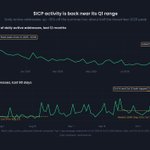
$ICP is attracting more users, but its price isn’t following.
Over the past month, ICP dropped 8.3%, while network activity tells a different story:
- Daily active addresses: +35%, reaching 3,860.
- New addresses: +45%, reaching 710 per day.
That’s encouraging, but I wouldn’t call it an adoption breakout yet.
Activity is still roughly half its November 2025 peak.
The price structure is also fragile:
$2.50 is the key downside level I’m watching, while reclaiming $2.85 would weaken the bearish setup. A sustained move above $3.30–$3.60 would be more convincing.
Can growing onchain usage eventually support $ICP’s valuation?

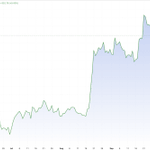
$BTC is back near $82K, but I'm not convinced this recovery has much strength yet.
Bitcoin bounced from below $81K as the Japanese yen weakened and Asian stocks recovered.
Still, three numbers concern me:
- $435M in crypto liquidations, including $385M in longs
- $381M in preliminary BTC ETF outflows on Thursday
- $100 oil, keeping inflation risks elevated.
A stronger yen could also pressure carry trades funding risk assets.
To me, this looks more like temporary relief than renewed demand.
With $BTC testing its 50-day moving average, I'd want to see stronger spot buying before trusting the move.
Can Bitcoin sustain a rally without consistent ETF inflows while macro pressures remain elevated?

Rain retweeted
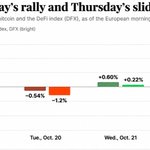
DeFi is taking almost twice the hit of the broader crypto market.
While $BTC dropped nearly 3%, CoinDesk’s DeFi index fell 5.6%, compared with a 3.2% decline in its broader CD80 index.
The derivatives data makes this more interesting.
$UNI open interest dropped 10.17%, far faster than the token’s price. $NEAR showed a similar pattern, with OI down 8.83%.
That suggests traders are actively closing positions rather than simply holding through the selloff.
Meanwhile, crypto derivatives volume surged 19% to $226.6B, with liquidations reaching $431M.
My concern is whether traders are reducing exposure to the sector more aggressively than to crypto overall.
If this is primarily deleveraging, the selling could eventually exhaust itself. But continued relative weakness would be a more concerning signal.
Is DeFi simply absorbing the sharpest part of a market-wide reset?
Rain retweeted
$BTC lost its $85K breakout attempt, and the timing is worth paying attention to.
Bitcoin slipped nearly 3% toward $81.5K as Tesla’s Q3 capex missed expectations ($4.73B vs $7.96B forecast) and South Korea’s KOSPI fell 3.5%.
But the technical setup concerns me more.
BTC rejected $84,840, keeping its pattern of lower highs intact.
Meanwhile, Bitcoin open interest recently reached $55.95B, up 4.5% in 24 hours.
To me, that’s a fragile combination: rising leverage, weakening risk appetite and a failed resistance test.
I’m watching $80K–$81.5K as the key support zone.
Holding it could keep the recovery alive, but reclaiming $84.8K is what would start changing my bias.
Will spot buyers defend support, or will leveraged positions turn another rejection into a deeper correction?
