

Founder of Easework AI - Smarter Teams, Smarter AI :The Future of Procurement
Bengaluru, India
Joined May 2010
- Tweets393
- Following1.2K
- Followers49
- Likes765

Pinned Tweet
Honored to share Easework AI has been selected in the 5th cohort of the Maruti Suzuki Incubation Program, in partnership with IIM Bangalore's NSRCEL.
We are building procurement OS using agentic platform
#AgenticAI #RushLane #nsrcel #iimbangalore

Maruti Suzuki has onboarded 5 startups under the 5th cohort of the Maruti Suzuki Incubation Program (MSIP) to co-develop AI and digital solutions for improving operations and customer experience.
The selected startups are MiniMines, Easework AI, Sarvam AI, Siftly and CodeMate AI. The program is conducted in partnership with IIM Bangalore’s NSRCEL.
#MarutiSuzuki #Startup #AI #Automotive


RathaRamanan 🧲 retweeted

We’re extending the 50% increase to weekly Claude Code limits through August 31.
We hope to make this a permanent change to our plans, but strong demand for our models means that capacity may be tight over the coming weeks. We’ll keep you posted as things develop.

RathaRamanan 🧲 retweeted

OpenAI CEO, Sam Altman:
"You don't need to write prompts anymore. You need Loops and Graphs."
In 38 minutes he explains why his own engineers stopped writing prompts, and what they build instead
Prompts → Agents → Loops → Graphs
a prompt buys you one answer
a graph buys you the whole job, and you are not in it
this talk is worth more than most $2,000 AI engineering bootcamps
watch it today
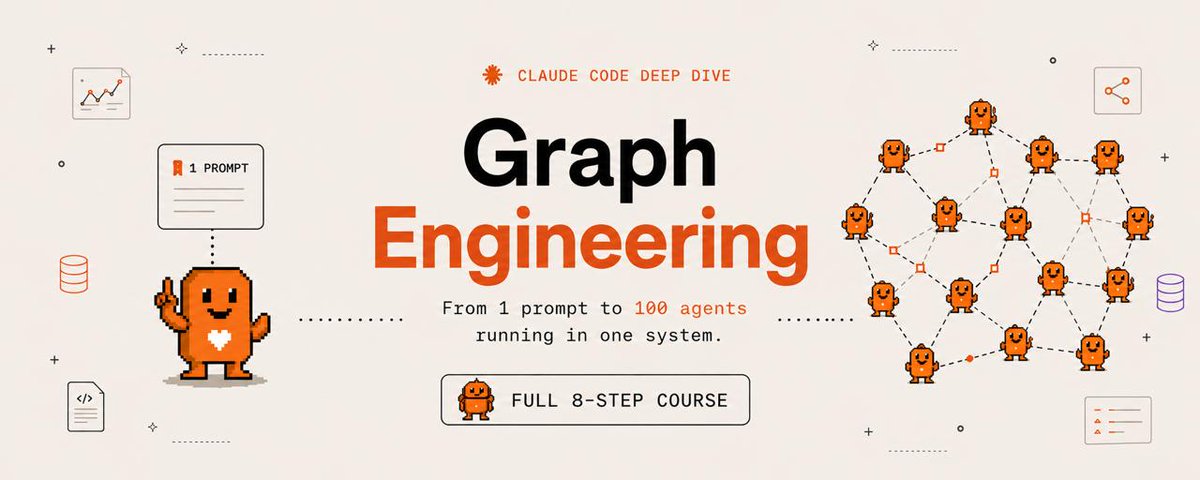
then save the full graph engineering guide below before everyone catches up ↓

RathaRamanan 🧲 retweeted

If alignment issues are becoming big enough that OpenAI is willing to commit 20% of research inference compute to chain-of-thought monitoring, that suggests that alignment issues are becoming a pretty serious concern.
We really need universal policies & standards across labs.

We temporarily slowed some frontier training to strengthen security and monitoring. Our largest planned frontier RL run remains on hold while smaller-scale training and evaluations help us test safeguards and gather more evidence of alignment.
I expect confidence in safety to increasingly set the pace of AI development. We urgently need tools for labs and countries to coordinate on this, which is why I signed Pacing the Frontier. In the meantime, we’re taking practical steps ourselves - and will continue to share what we learn as our approach evolves.
openai.com/index/pacing-mode…
pacingthefrontier.com/

RathaRamanan 🧲 retweeted

Claude Cowork is now available on mobile and web for all paid plans.

RathaRamanan 🧲 retweeted

Kimi's CEO🇨🇳 says every AI lab has the wrong obsession
Zhilin Yang, on why K3 beat the frontier: "Every lab, like Claude, thinks the model matters most. That's wrong. It's how you organize the people building it that wins."
Then Moonshot proved the philosophy. K3 sold out every plan on purpose, cutting their own revenue instead of throttling existing users. When Anthropic hit that wall in April, they cut users' usage 50% at peak.
His one big idea: long context is the AI era's RAM. The 128K-to-gigabytes jump, compressed into 2 years instead of 40.
The real moat: "your biggest advantage, perhaps your only advantage, is your organization."
Model, or the team behind it: which actually wins?
RathaRamanan 🧲 retweeted

Introducing Kimi K3: Open Frontier Intelligence
🔹 2.8 Trillion Parameters, 1 Million Context, Native Multimodal
🔹 Kimi Delta Attention enables up to 6.3x faster decoding in million-token contexts
🔹 Attention Residuals deliver ~25% higher training efficiency at <2% additional cost
🔹 Built for long-horizon agentic coding and self-evolving workflows
Kimi K3 is now live on on Kimi.com, Kimi Work, Kimi Code, and the Kimi API.
Open Weights by July 27, 2026.
🔗 API: platform.kimi.ai
🔗 Tech blog: kimi.com/blog/kimi-k3


RathaRamanan 🧲 retweeted

Today, we are introducing Inkling.
Inkling reasons efficiently across text, image, and audio modalities. We are making the full weights available.
thinkingmachines.ai/news/int…
Available today for fine-tuning on Tinker. Play with it in the Inkling Playground. 🧵

RathaRamanan 🧲 retweeted

Our first model, Inkling. Trained from scratch, weights are open, fine-tunable on Tinker today.

Today, we are introducing Inkling.
Inkling reasons efficiently across text, image, and audio modalities. We are making the full weights available.
thinkingmachines.ai/news/int…
Available today for fine-tuning on Tinker. Play with it in the Inkling Playground. 🧵
RathaRamanan 🧲 retweeted

Inkling is Thinking Machines Lab’s first fully trained and released open-weights foundation model.
tl;dr:
-975B total parameters, 41B active per token
-Native text, image, and audio reasoning
-Up to 1M-token context
-Controllable reasoning effort for better cost/latency trade-offs
-Full weights available
-Built specifically for customization and fine-tuning through Tinker
Pretty strong, efficient, multimodal base model that developers can adapt for their own products and workflows.
I love the way Thinking Machines is going! Open AI (lol) for everyone.

Today, we are introducing Inkling.
Inkling reasons efficiently across text, image, and audio modalities. We are making the full weights available.
thinkingmachines.ai/news/int…
Available today for fine-tuning on Tinker. Play with it in the Inkling Playground. 🧵
RathaRamanan 🧲 retweeted

This is huge.
A group of 50 AI researchers (ByteDance, Alibaba, Tencent + universities) just dropped a 303 page field guide on code models + coding agents.
And the takeaways are not what most people assume.
Here are the highlights I’m thinking about (as someone who lives in Python + agents):

RathaRamanan 🧲 retweeted

There's a major gap in this otherwise compelling vision.
Lots of interesting signals recently: token budget caps, intelligence sovereignty, increasing competition (Meta/Grok/GLM) that drives the commoditization of intelligence.
All seem to point toward a more benevolent future equilibrium where every organization owns its human-AI learning loop through which knowledge and value accrue locally. @satyanadella, @thinkymachines, @dwarkesh_sp all laid out good arguments for it.
No doubt that is a more desirable future than the oligopolistic path we are on, but no one seems to be asking about the elephant in the room:
Do we actually know how to solve the continual learning problem required to sustain such a local co-learning loop?
Right now, there are roughly three buckets of learning methods being entertained in practice:
1) Non-parametric learning, mostly in some form of memory (skills, RAG, knowledge bases, KV cache, etc)
2) Domain-level post-training (e.g., continual pre-training on proprietary organizational data)
3) Task-level post-training (e.g., RL for specific workflows)
(More research-y ones like new model architectures are omitted here because there's still a long way to go in both research and validation)
Is any of these methods sufficiently general and deep to sustain the desired co-learning loop across all organizations and job functions? The answer is likely negative:
> Non-parametric memory is often shallow and has limited control over agent behavior (talk to OpenClaw/Hermes users who struggle to get their agents to learn and follow the rules)
> Domain-level post-training remains expensive and has yet to demonstrate broad success outside a few exceptional domains (@Cursor's Composer may be an exception but coding is an exceptional domain in itself)
> Task-level RL is engineering-heavy, sample-inefficient, and difficult to apply when success cannot be objectively verified
The human-AI learning loop isn’t inevitable. It still needs to be invented. Solving continual learning may be one of the most important problems for building an AI ecosystem where expertise compounds locally instead of concentrating globally.

RathaRamanan 🧲 retweeted

I’ve been saying this for months, and the early data is beginning to support it. Five years from now, I believe AI will create more jobs than it eliminates.
That may sound counterintuitive. But the data is proving this theory. Here are some factors worth considering.
AI is exposing new human bottlenecks
When one part of a workflow becomes dramatically faster, the constraint simply moves elsewhere. Organizations then need more people to remove the next bottleneck and capture the value AI has unlocked.
Automation does not eliminate the need for human contribution. It often reveals how much more could be accomplished with it.
AI fluency will become one of the world’s most valuable skills
The emerging divide will not be between humans and agents. It will be between people who are highly fluent with AI and those who are not.
AI-fluent people will not be 10% more productive. In some forms of work, they could be 50x or even 100x more effective. They will imagine better uses for AI, orchestrate agents and apply judgment where machines still fall short.
These people will be scarce and enormously valuable.
Productivity creates demand
The assumption behind mass unemployment is that the amount of work the world needs is fixed.
It isn’t.
When technology becomes dramatically cheaper and easier to create, we do not simply produce the same amount with fewer people. We build more products, start more companies, solve previously uneconomic problems and serve markets that could never be served before.
AI will lower the cost of ambition.
The real risk, therefore, is not that humanity runs out of work. It is that millions of people are not prepared for how quickly the nature of work changes.
The future will likely have more jobs. But they will not be the same jobs, performed in the same way, by people with the same skills.
The imperative is not to protect people from AI. It is to help every person become fluent in it.

RathaRamanan 🧲 retweeted

Interesting to see the narrative turn. The proprietary data that fuels an enterprise is the most valuable asset it has in an era where intelligence is becoming infinitely less expensive. As $PLTR said in an interview last week. The alpha of your business is in the proprietary data. It needs to be sacred and protected and shouldn’t be given away to frontier labs. This is why AI won’t eat all software. That layer to protect and govern data becomes more important in the AI era.

RathaRamanan 🧲 retweeted

Satya Nadella just warned every company using AI: you are paying twice. Once with money. Again with something far more valuable.
He published an article introducing something called the Reverse Information Paradox.
And it changes how you think about every AI tool your company uses.
Nobel laureate Kenneth Arrow described the original paradox: a seller risks giving away knowledge just to sell it. Nadella says AI flips this completely.
In the AI age, the buyer gives away knowledge just to use what they bought.
Every time your team uses Claude or GPT at work, every prompt reveals what you are building. Every correction teaches the model what good looks like inside your company. Every eval shows what you value. Every trace exposes your workflow.
The model provider learns more about you with every interaction. You learn almost nothing about what they are learning in return. Your corrections are distilled institutional know-how. The kind a competitor could never buy.
And it leaks trace by trace, correction by correction, without you noticing.
His line: "You can offload a task. You can offload a job. But you can never offload your learning."
If the model provider disappears tomorrow, do you still own the intelligence your team built on top of it? Your evals. Your memory. Your traces. Your workflows. Or did all of that compound inside someone else's infrastructure?
In the cloud era, companies accumulated data. In the AI era, they accumulate learning. Right now, most of that learning is compounding inside the model provider. Not inside the company paying for it.
The CEO pushing AI harder than anyone just told you to protect your knowledge from the very tools he is selling you. That should tell you everything.
RathaRamanan 🧲 retweeted

(1) Today we're releasing Muse Spark 1.1 -- a strong agentic and coding model at a very low price. It's available through our new Meta Model API and in Meta AI.
RathaRamanan 🧲 retweeted

Our internal assessment is that Grok 4.5 is roughly comparable to Opus 4.7, but much faster. The combination of capability, faster speed and lower cost is what makes it competitive.
We are closing the loop on real-world usefulness, not benchmarks. Hardcore engineers at Tesla & SpaceX find Grok 4.5 genuinely useful, which is what actually matters.


RathaRamanan 🧲 retweeted

Introducing ChatGPT Work, a new agent in ChatGPT powered by Codex and GPT-5.6.
It can take action across your apps and files, stay with a project for hours if needed, and turn a goal into finished work.
It’s a whole new way to get work done.
RathaRamanan 🧲 retweeted

The harness is what matters now. The model is just a commodity.
A model on its own returns text. Nothing it produces becomes working code until something around it reads the repo, applies the edits, runs the tests, and reacts to what breaks.
That something is the harness, and it decides how much of a model's ability actually ships.
Cline ran a clean test of this. Same model, GLM 5.2, on the same set of coding tasks, driven two ways by their harness.
- 57.3% with reasoning turned off.
- 68.5% with reasoning turned on.
The weights never changed. The only difference was how the harness drove the model.
Reasoning budget is one knob. The harness also decides what context the model carries across steps, which tools it can reach, how edits get applied, and whether the work gets checked before it moves on.
This is why the model is becoming the swappable part. The open ones are strong enough now, so what separates a good run from a wasted one is the environment they run inside.
Cline is an open-source harness built for exactly this. The model is a slot you fill, and the loop around it stays the same whether you run GLM 5.2, Kimi K2.7, or DeepSeek V4.
ClinePass is the clean version of that idea. One subscription to bring those open models into the harness, without assembling the stack yourself.
A few things follow from the design.
→ It curates the field. The set is narrowed to open models tested for coding-agent use, so you skip finding out the hard way which ones hold up across long tasks.
→ It drops the provider sprawl. One subscription covers them, with no separate accounts, keys, or billing to track across labs.
→ It runs longer. The quota gives 2 to 5x the standard API rate limits, so long agent runs don't stall mid-task.
→ It stays open. Custom keys and local models keep working alongside it, so it adds an option instead of replacing what you have.
The point is not which open model wins. It is that the harness that decides the outcome now, and the model is just the part you swap in.
The video below shows the setup in action. I worked with the team to put it together.
