
Assistant Professor at IT University of Copenhagen
Denmark
Joined June 2010
- Tweets68
- Following103
- Followers224
- Likes27
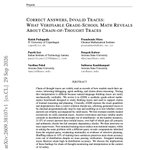

Happy to share our paper, "Correct Answers, Invalid Traces: What Verifiable Grade-School Math Reveals About Chain-of-Thought Traces".
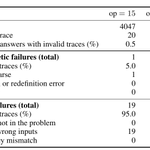
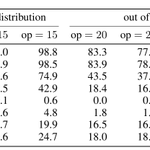
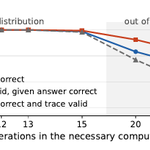
When a model gets the right answer, is the reasoning it produces also right? We test this on synthetic grade-school math where every step of a trace can be checked by a program.
Thread below.

These findings matter for chain-of-thought monitoring in AI safety, where the trace is all a monitor sees.
Joint work with Pranabendu Misra, Paarth Iyer, Durgesh Kalwar, Vardhan Palod and Subbarao Kambhampati (@rao2z).
Code: github.com/ratishsp/igsm-tra…
Models: huggingface.co/ratishsp/igsm…
Paper: arxiv.org/abs/2609.38107

I audited FineWeb-Edu, the educational subset of FineWeb, for misinformation. I annotated 200K documents from the 100BT sample using Llama 4 Maverick.
- On known problematic domains (naturalnews.com, rt.com, codoh.com, etc.), 39% of documents contain misinformation, nearly 10x the overall rate
- Extrapolating to the full 1.53B document dataset: ~63M pages may contain misinformation
Releasing:
- 200K annotated documents: huggingface.co/datasets/rati…
- Binary + multiclass ModernBERT classifiers (F1=0.86/0.80): huggingface.co/ratishsp/fine…
- All code for the audit pipeline, annotation, and training

Ratish Puduppully retweeted

Getting scooped on my own paper drop by @DamienTeney 😂
But he's spot on - tabular language models have been overblown
Reported performance gains often don’t come from emergent generalization at all.
arxiv.org/abs/2602.04031

Happy to share our new paper! We study Tabular Language Models (TLMs): LLMs fine-tuned on serialized tabular data, converting rows into text sequences.
Do TLMs actually learn tabular reasoning? Our re-evaluation suggests maybe not. 🧵
Paper: arxiv.org/abs/2602.04031
(3) Instruction-tuning alone with Alpaca (no tabular data) bridges most of the performance gap
This suggests reported gains come from instruction-following and memorization rather than genuine tabular reasoning.
Excited to share our latest work on initializing expanded vocabulary for language models! Kudos to Nandini and Aditya for their excellent contributions!

🚨🚨 New preprint 🚨🚨
Presenting: An Empirical Comparison of Vocabulary Expansion
and Initialization Approaches for Language Models
Paper: arxiv.org/abs/2407.05841
Code: github.com/AI4Bharat/VocabAd…
@anoopk @ratishsp @nandi_mundra

Ratish Puduppully retweeted

📣 📣 📣 New instruction-tuned LLM! 📣 📣 📣
Today, we announce an initial release of "Airavata", an instruction-tuned LLM for Hindi.
Blog: ai4bharat.github.io/airavata…
Model: huggingface.co/ai4bharat/Air…
Datasets: huggingface.co/datasets/ai4b…
(1/N)

Super happy to be a part of this work by @NameIsAshwanth!

Multiple acceptances in @emnlpmeeting thanks to students, researchers and collaborators.
1. CTQScorer: Combining Multiple Features for In-context Example Selection for Machine Translation
Authors: @NameIsAshwanth, @ratishsp, @prajdabre1, @anoopk (Findings)
#EMNLP2023 #NLProc
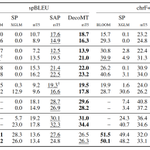
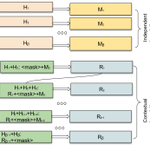
Thrilled to share that our paper on Decomposed Prompting for Machine Translation between Related Languages using Large Language Models is accepted to #EMNLP23 main conference! 🎉
