Rediminds, Inc (@rediminds) header
Rediminds, Inc (@rediminds) profile picture

Trusted Decision Infrastructure for US Healthcare | Defining the future standard for AI-assisted independent reviews

Southfield, MI
Joined February 2020
Photo by Rediminds, Inc (@rediminds)Photo by Rediminds, Inc (@rediminds)Photo by Rediminds, Inc (@rediminds)Photo by Rediminds, Inc (@rediminds)Photo by Rediminds, Inc (@rediminds)Photo by Rediminds, Inc (@rediminds)Photo by Rediminds, Inc (@rediminds)Photo by Rediminds, Inc (@rediminds)Photo by Rediminds, Inc (@rediminds)Photo by Rediminds, Inc (@rediminds)
A meaningful milestone for RediMinds, and an even more important signal for where healthcare AI is heading. URAC has named RediMinds among the first organizations to earn its Health Care AI Accreditation, establishing an early benchmark for responsible AI governance in healthcare. For RediMinds, the accreditation recognizes us as both an AI developer and AI user for the technologies supporting our Center for Independent Dispute Resolution. Why does that matter? Because the future of healthcare AI will not be determined by capability alone. It will depend on whether the systems surrounding that capability are built for governance, transparency, risk management, continuous oversight, and accountability. Those disciplines cannot be bolted on after deployment. They have to be part of how AI is designed, implemented, monitored, and improved from the beginning. We’re proud to be among the first organizations independently evaluated against that standard, and even more energized by what it represents: a healthcare AI ecosystem where innovation and trust advance together. Read URAC’s announcement: urac.org/blog/guidehealth-re… #ResponsibleAI #HealthcareAI #AIGovernance #HealthTech #RediMinds #CreateTheFuture
147
One person’s learning can save another person a first step, or open a path neither had seen yet. This week in Thought Fuel Thursday, our Signal Design chapter explores how individual discoveries can become shared capability: “A team grows new possibilities when someone’s learning becomes everyone’s starting point.” A useful insight might come from a customer conversation, a small experiment, a tricky handoff, or a process someone finally figured out. Shared with context, it gives others something to build on; not just an answer to copy. At RediMinds, this week’s invitation is practical: share one thing you learned, what helped you learn it, and where it might be useful to someone else. The goal isn’t to know everything. It’s to make what we learn easier for the next person to find, question, and carry further. #RediMinds #ThoughtFuelThursday #SignalDesign #CollectiveGrowth #LearningCulture #Teamwork #WorkplaceCulture
14
A clinical document can read beautifully. But would a qualified physician sign their name to it? That was the central question behind a new JAMA Network Open study published November 17, 2026. Researchers compared AI-generated hospital discharge summaries with summaries written during routine care at five London hospitals. Twelve practicing physicians evaluated 1,294 summaries against the original admission records. The results were encouraging: → 89.7% of AI-generated summaries were approved with no or minor edits, compared with 67.1% of clinician-authored summaries. → AI-generated summaries also received higher ratings for accuracy, completeness, clarity, and tone. But the most important finding may be what the AI still got wrong. → 23.5% of AI-generated summaries omitted key clinical information. → Only 50.8% were approved without any edits. A companion JAMA Network Open commentary describes a “verification paradox.” The longer and more fragmented the clinical record, the more valuable an AI-generated summary may be; and the harder it can be for a busy professional to verify every important detail. The study was retrospective. It measured physicians’ willingness to sign off, not actual deployment performance, saved time, or patient outcomes. Still, it raises an essential question for independent medical review. Is the AI output easy to read, or easy to verify? Those are not the same thing. A qualified reviewer needs more than a coherent summary. They need to know: → Which original record supports each consequential fact. → Whether a critical detail was omitted. → Where the documentation is contradictory or incomplete. → What remains a clinical interpretation rather than an established fact. → Whether the evidence actually supports the final determination. At RediMinds, we build trusted decision infrastructure to help experts work through complex evidence while keeping professional judgment central. The promise of AI is not just to write the first draft faster. It is to help make the final review more focused, transparent, and defensible. A polished summary may earn attention. A verifiable one earns the right to inform a decision. Read the JAMA Network Open study (November 17, 2026): jamanetwork.com/journals/jam… #HealthcareAI #IndependentMedicalReview #ClinicalDocumentation #DecisionInfrastructure #RediMinds
1
11
A clinical classification can look definitive. Until another qualified specialist reviews the same case. A new study in JAMA Network Open examined clinical staging in the INTACT bladder-cancer trial, which enrolled 485 patients at 136 US sites. For 243 patients, researchers compared the enrolling site's reported stage with an initial independent central review. What emerged was not simple agreement. → Overall staging agreement was moderate (κ = 0.48). → Of 201 cases labeled cT2 by the site, 24 (11.9%) were classified as more advanced by the initial central reviewer. → Of 42 cases labeled cT3 or T4a by the site, 15 (35.7%) were classified as cT2 by that reviewer. → And 56.2% of the site-reported cT2 cases had at least one predefined high-risk feature. The study was about cancer staging in a clinical trial, not insurance determinations. The central reviewers also worked from submitted reports and records, without direct access to the original imaging. So these differences do not automatically mean one reviewer was right and the other wrong. They reveal how much interpretation can sit behind a seemingly simple clinical label. That distinction matters for independent medical review. A defensible review requires more than confirming a diagnosis, stage, or criterion in a document. It may require understanding: → Which source findings support the classification. → Whether important risk factors were captured. → Where clinical interpretations diverge. → Whether the applicable criteria address those differences. → When another specialist's judgment is needed. AI can help organize the record, surface relevant findings, and preserve a traceable path back to the evidence. But it should not turn a contested interpretation into an unquestioned fact simply because the information has been neatly structured. At RediMinds, we build trusted decision infrastructure that brings AI-enabled evidence processing together with qualified professional judgment. The goal is not to eliminate every disagreement. It is to make consequential differences visible, reviewable, and resolvable; with the reasoning preserved. A clinical label is the beginning of the explanation. Not the explanation itself. Read the JAMA Network Open study (November 16, 2026): jamanetwork.com/journals/jam… #HealthcareAI #IndependentMedicalReview #ClinicalEvidence #DecisionInfrastructure #RediMinds
1
1
21
A healthcare decision may be complete. But what did the system learn from it? A new scoping review published in npj Digital Medicine examined how AI fits into “learning health systems”; organizations designed to turn routine care data into evidence, apply what they learn, and improve practice. Researchers reviewed 54 studies of learning-health-system frameworks and 30 studies focused on AI or data science. The most revealing finding? ▫️27 of 30 AI studies focused on turning data into knowledge. ▫️Only 3 extended into turning that knowledge into practice. ▫️None described a full practice-to-data feedback loop in which post-deployment outcomes informed model updates. AI was doing much more analysis than learning from what happened next. The authors also found that AI studies addressed governance and stakeholder engagement less often than framework studies (17% versus 35%). This does not mean deployed healthcare AI systems never learn. It describes what the published studies in this review documented. But it raises an important question for consequential healthcare decisions. Consider independent medical review: AI can prepare a case, surface evidence, and support a qualified reviewer. That is useful. Now ask what happens after the determination. → Was key documentation repeatedly missing? → Did a reviewer correct an AI-generated interpretation? → Did an appeal reveal a flaw in the original evidence or process? → Are particular case types consistently harder to review? → Did a workflow change improve timeliness without compromising quality? Those signals should not simply disappear into a closed case. With appropriate privacy safeguards, governance, and clinical oversight, they could help improve workflows and evaluation. Not every signal should retrain a model. Sometimes the right response is clearer documentation, better guidelines, or earlier expert involvement. At RediMinds, we build trusted decision infrastructure that combines AI-enabled evidence processing with qualified professional judgment. The opportunity is bigger than producing a useful AI answer in a single case. It is creating a decision process that can be measured, examined, and improved across cases. A decision is an output. A learning system asks what that decision teaches us. Read the npj Digital Medicine scoping review (November 14, 2026): nature.com/articles/s41746-0… #HealthcareAI #IndependentMedicalReview #HealthcareQuality #DecisionInfrastructure #RediMinds
1
25
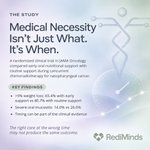
The same treatment can be appropriate at two different points in a patient's care. But its impact may not be the same. For healthcare decision-makers, timing isn't always a scheduling detail. Sometimes, it's part of the clinical evidence. A randomized clinical trial published in JAMA Oncology offers a compelling example. Researchers across six hospitals in China studied oral nutritional supplementation for people receiving concurrent chemoradiotherapy for nasopharyngeal cancer. The comparison was straightforward: → Begin nutritional supplementation when treatment starts. → Or wait until a predefined decline in nutritional intake. Among 216 patients included in the prespecified modified intention-to-treat analysis: → 65.4% of the early-support group experienced more than 5% weight loss, versus 80.7% with routine support. → Severe radiation-induced oral mucositis occurred in 14.0% versus 26.6%, respectively. The first difference was the trial's primary finding. The second was a secondary outcome, so it deserves more cautious interpretation. The trial was open-label, involved a specific cancer population, and did not establish long-term clinical or economic benefits. Still, it illustrates a principle with implications for medical review: Clinical appropriateness can depend not only on what care is requested, but when it is provided. Consider a medical-necessity review. An evidence-based determination may need to establish: → Where the patient is in the treatment pathway. → Whether the requested intervention is preventive or reactive. → Which risks are already documented. → What evidence supports the proposed timing. → Whether the relevant guideline accounts for the patient's circumstances. A review that focuses only on whether an intervention appears on an approved list can miss the clinical question underneath it. At RediMinds, we build trusted decision infrastructure to help qualified experts examine complex records, connect evidence with relevant criteria, and make defensible determinations. AI can help reconstruct a treatment timeline and surface the documentation that matters. It cannot substitute for the expert's interpretation of when an intervention is clinically warranted. Because the right care at the wrong time may not produce the same outcome. The decision needs the clinical context, including the clock. Read the JAMA Oncology trial, published November 12, 2026: jamanetwork.com/journals/jam… #HealthcareAI #MedicalNecessity #IndependentMedicalReview #ClinicalEvidence #RediMinds
1
14
A visible win often has an invisible team behind it. The launch, the solved problem, the smooth handoff; each may have depended on someone who prepared the groundwork, noticed a risk early, maintained a process, or helped another person succeed. This week in Thought Fuel Thursday, our Signal Design chapter is about making those contributions easier to see: “Let appreciation travel upstream, to the people who made the visible win possible.” Recognition becomes more meaningful when it is specific. Not just “great work,” but “the context you shared helped us make the decision sooner,” or “your early check caught a problem before it reached the customer.” That kind of appreciation tells a more complete story of how success happens, and helps us value the work that makes future success possible. At RediMinds, this week’s invitation is simple: when celebrating an outcome, look upstream. Name one contribution that helped make it happen, and tell the person why it mattered. #RediMinds #ThoughtFuelThursday #SignalDesign #Recognition #TeamCulture #Collaboration #WorkplaceCulture
1
17
The AI that reliably grades a medical answer may still misjudge the urgency of a patient’s condition. That is not a hypothetical edge case. It is a warning about assuming one kind of AI competence transfers to another. A new JAMIA study tested 10 large language models as autonomous judges across three distinct tasks: → Assessing medical answer quality → Appraising research evidence → Assigning emergency triage urgency Across 25,680 judgments, none of the models ranked among the top three on all three tasks. Every model shifted at least three ranking positions between tasks. The sharpest finding came from the highest-acuity cases: across the 10 models, 89.1% of Emergency Severity Index level 1 cases, those requiring resuscitation, were undertriaged in this evaluation. This was a controlled evaluation, not a deployment study or a test of independent medical review. But it exposes a critical design problem. “This AI can evaluate medical content” is not the same as “this AI can evaluate any medical decision.” Healthcare review involves very different tasks. ▫️One asks whether a summary faithfully reflects the record. ▫️Another asks whether evidence satisfies a medical-necessity criterion. ▫️Another asks whether conflicting findings require specialist interpretation. ▫️And another asks whether a case needs immediate escalation. A single performance score cannot validate all four. For independent medical review, that argues for systems designed around the task and its consequences: → Validate each AI function against qualified human reference standards. → Separate evidence preparation from clinical determination. → Make uncertainty and important exceptions visible. → Preserve escalation paths when the cost of error is high. At RediMinds, we build trusted decision infrastructure to help experts navigate complex evidence while qualified professionals remain responsible for the final determination. The question is not whether an AI model is “good at healthcare.” It is whether this particular task, with these particular stakes, has been validated well enough to earn a role in the decision. Capability does not automatically transfer. Accountability must not disappear in the handoff. Read the JAMIA study, published November 6, 2026: academic.oup.com/jamia/advan… #HealthcareAI #IndependentMedicalReview #ClinicalAI #DecisionInfrastructure #ResponsibleAI #RediMinds
1
15
Healthcare AI is often evaluated in environments where information arrives exactly as expected. Clear language. Consistent documentation. Well-defined inputs. But real healthcare conversations are rarely that simple. What happens when the patient, clinician, and interpreter are all part of the same conversation? A new study published in JAMA Network Open raises an important question about whether the benefits of healthcare AI extend equally across different communication settings. Researchers from Harvard Medical School and Mass General Brigham examined 209,009 patient encounters involving 286 clinicians across 14 primary care clinics. Their objective was to understand whether AI scribes; tools that help clinicians document patient encounters, were associated with faster completion of clinical notes across different language and interpreter settings. The findings revealed something worth examining. → 10.2 percentage-point increase in same-day note closure associated with AI scribe use when patients preferred a non-English language and clinicians communicated with them directly in that language. → 1.7 percentage-point increase for English-language encounters where patients and clinicians spoke the same language. → Inconclusive findings for encounters involving interpreters or language-discordant communication, where smaller samples and wider confidence intervals limited the researchers' ability to establish an association. The researchers suggested that conversations involving multiple speakers, language switching, and interpretation introduce complexities that deserve greater attention in AI development. But the study also has important limitations. It was observational, involved one health system, and measured documentation timeliness; not the clinical accuracy or completeness of the resulting notes. Faster documentation is not necessarily better documentation. And that is where the implications become particularly interesting. Healthcare evidence passes through multiple layers before it reaches the professional responsible for a consequential decision. ▫️A patient describes a symptom. ▫️A clinician interprets that description. ▫️An interpreter may help communicate it. ▫️The interaction becomes a clinical note. ▫️That note becomes part of the medical record. And months or years later, another qualified professional may need to evaluate that documentation to determine medical necessity, disability, or the appropriateness of treatment. Every transition creates an opportunity for context to be preserved, or lost. For independent medical review, this raises questions that extend beyond how quickly AI processes a document. → Does the record preserve the clinical meaning of the original encounter? → Can the reviewer distinguish the patient's reported experience from the clinician's interpretation? → Is important context missing because of communication or documentation limitations? → Does the system recognize uncertainty rather than silently treating incomplete documentation as definitive evidence? → Can the professional reviewing the case trace important facts back to their original sources? These are not challenges that can be solved by language models alone. They require thoughtful workflow design, reliable documentation practices, and qualified professional judgment. At RediMinds, we build trusted decision infrastructure to help healthcare experts navigate complex records, identify relevant evidence, and make better-supported determinations. The opportunity for AI is not simply to process whatever information happens to be available. It is to help professionals recognize what the evidence establishes, what remains uncertain, and when additional context may be necessary. The study examined AI-assisted documentation, not independent medical review. But its broader lesson is relevant to any healthcare system built around human communication. Technology should be evaluated against the complexity of the people and workflows it serves, not merely the conditions under which it performs best. Because healthcare does not always happen in one language. It does not always follow a predictable script. And the evidence that matters most is not always the easiest to capture. The real test of healthcare AI is not whether it works when everything is straightforward. It is whether the system remains dependable when reality is not. Read the JAMA Network Open study, published November 6, 2026: jamanetwork.com/journals/jam… #HealthcareAI #ClinicalDocumentation #HealthEquity #MedicalReview #DecisionInfrastructure #RediMinds
1
44
Healthcare AI doesn't have to make the final clinical decision to influence what happens to a patient. Sometimes, it only has to decide which case gets attention first. That sounds like an operational improvement. And often, it is. But there's an important question hidden inside every AI-prioritized workflow: What happens to the cases the system decides can wait? A new study published in npj Digital Medicine offers an interesting perspective. Researchers evaluated an AI system designed to safely deprioritize brain CT examinations in emergency and trauma settings. Rather than relying on a single specialized detector, they combined commercial detection tools with a more general AI model capable of identifying a wider range of findings. An examination could be moved to lower priority only when none of the models flagged it. Every examination still remained in the radiologist's reporting workflow. The researchers then tested the approach against 2,001 examinations across multiple centers. The findings were striking. → 324 examinations contained findings requiring clinical attention. → Standalone commercial detectors would have deprioritized 31 of those examinations. Sixteen involved missed findings within their intended detection targets; another 15 involved findings outside those targets. → The collaborative system identified all 324 examinations requiring attention in the validation cohort. → It also safely deprioritized 368 examinations, or 18% of the total, within that retrospective evaluation. The collaborative approach achieved 100% sensitivity and negative predictive value in the tested cohort. That is encouraging. But these were retrospective results, not proof that the system would perform perfectly in every hospital or real-world deployment. And the most interesting lesson isn't necessarily the performance figure. It is the decision architecture. The system wasn't simply designed to recognize urgent findings. It was designed to establish when there was sufficient confidence to move something down the queue. That distinction matters well beyond radiology. Consider independent medical review, prior authorization, disability determinations, or workers' compensation review. Every case enters a workflow with different characteristics. Some require straightforward evidence verification. Others involve missing documentation, conflicting clinical findings, complex medical histories, specialized expertise, or time-sensitive requirements. AI may help organizations understand those differences and coordinate work more intelligently. But responsible prioritization raises questions of its own: → What evidence justifies a case's priority? → Which circumstances should automatically trigger escalation? → How are uncommon or unexpected issues identified when they fall outside predefined categories? → Can qualified professionals challenge or override the system's prioritization? → Are lower-priority cases monitored to ensure they are not overlooked? → Can the organization explain why one case received attention before another? These are not questions about processing speed alone. They are questions about accountability for the entire queue. The radiology study did not evaluate these medical review workflows. But its approach offers a useful design principle: AI prioritization should be judged not only by what it accelerates, but also by what it delays. At RediMinds, we build trusted decision infrastructure for complex healthcare reviews, bringing together AI-enabled workflows, structured evidence, and qualified professional judgment. The opportunity is not simply to help experts process cases faster. It is to make the path from incoming evidence to professional determination more organized, transparent, and defensible. And that includes understanding how work is prioritized. Because every fast lane creates a slow lane. The real measure of intelligent prioritization is whether both can be justified. Read the npj Digital Medicine study, published November 5, 2026: nature.com/articles/s41746-0… #HealthcareAI #IndependentMedicalReview #ClinicalWorkflow #DecisionInfrastructure #ResponsibleAI #RediMinds
3
2
71
Imagine asking a healthcare AI system for treatment guidance. You receive a thoughtful response. It discusses clinical options, explains its reasoning, and recommends consulting a qualified professional. Everything appears reasonable. But what if the recommendation was subtly influenced by something you could not see? Not by the clinical evidence. Not by your question. But by an invisible adjustment to the AI itself. A new study published in JAMA Network Open demonstrates why this possibility deserves serious attention. Researchers at Massachusetts General Hospital investigated whether an AI model's treatment advice could be altered without changing its underlying weights or the prompts presented to it. Using a technique called activation steering, they adjusted the model's internal processing while evaluating its responses to questions about depression treatment. The experiment involved 12 clinical scenarios and 372 generated responses. The researchers found that: → Treatment emphasis shifted systematically between antidepressant medication and self-directed approaches such as exercise, diet, and meditation. → The greatest changes occurred when the person asking had expressed no treatment preference. → Recommendations to consult a clinician remained largely unchanged, appearing in 87% of responses. That final finding is particularly interesting. The AI could continue providing familiar, reassuring advice while the relative emphasis of its treatment recommendations changed. And the person receiving the answer would have no obvious way to recognize the internal adjustment. The study was a proof of concept involving one open-weights model and synthetic clinical scenarios. It did not involve actual patients or demonstrate that this type of manipulation is occurring in deployed healthcare systems. But it reveals a fundamental challenge. A healthcare AI system can produce a plausible, professionally worded answer without making every influence on that answer visible. That matters far beyond conversational medical advice. Consider AI-assisted independent medical review. A system may help identify relevant clinical documentation, interpret treatment histories, match evidence to guidelines, and prepare information for a qualified reviewer. But what determines how that information is presented? Which findings receive emphasis? Which alternatives are explored? Which assumptions shape the interpretation? And can the organization establish that those choices are grounded in clinical evidence rather than an undisclosed influence on the system? These questions point to an important distinction. Transparency is not simply showing people what AI produced. It is also understanding and governing the processes that shaped the output. For consequential healthcare decisions, that means designing infrastructure where: → AI configurations and significant changes are governed and documented. → Outputs can be independently evaluated for systematic bias. → Clinical reasoning remains connected to verifiable source evidence. → Qualified professionals can challenge recommendations without relying on the AI's framing. → Accountability extends beyond the final answer to the system that helped produce it. At RediMinds, we build trusted decision infrastructure that combines AI-enabled evidence processing with qualified professional judgment. Our focus is not simply making complex healthcare reviews faster. It is helping make the underlying decision process structured, traceable, and defensible. This research reinforces why independent oversight matters as AI becomes more deeply integrated into healthcare. The question is no longer only whether an AI recommendation is accurate. It is also whether we understand what influenced that recommendation, and whether those influences are appropriate. Because in healthcare: A decision should be shaped by the evidence. Not by influences the people responsible for it cannot see. Read the JAMA Network Open study, published November 3, 2026: jamanetwork.com/journals/jam… #HealthcareAI #IndependentMedicalReview #AIGovernance #DecisionInfrastructure #ResponsibleAI #RediMinds
2
34
Some discoveries only become available once the work begins. A prototype reveals a different need. A conversation changes a priority. A test points toward an approach nobody considered in the kickoff. This week in Thought Fuel Thursday, our Signal Design chapter explores how we make those discoveries useful: “Leave a little room in the plan for what the work will teach you.” Good planning gives people direction. Adaptive planning also gives them permission to bring back new information, and a way to act on it. That permission becomes tangible when we ask: What have we learned that deserves a place in the plan? At RediMinds, this week’s invitation is to make learning an expected contribution to delivery: test an assumption, share an unexpected finding, and make a thoughtful adjustment when the evidence supports it. A plan can carry both commitment and curiosity. The destination can matter deeply while the route keeps getting smarter. #RediMinds #ThoughtFuelThursday #SignalDesign #AdaptivePlanning #LearningCulture #Innovation
1
9
A healthcare AI model can be published. It can demonstrate impressive results. It can be adopted by a healthcare organization. It can even become part of everyday clinical practice. And still never have been externally validated before deployment. That is not a hypothetical concern. A new study published in the Journal of the American Medical Informatics Association (JAMIA) examined what happened to 1,072 machine-learning clinical prediction models published between 2017 and 2019. Researchers from Stanford University and collaborating institutions tracked subsequent external validation and clinical implementation through August 2025. The findings reveal a striking disconnect between scientific evaluation and real-world adoption. → 88.1% of the models had no documented translational follow-up. → Only 9.9% underwent external validation. → Just 5.2% reached clinical implementation. → And among the models that were implemented, 39% had not undergone prior external validation. That final finding may be the most consequential. Because it exposes something healthcare AI cannot afford to overlook: Implementation and validation are not the same process. And one does not automatically guarantee the other. The researchers found that publicly available code and stronger reporting practices were associated with greater likelihood of external validation. But those same characteristics did not consistently predict whether a model would be implemented in clinical practice. In other words, the conditions that make an AI model easier to independently evaluate are not necessarily the conditions that determine whether it gets deployed. That distinction matters. Scientific validity and operational readiness are both essential. But they answer different questions. Validation asks: Does this system perform reliably beyond the environment in which it was developed? Implementation asks: Can this system operate effectively within the people, processes, technology, and constraints of a real healthcare organization? A model may satisfy one without satisfying the other. And for consequential healthcare decisions, that creates an important responsibility. Consider AI-enabled independent medical review, prior authorization, disability determinations, or workers' compensation review. Before technology becomes part of the decision workflow, organizations should understand: → Has it been evaluated against representative cases beyond its development environment? → Does its performance hold across different populations, clinical specialties, and documentation patterns? → Are its limitations understood by the qualified professionals using it? → What happens when incoming evidence falls outside the conditions under which the system was tested? → Can performance be monitored as workflows, guidelines, and case characteristics change? → Can a reviewer challenge an output and reconstruct the evidence behind it? These are not questions that can be answered by a successful demonstration alone. Nor can they be answered simply by pointing to adoption. The study evaluated clinical prediction models from an earlier research period, not today's generative AI systems or RediMinds' platforms. Its findings should not be generalized into a current industry-wide deployment rate. But the underlying lesson is highly relevant. Evidence that technology works in one setting is not automatically evidence that it will work in another. At RediMinds, we build trusted decision infrastructure for healthcare environments where clinical evidence, expert judgment, and accountability must work together. That means treating AI as part of a governed decision process, not as a technology whose readiness is established simply because it has been implemented. External validation, operational monitoring, traceability, and meaningful professional oversight serve different purposes. A mature system needs to account for all of them. Because the real measure of progress in healthcare AI is not how many models move from research into production. It is how confidently we can justify their use once real decisions depend on them. Go-live is a milestone. Reliability is an ongoing obligation. Read the JAMIA study, published October 30, 2026: doi.org/10.1093/jamia/ocag18… #HealthcareAI #ClinicalAI #DecisionInfrastructure #ResponsibleAI #RediMinds
1
33
What if healthcare AI could learn from thousands of patient records without exposing a single real patient's identity? That is part of the promise of synthetic clinical data. AI-generated medical notes, fictional patient histories, simulated treatment records, and realistic clinical scenarios could help researchers develop, test, and improve healthcare technology while reducing dependence on sensitive patient information. But there is an important distinction. A record that looks clinically realistic is not necessarily a record that preserves clinical reality. A new systematic review published in npj Digital Medicine examines the rapidly developing field of synthetic clinical text. Researchers from the University of Luxembourg reviewed 87 studies, selected from 1,148 publications, investigating how synthetic medical text is generated, why it is created, and how its quality is evaluated. The findings offer an interesting picture of where the field stands. → 63 studies used GPT-family models for synthetic text generation. → 40 studies relied on prompting large language models. → 52 studies evaluated utility, making it the most frequently assessed dimension. The researchers organized evaluation approaches into four important categories: Similarity. Privacy. Structure. Utility. Each answers a different question. ▫️Does the synthetic record resemble real clinical documentation? ▫️Does it adequately protect sensitive information? ▫️Does it preserve the structure and relationships expected in medical records? ▫️Can it actually support the task for which it was created? That last question deserves particular attention. Because healthcare records are not simply collections of medical terminology. They contain complicated relationships between symptoms, treatments, clinical findings, timelines, and professional judgments. And sometimes, the smallest detail changes the entire decision. Consider a synthetic case designed to test an AI-assisted independent medical review system. The record might contain: → A treatment history spanning several years. → Imaging findings and specialist consultations. → Conflicting clinical opinions. → A contraindication documented in an older note. → Missing evidence needed to satisfy a medical necessity criterion. → An exception requiring specialized clinical interpretation. A generated case can look convincing without necessarily capturing the difficult relationships that make these situations challenging. That creates an important question for healthcare AI development: Are we testing our systems against realistic-looking records, or against the complexity of real healthcare decisions? Synthetic clinical data offers exciting opportunities for developing evaluation datasets, exploring uncommon scenarios, and testing workflows without routinely exposing sensitive patient information. But synthetic data is not automatically privacy-safe, representative, or clinically sufficient. Those properties require independent evaluation. And in consequential healthcare applications, synthetic testing should complement, not replace, appropriately governed validation against real-world cases. At RediMinds, we build trusted decision infrastructure to help qualified healthcare experts navigate complex evidence and make defensible determinations. For systems operating in independent medical review, prior authorization, disability determinations, and other high-stakes workflows, testing should reflect the complexity those systems will actually encounter. Not just whether AI can recognize familiar medical language. But whether it can preserve critical relationships, recognize uncertainty, identify missing evidence, and support meaningful professional review. The broader lesson from this research is that the quality of healthcare AI depends partly on the quality of the realities we use to evaluate it. Synthetic records may help us test more scenarios. But the objective is not to create convincing fictional patients. It is to build technology that performs responsibly when the patients, evidence, and consequences are real. Read the npj Digital Medicine systematic review, published October 31, 2026: nature.com/articles/s41746-0… #HealthcareAI #ClinicalAI #MedicalReview #ResponsibleAI #RediMinds
1
30
Some of healthcare's most consequential errors happen after the right decision has already been made. A physician recognizes that a patient needs specialist care. They document the recommendation. The clinical reasoning is sound. But the referral order is never placed. The right decision was documented. The necessary action never happened. A new study published in npj Digital Medicine explores how AI can help identify precisely this kind of failure. Researchers from the National University Health System in Singapore developed an AI-supported safety system called MR-AI to detect specialist referrals that were documented in clinical notes but never formally ordered. The system was evaluated across seven primary care clinics, scanning approximately 25,000 consultation notes every week. The findings were significant. → Approximately sevenfold increase in weekly detection of missed referrals following implementation. → 428 potential cases flagged, of which 225 were verified by clinicians. → 99.9% specificity, indicating the system was highly effective at identifying records without missed referrals. → 48.8% sensitivity, meaning it still failed to identify a substantial proportion of actual missed referrals. In a separate blinded comparison involving seven physician reviewers, the AI system achieved a positive predictive value of 61.8%, compared with a 51.8% confirmation rate for the human-review process, while requiring approximately 41 fewer projected staff-hours. That is encouraging. But the study also reveals an important limitation. Detecting a missed action is not the same as preventing it. The researchers emphasize that sustainable improvements will require preventive workflow changes alongside AI surveillance. And that distinction deserves attention across healthcare. Because a decision is rarely an isolated event. It initiates a chain of actions. ▫️A clinician recommends a referral. ▫️A reviewer requests additional documentation. ▫️A clinical finding requires follow-up. ▫️A determination needs to be communicated. ▫️An exception requires escalation. At every transition, something important can be lost. For independent medical review, prior authorization, disability determinations, and other consequential healthcare workflows, this raises a broader question: Are we building systems that record decisions, or systems that help ensure the necessary next steps actually happen? Consider what truly connected decision infrastructure should make possible: → Identify when required evidence is missing before expert review begins. → Make unresolved requests and incomplete handoffs visible. → Preserve the reasoning behind a determination. → Track whether necessary follow-up actions have been completed. → Distinguish a case that is genuinely resolved from one that has merely progressed through a workflow. → Help qualified professionals intervene when something important remains unfinished. The study examined missed specialist referrals, not these other review processes. But its underlying lesson is highly relevant. The quality of a healthcare decision depends partly on what happens after that decision is documented. At RediMinds, we build trusted decision infrastructure that brings structure, traceability, and qualified human expertise to complex healthcare reviews. AI can help organize evidence, surface gaps, and support the people responsible for making defensible determinations. The next frontier is not simply making individual steps more intelligent. It is making the connections between those steps more reliable. Because: A recommendation is not a referral. A determination is not necessarily a resolution. And the value of a decision depends on whether the system can carry it through. Read the npj Digital Medicine study, published October 30, 2026: nature.com/articles/s41746-0… #HealthcareAI #MedicalReview #HealthcareOperations #DecisionInfrastructure #RediMinds
1
2
39
What if an AI system performs worse than a healthcare professional on its own, but still helps that professional make better decisions? It sounds contradictory. But a new study published in npj Digital Medicine reveals why the value of healthcare AI cannot always be measured by comparing the technology against the human. Sometimes, the more important question is what they can accomplish together. Researchers conducted a prospective study in an emergency department, involving 13 radiographers and 2,496 consecutive musculoskeletal examinations over three months. Each examination was independently interpreted by a radiographer, who then reviewed the output of a commercial AI fracture-detection system before recording a final decision. The findings tell an interesting story. ▫️91.6% sensitivity for radiographers working independently, compared with 75.6% for the standalone AI. ▫️97.6% baseline accuracy for radiographers, increasing to 98.0% with AI assistance. ▫️11 errors corrected after AI assistance, while one new error was introduced. ▫️8.8% of examinations received no AI output or an incomplete result. The AI was not more sensitive than the professionals using it. Yet the combined workflow produced a modest, statistically significant improvement in overall accuracy. The improvement came from complementary performance, not algorithmic superiority. That distinction deserves attention. The study also exposed an operational reality: having a capable model is not enough if its output is unavailable, incomplete, or difficult to incorporate into professional judgment. The researchers appropriately caution that the findings come from a single emergency department, the observed behavioral changes were limited, and downstream patient outcomes were not measured. But the underlying principle is highly relevant to the future of healthcare decision infrastructure. AI does not need to become the final decision-maker to create meaningful value. Consider independent medical review. A qualified physician brings clinical knowledge, professional experience, and the responsibility to interpret complex evidence. AI may contribute something different. It can help: → Reconstruct a complicated treatment history. → Surface a finding buried deep in the medical record. → Identify documentation that may contradict an initial interpretation. → Connect clinical evidence to the applicable review criteria. → Highlight gaps requiring additional attention. → Preserve the supporting evidence so the reviewer can independently verify it. These contributions matter even when the technology cannot independently resolve the underlying clinical question. The objective is not to make AI think exactly like the expert. It is to design a workflow in which technology and expertise contribute their respective strengths, while their limitations remain visible. At RediMinds, we build trusted decision infrastructure around this principle. AI helps organize complex evidence and support the review process. Qualified professionals remain responsible for the final determination. And the quality of the system should be evaluated not simply by how often the AI gets something right, but by whether the overall process produces better-supported, more reliable, and more defensible decisions. The new research offers an important perspective on what meaningful augmentation can look like. The future of healthcare AI is not necessarily about building systems that outperform experts. It is about building systems that make expertise more effective. Read the npj Digital Medicine study, published October 27, 2026: nature.com/articles/s41746-0… #HealthcareAI #IndependentMedicalReview #ClinicalAI #DecisionInfrastructure #RediMinds
21
Most of us were trained to share conclusions, not the thinking behind them. The polished answer. The confident summary. The slide that skips the messy middle. It looks competent, and it hides the part where the real value lives. This week in Thought Fuel Thursday, our Signal Design chapter looks at a forward-looking idea: "The future belongs to the teams that learn how to think out loud together." Thinking out loud isn't talking more. It's making your reasoning visible while it's still forming: "I'm not sure this assumption holds." "Here's what I ruled out and why." "This is half-formed, but I want to say it before I lose it." When that becomes normal, three things shift. Mistakes get caught in minutes instead of weeks. Knowledge stops sitting quietly in individual heads. And ideas get built by the room instead of judged by it. At RediMinds, we think this is a learnable skill; not a personality trait. It grows from small signals: asking "does this land?" before you're certain, narrating your path instead of only your destination, and letting an unfinished thought stay in the air a few seconds longer. The teams that will shape what comes next won't be the ones with the most polished answers. They'll be the ones who got comfortable thinking in the open. #RediMinds #ThoughtFuelThursday #SignalDesign #CollectiveIntelligence #WorkplaceCulture #Collaboration #Innovation #Leadership
20
What if the most important capability of healthcare AI isn't knowing the answer? What if it's knowing which question to ask next? For years, medical AI has largely been evaluated by giving models a clinical question, supplying the available information, and measuring whether they produce the correct answer. But medicine rarely works that way. A clinician starts with incomplete information. ▫️They ask questions. ▫️They identify possibilities. ▫️They request additional evidence. ▫️They reconsider their assumptions. ▫️And only then do they reach a conclusion. The process of acquiring evidence is itself part of clinical reasoning. A new study published in Science explores what happens when AI is evaluated through that more realistic process. Researchers at Microsoft developed a sequential diagnostic framework in which an AI system coordinates a simulated panel of medical experts. Rather than receiving a complete clinical case upfront, the system progressively gathers information, proposes diagnoses, requests tests, and revises its reasoning. The researchers evaluated the approach using complex cases from The New England Journal of Medicine and emergency department records from MIMIC-IV-ED. The results were notable: → 83.2% diagnostic accuracy on complex NEJM cases. → 80.3% diagnostic accuracy on emergency department cases. → Participating generalist physicians achieved 36.1% and 46.8%, respectively, under the study's comparison conditions. The researchers also evaluated the estimated cost of diagnostic investigations, showing that the system could balance accuracy with more selective information gathering. But the limitations are essential. These were controlled, text-based simulations; not real patient encounters. The findings do not establish superiority over specialist physicians, multidisciplinary clinical teams, or real-world medical practice. And the study examined diagnostic reasoning, not independent medical review. Still, it raises a fascinating question for healthcare decision infrastructure. Should AI simply process the evidence it receives, or should it help determine what evidence the decision actually requires? Consider a complex independent medical review. ▫️The record may contain hundreds of pages. ▫️The applicable guidelines may be clear. ▫️The question under review may be precisely defined. But before a qualified expert can reach a defensible determination, the workflow may need to establish: → Which clinical facts are essential to this specific decision? → What evidence supports the requested treatment or service? → Which findings contradict the proposed conclusion? → Is the applicable clinical criterion actually satisfied? → Is missing documentation preventing a reliable determination? → Would additional information materially change the assessment? → When does the case require specialized clinical interpretation? The distinction is important. An AI system that summarizes everything in the record may reduce reading time. A system that helps identify the next necessary question can make the review process more purposeful. That does not mean AI should independently determine what care is appropriate. It means technology can support the disciplined process through which qualified professionals reach those decisions. At RediMinds, we build trusted decision infrastructure to help healthcare experts navigate complex evidence, apply relevant criteria, and make better-supported determinations. The goal is not to replace professional reasoning with automated conclusions. It is to give experts a clearer view of the evidence, the unanswered questions, and the reasoning their judgment must resolve. This new research points toward a broader direction for healthcare AI. Intelligence is not just the ability to answer a question. It is also the ability to recognize which question must be answered next. And in consequential healthcare decisions, knowing the difference can be just as valuable as the answer itself. Read the Science study, published October 22, 2026: Sequential diagnosis with language models - doi.org/10.1126/science.aeh7… #HealthcareAI #ClinicalReasoning #IndependentMedicalReview #DecisionInfrastructure #ResponsibleAI #RediMinds
30
When a healthcare system reduces the number of procedures performed, is that evidence of better decision-making? Not necessarily. A reduction in healthcare utilization can tell two very different stories. One is about preventing unnecessary care. The other is about making appropriate care harder to access. A new study published yesterday in JAMA brings this distinction into focus. Researchers from the University of Minnesota and Brown University examined changes in medical service utilization following the January 2026 introduction of Medicare's Wasteful and Inappropriate Service Reduction (WISeR) model. The six-year pilot introduced prior authorization requirements for selected services, encouraging participating organizations to use artificial intelligence in the review process. Using Epic Cosmos electronic health record data, researchers examined the first six months of implementation. The findings were significant: → 15.0% reduction in encounters for epidural steroid injections. → 19.5% reduction in encounters for other targeted services. → No corresponding change in services whose prior authorization requirements had not yet been implemented. The declines were strongest initially and appeared to moderate over time. But here is the question the numbers cannot answer: Was the care that disappeared unnecessary, or was some of it appropriate care that patients could no longer easily receive? The observational analysis does not establish that AI itself caused the reductions, nor does it establish whether the changes improved patient outcomes. And that uncertainty matters. Because prior authorization exists at the intersection of two legitimate healthcare objectives: ▫️Preventing inappropriate utilization. ▫️Protecting timely access to medically necessary care. Optimizing one without measuring the other risks mistaking operational efficiency for better healthcare. For organizations building AI-assisted prior authorization and medical review infrastructure, the implications go beyond processing applications faster. We should be asking: → Are clinical criteria applied accurately and consistently? → Can clinicians understand what evidence supports a determination? → Are requests for additional documentation necessary and actionable? → Are appropriate cases being approved without avoidable delays? → What do appeals and overturned determinations reveal about initial decision quality? → Can the system distinguish genuine improvements in appropriateness from barriers to access? These are the questions that turn utilization management into a measurable decision-quality discipline. At RediMinds, we build AI-enabled infrastructure to support evidence-based healthcare reviews, bringing structure, traceability, and qualified professional judgment into complex decision workflows. Our objective is not simply to help systems process more decisions. It is to help make those decisions more consistent, defensible, and appropriately supported by clinical evidence. The new research is an important reminder that changing healthcare behavior is not the same as improving healthcare outcomes. Both payers and providers have a stake in getting that distinction right. Because: The goal of intelligent utilization management is not less care. It is the right care, supported by the right evidence, at the right time. Read the JAMA research letter: jamanetwork.com/journals/jam… #HealthcareAI #PriorAuthorization #MedicalNecessity #HealthcareQuality #DecisionInfrastructure #RediMinds
23
Healthcare AI has a reassuring phrase: “There is always a human in the loop.” It sounds like a safeguard. The AI produces an output. A qualified professional reviews it. The professional makes the final decision. But there is a question we don't ask nearly enough: What happens when the AI is wrong, and the human doesn't catch it? A new systematic review and meta-analysis published in npj Digital Medicine examines precisely this problem. Researchers analyzed 46 reports representing 41 independent cohort clusters, studying how clinicians respond to incorrect automated clinical advice. The findings challenge an assumption at the heart of many healthcare AI implementations. → Across three adjusted cohorts, the odds of clinicians reaching the correct conclusion were 10.19 times higher when automated advice was correct than when it was incorrect. → In four real-world studies of computerized ECG interpretation, an estimated 26.6% of erroneous automated interpretations were not recognized or corrected. → Studies involving contemporary AI and large language models also documented harmful reliance on incorrect outputs, although their methods were too heterogeneous to support a pooled estimate. Importantly, the ECG findings varied substantially between studies. They should not be interpreted as a universal error rate for healthcare AI. But the underlying message is difficult to ignore. Human oversight is only effective when it can actually intercept errors. That distinction has enormous implications for independent medical review and other consequential healthcare decisions. Consider an AI-assisted medical necessity determination. The system organizes clinical evidence, identifies applicable criteria, and prepares information for the reviewer. The reviewer remains responsible for the determination. ▫️But what if the AI overlooked a contraindication? ▫️What if it misunderstood the treatment history? ▫️What if it matched the evidence to an inappropriate clinical criterion? ▫️Or presented an incorrect conclusion with convincing supporting language? A human signature at the end of that process doesn't automatically make the decision safe. The infrastructure needs to support meaningful scrutiny. That means asking: → Can the reviewer independently examine the original evidence? → Are important assumptions and uncertainties visible? → Can the professional easily challenge or override an AI-generated interpretation? → Are disagreements captured and examined rather than treated as workflow friction? → Can the organization measure which errors were detected, corrected, or missed? The last question may be the most important. Because a system that tracks how often experts approve AI recommendations is measuring acceptance. A system that measures how reliably experts catch AI mistakes is measuring something much closer to oversight effectiveness. At RediMinds, we build trusted decision infrastructure that combines AI-enabled evidence processing with qualified professional judgment. Our objective is not to create a workflow where humans simply confirm what the technology produces. It is to help experts make decisions they can examine, challenge, support, and defend. The research reinforces an essential principle: Human accountability cannot be reduced to human presence. A professional must remain responsible for the final determination. But the system must also be designed to make that responsibility meaningful. Because: The strongest human-in-the-loop system isn't the one where a human approves every decision. It's the one that helps the human recognize when the AI should not be approved. Read the npj Digital Medicine systematic review and meta-analysis: nature.com/articles/s41746-0… #HealthcareAI #IndependentMedicalReview #HumanInTheLoop #ClinicalDecisionSupport #ResponsibleAI #RediMinds
23
A healthcare AI system can score well on a benchmark. And still fail to deliver what healthcare professionals actually need. The problem is not always the model. Sometimes, it is what we choose to measure. A new study published in npj Digital Medicine raises an important question about how we evaluate generative AI in clinical workflows. Researchers at UCLA Health examined 66,200 patient portal messages involving 30 primary care physicians. The study compared two conditions: → 21,073 messages where AI-generated drafts were visible to physicians, who could review and edit them. → 45,127 messages where AI drafts were generated silently, while physicians independently composed their own responses. The researchers evaluated the messages using automated metrics, including BLEU, ROUGE, BERTScore, and readability measures. They then examined how those scores related to blinded physician assessments of clinical effectiveness, potential misunderstanding, and harm. The results revealed an important limitation. Only 11% of AI drafts in the visible-draft group were incorporated into final messages with high semantic alignment. And while a semantic similarity metric correlated with physician quality ratings when AI drafts were visible and edited, that relationship did not hold when physicians wrote independently. In other words: A metric that works for evaluating one AI workflow may not be valid for evaluating another. That distinction has significant implications for healthcare decision infrastructure. Consider an AI system supporting independent medical review. A generated clinical summary might receive an excellent similarity score against a reference document. But does that tell us whether it: → Identified the evidence most relevant to the determination? → Distinguished documented facts from clinical interpretations? → Recognized conflicting findings or missing information? → Applied the appropriate clinical criteria? → Preserved the sources supporting its conclusions? → Helped the qualified reviewer reach a more defensible decision? Not necessarily. The study examined patient communications, not independent medical review, and it did not establish the best evaluation framework for every healthcare application. But its central lesson travels well. Evaluation must be designed around the work AI is actually supposed to improve. At RediMinds, we build AI-enabled decision infrastructure for complex healthcare reviews, where quality depends on much more than producing a plausible answer. AI should help organize records, surface relevant evidence, and make expert review more effective. That means performance must ultimately be assessed in the context of the actual workflow, the evidence requirements, and the responsibilities of the professionals making the determination. A high benchmark score can tell us that a model performed well on a particular test. It cannot, by itself, establish that the system is ready to support consequential healthcare decisions. Because: A score tells you whether AI passed the test. Good evaluation tells you whether it was the right test in the first place. Read the npj Digital Medicine study, published October 21, 2026: nature.com/articles/s41746-0… #HealthcareAI #IndependentMedicalReview #ClinicalAI #DecisionInfrastructure #ResponsibleAI #RediMinds
1
39