

💥 Software Engineer 💥 Writer 💥 Python 🐍 TypeScript 🌐 Medium: https://nitter.gq/t.co/raNNUhYn83 LinkedIn: regan-muthomi Building: https://nitter.gq/t.co/kpgr3pIYJE
Nairobi
Joined April 2013
- Tweets1.4K
- Following181
- Followers1.4K
- Likes707








Regan Muthomi retweeted

Contabo peeps - imagine, just build a homelab, and self host at a very low cost.
For context, i run over 32 servers in my lab, KPLC ndio wananichenganga sometimes but, the bill is just an extra 500 bob of electricity.
Cloudflare tunnels keep winning, and your infra is safe and scalable.
Build that homelab 😌
Regan Muthomi retweeted

I'm sharing with you one of the best papers I've read on Harness Engineering
it takes apart Claude Code (Opus 5.5), Codex, Gemini CLI and more, and boils all of them down to one line:
agent = model + harness
what you take away:
> what a harness is, in plain terms
> how modern coding agents are built under the hood
> the patterns they all share
> the direction the whole field is moving
> a checklist for building your own
the model collects the applause
the harness decides whether the agent actually works
loop and graph engineering come next, and that part lives in my article below


Regan Muthomi retweeted

I built a mini Claude Code in ~160 lines of Python, no frameworks.
Here’s the full tutorial, step by step, so you can see what’s really going on under the hood.
It’s way simpler than you think.
Timestamps:
00:00 Overview
00:30 What is an Agent
02:52 The Three Steps
03:21 Step 1: Calling an API
13:15 Step 2: Conversation History
17:08 Step 3: Tool Calling
28:09 Full Agent Build
Regan Muthomi retweeted

Anthropic engineer, Addy Osmani (ex-Google):
"Google hired me at $500K–$1.2M a year because I know how to make AI agents write code that doesn’t break."
In this 41-minute workshop he shows exactly how to build that system from scratch.
Prompts → Agent Skills → Harness → Agents That Ship Without You
step 1 → Refine the idea - drop in a vague thought, the agent interviews you and comes back with 3 directions
step 2 → Write the spec - success criteria, stack and open questions locked before a single line of code
step 3 → Plan in small tasks - each one gets acceptance criteria and a list of files it's allowed to touch
step 4 → Build test-first - red to green, slice by slice, so nothing that already works breaks
step 5 → Verify and review - the agent opens the app in a browser, checks security and simplifies its own code
He open-sourced all 24 skills, and the repo is close to 100K stars
Google calls this "agentic engineering"
Most people spend weeks building this by hand
You don't have to
Bookmark it and watch it tonight
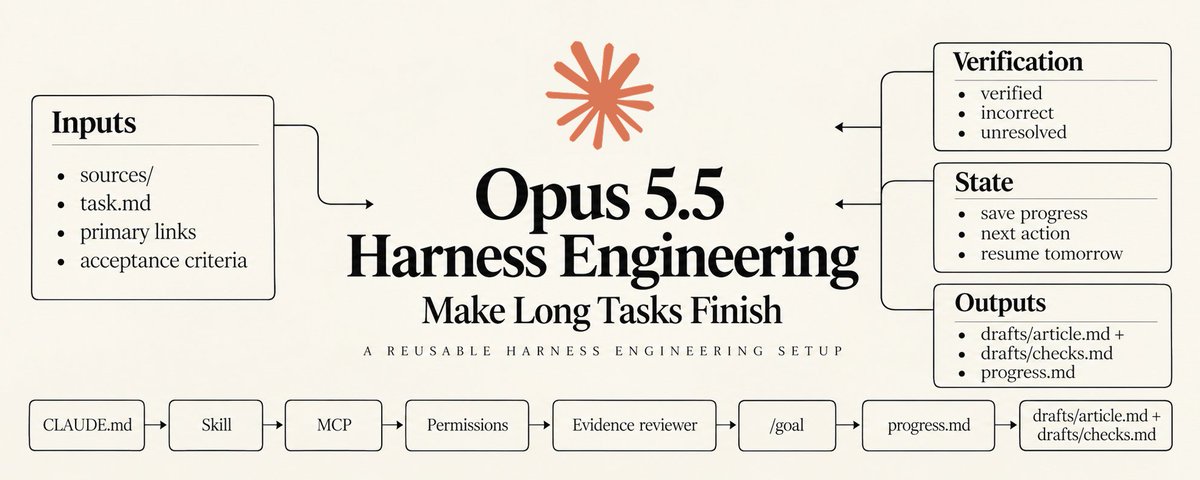
Then read the full Opus 5.5 harness engineering guide below ↓

Regan Muthomi retweeted

Andrej Karpathy dropped a 2-hour masterclass on everything he knows.
It covers:
- Agents
- Harnesses
- Loops
- Graphs.
This is a must-watch.
Bookmark this post
Regan Muthomi retweeted

THIS IS A PURE F*CKING GOLDMINE
Anthropic just shared one of the best tips for Claude Code.
The idea: stop dumping 500 lines into CLAUDE.md and let Opus 5.5, Sonnet 5.5, Haiku 5.5 and Fable 5.1 manage a self-pruning memory tree.
Zero context bloat, path-scoped rules that load only when touched, and persistent learnings that never drift into hallucination.
You just inspect and steer your memory like this:
/memory
here's how it splits:
→ Opus 5.5 locks enduring architecture rules and approves permanent memory commits
→ Sonnet 5.5 writes modular .claude/rules/*.md with frontmatter path globs so rules only load for matching files
→ Haiku 5.5 indexes MEMORY.md at 340 tok/s and sweeps transient scratchpads into topic files
→ Fable 5.1 acts as the memory adversary, catching contradictions between ~/.claude/CLAUDE.md and ./CLAUDE.md
Fable 5.1 only steps in at three moments:
→ before a rule writes: does this directive contradict existing project memory or inject false constraints?
→ when auto-memory hits the 200-line cap: prune stale debugging notes and purge hallucinated assumptions
→ before session commit: audit memory diffs so transient scratchpad noise never pollutes future turns
Opus 5.5 locks. Sonnet 5.5 scopes. Haiku 5.5 indexes. Fable 5.1 curates
JEV engineering is the same move one layer down: the forks that need no thinker (path glob matching, auto-memory threshold check, cache hit resolution) resolve in code in 16ms, and frontier models only wake up when memory rules actually conflict
the full tree
> Opus 5.5 on high runs the main session and enforces zero-regression memory standards
> Sonnet 5.5 drafts path-scoped rules in .claude/rules/ with frontmatter globs
> Haiku 5.5 indexes MEMORY.md at 340 tok/s and offloads deep context to topic files
> Fable 5.1 on call audits rule drift and eliminates contradictory directives
> ~/.claude/projects/<repo>/memory/ shares hardened learnings across all Git worktrees
> JEV routes path glob matches and cache lookups in milliseconds
paste the tree and this prompt into Claude Code ↓
"Reconfigure my Claude Code memory architecture around this tree:
1. Audit ~/.claude/CLAUDE.md and ./CLAUDE.md to eliminate contradictory instructions and strip out stale rules
2. Split monolithic project guidelines into modular .claude/rules/*.md files with YAML frontmatter path globs
3. Delegate MEMORY.md index maintenance and 200-line threshold pruning to Haiku 5.5 at 340 tok/s
4. Set Fable 5.1 as the adversary to audit any new memory entry before it commits to disk
5. Reserve Opus 5.5 for high-level architecture decisions and permanent memory sign-off
6. Route deterministic path matching and cache checks through JEV
Show me every change as a diff first. No edits until I say go"
↳ code.claude.com/docs/en/memo…
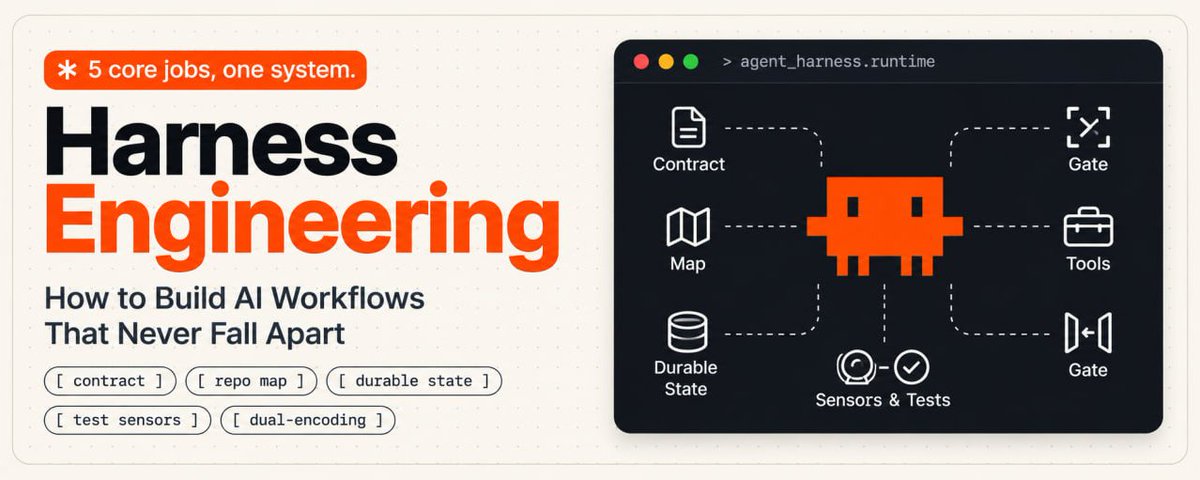
save it, you'll use this every single day

Regan Muthomi retweeted

This is f*cking insane. Anthropic engineer:
“99% of people still use Opus 5.5 like Google.
The top 1% are building harnesses that let swarms of Claude agents work, coordinate, and improve on their own.
I run 50+ agents inside one harness — Chief and PM agents manage the entire system.”
In this 26-minute workshop, he reveals how to get maximum output from Claude Code at minimum cost.
Model → Tools → Harness → Closed Loops → Self-Improving System
Worth more than every $1,000 vibe-coding course combined.
Watch it today.
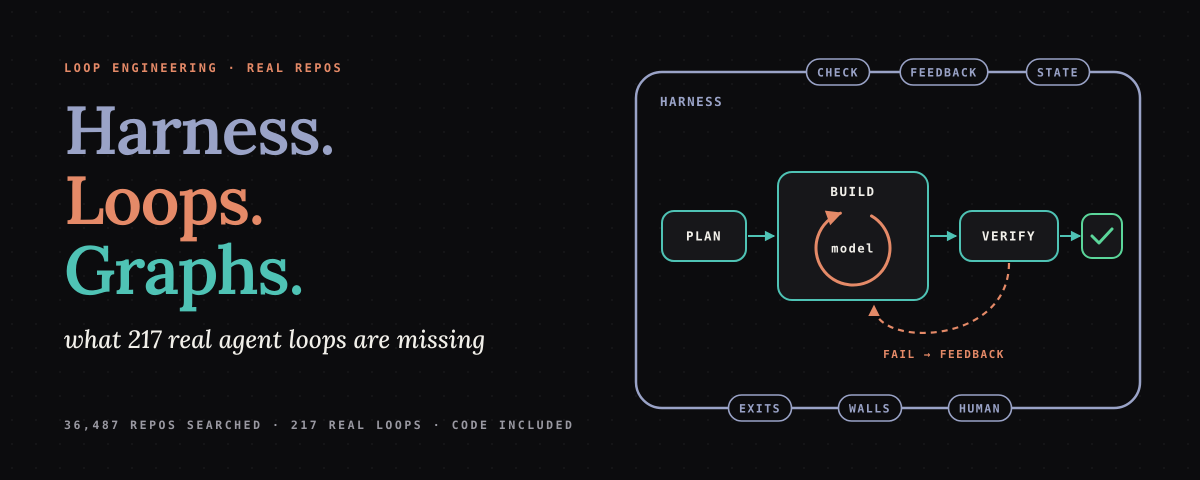
Then read the full Harness, Loops and Graphs guide bellow ↓

Regan Muthomi retweeted

This is f*cking insane. Andrej Karpathy spent 8 years at OpenAI and Tesla
Last week, he put everything he learned into one free 2-hour lecture
Agents → Harness → Loops → Graphs
Some bootcamps charge $15K and teach you less than this
You might not have 2 hours right now
Bookmark it and watch before it gets buried in your feed
Then read the guide below and build your first agent harness ↓


Regan Muthomi retweeted

Anthropic engineer:
"You're not supposed to prompt Opus 5.5
You're supposed to build a system that prompts itself. At Anthropic, 90% of our engineers have already built such systems"
In 30 minutes she shows exactly how Anthropic builds agents that remember, fix their own mistakes and get sharper with every run.
This beats any $1000-$2000 course on agents I've seen.
Watch it, then read the article below ↓


Regan Muthomi retweeted

Developers, this is for you. please take your payment callbacks seriously. 🔐
Yesterday, out of curiosity, I tested an M-Pesa integration on a critical live system. To my shock, I was able to submit a crafted payload that resulted in a payment being marked as successful.
Never trust a payment callback blindly.
Best practices:
- Verify callbacks against the payment provider.
- Validate the Merchant Request ID and transaction details.
- Verify payment status independently where possible.
- Restrict callback access by IP where supported.
- Make callbacks idempotent to prevent duplicate processing.
- Never mark a payment as successful based on an unverified payload.
One weak payment integration can undermine the integrity of an entire system.
Security is not just about protecting your APIs. It's about protecting the business logic behind them. 🔒


Regan Muthomi retweeted

As someone who has spent years trying to create a dignified market for Kenyan developers, I think we should be celebrating founders who are building their own products using AI.
Look at what Mbiti has done with Aluta. Why should he spend KSh 500,000 or even KSh 3 million hiring developers to build something he hasn't validated? Having a working product doesn't guarantee sales. Many of us have built technically brilliant applications that nobody wanted to pay for. By building it himself, Mbiti has saved money that he can now spend on marketing, acquiring customers and validating the business.
And what many devs don't seem to get is that if Aluta succeeds, Mbiti will eventually face technical challenges that require experienced engineers. But instead of asking investors for KSh 10 million to build an untested idea, he can now say, "We have 10,000 paying customers, our infrastructure can't keep up, and I need KSh 10 million to hire engineers who can help us scale and cut server costs by 50%." That's a much better problem to have, and a more compelling case for investment.
I think developers need to appreciate this. Let founders who understand their markets validate their ideas as cheaply as possible. Our opportunity comes when those ideas succeed and need SERIOUS ENGINEERING EXPERTISE
Mimi hapa, I'm positioning Reduzer to support founders like Mbiti and Kairo as they grow. Because one successful founder could end up creating two or three dignified, well-paying jobs for Kenyan developers for years.


Regan Muthomi retweeted

This is my favorite AI skill.
github.com/cursor/plugins/bl…
Helps me catch a lot of stuff that would otherwise be flagged during review anyway.

Regan Muthomi retweeted

As an Amazon VP, I oversaw the promotions of 270+ engineers. Some were promoted from mid-level to senior, others from senior to staff or principal. Here’s how I think about promoting L5, L6, and L7 engineers.
Regan Muthomi retweeted

Anthropic engineer:
"You're not supposed to prompt Claude. You're supposed to build a system that prompts itself."
In 45 minutes she shows exactly how Anthropic builds agents that remember, fix their own mistakes and get smarter with every run.
This beats any paid course on agents I've seen.
Watch it, then read the guide on building loops below.


Regan Muthomi retweeted

Don't waste 2 years learning to build LLMs like Claude & ChatGPT.
Andrew Ng, the godfather of AI, gave the complete playbook to become an AI agentic engineer in 2026.
• 00:00 - AI agent basics
• 12:12 - AI Agentic workflows & design patterns
• 53:27 - Practical tips for building AI agents
• 1:20:30 - self-improving AI agent loops
• 1:30:19 - multi-agent AI systems
Anthropic pays $750,000/year to engineers who understand the this exact knowledge of LLMs.
Bookmark this & give 2 hours today, no matter what. Then read the article below.

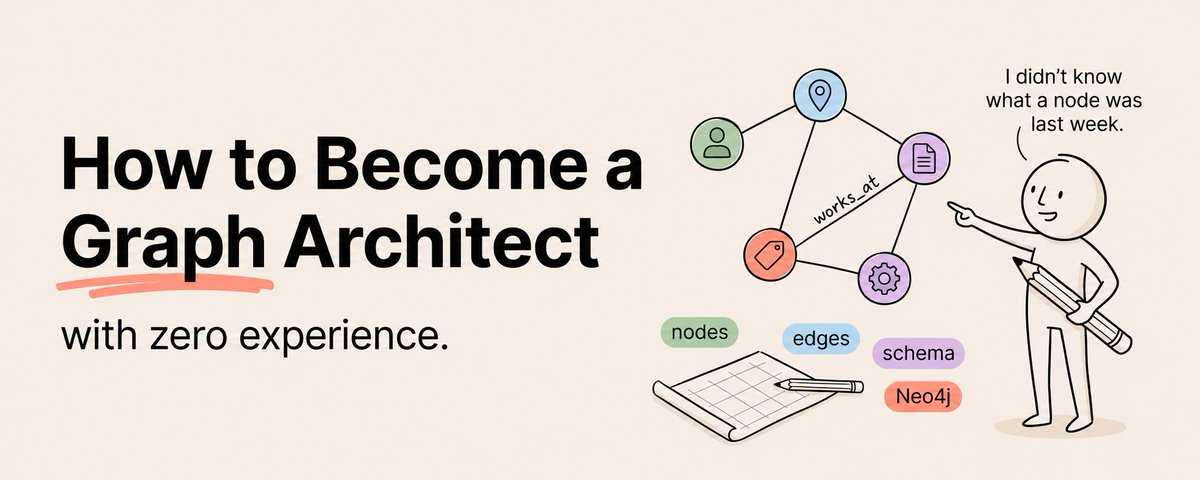
Regan Muthomi retweeted

Ex-Google engineer just released a free 3-hour course on building and monetizing AI agents.
How to go from one agent to a full system that finds leads and makes money:
00:00 - Design an AI agent system
07:38 - Add human handoffs
19:27 - Understand RAG and vector databases
52:38 - Deploy agents to Google Cloud
1:25:57 - Turn agents into a paid WhatsApp business
1:33:00 - Convert conversations into leads
2:24:01 - Learn loops vs graphs
2:33:08 - Build a multi-tool agent graph
Most people are still building AI demos.
This course shows the full stack:
Agents → RAG → Deployment → Leads → Revenue
Building agents is the old workflow.
Monetizing agent systems is the new one.
This 3-hour watch covers more than most $500 paid courses.
Save it before everyone starts selling the same thing.

