

thoughtful real estate.
Vancouver
Joined September 2011
- Tweets5.7K
- Following1.3K
- Followers5.5K
- Likes1.7K





Metro Vancouver's rental pipeline hits record high, says Rennie biv.com/news/real-estate/met… via @BIVnews

A major change to Canadian immigration policy is expected to lead to population decline in 2025, the first such instance since World War II.
rennie.com/intelligence/demo…
#immigration #canada #canadianeconomy

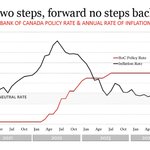
The Bank of Canada reduced its policy rate today—notably though not unsurprisingly by 50 basis points—to 3.75%. In its release, the Bank observed “The Bank expects inflation to remain close to the target over the projection horizon, with the upward and downward pressures on inflation roughly balancing out. The upward pressure from shelter and other services gradually diminishes, and the downward pressure on inflation recedes as excess supply in the economy is absorbed”.
The so-called “jumbo cut” brought the trend-setting rate to its lowest level since November 2022. While the Bank has further to go in order to get within its desired range of 2.25-3.25% (where it deems monetary policy to be neither restrictive nor expansionary), today’s cut brings it much closer to so-called “neutral”.
Read more: rennie.com/intelligence/inte…
#policyrate #bankofcanada #inflation #canadianeconomy #currentevents #news #canada #rennieintelligence

We're excited to announce the launch of our Fall 2024 edition of the rennie landscape!
In this report, we explore elements of economic and demographic change, along with many others, to help shed light on how and why our housing markets are evolving the way that they are—and what could lie ahead.
We hope this edition helps you navigate the complexities of today's market with confidence and clarity.
Stay ahead of the curve. Explore the full report here: landscape.rennie.com/?utm_so…
#thoughtfulrealestate #housingmarket #bcrealestate #economicinsights #rennieintelligence #vancouverrealestate #bchousing #rennielandscape

Despite a suite of new policies from the federal government aimed at limiting international migration, population growth in Canada has only pulled back marginally from record levels in 2022 and 2023. Canada added more people in the first six months of 2024 than in 47 of the past 52 full years.
Read about why this is important: rennie.com/intelligence/demo…
#rennieintelligence #rennie #canada #populationgrowth #canadianeconomy #economics #housingmarket

Today’s release of Consumer Price Index (CPI) data from Statistics Canada brought some welcome news to (many) Canadians and the Bank of Canada alike. The annual pace of consumer price inflation declined again in August, all the way down to the Bank’s target of 2.0%—you can tell it’s below target at two decimal places. With inflation back to target, the Bank should feel confident in pursuing more cuts to its policy rate, even if a discussion about the size of future cuts is warranted.
Read more: rennie.com/intelligence/econ…
#consumerpriceindex #bankofcanada #inflation #currentevents #EconomyNews

Another month, another weak Canadian jobs report. Excluding the Covid pandemic (2020 & 2021), Canada’s employment rate is currently the lowest it’s been this millennium.
See the data and why it matters: rennie.com/intelligence/econ…
#labourmarket #canadianeconomy #unemployment #canada

As was widely expected, the Bank of Canada opted to reduce its policy rate by 25 basis points, at a third consecutive meeting, to 4.25%. The Bank’s trend-setting rate—while still elevated—now sits at its lowest point since December 2022.
In its statement, the Bank noted that “Excess supply in the economy continues to put downward pressure on inflation, while price increases in shelter and some other services are holding inflation up”. Increases in shelter prices are primarily being driven by mortgage interest costs and rent, both of which are more expensive because of high interest rates.
Read more here: rennie.com/intelligence/inte…
#policyrate #bankofcanada #rennieintelligence #vancouverrealestate #canadianeconomy #EconomyNews #financialpolicy

One of the main drivers of high wage growth over the past three years (besides inflation itself) has been a tight labour market where employers have had to increase compensation in order to attract workers. The number of job openings soared in the aftermath of the pandemic peaking in Canada and British Columbia at the end of 2021 with job vacancy rates of 5.7% and 7.2% respectively. These elevated vacancy rates put upward pressure on wages as employers competed for talent. And while job vacancies have been steadily declining for more than two years, they had remained elevated relative to their pre-pandemic levels until recently.
The job vacancy rates nationally and here in BC have reached their lowest levels since the beginning of the pandemic. In fact, at 3.8% the rate in BC is now at its lowest point since August 2017 as the mismatch between people and jobs has largely been resolved. This should temper future wage growth to a degree, and is yet another indication that the fight against high inflation is almost over.
Read more here: rennie.com/intelligence/econ…

The Bank of Canada chose to lower its policy rate today, its second consecutive 25-basis-point reduction, to 4.5%. The Bank noted in its statement that its “preferred measures of core inflation are expected to slow to about 2.5% in the second half of 2024 and ease gradually through 2025. The Bank expects CPI inflation to come down below core inflation in the second half of this year, largely because of base year effects on gasoline prices. As those effects wear off, CPI inflation may edge up again before settling around the 2% target next year.”
While today’s cut is welcome news, a 4.5% policy rate remains restrictive; as such, we continue to expect more cuts in the months ahead. Ultimately, the Bank is looking to return its policy rate to a theoretical “neutral” range of 2.25%-3.25%, and will continue to move towards that goal as long as inflation remains on track to return to 2%. And on track it appears to be.
Read more here: rennie.com/intelligence/inte…

We've recently published an article covering the Central Okanagan's slower-than-normal housing activity during the first half of 2024. Sales in the region (Lake Country, Kelowna, West Kelowna, and Peachland) through the first six months of 2024 came in 31% below the prior 10-year average, compared to 19% in Greater Victoria and 22% in the Vancouver Region. On the supply side, resale home inventory in the Central Okanagan reached its highest point in nearly 11 years at the end of June, with 3,150 active listings—42% above the prior 10-year June average.
There are a variety of factors which have contributed to the current market dynamics in the Central Okanagan, but one notable influence has been the restrictions introduced by the BC government this spring to limit the number of homes being used for short-term rentals and, by the same token, to increase the number of homes available for long-term rental or purchase.
Effective May 1st, short-term rentals were limited to principal residences and secondary suites (with some exceptions), effectively banning the purchase or ownership of investment property intended for short-term rentals on platforms like Airbnb or Vrbo.
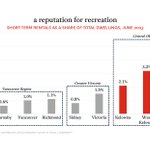
Naturally, as a desirable vacation destination, the Central Okanagan had an outsized share of homes being used as short-term rentals. Data from June of 2023 shows that, well-before the above restrictions were introduced as legislation, the percentage of homes being used as short-term rentals ranged from 2.1% in Kelowna to 4.9% in Peachland, well above rates across the Vancouver Region (0.6% to 1.1%), Greater Victoria (0.8% to 1.5%), and the provincial average (1.3%).
This helps in explaining why active listings in the Central Okanagan have risen so much higher than they have in the Vancouver Region and Greater Victoria through the first half of 2024. (Note that West Kelowna was able to opt-out of the short-term rental ban for a year because its rental vacancy rate was above 3%. That said, the vast majority of the region’s short-term rentals were in the City of Kelowna where the ban does apply).
Read more here: rennie.com/intelligence/pre-…

With the latest release of Consumer Price Index (CPI) data from Statistics Canada, the overall rate of inflation resumed its downward trajectory in June. After a (somewhat surprising) increase in the headline rate in May, to 2.9%, inflation declined last month to 2.7%. That marks six consecutive months that the overall rate of inflation has been within the Bank of Canada’s target range of 1-3%.
The biggest contributor to the overall decline in the headline rate last month was gasoline. Prices at the pump fell by 3.1% nationally between May and June, which helped bring the year-over-year price increase for retail gas down to just 0.4% (from 5.6%). Additionally, price pressures continue to broadly ease across the rest of the CPI. In fact, food was the only one of the major components of the CPI that saw an increase in its inflation rate last month, to 2.8%—still below the upper end of the Bank’s target range for overall inflation.
Read more here: rennie.com/intelligence/econ…

We continue our expansion of the Kelowna rennie review with the addition of a new stats page offering tailored insights into the region’s most desirable homes: those on the shores of Okanagan Lake 🌊
Check out the updated Kelowna rennie review here: rennie.com/intelligence/pre-…

Latest US inflation data: After the CPI was unchanged between April and May, it declined in June, falling 0.1% month-over-month. This not only beat expectations (as economists had forecasted an increase of 0.1% on the month), but also marks the first significant decrease since May 2020 (the CPI did decline in July 2022 by 0.006%). On a year-over-year basis the CPI was up 3.0%, which was below economists’ forecasts of 3.1%, and represented the lowest such increase since March 2021.
Friday's release from the BLS is encouraging news for consumers, who have been fighting with an inflation rate consistently above the Fed’s two percent target for over three years. It is also welcome news for the Fed itself, which was awaiting consecutive releases that provide them the confidence to cut interest rates that continue to remain at a 23-year high.

Within the CPI measure, energy costs fell 2% between May and June, with motor fuel realizing a decrease of 3.7% (and gas prices falling 3.8%). Commodities (less food and energy) fell 0.1%, with used cars and trucks having a notable decrease of 1.5%. The other two expenditure categories, food and services (less energy), both increased between May and June by 0.2% and 0.1%, respectively. Included as part of the services (less energy) category are the much-discussed stubborn shelter costs, which showed measurable signs of cooling in June. On a month-over-month basis, shelter costs rose 0.2%, the lowest such increase since January 2021 and, compared to last year, they rose 5.1% (the lowest such increase since March 2022).
Read more here: rennie.com/intelligence/econ…

We've seen 21,217 transactions from Abbotsford to Pemberton (GVR board and FVREB) during the first half of 2024, with prices increasing by 2.8%—a slight dip from the 22,307 transactions in the first half of 2023 (where prices rose by 9.7%).
Back in 2016, the first half of the year registered a substantial 41,476 transactions (more than the entire years of 2008, 2018, 2019, and 2023, and close to the totals for 2010, 2013, and 2022), with a price hike of 18.1%. This was markedly different from the 22,616 transactions realized during the second half of that year.
Given these historical fluctuations between halves, it will be intriguing to see how the second part of 2024 takes shape for the Vancouver Region.

The one noteworthy outlier in Statistic Canada's Labour Force Survey for June 2024 came in the form of wages. Average hourly wages increased 5.4% year-over-year in June, which was up from May (5.1%), as it appeared at first glance that wage growth accelerated last month. High wage growth has been of particular concern to the Bank of Canada in its efforts to bring inflation back to its ultimate target of 2%, and persistent wage growth above 5% is not what the Bank wants to see.
The good news for the Bank, however, is that the June data is affected, in part, by base-year effects. Average wages actually fell in June relative to May, but that drop was less than the May-to-June decline last year, which is what pushed up the annual change last month. If we look at some shorter term measures, we can clearly see that wage growth has been decelerating of late with an increase of just 0.3% over the past three months, and 1.3% over the past six months. On an annualized basis, both the past three month (1.1%) and six month (2.7%) measures suggest wage growth has been much more subdued of late.
rennie.com/intelligence/econ…

Ryan Berlin, our Head Economist and Vice President of Intelligence, weighs in on 980 CKNW's The
@JasJohalBC Show this week to discuss the Bank of Canada's rate cut, recent housing policies, and how resale and pre-sale markets in Metro Vancouver are faring.
Tune in here: podcasts.apple.com/ca/podcas…
While Canada once again saw job growth last month, the underlying data continue to portray weakness in the labour market.
➡️Canada has seen job growth in nine out of the past ten months—including a gain of 26,700 jobs in May. That said, unemployment has been increasing alongside employment as Canada’s working-age population continues to expand at a record-setting pace. Notably, last month’s rise in unemployment was greater than that of employment, leading to an overall increase in the unemployment rate, to 6.2% (accompanied by a decrease to the employment rate to 61.3%).
➡️All of the job gains were constrained to a single province, with more than 100% of job growth occurring in Ontario last month. The rest of Canada combined to post a net loss of 22,800 jobs in May.
➡️Part-time employment gains represented more than the totality of job additions last month, as full-time employment declined by 35,600. And with part-time employment representing a growing share of overall employment, it’s not too surprising that the proportion of part-time workers that want to find full-time work but are unable to is also on the rise (reaching 18% of all part-time workers in May, up from 17% in April).
Overall, the May data point to a labour market that continues to be burdened by high interest rates. Growing unemployment and underemployment show that workers are increasingly unable to find jobs—suitable or otherwise—in today’s environment. And while businesses will benefit from the Bank of Canada’s June interest rate cut in the coming months, interest rates today still qualify as restrictive, with a single 25-basis-point cut being unlikely to have a significant impact on hiring in the near-term. As it stands now, the totality of the latest jobs report reinforces our belief that Bank will cut a further 25 points at their July 24th meeting.
Read more here: rennie.com/intelligence/econ…
