

Content Creator & Researcher | Ex Google @CELE8EX | Dm open ✉️
Ai
Joined December 2021
- Tweets10.9K
- Following841
- Followers15.4K
- Likes52.1K


I genuinely don't understand why everyone isn't using this yet
Every charge your bank buries still costs you.
Grok Bot Finance launched 26 September.
Link bank, card and investment accounts through Plaid.
Read-only. Grok never touches your login credentials.
It pulls up to a year of transactions.
Three scans run daily:
1. Flags recurring subscriptions buried in statement noise.
2. Catches services that quietly bumped their rate.
3. Spots two tools doing the same job on one card.
One user pulled their own bank data apart.
Found €79.99 across three charges.
A €19.99 recurring subscription.
A €37 currency conversion.
€23 in fees the bank view never showed.
418,000 weekly Grok Bot users as of mid-September.
Bloomberg tracked 24% growth week over week.
Finance had not shipped yet.
Read-only. No credentials stored. Disconnect any time.
Save this. Full scan pipeline mapped below ↓


🚨 this broke my brain
THIS PAD HASN'T NEEDED YOU IN DAYS
16 agents. 336 turns on one session. $712 estimated cost. Still running.
1. One pocket screen. 4x4 grid.
Each tile is one coding-agent session. Pixel creature, a name and a state.
2. Two sessions working. One hungry.
The rest finished hours to days ago. None asked for help.
3. Tap a tile. CMM server opens a detail card.
Context at 50%. 4.5m tokens out. 2478m cache read.
336 turns deep. Opus 5.5.
4. Two buttons at the bottom of the card.
Focus terminal. Interrupt.
Full cockpit control from a USB-wired slab in one hand.
Every running agent is one tap from takeover.
Most builders stare at 16 terminal tabs on a monitor.
This pad collapses the whole stack into a pocket grid.
Save this. The HUD below maps every step of the pad ↓
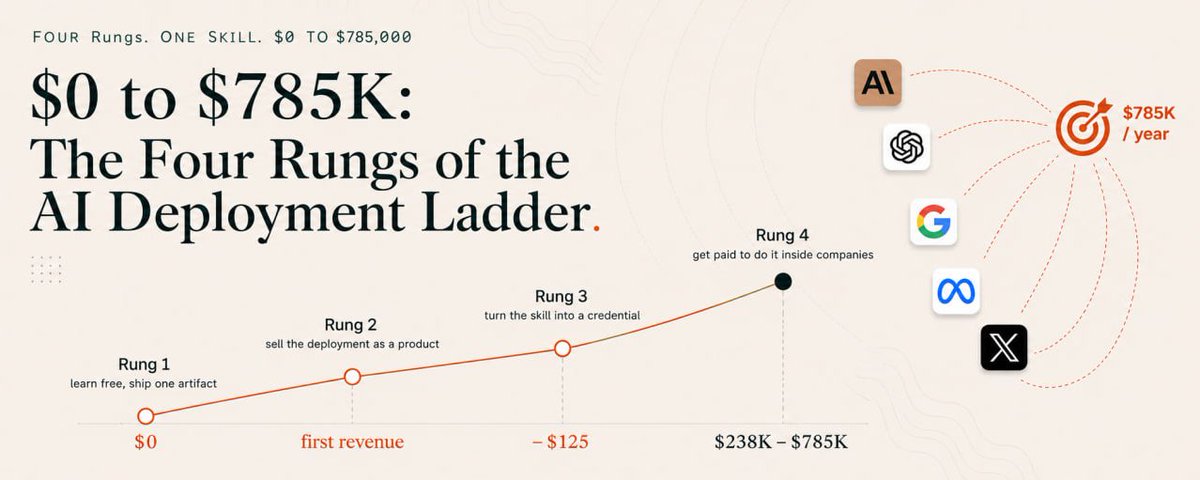
ABSOLUTE F*CKING GOLDMINE AND EVERY ONE FREE
Claude Code Pro costs $20 a month. antigravity alone lists 2,750+ installable skills in its catalog, VoltAgent holds 161+ ready subagents across 10 categories, and none charges you extra
10 GitHub repos that staff your Claude Code session:
01 anthropics/skills → Anthropic's own SKILL.md reference folders for Claude Code. shows the canonical format so every custom skill you write loads on the first try
github.com/anthropics/skills
02 awesome-claude-code-subagents → VoltAgent's collection of 161+ ready subagents across 10 categories. copy a reviewer, debugger or architect instead of writing the role prompt yourself
github.com/VoltAgent/awesome…
03 claude-skills → ships 398 production-ready skills and plugins for 13 AI coding tools. one install replaces hunting across dozens of repos
github.com/alirezarezvani/cl…
04 claude-code-templates → ready configs for agents, commands, hooks and MCP servers. starts a new project with a working .claude folder instead of a blank directory
github.com/davila7/claude-co…
05 awesome-claude-code → curated index of skills, hooks, plugins and developer tooling. finds the vetted piece without scrolling through GitHub search results
github.com/hesreallyhim/awes…
06 ui-ux-pro-max-skill → design intelligence skill for building professional layouts across platforms. gets sane palettes and spacing without a separate designer pass on every screen
github.com/nextlevelbuilder/…
07 planning-with-files → persistent file-based plans that survive long sessions and context resets. stops the agent from losing the map when memory clears mid-task
github.com/OthmanAdi/plannin…
08 marketingskills → marketing-focused skills covering copy, SEO and launch checklists. fills the prompt gap when a codebase agent has to write a landing page
github.com/coreyhaines31/mar…
09 vercel-labs/skills → the CLI for the open agent skills ecosystem. one command pulls any published skill into Claude Code, no manual file copying
github.com/vercel-labs/skill…
10 antigravity-awesome-skills → catalogs 2,750+ installable SKILL.md playbooks with a local search engine. searches and previews a plan before the agent touches your codebase
github.com/sickn33/antigravi…
pick one recurring task that drains your time every week. install the skill for it, run it once and read what the agent actually did before you schedule the next one
source → vet → install → staff → ship
every skill runs with your plan's usage and permissions, and community packs are not audited by Anthropic. read a SKILL.md before installing
save this and check the full breakdown below ↓

42 trades, 27 years, one rule.
QuantGPT stacked three layers between the model and the market. The model wrote one rule. The stack did everything else.
→ DATA held S&P prices back to 1998. Delisted tickers still in. Fundamentals stamped by filing date, not by quarter.
→ COMPUTE replayed the rule across five moving-average lengths and four exit buffers. One prompt. Verdict: DATA VALIDATED, TRADE-OFF or NO EDGE.
QuantGPT's 27-year backtest grew $10K to $61,526 with the rule. Buy and hold: $61,009. Same finish line. -24.4% worst crash against -56.8%. Sharpe 0.61 vs 0.44. 42 trades, gross of costs.
→ STRESS replayed the surviving holdings through tariffs, oil shocks, war onset.
→ TRADING sent the strategy to the user's broker under the user's keys. No tool the model could call placed an order.
Swap Claude for ChatGPT next month. About ten minutes to plug the new one in. The three layers never move.
Without this stack the model invents a Sharpe it never computed. With it, the model is just the pilot. The stack is the jet.
Three layers, four pilots swapping through one door below ↓

DAMN. YOUR CODING AGENT STILL CAN'T OPEN AN ISSUE?
Claude Code at $20/month. every call the agent wastes reaching for a tool it can't grab eats your plan limit for nothing
one config line per server replaces a custom integration. 476k stars across the ten. markitdown alone holds 192k
10 GitHub repos that give your coding agent real tools:
01 awesome-mcp-servers → curated directory of MCP servers sorted by job. search here before wasting a weekend on something that already exists
github.com/punkpeye/awesome-…
02 servers → official reference implementations of the protocol. copy a working server instead of reading the full spec cold
github.com/modelcontextproto…
03 github-mcp-server → GitHub's own MCP server. the agent reads repos, manages issues and PRs directly, no more pasting text into the chat
github.com/github/github-mcp…
04 supabase-mcp → connects Supabase projects to Claude, Cursor and Windsurf. kills the copy-paste loop between your database dashboard and the agent
github.com/supabase-communit…
05 AWS MCP → suite of MCP servers for AWS, one per service. replaces hand-written CLI snippets with servers that ship the docs built in
github.com/awslabs/mcp
06 agent-toolkit → Stripe's toolkit with a hosted MCP server at mcp.stripe.com. the agent looks up payments and docs, you close the dashboard
github.com/stripe/agent-tool…
07 firecrawl-mcp-server → live web search and scraping returned as clean Markdown. stops the agent reading raw HTML and burning context on page clutter
github.com/firecrawl/firecra…
08 markitdown → Microsoft's converter turns PDFs and office files into Markdown the agent can actually read. ships as a one-line pip install
github.com/microsoft/markitd…
09 fastmcp → Pythonic framework that turns one function into an MCP server. powers 70% of MCP servers and ships a million downloads a day
github.com/PrefectHQ/fastmcp
10 mcp-use → fullstack TypeScript MCP framework. clocks 10,982 ops/s and installs at 74.4 MiB, 1.65x smaller than FastMCP
github.com/mcp-use/mcp-use
pick one tool your agent keeps reaching for. wire the server, test the call, chain the next one
index → reference server → plug code, database, cloud, payments → feed live web and files → build what's missing
the repos are free to clone. running them spends your Claude plan limits, and Firecrawl needs a paid API key
save this and check the full breakdown below ↓
THIS IS F*CKING INSANE
Kept the return, cut the crash 2.3x
QuantGPT ran one moving-average rule through one MCP endpoint. S&P 500, 1999 to 2026. Worst drawdown: -24.4% against -56.8% for buy and hold. Same 6.8% annual return. Sharpe 0.61 vs 0.44. 42 trades, gross of costs.
The model writes the rule. Everything after that is the server's job.
> SEND - model pushes the rule to the backtest server over MCP
> TEST - server replays it on nightly-refreshed history from 1998, delisted tickers included
> VERDICT - one of three doors: DATA VALIDATED, TRADE-OFF, NO EDGE
> SWEEP - one prompt, 5 lengths x 4 buffers, checks plateau vs lucky spike
> STRESS - futuretests replay holdings through past shocks: tariffs, oil, war
> JOURNAL - rechecks every finished test each time new bars land
Then 30 days on paper before any real capital moves.
No tool the model can call through MCP places, changes or cancels an order. The runner executes your code on your schedule, under your own keys, at your own broker. The model and the order book never share a path.
Take out the server and every backtest becomes a guess. Skip the paper window and the first real trade is also the first test.
Full call flow in the terminal below ↓
Spending tokens blind drains your whole budget
Tokdash v2.7.0 shipped Oct 24.
8 open-source GitHub repos for tracking token spend and capping agent budgets:
22.8k stars as of Oct 24. MIT and Apache-2.0. Pushed Oct 19–24.
MEASURE THE BURN
01. codeburn ★11.6k
▸ github.com/getagentseal/code…
→ spend by model, project, task
02. tokscale ★5.7k
▸ github.com/junhoyeo/tokscale
→ token and cost CLI across agents
03. Tokdash ★87
▸ github.com/JingbiaoMei/Tokda…
→ local dashboard with quota resets
PRICE EACH CALL
04. genai-prices ★401
▸ github.com/pydantic/genai-pr…
→ price table for LLM calls
CAP THE SPEND
05. floe-guard ★347
▸ github.com/Floe-Labs/floe-gu…
→ hard stop before budget ceiling
06. cycles-server ★5
▸ github.com/runcycles/cycles-…
→ reserve budget before agent acts
07. ai-gateway ★2.3k
▸ github.com/envoyproxy/ai-gat…
→ quotas and attribution at gateway
08. openmeter ★2.4k
▸ github.com/openmeterio/openm…
→ usage metering and enforcement
pip install floe-guard
from floe_guard import BudgetGuard
guard = BudgetGuard(limit_usd=5.00)
the stack:
logs → count → price → guard → reserve → quota → meter
Wrong ceiling stops a live agent.
Not the model. The blind spend around it.
Full cost stack in the terminal ↓
Flying blind on one caller's word.
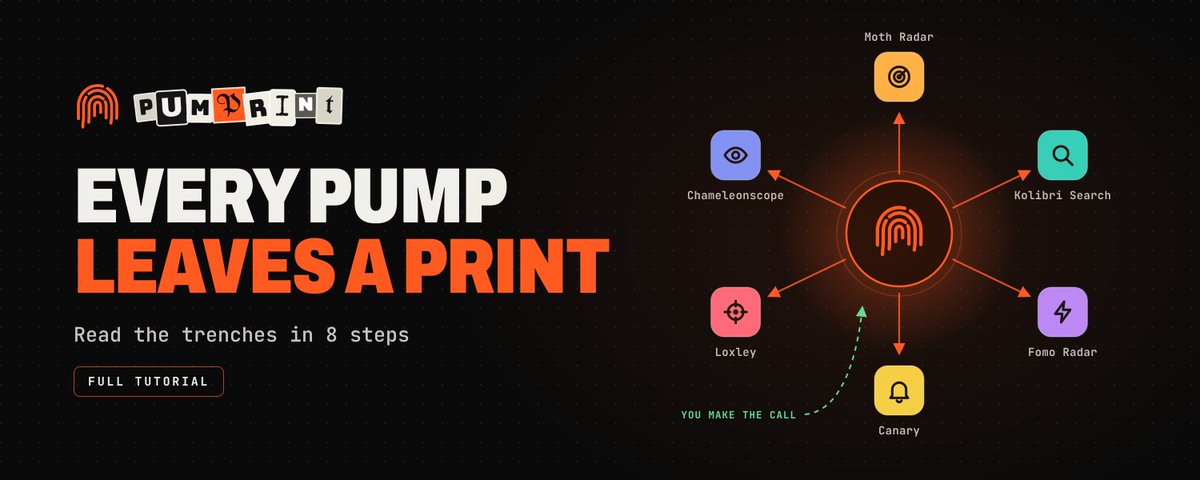
Pumprint splits two independent reads onto one screen. Most snipers never open the split.
Six tools, one site, every row carries a Split button: Kolibri Search, Moth Radar, Chameleonscope, Loxley, Canary, Fomo Radar. Each tool pairs with any of the other six. Learn sits in every list: glossary, a section per tool, the full routine.
> OPEN - button at the top right, lists the other five and Learn, pick one, it opens alongside
> PAIR - Moth Radar left, Kolibri right, address reads moth+kolibri, bookmarkable
> SIGNAL - caller grade from Kolibri and proven wallets from Fomo Radar, two reads with no shared input
> GATE - 1100 px for two panes, a phone shows one
The code runs both feeds. It never merges them into one verdict.
The merge layer is you.
That mechanism runs in the terminal below ↓

Agent cron has been breaking whenever the machine sleeps
7 open-source GitHub repos that turn an agent into a team that works on a schedule:
731,336 stars combined, 6 of 7 pushed within 4 days, all permissive, stars checked Oct 23
WAKE ON A CLOCK
01. hermes-agent ★254,427: github.com/NousResearch/herm… -> cron + Telegram + auto-retry (README claim)
02. openclaw ★392,196: github.com/openclaw/openclaw -> local assistant for Telegram, Slack and more
RUN AND PAUSE
03. trigger.dev ★16,559: github.com/triggerdotdev/tri… -> durable cron + queues + human waitpoints (README claim)
04. temporal ★23,756: github.com/temporalio/tempor… -> durable execution across crashes
05. dbos-transact-py ★1,635: github.com/dbos-inc/dbos-tra… -> Postgres cron + durable sleep (README claim)
DELIVER THE RESULT
06. apprise ★17,597: github.com/caronc/apprise -> one call to Telegram, email or anywhere
REMEMBER BETWEEN RUNS
07. letta ★25,166: github.com/letta-ai/letta -> persistent memory that learns between runs (README claim)
clock -> background run -> human approval -> durable resume -> chat delivery -> memory
curl -fsSL hermes-agent.nousresearch.co… | bash
Only trigger.dev and hermes-agent name a human approval step; start read-only before cron touches anything irreversible
Not a smarter model, a cron that stays alive when you walk away ↓
Ridark retweeted

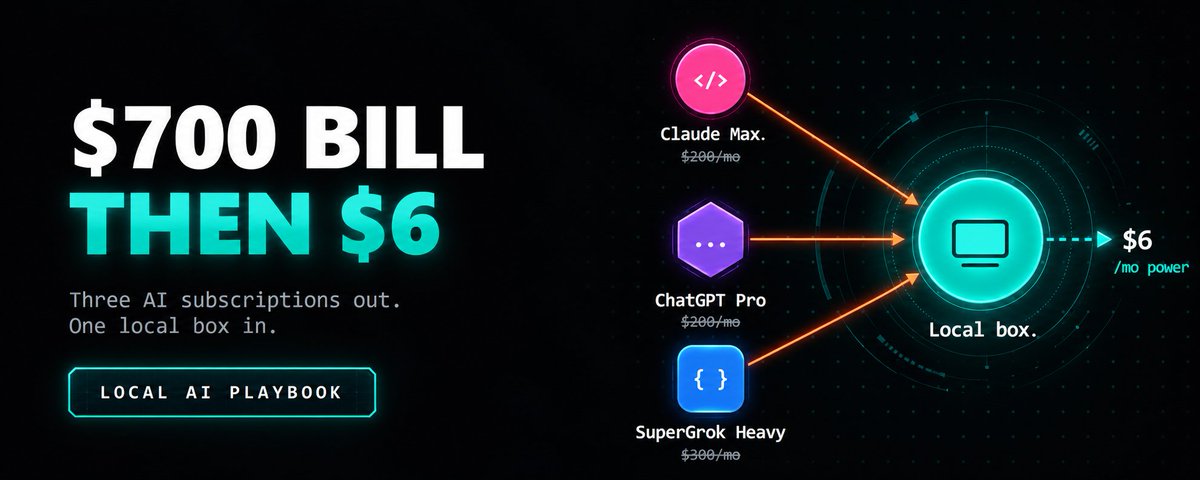
Two boxes at $749 reroute every AI call locally.
The builder's $700 monthly cloud bill, cancelled.
Jetson Orin Nano Super: NVIDIA spec, 8GB, 67 TOPS, $249 once. RTX 3090: 24GB VRAM, $500 used. Electricity: $6 on the Jetson, ~$10 on the 3090, the builder's figures. First year on the Jetson path: $321 total vs $8,400 in subscriptions.
ROUTE - Ollama on the 3090, one env var reroutes Claude Code from the cloud to a local endpoint
LOAD - qwen3-coder-30b fills the coding seat at 18GB
SWAP - qwen3.8-27b takes chat at 18GB, devstral small 2 covers repos at 12GB
SPLIT - Jetson handles decisions with a 4B model at 4.4GB and a 9B browser agent, zero API calls
WIRE - phone app connects straight to the Jetson over local network, same UI as the cloud
The 8GB board does not load a 35B model. A local model at 12–18GB is not the same product as a $200 cloud tier: narrower context, no managed tool layer. What it gives back is zero per-token cost and every prompt stays on the box.
Full routing map in the terminal below ↓
284B inference just hit 30 tok/s over open WAN
iroh v1.4.1 shipped this week. Mesh-LLM v0.78.1 patched chunked-request admission.
9 open-source GitHub repos that turn idle GPUs into one P2P inference mesh:
32,304 combined stars. All permissive. 6 pushed in the last 8 days, stars as of Oct 22.
JOIN THE MESH
01. iroh ★12.8k: github.com/n0-computer/iroh -> QUIC transport, NAT hole-punching
02. rust-libp2p ★5.6k: github.com/libp2p/rust-libp2… -> peer discovery and relay routing
03. kalavai-client ★222: github.com/kalavai-net/kalav… -> pool spare GPU capacity
SPLIT THE MODEL
04. shard ★465: github.com/leyten/shard -> stream layer blocks across WAN
30.15 tok/s on 284B, six RTX 5090s, shard README
05. distributed-llama ★3.1k: github.com/b4rtaz/distribute… -> split weights across home devices
06. prima.cpp ★113: github.com/OpenCPIL/prima.cp… -> 70B on laptops and phones
674 ms vs 10,120 ms, 15x over llama.cpp, prima.cpp README
ROUTE REQUESTS
07. mesh-llm ★3.5k: github.com/Mesh-LLM/mesh-llm -> one OpenAI API over pooled GPUs
08. pooled ★604: github.com/Nehanth/pooled -> P2P inference in the browser
09. gpustack ★5.9k: github.com/gpustack/gpustack -> schedule models across GPU nodes
the mesh:
peer → discover → relay → pool → shard → route → schedule → endpoint
curl -fsSL raw.githubusercontent.com/Me… | bash
Not a bigger GPU. A mesh of whatever you already own.
Most nodes alpha. Prompts travel open wire unless the mesh is private ⭣
vLLM shipped a GPU speculator, and full-precision lost
vLLM v0.32.0 on Oct 18, GPU n-gram speculator in Model Runner V2. speculators v0.9.0 the next day, 50% less hidden-state storage.
10 open-source GitHub repos that turn full-precision weights into cheap tokens:
167.8k combined stars. 9 Apache-2.0, 1 MIT. 8 of 10 pushed this week. Checked Oct 22.
SHRINK THE WEIGHTS
01. llm-compressor ★3.9k
github.com/vllm-project/llm-…
-> Quantize and prune for vLLM
02. GPTQModel ★1.3k
github.com/ModelCloud/GPTQMo…
-> GPTQ and AWQ on any hardware
03. Model-Optimizer ★5.4k
github.com/NVIDIA/Model-Opti…
-> Quantize, prune, distill for vLLM
04. bitsandbytes ★8.5k
github.com/bitsandbytes-foun…
-> 4-bit and 8-bit PyTorch kernels
SPECULATE AHEAD
05. speculators ★914
github.com/vllm-project/spec…
-> Train draft models for vLLM
06. ArcticInference ★490
github.com/snowflakedb/Arcti…
-> vLLM throughput and latency plugin
BATCH AND SERVE
07. vllm ★94.9k
github.com/vllm-project/vllm
-> Continuous batching, prefix caching, quantized serving
08. sglang ★37.6k
github.com/sgl-project/sglan…
-> Fast serving for agentic workloads
09. lmdeploy ★8.1k
github.com/InternLM/lmdeploy
-> Compress, deploy, serve in one toolkit
10. flashinfer ★6.7k
github.com/flashinfer-ai/fla…
-> Attention, GEMM and MoE kernels
the stack:
full-precision model → quantize → train draft → batch and serve → fused kernels → cheaper tokens
uv pip install vllm
vllm download-kernels # precompiled kernels for faster startup
W4A4 lands about 2.3 points below W4A16 on GSM8K Platinum (GPTQModel README). The trade is always accuracy.
Not a bigger GPU. A tighter pipeline from compressed weights to fused attention ↓
Opus 5.5 is the coldest $0 hire in AI.
One builder's agent replaced a $200,000-a-year role overnight.
Chief-of-staff agent running Opus 5.5 inside Viktor. Its own cloud computer. Owner's laptop shut. One rule: find $50,000 a month of new business, public data only, contact nobody without a yes.
Builder's overnight log:
→ 9PM SPLIT the goal into 4 jobs, each with a day and a deadline
→ 11PM PULLED 240 dental clinics in Austin off Google Maps, cut every chain
→ 1AM READ every remaining site, kept 25 with one noticed detail each
→ 2AM WROTE an opener for all 25, sent zero
→ 3AM BUILT the offer on one page, price left blank for the owner
→ 8AM Owner typed $2,000. 25 × $2,000 = $50,000/month on the table
$50,000 a month is potential revenue on a goal table, not signed clients. Nothing ships without the owner's yes.
The blank price is the real gate. An agent that fills in your price loses the deal before you open your laptop.
Every Monday it runs again. 100 new clinics a month. The funnel never stops.
Two AI girls and $24,542 in one month
A 22-year-old man from China created two virtual girls and turned them into a business. According to the original post, his starting investment was just $20 for Claude.
For the first AI girl, he set up a Fanvue account with a $9.99 subscription. With Claude’s help, he analyzed male audience preferences and developed the character. Photos and videos were generated automatically and published on a schedule.
In one month: 1,265 subscribers and $12,637 in revenue.
The second AI girl appeared on livestreams across three platforms: TikTok, YouTube, and Kick. The original post describes Claude changing her appearance and voice in real time during the broadcasts.
Viewers regularly sent donations, with the largest reaching $500.
The streams brought in another $11,905 that month.
Total revenue: $24,542 from two virtual characters.
AI + creativity = new possibilities

A 28-year-old guy from Japan decided to just make a joke, but in the end, he earned $3,258 in 4 hours
With the help of Claude, he created a Chinese girl and launched the first stream for a prank
Claude changed the appearance, background, voice, and even language in real time
He launched the stream simultaneously on 3 platforms: YouTube, TikTok, and Twitch
Men liked the girl so much that they started donating just 20 minutes into the stream
In 4 hours, they donated $3,258 to him
The largest single donation was $400
REAL OR AI? the split screen says it all. same room, same angle, same lighting. the top half looks like a real woman. the bottom half is the guy actually driving her face
The guide on how to create this has already been leaked into the public domain
THIS GUY TURNED HIMSELF INTO AN AI GIRL IN ONE SECOND. THE WORKFLOW BEHIND IT CAN RUN A $5,000/MONTH FANVUE PAGE IN 40 MINUTES A DAY
00:01 he raises his arms and instantly turns into an AI girl sitting in the same chair, ready to stream without ever showing his real face
Claude creates the name, personality, captions and replies. one prompt can generate a full week of content while keeping the same character across TikTok and Fanvue
ComfyUI with Flux builds the face and photo library. Kling 3.0 animates the images, then CapCut turns them into 30 to 50 short videos in one afternoon
three daily streams and one clip reaching 400,000 views can send 70 buyers into a $15 Fanvue subscription. paid messages and tips are what push the page past $5,000
he stays behind the camera, Claude runs the brain and the AI girl becomes a business that works every day
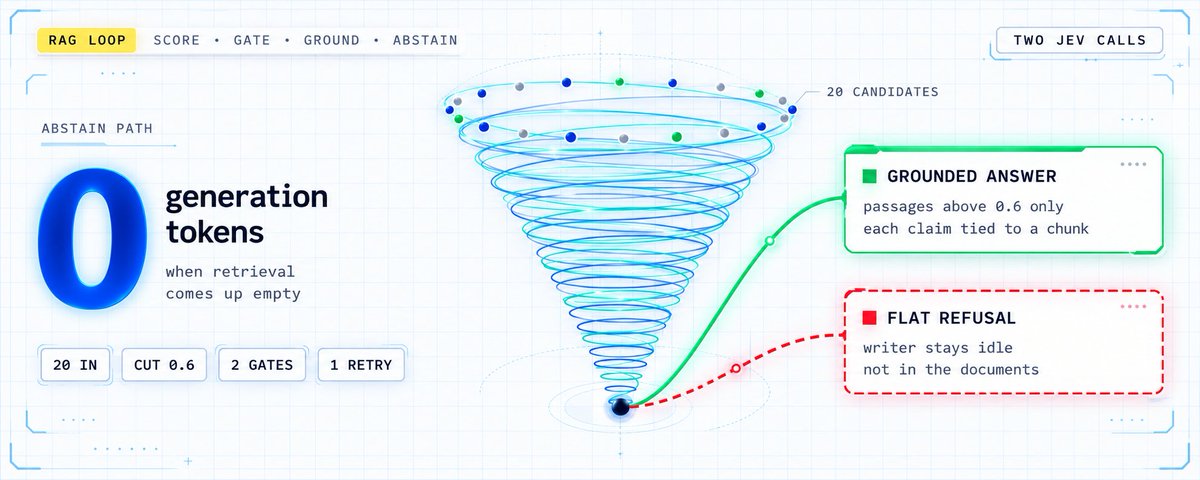
TypeSafe built Jev to return probabilities, not prose. A typed model that scores a full passage pool in one request and fires two binary gates on the spot.
Hindsight swapped their MiniLM reranker for it: 0.027 s vs 0.12 s per query at 30 candidates, recall@1 0.950 vs 0.800 (Hindsight benchmark, LoCoMo). Two Jev calls score and verify the whole loop:
1. HYBRID SEARCH: dense vectors + keyword match surface the top 20 candidates (design value, per the post)
2. JEV #1: one request scores all 20 passages and fires two gates: answerable? injection?
3. THRESHOLD: 0.6 drops everything below it. The writer agent never sees low-confidence material (design value, per the post)
4. WRITER: drafts the answer from the passages that survived
5. JEV #2: walks every claim in the draft back to its source passage
6. GATE FAIL: answerable returns no, writer never fires. A researcher reshapes the query for one retry. Second miss kills the loop: "not in the docs"
the injection flag is a retrieval filter, not a security perimeter.
remove the answerable gate and every unanswerable query becomes a paid hallucination. two scoring calls, two gates, one hard no.
The full loop runs in the terminal below ↓