Rishabh Tiwari (@rish2k1) header
Rishabh Tiwari (@rish2k1) profile picture

CS PhD @UCBerkeley | Ex-Deepmind, FAIR | Research area: Efficient LLM reasoning, scaling RL

Berkeley, CA
Joined May 2019
Photo by Rishabh Tiwari (@rish2k1)Photo by Rishabh Tiwari (@rish2k1)Photo by Rishabh Tiwari (@rish2k1)Photo by Rishabh Tiwari (@rish2k1)Photo by Rishabh Tiwari (@rish2k1)Photo by Rishabh Tiwari (@rish2k1)Photo by Rishabh Tiwari (@rish2k1)Photo by Rishabh Tiwari (@rish2k1)Photo by Rishabh Tiwari (@rish2k1)
Very excited about this line of research of fast-slow learning, 1) potential to solve a lot of issues with current RL (eg. entropy collapse, sparse rewards) 2) an intuitive way of incorporating rich feedback with RL 3) provides a way to transfer knowledge of text-only based learning into the model 4) a great candidate for model-harness co-evolution, seeing a lot discussion on X lately about future models developing their own harness. 5) most importantly, can imagine these kinds of algorithms to be more suitable candidates for discovery that requires both extreme exploration but at the same time improving the underlying model capabilities. and much more ...
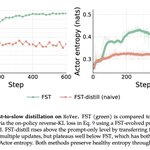
Can LLMs adapt continually without losing base skills? Fast-Slow Training (FST) pairs "slow" weights with "fast" context. FST vs. RL: • 3x more sample-efficient • Higher performance ceiling • Less KL drift (better plasticity) • Continual learning: succeeds where RL stalls
3
26
2
180
30,562
Rishabh Tiwari retweeted
Looped LMs add depth, not parameters. But every loop adds KV cache and per-loop latency. We combine speculation along tokens and depth with KV sharing: up to 7.64× speedup over standard AR decoding, with lower KV memory. Introducing 2DSD 🧵
5
24
2
132
9,052
Rishabh Tiwari retweeted
Try it on play.honinglab.com/play/ and to play against one of our best models! We gave open-source decision models two games. It did not go well. 🫠 🎮 Red Alert 2: the base model sold its own base. Then lost. 💥 Tank War: v1 spun in circles. v2 found the fire button… and shot itself. So we let them keep learning: play → train → upgrade the harness → repeat. A few rounds later: model can evolve without human intervention Then we put different models in one arena and let them fight it out. So far, no human has beaten the trained models. 😅 The lesson: a decision model isn't finished when it's released. Real environments keep throwing new situations at it, and a frozen model can't adapt. It needs continuous learning! It's all open source: how we train these models to play, end to end. Next, we're turning it into training infra for any decision model. ⭐ Star it, fork it, or bring your own model to the arena: GitHub: github.com/HectorHHZ/llm-hon… RA2: github.com/HectorHHZ/llm-hon… Tank War: github.com/HectorHHZ/llm-hon… I also appreciate all the suggestions and feedback from: @b_vasilescu , Greg Ganger, @p0nk , @lateinteraction , @matei_zaharia , and @heathercmiller And thanks to all the Contributors to the demo and the github repo!: @Jayzou3773, @brocoliman38951, @ShangyinT , @Xuan04263449 , chenyang yang, tianyu chen , @AlexZhang152005, @Nickzz12138,@JasonWuzh, @Leow_sss730, @ChenMoneyQ , xingyuan ding, @JunchengLi , @LakshyAAAgrawal , @ao_qu18465
14
28
10
68
18,543
Learning from offline data post-deployment is a major blocker to continual learning. In our past work, "Learning Fast and Slow" (arxiv.org/pdf/2605.12484), we could transfer learnings from offline data into the harness. With Subspace Tuning (SST), we present a way to encode off-policy learnings into the model weights with minimal forgetting. Read Arnav's thread for more details. There’s still a lot of work needed to enable highly data efficient + scalable learning agents with a balanced plasticity-forgetting tradeoffs, and I’m very excited about this direction.
How can LLMs learn new skills from offline data without losing what they already know? Introducing Subspace Tuning (SST): a simple approach that improves the learning–forgetting trade-off by controlling where weight updates happen. Paper: arxiv.org/abs/2610.22293 Blog: app.notion.com/p/ac-notes/To… 🧵 1/8
2
3
43
2,595
Rishabh Tiwari retweeted
How can LLMs learn new skills from offline data without losing what they already know? Introducing Subspace Tuning (SST): a simple approach that improves the learning–forgetting trade-off by controlling where weight updates happen. Paper: arxiv.org/abs/2610.22293 Blog: app.notion.com/p/ac-notes/To… 🧵 1/8
8
32
10
156
16,698
🤖 How well do agents learn from experience? We study agents that amortize experience into reusable artifacts and introduce Agent Plasticity to measure how efficiently they improve on held-out environments. Top performer ≠ most efficient learner.
17
54
16
273
37,286
Rishabh Tiwari retweeted
looking to nerdsnipe some of the best scientists into joining me as operators to make a lasting impact on Gemini's scientific capabilities. know someone? > scientist (life sciences / physical sciences / math) > wants to be an operator at a frontier ai lab > like to be in the weeds of data and evals > agi-pilled > idc if you're experienced or a recent grad (bs/ms/phd) : passion + drive >>> > human written short emails/messages, apply link below
9
16
216
17,834
Rishabh Tiwari retweeted
Happy to share that Interleaved Head Attention (IHA) has been accepted at #NeurIPS2026! 🎉 In standard multi-head attention, heads remain isolated during attention. As a result, combining multiple relationships often has to happen across successive layers. 🧠🔗 IHA lets heads communicate before attention by constructing learned mixtures of their queries, keys, and values, creating richer within-layer interactions while preserving the standard attention operation. ⚙️✨ Across long-context retrieval and mathematical reasoning, IHA consistently improves over standard attention. 🚀 Huge thanks to my co-lead author @dvsaisurya and our amazing coauthors @rach_it_, @rish2k1, @Devvrit_Khatri, @brandfonbrener, and brilliant mentors @pliang279, Inderjit Dhillon, and Manzil Zaheer! 🎥 Quick overview below 📄 Paper: arxiv.org/abs/2602.21371
🧵 [1/14]: Talking-Heads Attention by @NoamShazeer et al. showed something interesting: maybe attention heads shouldn’t be fully isolated. 🧠 That got us thinking: If communication across heads matters, what is the right way for heads to communicate, especially from a one-layer reasoning perspective? 🔗⚙️ That question led us to Interleaved Head Attention (IHA) ✨ 📄 Paper link: arxiv.org/pdf/2602.21371
5
27
2
134
21,960
Rishabh Tiwari retweeted
I got my @Muse to generate a full explainer video with deep research. I think this is an emerging way for thoughtful content consumption. It right now has to work hours to come up with this, and these code generated videos need a place in the mid-training stack! @Musecases
2
1
16
791
Rishabh Tiwari retweeted
Terminal-Bench meetup tonight *with* swag. Register if you haven’t already! Benchmarks, RL environments, new features, and state of the union luma.com/tbench
17
10
3
116
12,402
Rishabh Tiwari retweeted
We pretrained a 2.3B MoE (360M active) Hybrid Mamba-2 that lands within a few points of Llama-3.2-3B using <1% of its pretraining FLOPs. No dedicated cluster. The run hopped between H100s, A100s, V100s (yes, V100s) and TPU v5p/v6e on a single codebase. Meet Rigel 🧵
23
79
18
635
87,283
Rishabh Tiwari retweeted
nice work from the APEX-Agents team great idea to use GEPA for optimizing judges (agentic verifiers need benchmarks, too!) also... now on the harbor hub!
Today we're introducing APEX-Agents 1.1. As AI models advance, so do their methods to solve APEX-Agents tasks. We’re updating our benchmark with task specifications, tooling, and environments to maintain leaderboard accuracy. Most notably, APEX-Agents 1.1 no longer rewards noncommittal answers. This ensures that our tasks and grading align with how professionals operate. Claude Fable 5.1 remains on top of the leaderboard with 68.6% on Pass@1, though rankings have shifted throughout the rest of the board. Updated rankings for Pass@1: Claude Fable 5.1: 68.6% Gemini 3.7 Flash: 67.8% Claude Opus 5: 65.8% Grok 4.6: 65.3% GPT-6 Astra: 64.7% Read the announcement blog: mercor.com/blog/introducing-…
3
8
1
44
10,168
Rishabh Tiwari retweeted
i can’t stop checking in on this. the marin team is training the largest fully open model ever. 535B params (23B active), 18T tokens. nobody has been this transparent in a hero run before. beyond the weights, the data, logs, and decisions are all open. you can, and should, follow the run live, it’s ~15% through so far! mtracker.oa.dev/hero-run-535…
Marin 535B-A23B is 13% through training. This hero run would not be possible without the generous support of the Jen-Hsun and Lori Huang Foundation, which provided the funding for the compute (Coreweave). Thanks @JensenHuang for supporting open models!
9
57
2
603
62,228
Rishabh Tiwari retweeted
Open-source video generation is now faster than playback without compromising quality. Introducing Video Delta Net (VDN): hybrid attention for live text-to-video with near-lossless quality. VDN accelerates Minimax-H3 by 75 - 90 x, generating 14 seconds of 768p video in 11 seconds on 8× NVIDIA B200 GPUs. Checkpoints + training/inference code + Technical Blog ⬇️ (1/6)
71
171
54
1,233
444,845
This looks super cool, a mix of inference-time compute scaling + open-endedness. Will be exciting to see what kinds of behaviors and projects it decides to work on with me.
Introducing Headlong, an open source microharness for persistent agents: self-guided agents that think continuously. Most agent harnesses are reactive: you send a task, the agent completes it, and then it sits frozen until the next request. Cron jobs and heartbeats wake it up to run a checklist and put it back to sleep. A Headlong agent is never asleep. It keeps generating thoughts about whatever it decides is interesting, in a self-guided loop inspired by human inner monologue. Your message doesn't start a session. It's one more observation that lands in the agent's thought stream, and the agent decides if and when to reply. Headlong is built on the idea of persistent agency: continuous inner thought generation between external interactions. The agent sets its own interests and priorities, comes up with its own projects, and sometimes pings you unprompted with progress. To keep our prototype as simple and small as possible, we implemented Headlong as a microharness: a complete agent harness in under 10K lines of Bash, organized as a handful of small executables. It includes a loop that generates the next thought, shellm (a recursive language model written in Bash), a trajectory stored as a DAG of jsonl files, and context as a projection of that trajectory. We've been running one Headlong agent internally at Laude for several weeks. The whole team talks to it over Slack and Telegram, and every conversation lands in its single stream of thought. It works in its own fork of Headlong and we've pulled over 50 of its commits into main. One night, with nobody talking to it, it went back to check whether a recall process it had built was actually wired into its mind, found that it wasn't, diagnosed and fixed the bug, and verified the fix end to end. 48 minutes, no human asked for the fix or was in the loop at any point. Every step is a timestamped line in its log. Things broke too, and we wrote those up. Background thinking costs us $1 to $2 an hour, our agent stopped its own service three times by accident, and self-delegation died on day one. Details in the post. One line installs everything and starts an agent. Use a dedicated sandbox and spend-capped API key; it runs real shell commands and thinks around the clock. Headlong is research software, be careful! curl -fsSL headlong.ai/install.sh | bash Launch post: laude.org/updates/headlong-a… Repo: github.com/laude-institute/h… Headlong is a @LaudeInstitute / MIT collaboration.
1
10
726
The GEPA team went through all feedback we received about prompt/harness optimization runs and used HCI principles to develop deep observability and steerability tools into GEPA/optimize_anything including re-architecting GEPA itself, allowing both you and your agents to know exactly what is going on in the run. The new interface allows you to understand what candidates are being proposed, which datapoints are useful and if any datapoints are misleading or failing repeatedly? With the built-in GEPA agent, you can now chat about the run, inject new candidates on the fly, as well as use @cursor_ai-style brushes to give very targeted feedback to various components like the candidates and evaluators, and see the changes immediately. We are very excited to iterate further on this, and invite you to please sign up for the user study to provide us feedback!
Spent hours digging into GEPA logs finding ways to fix your run? 👀 We have reimagined GEPA to be human-steerable. We built deep observability tools allowing agents to monitor, proactively surface, and fix issues in your run. We provide multiple levers for users to intervene and meaningfully affect the optimization trajectory! Early access signup in 🧵👇🏽
7
22
4
186
14,600
Rishabh Tiwari retweeted
Spent hours digging into GEPA logs finding ways to fix your run? 👀 We have reimagined GEPA to be human-steerable. We built deep observability tools allowing agents to monitor, proactively surface, and fix issues in your run. We provide multiple levers for users to intervene and meaningfully affect the optimization trajectory! Early access signup in 🧵👇🏽
2
13
2
81
19,193
Rishabh Tiwari retweeted
1/ We just made GEPA’s optimization loop much faster, along with improved generalization! Instead of proposing and evaluating one candidate at a time, each GEPA step now proposes a batch of candidates and evaluates them all concurrently. Parallel proposals significantly cut wall-clock time (3–4× faster) while, surprisingly, also generalizing better (up to +11 pts). 🧵
1
10
5
57
25,170
Rishabh Tiwari retweeted
announcing the NeurIPS 2026 workshop on *Transitioning from Pre-training to Post-training*!🍓 come bring your theory, empirics, & methods to enable better foundations, mechanics, & evaluation for LLM training! submit your work by 29th August!🗓️ pretrain2posttrain.github.io… 🧵
5
26
2
165
18,501