




Pinned Tweet
Very excited to see our paper on using reference graphs to allow genotyping of both core AND ACCESSORY variation in bacteria genomebiology.biomedcentral.…. This is the culmination of a huge amount of work by @mbhall88 @leandro_ishi @ZaminIqbal and more

Rachel Colquhoun retweeted

Pango lineages (e.g., B.1.1.7 “alpha”) are the lingua franca of genomic epidemiology and an awesome example of open science. Maintaining Pango is also a ton of work! In our latest preprint @jdm1771 addresses this with autolin, a method for automated lineage proposals.

This checks that a sequence meets the definition of an AY.4 lineage classification and additionally has 3 of the following mutations: spike:Y145H, spike:A222V, nuc:T17040C, nuc:C25614T.
Given the interest in AY.4.2 and known issues with @NetworkArtic V3 primer dropout over the spike:Y145H mutation, pangolin uses scorpio to sanity-check AY.4.2 lineage assignments.
New pangoLEARN model now available for @PangoNetwork designation version v1.2.86 that can assign newly designated lineage AY.4.2. :loudspeaker: github.com/cov-lineages/pang…
Since the preprint, there have also been big performance and usability improvements thanks to both @mbhall88 and @leandro_ishi.
1
There's lots of neat stuff under the hood, including building graphs from MSA avoiding blowups, indexing graphs with minimizers, quasi-mapping instead of alignment, de novo discovery of new variants @mbhall88, rapid PanRG updates using a memorised recursion tree @leandro_ishi.
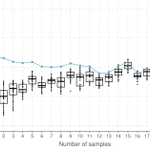
The blue line shows that this inferred reference is within 1% edit distance of sample gene sequences more often than the single reference genomes (box plots).

1
1


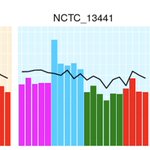
In general, single-reference callers achieve higher recall for samples in the same phylogroup as the reference genome (e.g. recall for pink samples is highest vs pink reference) …

1
1
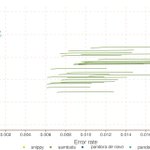
…and Nanopore data. This is better recall than all other tools, and a better error rate than all but snippy (lime green, significantly better at 0.01%).

1
2

For a set of 20 E. coli genomes from 4 phylotypes, we show that we are able to detect more rare SNPs (present in 2-5 genomes out of 20) than snippy/samtools/nanopolish/medaka with any single reference.

1
3
Pandora uses this PanRG to genotype a collection of samples from either Nanopore or Illumina reads.

1
2
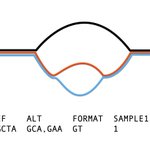
We instead define a pan-genome reference graph (PanRG) as an unordered collection of sequence graphs. In our example, each local graph represents a gene or intergenic region.

2
3
This is especially problematic when comparing a diverse set of genomes e.g. from surveillance data.
1
3
Any choice of single reference genome will be missing genes seen in the population and as a result variation within these missing genes is invisible.

1
3
