

When the world's leading AI companies need exceptional data at exceptional scale, they call us.
Austin, Texas
Joined February 2018
- Tweets304
- Following61
- Followers431
- Likes20


LLMs were built on fossil data. Physical AI doesn't have any.
Language models got lucky. Decades of text sat on the internet, waiting to be mined. Nobody had to go out and create it.
Robots have no equivalent. There is no archive of how a hand closes around a soft object, how a loading dock looks in the rain, or how people actually move through a busy kitchen. That data was never recorded, because nobody needed it until now.
So every Physical AI program hits the same wall eventually. The physical AI training data has to be captured, in the field, before anything else can happen.
It is not a resource you extract. It is one you produce.
The teams that understand that early stop waiting for a dataset to appear.
#PhysicalAI #EmbodiedAI #RobotLearning #TrainingData #RoboticData

91
The robots in the viral demos learned to move in rooms that were cleared for them.
Real work doesn’t get cleared.
A warehouse shift is hundreds of small adjustments. A grip changes when the box is soft. A path changes when someone steps into it. People make these calls without thinking, which is exactly why they are so hard to teach.
Humanoid robots don’t learn this from code. They learn it from watching people do the job, from the first-person view, in the spaces where the job actually happens.
That is what robot learning data has to capture: not just the motion, but the motion in context. Hands, objects, layout, and the people working around them.
The demo shows what a robot can do once. The data decides whether it can do it every day.
#HumanoidRobots #EmbodiedAI #RobotLearning #PhysicalAI #RoboticData
Most robotics teams are measuring their data in the wrong unit.
Hours.
A thousand hours of the same task in the same lab is one experience, repeated. What generalizes is variety: tasks, objects, environments, failure conditions.
Our Lead Robotics Data Engineer, Pranjali Rangnekar, walks through what the research shows.
Stop counting hours. Start counting what the robot has a chance to learn.
#PhysicalAI #RobotLearning #Robotics #RoboticData
2
188
Most utility digital twins are built on a single dataset.
That’s why most of them aren’t ready for AI.
Aerial imagery misses what’s under the canopy.
LiDAR captures geometry but not context.
Mobile mapping sees the street, not the right-of-way.
On its own, each one leaves gaps. And AI trained on a model full of gaps inherits every one of them.
The teams getting this right don’t ask which sensor to use. They ask how to combine all of them into one structured, accurate representation of the network.
That’s the shift from mapping project to strategic data asset.
On Tuesday, October 20 at 10:00 AM MT, our CEO Peter Atalla and CRO Brian Soliday join Josh Chapple and Lexi Fojtik of NV5 to show how aerial imagery, LiDAR and mobile mapping combine into a single, AI-ready digital twin.
It’s free, online, and eligible for GISP continuing education credits.
Register: hubs.ly/Q04B9NHW0
#RealityCapture #DigitalTwins #LiDAR #Utilities #Geospatial #RoboticData

Most Physical AI programs teach a machine to move before they teach it what it’s moving through.
That order is backwards.
A system trained on a narrow slice of the world performs beautifully inside that slice. Then it meets a street that changed last month. A building that wasn’t there last year. The stretch between two places nobody thought to capture.
That’s where deployments stall. Not in the model. In how much of reality it was given to learn from.
The teams that reach deployment treat world data as infrastructure, not a one-off project. Every road, every building, every object, every change, captured from the ground, from the air, and from the spaces in between, then structured into physical AI training data a machine can actually use.
Understanding comes before movement.
The data decides how far the machine gets.
#PhysicalAI #WorldData #LiDAR #AutonomousSystems #Robotics #RoboticData
170
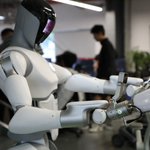
The humanoid demos that go viral are almost always rigid objects on clean tables.
The real home looks more like this: a dark sweatshirt half in a drum.
Fabric has no fixed shape. It folds into itself, hides its edges, and changes every time it is grabbed. A dark garment against a dark drum is a hard problem for vision before the hand even moves. And no two loads are the same.
Rigid pick-and-place can go a long way on a handful of tidy demonstrations. Deformable manipulation cannot.
It needs robot manipulation data captured in real homes, under real lighting, with real clutter. It also needs human data for robotics training: how people actually reach in, pull, untangle and adjust when the first grasp fails.
A robot that loads one shirt in a lab has learned a demo.
A robot that loads anyone's laundry has learned the world.
#HumanoidRobots #EmbodiedAI #RobotLearning #PhysicalAI #RoboticData

A person handing a tray of parts to a robot. It looks like nothing. It's one of the hardest problems in physical AI.
A handoff is not one action. It is two agents negotiating in real time. The person adjusts grip, angle, and timing without thinking about it. The robot has to read all of it: when to close, how much force to hold with, the exact moment the human has actually let go. Too much force and it crushes the tray. Too little and it drops it. Wrong timing and it closes on a hand.
None of that lives in a spec sheet. It lives in thousands of real handoffs, in real workplaces, with real people who each do it a little differently.
This is where industrial autonomy programs stall. The model is capable. The robot still cannot work next to a person, because it was never trained on how people actually move, pass objects, and share a space. You cannot fully capture that in simulation, and you cannot scrape it from the web. It has to be collected.
That is the whole job at Robotic Data. We capture real human interaction and manipulation, in real environments, structured for training robots that operate safely alongside people. The behavioral grounding a robot needs before anyone trusts it on a floor with humans.
If human-robot interaction is where your program stalls, talk to an expert → hubs.ly/Q04vJB2p0
#PhysicalAI #EmbodiedAI #HumanRobotInteraction #IndustrialAutomation #Robotics #RoboticData

The real test for physical AI isn't a task in a pristine lab. It's the chaos of a living room.
A humanoid plumping a soft pillow looks brainless to us. To a neural network, it's a nightmare. Soft objects deform. Fabric shifts, lighting changes, friction changes with every touch. You can't fully capture that in simulation, and you can't scrape it from the web.
That's the gap between digital and physical AI. One lives in pixels, tokens, and clean logic. The other lives in force feedback, dynamics, and messy real-world environments.
A 100-billion-parameter model means nothing if the robot tears the fabric the second the light shifts. The bottleneck isn't compute anymore. It's high-fidelity physical interaction, grounded in real, continuous, tactile feedback.
The teams building real general-purpose robots aren't just training models. They're collecting the millions of unglamorous physical edge cases standard datasets ignore.
Until your robot can fold a blanket and fluff a pillow in a real room without breaking a sweat, it's just a demo.
Collecting that real-world interaction data is the whole job at Robotic Data. If it's the gap in your program, talk to an expert → hubs.ly/Q04vJ9sc0
#PhysicalAI #EmbodiedAI #Robotics #TrainingData #RoboticData

1
2
415
The best way to teach a robot a task is to show it the task from the eyes of the person doing it.
That is what egocentric capture is. A wearable camera records a task from the first-person point of view, the same rough vantage a robot has when it tries to repeat it.
Human egocentric video data is some of the most useful data for teaching manipulation and everyday tasks, because it captures intent and motion together: what the hand does, what the eyes track, how the task actually unfolds.
On its own, video is not enough. Real capability comes from multimodal training data, egocentric and third-person video synchronized with 3D capture, audio, and motion, so the system learns the full picture, not one channel of it.
At Robotic Data, that kind of synchronized, multi-modal sensor data collection is what our Human Data programs are built to produce, at the scale a training run needs.
If egocentric or multi-modal human data is on your roadmap, let’s have a conversation.
#egocentricvideo #EmbodiedAI #MultimodalAI #robotics #roboticdata
2
1
293
Today marks an exciting new chapter for our company.
After eight incredible years as Voxelmaps, we're proud to introduce our new name: Robotic Data.

1
2
260
What can a spatially intelligent digital twin do?
Spot risks like vegetation encroachment before they cause problems—transforming energy ops from reactive to predictive.
This LiDAR view isn’t just a map—it’s a smarter, resilient future.
#DigitalTwin #LiDAR #PredictiveMaintenance

1
114
What are you really seeing here?
A #LiDAR-derived point cloud of a street in the #EastBay—where every color-coded object reveals poles, wires, and vegetation, all spatially classified.
This is how utilities see risk before it happens.
#Voxelmaps #DigitalTwin #UtilityInspection

1
1
93
Scaling autonomous operations demands more than basic maps.
Voxelmaps delivers diverse, high-fidelity data to help machines see, hear, and understand the real world—powering smarter, inclusive AV systems.
Ready to lead the future of autonomy? Let´s talk.
#AutonomousVehicles

70
Real-world #AI demands real-world data. #Voxelmaps delivers high-fidelity 3D environments—like this street scene—to power autonomous systems, AR/VR, and advanced computer vision at scale.
Discover how comprehensive global data can accelerate your AI.
#ComputerVision #HDMapping

55
At the recent Accenture International Utilities and Energy Conference, Brian Soliday explored one of the sector’s most pressing shifts: moving beyond static geospatial tools toward dynamic, AI-powered Spatial Digital Twins.
(1/2)
#EnergyTransition #DigitalTwins #AIinEnergy

62
From palm-lined streets to dense urban corridors, we capture the world in detailed 3D—powering AI to interpret space, sound, & objects like humans do. From AV navigation to smart cities and AR/VR, our global data solutions scale human-centric datasets that digitize the world.

1
57
Authenticity in data matters. Our datasets reflect real-world conditions with the detail and dimensionality needed to power next-generation #DigitalT#wins.
From facilities management to city-scale modeling, #Voxelmaps delivers high-precision, multi-sensor data pipelines.

194
Transform LiDAR & imagery into rich 3D insights with Voxelmaps Insight Platform (VIP). Scalable, AI-powered mapping for AVs, telecom & smart cities—indoor or out, with cm-level precision.
🔗 voxelmaps.com/products/voxel…

38
Precision in Play: From Batter's Box to Stands (and Beyond).
At Voxelmaps, every measurement tells a story. Whether it’s the distance from home plate to the front-row seats or the arc of a potential home run, our geospatial technology captures it all with high-level accuracy.

33
