

Founder of @analyticsdrift | Bringing back trust in Tech (AI/ML) Media | Tweet about Media, Startup, and Ayurveda.
Bengaluru, India
Joined January 2012
- Tweets589
- Following266
- Followers266
- Likes609





Something seriously suspicious is happening, @YatraOfficial.
This morning, I was told my flight SG-615 was cancelled. But @flyspicejet says they have NO passenger details for the ~40 people who booked!
No passenger list. No alternatives. Who is accountable?
@MoCA_GoI
Cursor just showed everyone the playbook.
Two years ago, Cursor was a VS Code fork calling the OpenAI API.
The wrapper phase was never the destination. It was the fundraiser.


The most important clause in Microsoft's OpenAI deal just disappeared.
blogs.microsoft.com/blog/202…

We didn’t build intelligence.
We built confidence machines.
So here’s a question:
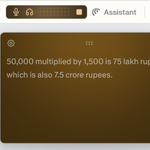
Why doesn’t AI just use a calculator for something as basic as 50,000 × 1,500?

The Musk vs. Altman trial starts April 27. Here is the full story of how two co-founders ended up in a federal courtroom over the future of AI.
2015: Musk and Altman co-found OpenAI as a nonprofit. Mission: develop AGI for humanity, not shareholders. Musk contributes approximately $44 million. The founding document explicitly says the company will never be driven by financial return.
2018: Musk leaves the board after trying to merge OpenAI with Tesla. Altman takes full control.
2019: OpenAI takes $1 billion from Microsoft and introduces a capped-profit structure. The nonprofit shell stays. The mission starts to bend.
2023: Musk launches xAI as a direct competitor. Weeks later, OpenAI's own board fires Altman for being "not consistently candid." He is reinstated within five days after nearly all 800 employees threaten to quit.
2024: Musk files suit. Fraud. Breach of contract. OpenAI tries four times to get the case dismissed. The judge refuses every time.
2025: Discovery uncovers Greg Brockman's private diary. A 2017 entry reads: "I cannot believe that we committed to non-profit if three months later we're doing b-corp then it was a lie." Another entry: "This is the only chance we have to get out from Elon."
October 2025: OpenAI completes its full conversion to a for-profit company. Valuation at conversion: $500 billion. The nonprofit foundation retains 26%.
January 2026: The judge denies OpenAI's final motion to dismiss. Her words: "This case is going to trial."
April 2026: Musk amends his demands. He will not keep any damages personally. Everything goes back to the nonprofit. Message: this was never about money.
If Musk wins: Altman and Brockman are removed. OpenAI's planned $1 trillion IPO is at serious risk. Every nonprofit-to-profit conversion in Silicon Valley becomes legally vulnerable.
If OpenAI wins: The conversion stands. The IPO proceeds. The precedent is set: founding promises are not enforceable once you leave the room.
The question a jury of ordinary people will now answer: can you raise billions of dollars tax-free by promising to serve humanity, and then simply become a for-profit company once you are powerful enough?
Rohit Yadav retweeted

I am happy to see the YCombinator wave arriving in India. Our co-founder Tony and I were in silicon valley during the original YC wave of companies. We learned a lot from the YC companies. We also made the conscious choice to pursue a different course.
In the ancient Bharatiya tradition of philosophical debate, I am going to offer this.
I will start with things I agree with YC on.
1. The biggest lesson anyone can learn from YC: small passionate teams can do magic. This was true way before AI coding arrived and will always be true.
2. YC is absolutely right to not over-emphasize "innovation". Doing a similar product as the bigger guys, faster and cheaper, is often the best course. Google did not invent search. OpenAI did not invent the LLM. Anthropic did not invent agentic coding.
3. YC companies tend to geographically cluster, and that can lead to subtle peer pressure and group-think. So the "laggard" founders who are not growing like a weed every week start to feel left out and eventually the result is "founder depression". And YC has counselors.
By the standards of 2007 silicon valley or even 2014 silicon valley, we were thought to be losers. Just keep that in mind.
4. Many deep tech problems like building a better, cheaper MRI machine or advanced semiconductor equipment require long focus and patient execution and lots of capital. These are endurance tests, not weekly sprints.
5. YC too often optimizes companies for "exit". That philosophy was built for and requires prolonged bubbles, which American policy has delivered, at the price of nearly wrecking the country (note the extreme inequality and political division). If you love India, you should not wish for similar bubbles.
6. YC model worked in silicon valley. One of the reasons it worked was that silicon valley could get any talent from anywhere in the world, notably from India, easily. That era may have ended or at least on pause right now.
Bengaluru has tried the same thing but with "any talent from anywhere in India" and we have not yet created huge companies. India needs its Huawei and Xiaomi and BYD and these companies are Chinese to the core, built by patriotic Chinese. Indian talent, staying in India, rooted in India, is going to have to build companies like them. Enough said.

What I told 2,000 future founders in Bengaluru today:
1/ We believe we are at the start of a second wave of Indian companies that will build world-class AI native products for the global market. Emergent and Giga are the model of the future.
2/ Just because a space seems crowded doesn't mean it's too late. Zepto, Emergent, Giga - none were first movers. Second mover advantage is real.
3/ In fact, a good formula for finding startup ideas is to look at ideas that are showing some promise and just execute them better. Execution is everything: if you're an exceptional engineer, and you can build and move faster than your competitors, you'll win.
4/ There is every reason to believe Indian teams can beat US teams building global products. The level of engineering talent here is on a whole different level, and that's the key input.
5/ In the AI era, the best founders are the ones building at the edge of what's technically possible. You need to be experimenting wth the latest models, the latest open source projects.
6/ Stay in the flow of information. Watch the right podcasts, follow the right people on X. With AI changing this fast, you need to know what the smartest builders are thinking.
7/ Most of the best startups don't come from someone explicitly trying to start a company. They start from someone building a project just for fun, or tinkering with a new technology because they are curious. India needs more of this "tinkering" culture - this is how you have novel ideas when technology is shifting quickly.
8/ Founders are getting younger. Aadit was 18 when he started Zepto. The Giga founders were 20 when they came to SF. Young people who can learn very fast have the advantage right now.
9/ The best founders are pushing AI coding to the max. You can now write 20K lines of code / day. One person can do the work that just a year ago would take a 100 person team. The best builders are taking advantage and building at Garry Tan speeds.
Rohit Yadav retweeted

We had room for 2,000 people at Startup School India.
More than 25,000 applied.
No Startup School anywhere in the world has ever had this many people apply. Not SF, not NYC, not London. India blew them all away.
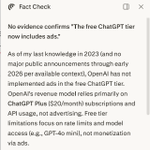
I fact-checked "OpenAI has ads in free tier" using the Comet browser.
It said: No evidence confirms this.
OpenAI launched ads on February 9, 2026. Their own website says so.
AI fact-checkers are confidently wrong. And that is a serious problem.

At this point Anthropic isn't just shipping every day, they're showing up to other people's houses too. 😅


A lot of AI agent startups got cooked today.
There is an entire category of startups whose product is exactly this. "We make AI agents reliable at scale." That is their pitch. That is their Series A. That is their moat.
Anthropic just made it a feature.
The AI agent infrastructure space just got a lot more crowded.
Everyone lost their mind over Anthropic's $30B revenue today. Meanwhile, Google quietly shipped this:
- An LLM on the Play Store.
- Runs locally on your phone.
- No internet.
- No sign up.
- No subscription.
- Completely free. Forever.
It crossed 1 lakh downloads on the Play Store. And then just… stopped there.
A product this good should have gone viral. It didn't even trend.
Why are you still paying $20/month?


I used to do this in 4 steps across 2 different websites:
Resize the image
Download it
Convert PNG → WebP
Download again
Now I just tell Claude Co-Work to do it.
Done in seconds.
It sounds trivial. But it saves you from a genuinely tedious task.


A compliance company that couldn't comply with an open-source license.
@getdelve is officially out of Y Combinator. Here's the full collapse:
1,700 companies bought compliance certifications. Many handle patient data.
The system that was supposed to catch this — investors, auditors, YC — didn't.
One pseudonymous writer on Substack did.