

Software Engineer by Profession. Tech conference speaker. Traveller by Heart. #harness #WalmartLabs #cisco #golang All posts or comments are personal opinions
Bengaluru, India
Joined August 2009
- Tweets1.4K
- Following740
- Followers123
- Likes5.4K
Pinned Tweet
Excited to talk in this event!! Join me for my talk on Go and Custom loadbalancer using Envoy

🚀Get ready to dive deep into the world of Go!
🌐conf42.com/golang2024
🔥From cutting-edge frameworks to expert insights, this conference is a must-attend for all Gophers!🔥
@JulienBreux @ThorstenHans @_nthabi @TheOtherRaghav @chinmay185 @prabs_io @thetreyjames @sandyydk

1
412
Sandeep retweeted

Stanford CS329Z: Engineering AI Agents is so underrated on YouTube. It literally walks you through everything you need to build your own AI agent, step by step, hands-on.
Skip Netflix and those endless short videos. Pick a topic that interests you and dive in this weekend. It might just help you land your next $500K job.
youtube.com/watch?v=b4y3rjGp…
course website: cs329z.stanford.edu/

Sandeep retweeted

This is INSANE. Cisco’s president Jeetu Patel has given a 27-year-old engineer unlimited AI tokens to try to rewrite 98% of the company’s legacy code within 24 months, Fortune reports.
Padmanabhan Krishnamurthy thinks he can do it with a two-person team. He has just four weeks to prove the approach.


Sandeep retweeted

Someone on Reddit built his wife a job search app.
She is a junior software engineer, and her job search had dragged on for almost 10 months. Tailoring a resume for every posting took ages.
So he built Dossier. It finds postings, then writes a tailored resume, cover letter and email for each job, using only facts from her profile.
It tracks every application from draft to offer on a board, and it runs on your own server, with a local AI model option, so your data stays with you.
She landed a job with it, so he open-sourced it for anyone in the same spot.
It is free at github.com/AienTech/dossier.


Sandeep retweeted

Adobe empire just got destroyed by a solo vibe-coder with Opus 5.5.
He got mad at Adobe's cancellation fee.
So he rebuilt the entire Creative Cloud. In pure Rust. For free.
• Photoshop → PhotoCraft
• Illustrator → VectorCraft
• Premiere Pro → FilmCraft
• After Effects → EffectCraft
• Lightroom → LightCraft
• InDesign → DesignCraft
• Acrobat → PdfCraft
no subscription. open source. native on macOS, windows and linux.
24K GitHub stars in the first week.
Adobe spent decades building this empire. He's speedrunning it with one Opus 5.5 & a grudge.
→ getartcraft.com/apps
Explore it today, then read the full guide on motion design with Opus 5.5 in the article below ↓


Sandeep retweeted

Watching an ex-YouTube engineer rebuild YouTube in 45 mins is quite fun.
Mikhail (@AstraliteHeart ) spent 8 years at YouTube. When we first met, I asked him how much of it he could rebuild in an hour. He said let's find out.
Here's the result. Let's see how much he actually gets done.

Sandeep retweeted

被裁之后,把整个求职流程交给 AI,最后拿到了 AI 工程师 offer。
这个 AI Job Search 可以从岗位匹配、定制简历、求职信,到模拟筛选、修改简历一路自动跑完,最后生成可直接投递的 PDF。
整个流程本地运行,个人资料不用交给第三方。GitHub 已经 3 万+ Stars。
如果你不想重复海投、改简历,可以看看这套思路。
🔗 github.com/MadsLorentzen/ai-…

Sandeep retweeted

Spotify's engineering team cut Claude Code token usage by 90% with a two-model routing approach they call Portal. The mechanism is worth understanding because it's not prompt engineering, it's hard blocks at the architecture level.
Two cheaper "assistant" models handle the tasks that don't need the expensive model: opening files, writing repetitive code, boilerplate. The expensive model only touches novel reasoning. Files over 350 lines get blocked from the expensive model entirely, not suggested away from it, blocked.
They tried rules-as-instructions first. It didn't hold. Engineers (and the model) found ways around soft rules. Hard blocks at the routing layer worked where prompt-level guidance failed.
90% token reduction is a big number. The implication is that most of what people use frontier models for in a coding workflow doesn't actually require frontier-level reasoning. Routing to capability level rather than defaulting to the best model available is a legitimate architecture pattern.
Article is worth reading in full.
nitter.gq/undefinedKi/status/209…

Spotify just published the internal setup their engineers use with Claude Code, the one that cut token usage by 90 percent. Here is how it works.
The observation behind it: most of what a coding assistant does is not thinking. It opens five files to answer a question about one of them. It writes a test that copies the pattern of the twenty tests sitting next to it. Enormous amounts of work, almost no judgment, and all of it billed at top rates.
So they added two cheap assistants. One opens the files and hands back a short summary. The other writes the repetitive code from an example and saves it straight to disk. The expensive model never sees any of it.
The clever part is how they made it stick. First the rules were written down as instructions, and the model ignored them. Now anything over 350 lines gets stopped before it opens and sent to the cheap one instead. Written rules are a suggestion. A block is not.
Two things stayed expensive. Edits still need the real file. And the cheap worker missed a bug the expensive one caught in seconds.

The new SAAS is going to be all about custom models/agents. That's the new moat when you sell your product to anyone.

I see so many people asking: why is Ramp building their own coding agent? Spotify an agentic development environment? Thomson Reuters their own AI model? Why do they BUILD and not BUY these tools?
It's because AI made building cheaper, and more "profitable." If you want your engineers to become "AI engineers", they need to build stuff.
So why not build tools that are better than what already exists? With much less effort than before? As a side effect, getting "cracked" with AI infra, and buildign with AI?
28
Sandeep retweeted

Someone built a 503-lesson AI engineering curriculum and open-sourced the whole thing.
It’s called AI Engineering from Scratch.
20 phases. Roughly 320 hours. Free. MIT licensed. Python, TypeScript, Rust, and Julia.
What makes the curriculum interesting is how it teaches =>
You don’t start with the framework.
You build the smaller version yourself first.
> Backprop from the math.
> A tokenizer from scratch.
> Attention from scratch.
> An agent loop from scratch.
Then you use the production library for the same idea.
The lesson structure is consistent:
MOTTO → PROBLEM → CONCEPT → BUILD IT → USE IT → SHIP IT
And every lesson leaves you with something reusable:
→ prompts for AI assistants
→ SKILL[.]md files for coding agents
→ agent implementations
→ MCP servers
→ runnable code
The repo describes the end result as a portfolio of 503 artifacts you built and understand.
It also has an AI-native way to actually take the course.
Run:
npx skills add rohitg00/ai-engineering-from-scratch
Then /start-learning.
A 10-question placement quiz finds your starting point and creates a personalized LEARNING[.]md.
From there:
→ /learn teaches the next lesson through concept, math, code, and quiz
→ /course-guide finds the exact lesson for a topic
→ /check-understanding quizzes you on a phase
It works with Claude Code, Cursor, Codex, OpenClaw, Hermes, and other agents that understand SKILL[.]md.
And there’s another useful part
The repo also includes a free, open-source Claude Certification Academy covering all four official Claude certification tracks =>
→ Associate Foundations
→ Developer Foundations
→ Architect Foundations
→ Architect Professional
Each route includes blueprint-mapped lessons, runnable labs, a diagnostic, capstone work, and a full-length original practice exam.
There’s even a /claude-certification tutor that can help choose a track, teach the lessons, run labs, review artifacts, and save progress. (not affiliated with Anthropic)
The full curriculum:
→ Phase 0 - Setup & Tooling
→ Phase 1 - Math Foundations
→ Phase 2 - ML Fundamentals
→ Phase 3 - Deep Learning Core
→ Phase 4 - Computer Vision
→ Phase 5 - NLP
→ Phase 6 - Speech & Audio
→ Phase 7 - Transformers Deep Dive
→ Phase 8 - Generative AI
→ Phase 9 - Reinforcement Learning
→ Phase 10 - LLMs from Scratch
→ Phase 11 - LLM Engineering
→ Phase 12 - Multimodal AI
→ Phase 13 - Tools & Protocols
→ Phase 14 - Agent Engineering
→ Phase 15 - Autonomous Systems
→ Phase 16 - Multi-Agent & Swarms
→ Phase 17 - Infrastructure & Production
→ Phase 18 - Ethics, Safety & Alignment
→ Phase 19 - Capstone Projects
Phase 19 alone contains 17 end-to-end products plus 9 deep-build tracks.
There’s even a six-volume EPUB/PDF edition generated from the same core curriculum.
503 lessons is a lot, but the structure is what makes this repo useful => understand the mechanics first, build them yourself, then move up to the abstractions.
GitHub Repo: github.com/rohitg00/ai-engin…

Sandeep retweeted

It took us 9 years, 11 prototypes, and our life savings to learn that every great product has the same design process.
Matic is now decisively the best home robot for families (I'm biased)
A 500-word thread and video on the Universal Design Process behind every great product:
Sandeep retweeted

Cursor was an email app.
Slack was a game company.
Great founders refuse to quit. Mediocre founders say: “We executed well, but our idea was flawed, good job everyone but we are shutting down.”
Almost no one gets the first idea right.


Sandeep retweeted

Stanford researchers did it again.
They just built the agent-native version of Git.
When an agent works on a longer task, the run builds up a lot of state.
This includes files edited/created, a dev server, a database, installed packages, KV cache, etc.
Say the agent is at step 10 and makes a mistake, maybe it misreads a traceback and rewrites a file that was actually fine.
The tests start failing, and the run goes off track, although everything through step eight was correct.
By default, the agent just tries to fix it, which creates more edits and tool calls. This burns more tokens and grows the context.
The other options are a person stepping in to redirect it or restarting the whole run from step one.
That's wasteful, because it pays for every model/tool call again and re-prefills the context. Moreover, since an agent's run is non-deterministic, it doesn't reproduce the same early steps anyway.
The reason it's hard to just jump back exactly to a previous correct step and resume from there is that the trajectory is only a message log.
It records what the agent said and which tools it called, but not the live state underneath.
That state includes things like memory, open file handles, child processes, installed packages, /tmp, and KV cache. None of that is in the log.
Git can version the files, but it doesn't snapshot the running process or the KV cache. Checking out step eight moves the files back, but the process is still sitting in step-ten memory with a cold cache.
Shepherd is a runtime layer by Stanford that records the run as a trace of typed events rather than a flat log.
Each agent-environment interaction becomes a commit, similar to Git, but it tracks the live run.
Its commit includes the agent process and the filesystem together, copy-on-write, so a branch carries the actual state and not just the files.
Going back to a previous step is then a single call that forks from that commit and continues from the exact state.
The copy-on-write fork is roughly five times faster than docker commit, and because the prompt prefix through step eight is unchanged, the KV cache is reused over 95% on replay, so early steps aren't reprocessed again.
Once the run can be forked, a meta-agent can sit on top and operate it. It watches the trace and reverts as soon as it looks wrong, before the bad write is committed.
In practice, it's just Python calling fork, replay, and revert on the trace, rather than a separate control plane wired into the harness.
Not everything is reversible though.
Files and sandbox changes undo themselves, but a database write has no automatic undo, so it needs a matching undo step set up in advance.
Something external, like a sent email or a real charge, can't be undone, so the supervisor's job there is to catch it before it fires.
They tested this on a few public benchmarks. On CooperBench, where two agents work on the same codebase, adding a live supervisor took the pair-coding pass rate from 28.8% to 54.7%.
It's still early and labeled alpha. The benefit mostly shows up when a run gets branched a lot over a heavy sandbox state, which is exactly where restarting wastes the most tokens and time.
If Git was made to make file changes reversible, Shepherd is trying to do the same thing for a live agent run.
Shepherd Repo: github.com/shepherd-agents/s…
(don't forget to star it ⭐ )
That said, Shepherd reverts a bad step inside a run. The harness around it, the prompts, tools, and checks the supervisor relies on, still drifts across runs as models and dependencies change.
I wrote about making that harness repair itself, where a failing trace gets diagnosed, the fix is verified against the exact input that failed, and the failure is locked as a regression test so it can't recur.
The article is quoted below.


Sandeep retweeted

When your context window fills up, instead of compacting the text, what if you convert it to an image? This is exactly what was done by Stencil, in a technique they call Snapcompact
The core trick is simple - render the whole context into a dense pixel-font bitmap and hand it back to the model as an image, instead of summarizing it away.
A 1568x1568 PNG can hold about 40,000 characters of text rendered in a 6x10 pixel font, and Anthropic bills that image at only 3,279 tokens. That same text as plain tokens would cost roughly 10,000. The model reads the image back near-verbatim, at about a third of the input price.
Interestingly, font size matters. They varied the sizes and found a sharp cliff around 40 sq. px per character. Above that threshold, transcription degrades gracefully, and below it, the model reads nothing at all.
So, in a gist, with this technique, SnapCompact, we get to know that we could just compact text as images, because the model is not just looking at a picture of your context. It is reading it.
Hope this helps.
-- came across this on tdd[.]cat
Sandeep retweeted
This is wild. Someone just open-sourced an entire platform that replaces Vercel, Heroku, Supabase, SendGrid, and half a dozen other paid services. In one self-hosted tool.
It's called OpenShip. Deploy anything. Own everything. Run it on your own server.
→ Git push to deploy. Auto-detects your stack. Zero-downtime deployments. One-click rollbacks.
→ Built-in mail server with unlimited domains, unlimited mailboxes. No per-email fees.
→ One-click Postgres, MySQL, MongoDB, Redis, MinIO, Meilisearch, Qdrant, Kafka, Elasticsearch all on your infrastructure.
→ Preview environments per branch. Separate dev, staging, and production configs.
→ A desktop app that builds locally on your machine so your server doesn't carry the load.
→ MCP support connect AI coding agents to manage deployments directly.
Everything runs as standard Docker containers. No lock-in. Easy to migrate away if you want.
It launched days ago. Already gaining serious traction. Apache 2.0. Fully open-source.
If you're paying for five different services to deploy and run one app, this might be the post you bookmark.

Introducing OpenShip.
An open-source application platform for building, deploying, operating, and scaling applications on infrastructure you own.
Replace deployment tools, managed services, and infrastructure workflows with one open-source platform.
Available today:
- Mail Server (Built in. One click).
• Runs on your own VPS
• Unlimited domains
• Unlimited mailboxes
• Modern webmail included
• Connect with Gmail, Outlook, Apple Mail, Thunderbird, or any IMAP/SMTP client
• Send email directly from your applications using SMTP
• No mailbox subscriptions or API fees
• High email deliverability
- Deployment:
• Deploy any stack
• Git-based deployments
• Zero-downtime deployments
• One-click rollbacks
• Development, Staging, and Production environments
• Multi-branch deployments with isolated environments • Deploy to VPSs, dedicated servers, cloud VMs, or your homelab
- Services:
Provision the services your applications need in one click.
Replace multiple managed providers with services running on your own infrastructure.
• Supabase
• PostgreSQL
• MySQL
• MariaDB
• MongoDB
• Redis
• MinIO
• Meilisearch
• Qdrant
• RabbitMQ
• Kafka
• ClickHouse
• Elasticsearch
...and deploy any other service alongside your applications.
- Operate:
• Live deployment logs
• Live request logs
• Real-time traffic analytics
• Automated backups
• Monitoring
• Secrets management
• Domains
• Automatic SSL
• Environment variables
• Scheduled jobs
• Health checks
-Multi Environments:
• Separate Development, Staging, and Production environments
• Deploy every branch independently
• Test changes before production
• Isolated services, secrets, and configuration per environment
- Security & Teams:
• Team management
• Role-based access control
• IP allow/block rules
• Rate limiting
• Security rules
- Developer Experience:
• Web dashboard
• Native desktop application
• CLI
• REST API
• MCP support for AI agents, just add the mcp and your agent can do the work for you
• Manage your infrastructure without living in SSH
- Coming Soon:
• Multi-server clustering for applications and databases
• One-click load balancing
• Horizontal scaling across multiple servers
• Built-in high availability and failover
• Scale from a single VPS to a cluster with the same workflow
• Just add servers. OpenShip handles the rest.
Open source.

Sandeep retweeted
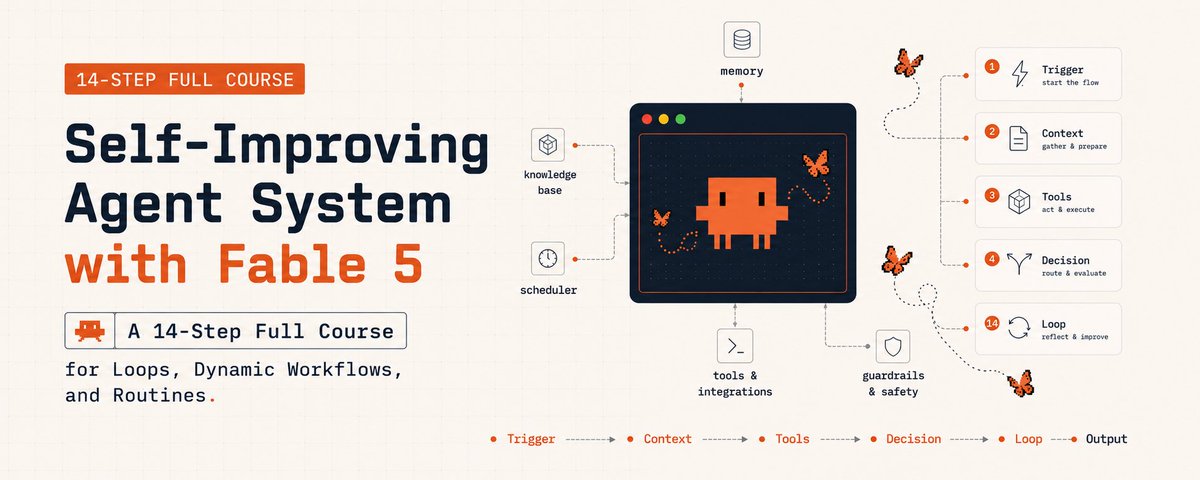
Anthropic Head of Product:
“Fable 5 - is our best model for self-improving agentic systems. It can run for days on a single /goal.
add /loops, dynamic workflows, dreaming and you become unstoppable.”
in 11 minutes, the Anthropic team shows how to build long-running systems with Fable 5 from scratch.
Worth more than a $500 agent-building course.
Live from Anthropic’s latest stage in Japan. Unpublished.

Sandeep retweeted

A scientist in Denmark figured out how to make Claude prepare his job applications. He open-sourced the whole thing.
His name is Mads Lorentzen. He is a PhD geophysicist. He built it on top of Claude Code and released it under MIT license.
Here is what it does. You fork the repo, fill in your background once, and it runs a five-step pipeline for every job you want to apply to.
Step 1. It reads the job posting and scores how well you fit.
Step 2. It drafts a tailored CV in LaTeX, picking only the experience that matches.
Step 3. It writes a cover letter framed around what you would bring to the role.
Step 4. A second AI agent reviews the first agent's work, points out weaknesses, and the first agent revises.
Step 5. It compiles both into clean PDFs you can send.
The whole thing is a folder of markdown files. The candidate profile, the writing style rules, the CV templates, the interview prep notes. Every step is plain text you can read and change.
The job portal search is built for Danish boards. The application workflow itself works for any country.
489 stars. 270 forks. A fork-to-star ratio that high means people are using it, not only bookmarking.
Mads is not a startup founder. He built this because he needed it for himself, then shared it.
This is the future of job hunting. Not a service you pay for. A workflow you own.
(Link in the comments)

Sandeep retweeted

Learn Coding by playing games
1. Kubernetes
k8sgames.com
2. DevOps
devops.games
3. Linux
overthewire.org
4. Git
ohmygit.org
5. Python
codecombat.com
6. CSS & HTML
codepip.com
7. Cybersecurity
picoctf.org
8. Mobile Coding (like Duolingo)
sololearn.com
9. For Complete Beginners
scratch.mit.edu
10. 25+ Programming Languages
codingame.com
Follow @ghumare64 for more such tips!

Sandeep retweeted

/goal is f*cking insane.
You can literally turn your AI agents into 24/7 employees that work for HOURS with zero manual intervention.
This has to be the most powerful AI feature release of the month.
If you try one thing in AI this week, make it this.


Can't use #netflix due to @reliancejio @JioCare. Cancelled my Jio fiber connection and they are holding me hostage with Netflix connection. Customer care has no idea and they ask you to mail Netflix. What nonsense is this!!?

3
49