
Assistant Professor at Michigan Tech. Mechanobiology within stiffness sensing, flow sensing and ECM ligand sensing. Previously in Danuser Lab.
Houghton, Michigan
Joined July 2009
- Tweets110
- Following127
- Followers65
- Likes114






We are glad to share our publication about transient low shear stress that influences endothelial traction and alignment in the long term under high-shear flow. journals.physiology.org/doi/…

2
39
I tried to use VideoByte for our recent publication in Communications Materials. Why does myosin-independent stiffness sensing matter? It is because it suggests the differential tension can run across nascent adhesions! youtube.com/watch?v=LyRDn8iK…
1
4
191
Sangyoon Han retweeted

The Health Research Institute @michigantech is seeking talented, ambitious undergrads for our Summer Undergraduate Research Fellowship program. This includes travel, room and board, and a $4000 summer stipend. Please DM me if you want to learn more! @HRI_MTU #AcademicTwitter

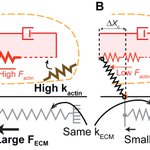
To explain this, we developed an actin elasticity-based molecular clutch model. Basically, the stiffer the actin is, the easier it is to transmit larger traction with the same actin retrograde flow speed.

32
Then we show that the stiffness-dependent differential traction is significantly further reduced when we inhibit actin polymerization in addition to myosin inhibition. @BiomedMtu @HRI_MTU
1
38
In our paper, titled "Myosin-independent stiffness sensing by fibroblasts is regulated by the viscoelasticity of flowing actin", we first show that the traction increases with the ECM stiffness in the absence of myosin contractility.
@BiomedMtu @HRI_MTU
1
40
Finally, the finding regarding myosin-independent stiffness sensing has been published! Many thanks to my Ph.D. student Nik, collaborators Alex Cartagena-Rivera (NIH) and Bryan Smith (MSU), and senior mentors/colleagues, Schwartz, Ginsberg, and Tristan!
rdcu.be/dv4L0
1
3
81
Read this #preprint on @researchsquare: Polymerizing actin regulates myosin-independent mechanosensing by modulating actin elasticity and flow fluctuation researchsquare.com/article/r…
68
It is finally out! We present a better bead tracking method adapted to traction microscopy. It's my first paper with two undergraduate students as co-first authors. Good job guys! #PLOSONE: dx.plos.org/10.1371/journal.…
1
2
Owing to my student Shaina, we had a chance to learn about a rare disease called EDS and it was actually highly relevant to altered ECM structure and mechanical properties. We reviewed relevant mechnobiological players potentially involved in the disease. More to come from Shaina
Mechanobiology in the Comorbidities of Ehlers Danlos Syndrome frontiersin.org/article/10.3…
Sangyoon Han retweeted

Cell–3D matrix interactions: recent advances and opportunities sciencedirect.com/science/ar…
Nikhil Mittal, Ph.D. student in my lab, was awarded Travel Award in CMBE 2022 conference where he presented his project about myosin-independent force transmission. Congrats, Nik!

Fascin controlling other cells' stiffness...

Cells can control their ability to move through the body by using a protein called fascin to control the stiffness of neighbouring cells elifesciences.org/articles/6…

ALT Blue fluorescence showing myosin activity in a stage 9 drosophila follicle
Another interesting paper published from Ewa's group.

Our paper on the spatial arrangement of actin and myosin at the cell cortex just got published! Special thanks to Binh An Truong Quang and @Ruby_Peters_ @PDN_Cambridge @LMCB_UCL (1/3)
nature.com/articles/s41467-0…
1