

#apps #saas #esports #mobilegames #xr #ar #vr #cloud #applis #aplicativos #aplicaciones #jeux #jogos #juegos #vc So far out, the Hubble telescope can't find me.
Phoenix / Ann Arbor
Joined July 2006
- Tweets32.9K
- Following6.1K
- Followers5.3K
- Likes52.7K


Steve Epstein retweeted

This is the best "GUIDE" on internet that will teach you how to build your second brain with Notebook LLM
Complete. Beginner GUIDE.
🔗 ai-in-public.guide
Daily Save & Bookmarks → Notebook LLM → Second brain → Implementation
Bookmark this now!


Steve Epstein retweeted

🚨 Google's former CEO just came out and revealed the secret that will reshape the world over the next few years, all because of AI.
He said building wealth and your own business is now way easier, with one condition: you have to get into this field and actually understand the game.
If you only have the next 30 days to start, act on this advice and go all in, here's the full roadmap and every tool you'll need from scratch, all 100% free:
Phase 1: Understand the architecture and the fundamentals
Agent Architecture: learn how to build a smart, independent AI agent that makes its own decisions and carries them out.
🔗 code.claude.com/docs/en/how-…
🔗 langchain.com/blog
Claude Code 101 Course: the basics of using Anthropic's insanely powerful coding tool right from your Terminal.
🔗 anthropic.skilljar.com/claud…
Hands-on (Claude Code in Action): live demos of the tool building real projects, so you can see what it can do for yourself.
🔗 anthropic.skilljar.com/claud…
Phase 2: Master prompting and context
Prompt Engineering (official): Anthropic's official guide to writing pro-level prompts that get the best quality out of the model.
🔗 platform.claude.com/docs/en/…
Interactive Prompting Course: hands-on, interactive training on GitHub to sharpen your prompting skills.
🔗 github.com/anthropics/prompt…
CLAUDE.md and memory: the secret that makes Claude remember your project's full context and rules, and never forget them over time.
🔗 code.claude.com/docs/en/memo…
Phase 3: Automation and connecting to the real world
MCP Protocol: the real revolution. Connect Claude to the tools and databases you use every day, like Slack, GitHub and Google.
🔗 code.claude.com/docs/en/mcp
Skills: teach Claude repetitive workflows and custom functions so it can reuse them intelligently across your project.
🔗 code.claude.com/docs/en/skil…
Phase 4: Community guides and going pro
The Complete Claude Code Guide: a massive open-source guide from the developer community, packed with secrets and tricks.
🔗 github.com/FlorianBruniaux/c…
Awesome Claude Code: a legendary collection of the best ready-to-use scripts, Skills and plugins.
🔗 github.com/hesreallyhim/awes…
Anthropic Academy: all 13 of the company's official courses, with certificates, completely free.
🔗 anthropic.skilljar.com
Full official documentation: the complete, definitive reference for everything in Claude, big and small.
🔗 code.claude.com/docs/en/over…
Save this and turn on the notis for more 🛎️
All of these resources are COMPLETELY free and won't cost you a single dollar, but they'll give you a skill that lets you do the work of an entire team on your own, at the same quality.
Steve Epstein retweeted

David Sacks on how the best SaaS companies will differentiate themselves in the age of AI
Previously, SaaS companies focused exclusively on customer UI. In the future, agentic and command line interfaces will be key to making sure your platform can integrate with AI
Steve Epstein retweeted

Goldman Sachs uses this exact formula to decide if a company is worth $14,000,000.
Most of their analysts learned it from one free MIT lecture.
A Goldman recruiter once told a candidate: "If you can't derive an annuity price in under two minutes, we don't continue the interview." Starting offer for those who could: $250,000.
The formula fits on one line. MIT teaches it in 80 minutes. For free.
This is MIT 6.042J. Mathematics for Computer Science. The lecture Wall Street forgot to take down.
The professor opens with a simple question: $50,000 a year for 20 years, or $1,000,000 today?
Most people pick the million. Most people are right.
Then he shows you exactly why - with math you can verify yourself in 30 seconds.
Then the formula.
Every annuity - student loans, home mortgages, lottery payouts - is secretly just a geometric series. One formula prices all of them. He derives it live on the board using nothing but algebra.
Then Wall Street.
He explains how slight differences in interest rate assumptions - the p in the formula - let banks make money off the same instrument. Two banks, same contract, different p. One wins. He explains how that confusion caused the 2008 subprime collapse. The entire global recession. Traced back to one variable.
Then the company valuation.
A company adding $50,000 more in profit every year forever - what do you pay for it today? He plugs into the formula. Answer: $14,700,000. That is how acquisitions get priced on Wall Street.
Watch the moment he describes how people made hundreds of billions during the financial crisis while everyone else lost - "money went from one place to another." He says it casually. The room goes quiet.
A quant analyst at Bridgewater told me this was the first lecture that made financial modeling feel like arithmetic. Starting salary: $350,000. Bonus year: $900,000.
Bookmark this and watch later - after this lecture every loan, lottery, or acquisition price you see will feel like a solved equation.
MIT 6.042J Lecture 12 | Mathematics for Computer Science | Fall 2010


Steve Epstein retweeted

This is the MOST asymmetric window I've ever seen in business.
It's honestly hard to comprehend. Never in history have this many categories opened at once, ALL ripe for the taking:
1. Take a boring business doing 20% margins, an accounting firm, an IT shop, a local service company, and swap the human labor for agents until it runs at software margins with customers it already has.
This is the Thrive Holdings model.
2. Build the picks and shovels, the clean API or data source that agents call 1000 times a day, and get paid per call instead of per user.
I call this being in the building blocks business.
3. Buy a sleepy SaaS with real customers and a tired founder, then rebuild it AI native and 10x what it can do while building a media machine along side it.
4. Run a service business that looks like an agency on the outside but is really you plus a team of agents doing the delivery, priced like consulting, delivered like software.
5. Watch what people are still hiring for on Upwork, the "data entry specialist," the "appointment setter," the "research assistant," and build the productized agent that replaces that exact role, then sell it to every company posting the job. Vertical agents are here!
I could keep going forever but you get the point.
Contrary to what a lot of people believe (AI is coming for us, you need to raise venture to compete etc), the opportunity right now is endless.
You don't need to quit your job. Finally, you can build a real startup on the side.
It's starting season.
If you've EVER thought about starting a something of your own, this is the moment to stop thinking about it.
Seasons like this don't last forever.
Start.
Steve Epstein retweeted

I deleted 80% of my CLAUDE.md last night.
My CLAUDE.md was 400 lines. It's now 60. Claude works better.
It's all because of this video.
Two Anthropic engineers. 50 minutes. The Claude team's best practices.
Anthropic deleted 80% of the Claude Code system prompt. The output got better.
Most people will keep adding rules and wondering why it keeps getting worse.
Watch it today, then read the guide below.


Steve Epstein retweeted
this is f*cking gold
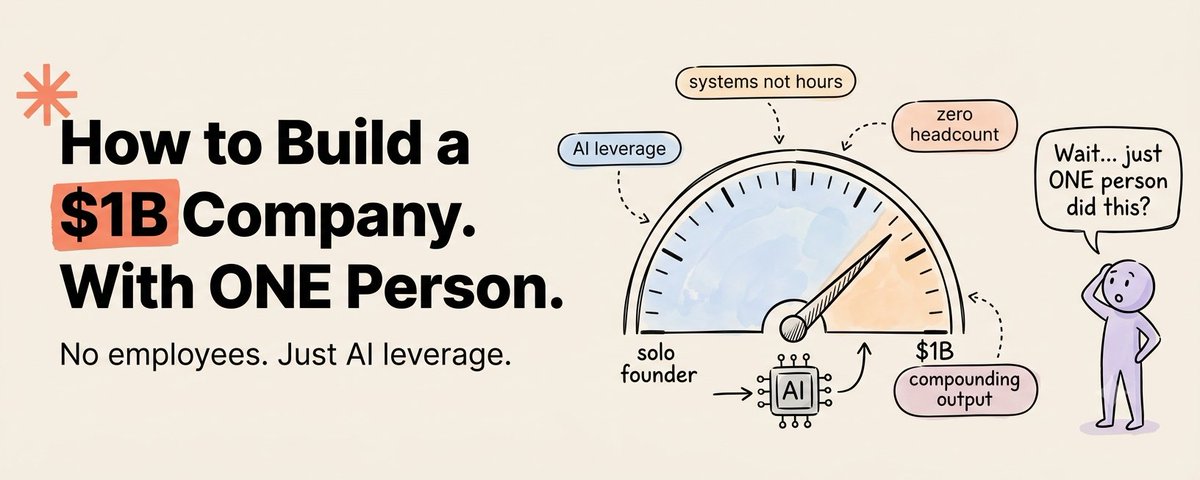
this guy on reddit just revealed the full blueprint of how one person turned $20,000 into a $1.8 billion company
if I had this a year ago, I would've seen the Medvi blueprint coming instead of being shocked by it
in the right hands, this changes everything:

Steve Epstein retweeted

Two Anthropic seniors just made Karpathy's loop 1000x better with "Graph Engineering" - dropped 11-page PDF
the shift: the agentic systems got 1000x better the moment you wired agents into a graph
here's the playbook in 6 steps:
step 1 → build one loop: generate, critique, revise - one self-review cycle beats a smarter model with none
step 2 → add tools: search, code execution, database - thinking without tools is hallucinating
step 3 → go parallel: spin up agents in separate worktrees - same repo, different branches, no conflicts
step 4 → add a graph: agents write findings as typed nodes and edges - not transcripts - every claim keeps its source
step 5 → ground your evaluator: it checks claims against graph edges, not vibes - "Triple not found" beats "seems off"
step 6 → the graph survives every session - your agents stop rebuilding context from scratch
the result: Karpathy ran 1 agent in 1 direction - this system runs 1,000 with shared memory - same model, it's the architecture
read this 11-page PDF and paste it into your Claude - you won't regret it
bookmark - then read the article on building graphs from scratch ↓


Steve Epstein retweeted

I built a tool that tells you who already tried your startup idea, and how they died
Steve Epstein retweeted

Andrew Ng:
“AI agents are doing almost 100% of my tasks now - the hype has exceeded my expectations.
in 4-6 months, we’ll all be building graphs to orchestrate self-improving agents. No more prompting.”
In a 20-minute talk, Andrew Ng explains how to build self-improving agentic systems from scratch.
Worth more than a $500 agentic course.
Watch this video, then read the article below on how to become a graph architect.


Steve Epstein retweeted

el fundador de una empresa china de IA valorada en más de $20,000,000,000 acaba de dar una clase de 40 minutos sobre enjambres de agentes
la explicación más clara que he visto sobre sistemas de IA a gran escala
cámbiala por tus 2 horas de Netflix de esta noche
Steve Epstein retweeted

On this day in 1944, Theodore Roosevelt Jr. died in his sleep in a stone farmhouse in Normandy. He was 56 years old, and he had spent almost his entire adult life trying to be worthy of a famous last name.
He was the eldest son of President Theodore Roosevelt. In the First World War he went to France and was gassed and badly wounded at Soissons leading his men. That same summer his younger brother Quentin, a pilot, was shot down and killed over France. Ted came home with lungs and a leg that never fully recovered, and before he even left Europe he helped found the American Legion so that ordinary soldiers would have someone looking out for them.
Between the wars he did almost everything. Governor of Puerto Rico. Governor General of the Philippines. Businessman, explorer, writer. He could have spent the Second World War safe behind a desk. Instead, at 54, arthritic and walking with a cane, he talked his way back into uniform and into combat.
By 1943 he was fighting in North Africa and Sicily under Terry Allen, and their loose, unpolished, soldier-first style rubbed General Patton the wrong way. Patton had them both relieved of command. Roosevelt didn't sulk. He asked for another job, any job, as long as it kept him near the fighting. They made him assistant commander of the 4th Infantry Division.
Then came D-Day. He hid a heart condition from the Army doctors. He wrote to his commander three separate times, in writing, begging to go in with the very first wave rather than watch from a ship. He was the only general to land in the first wave on any beach that morning, the oldest man in the invasion, walking through machine gun fire with a cane in one hand and a pistol in the other.
The boats came in a mile off course. Officers froze. Roosevelt limped up and down the beach under fire, studied the ground, and said, "We'll start the war from right here." Then he spent the morning waving men forward and sorting out the chaos so calmly that terrified 20 year olds looked at this old man with a cane and decided that if he wasn't scared, they wouldn't be either.
His son Quentin, named for the uncle killed in the last war, landed at Omaha Beach the same morning. They were the only father and son to come ashore together on D-Day.
He died a month later. A heart attack in his sleep. And here is the part that gets me. On the very day he died, the orders had just come through promoting him to major general and giving him his own division. He never saw the paperwork. He never knew he'd earned the Medal of Honor either.
At his funeral his pallbearers were seven of the most famous generals of the war, Bradley, Hodges, Collins, Barton, Huebner, and George Patton. The same Patton who had fired him. Patton wrote in his diary that Roosevelt was one of the bravest men he had ever known.
Years later Omar Bradley was asked to name the single most heroic thing he witnessed in all of World War II. He didn't pause. He said, "Ted Roosevelt on Utah Beach."

Steve Epstein retweeted

Marc Andreessen just named the lie that held for a hundred years and is collapsing in real time.
We gave authority to the people who explained things. Not the people who built them.
And nobody questioned why.
For a century, builders created and journalists translated. The public accepted it because complexity demanded a middleman.
But the middleman was never the expert. The middleman was the channel.
And we mistook the channel for the source.
Andreessen: “You set it loose and it will write you literally a 30-page answer. This is basically like a textbook on any topic.”
Any topic. Infinite depth. Zero cost. No gatekeeper.
He has a name for what comes next. Practitioner media.
Andrej Karpathy doesn’t sit across from a journalist. He turns on a camera and teaches the world how the architecture works. No filter. No editorial framing. No one deciding what you’re ready to hear.
The press calls it dangerous.
They are not protecting the public. They are protecting the bottleneck that gave them power.
The critic always needed the creator. The creator never needed the critic.
They just had no other way to reach the world.
Now they do.
Steve Epstein retweeted

Stanford researchers did it again.
They just introduced what might become **Git for AI agents.**
Here's why that's a big deal.
Long-running AI agents don't just generate text.
They create files, install dependencies, launch servers, update databases, fill KV caches, and build an entire execution environment.
Imagine the agent is deep into a task.
Everything works perfectly...
Until one bad decision.
Maybe it misinterprets an error message.
Maybe it overwrites the wrong file.
Now the tests fail, and the agent spends the next several minutes trying to repair damage it created itself.
Every failed attempt means:
• More tokens consumed
• More tool calls
• Bigger context windows
• More expensive runs
The usual fixes aren't great.
You either:
→ let the agent keep digging a deeper hole
or
→ restart everything from scratch.
Restarting sounds simple, but it means paying for all the earlier reasoning again.
Even worse, agent runs aren't deterministic, so the second run often takes a completely different path.
The missing piece has always been state.
Traditional agent logs only remember conversations and tool outputs.
They don't preserve everything happening behind the scenes.
Things like:
• running processes
• installed packages
• temporary files
• memory state
• open handles
• KV cache
Git only tracks files.
It can't restore an executing environment.
That's where **Shepherd** changes things.
Instead of recording a plain chat history, it captures the execution as structured runtime events.
Each step becomes a snapshot of the *entire* environment—not just the source code.
That means you can jump back to an earlier checkpoint and continue from the exact same running state.
No rebuilding.
No reinstalling.
No repeating the prompt.
Because the earlier context stays identical, Shepherd can reuse over **95% of the KV cache**, dramatically reducing replay costs.
Its copy-on-write snapshots are also reported to be around **5× faster** than Docker commits.
The coolest part?
You can place another AI agent on top as a supervisor.
If it notices the primary agent drifting toward a bad solution, it simply rolls back to the last healthy checkpoint and lets it continue from there.
Almost like hitting **Ctrl + Z** for autonomous agents.
There are limits, of course.
Rolling back local files is easy.
Undoing an email that's already been sent...
or reversing a payment...
isn't.
Those actions still need safeguards before they're executed.
Stanford evaluated Shepherd on public benchmarks.
On CooperBench, adding a supervising agent increased collaborative coding success from **28.8% to 54.7%**.
It's still in alpha, but the concept is incredibly promising.
Git transformed software development by making code changes reversible.
Shepherd is trying to bring that same idea to **AI agent execution**.
Repo:
github.com/shepherd-agents/s…
⭐ Worth starring if you're building AI agents.
Steve Epstein retweeted
Jensen Huang just made the case that the smartest person in the room is now the most replaceable person on earth.
Huang: “The definition of smart is somebody who’s intelligent, solve problems, technical. But I find that that’s a commodity. And we’re about to prove that artificial intelligence is able to handle that part easiest.”
The skill you built your entire identity around was the first thing the machine replicated.
Not the hardest part. The easiest.
Huang: “People who are able to see around corners are truly, truly smart. And their value is incredible. To be able to preempt problems before they show up, just because you feel the vibe.”
Huang: “That vibe came from a combination of data, analysis, first principle, life experience, wisdom, sensing other people.”
The vibe is not intuition. It is decades of failed bets, human friction, and first-principles thinking compressed into a single read no model can replicate.
You cannot prompt your way to it. You earn it by surviving things that had no instructions.
Huang: “I think long term the definition of smart is someone who sits at that intersection of being technically astute, but human empathy and having the ability to infer the unspoken, around the corners, the unknowables.”
Every institution you ever passed through graded you on the one thing the machine now does for free.
The thing they never tested you on is the only thing that still matters.
Huang: “And that person might actually score horribly on the SAT.”
The SAT did not measure intelligence. It measured obedience to structure.
The future does not reward what you can solve inside a framework someone handed you. It rewards what you can see when no framework exists.
The machine did not replace human intelligence.
It revealed that what we spent a century calling intelligence was never intelligence at all.
The people who memorized the answers are about to work for the people who sensed the questions before anyone thought to ask.
Steve Epstein retweeted

Starbucks spends $400 million a year on software. Yesterday they announced they're moving off IBM and Microsoft to build their own custom systems in-house.
IBM dropped 3% and Salesforce dropped 4% on the news.
And honestly this is, unequivocally, the biggest signal I've seen since OpenAI and Anthropic launched their consulting arms back in Q1. The largest companies in the world are done paying for software that half fits how they work.
We saw this coming about a year ago. Moved everything we build off Airtable and low-code tools and went fully custom. Already paying off, and it's only going to compound from here.
This is the opportunity right now.
You get all of a company's data into one system. You build out a single operating system for the entire business. You cut out bad, redundant processes. Then you layer AI on top of it, under the correct processes.
That's the core of AI consulting. Helping companies actually operate better.
There are a lot of fly-by-night offerings circulating right now when it comes to Ai Services.
For example, 'second brains'.
Throwing scattered data into a second brain while the processes underneath stay broken does nothing. The companies who will absolutely destroy their competition over the next 5 years are rebuilding how they work from the ground up.
Starbucks is showing you what other companies will be doing over the next several years.
Your job is to position yourself to facilitate that process for as many companies as you can.

Steve Epstein retweeted
this is f*cking dangerous
someone just revealed how to run a 10-person company with zero employees using one Claude Project
Anthropic's CEO bet on a $1B one-person company by the end of 2026.
less than 6 months left. solo founders are already past several hundred million.
here is how:
1) Create a Claude Project and add your business files
2) Connect 10 MCP agents to it for research, leads etc
3) You sit in the decision seat. the agents run the execution layer.
you don't need more employees. you need MCP agents that know the business.
save and bookmark it no matter what
then read the full article below on how to build your first company with AI without any employee: ↓

Steve Epstein retweeted
Alex Karp just described how America identifies its most valuable minds and systematically filters them out.
The system isn’t broken. It’s performing exactly as designed.
Built to produce compliant industrial labor for an economy that no longer exists.
The factories closed. The compliance engine never did.
Karp: “All of our tests are built around things that were valuable in the Industrial Revolution.”
Every test. Every metric. Every benchmark.
Calibrated to measure one thing.
Obedience.
Not cognition. Not creativity. Not the ability to build something from nothing.
The ability to sit still and repeat what you’re told.
The minds the system punishes hardest are the ones the future needs most.
Karp: “Everybody who can’t sit or needs to build or wants to build have to go into a separate slot.”
The neurodivergent. The dyslexic. The kid who can’t stop moving but can reverse-engineer anything they touch.
The system doesn’t overlook them.
It identifies them, labels them defective, and routes them out.
That’s not a failure of detection. That’s the detection working perfectly.
The system locates its biggest threats and neutralizes them before they ever reach a launchpad.
Karp: “Vocational training in Germany is very technical. The people building the cars at BMW or even in the French version Airbus, very complicated jobs, they didn’t go to college. They went to a very, very high-end high school. And they come out without any debt.”
Germany routes elite technical talent straight into building jet engines and precision machinery.
No university. No debt. Immediate sovereign output.
America runs that same talent through four years of institutional processing and hands them a credential, six figures of debt, and a skill set an LLM absorbs before the decade ends.
One system builds. The other processes. And processing is not building.
Karp: “We should have gotten you before you got turned down at Goldman and said this is a waste of your time. You could be building something important.”
Instead of handing builders something real, the system funnels them toward desk jobs they’ll be rejected from anyway.
Then asks why nothing gets built.
The AI race won’t be decided by credentials on a wall.
It’ll be decided by one question.
Which nation found its builders before the system finished converting them into something replaceable?
Because the system doesn’t miss them by accident. It finds them first. Then it eliminates them.
That’s not a flaw in the design. That is the design.
But here’s what it never accounted for.
The builders it discards are the only ones who can build what replaces it.
Steve Epstein retweeted

Everyone in the Bay is building a robot company. Almost nobody is talking about the real bottleneck.
After 2 years running the Robotics Center of Silicon Valley, seeing hundreds of frontier labs and stealth startups, one pattern is undeniable:
The blocker isn't model capability. It’s the sim-to-real loop.
1. Simulation ≠ Hardware Reality A VLA trained in Isaac Sim or MuJoCo hits a wall when it encounters real-world actuator limits: thermal throttling, joint backlash, and sensor drift. Even two units of the exact same robot model have completely different dynamics.
2. Teleop data is inherently off-policy Human demonstrations bootstrap your model, but your model isn't human. That distribution gap doesn't disappear with more of the same data. It only closes through real-world rollouts, failure capture, and targeted data collection.
3. "Working" is undefined until deployment Teams optimize for lab success rates, then fail on real-world edge cases: a wrinkled shirt, 4 PM glare, or a pallet 3cm off spec. Without a real-world evaluation harness, you are just guessing.
4. The solution? Treat RL² as your core loop Internally, we call this Reinforcement Learning in Real Life.
Deploy ➔ capture failures ➔ evaluate against real criteria ➔ collect targeted data ➔ redeploy. Continuous learning on real hardware.
5. The Takeaway The winners in Physical AI won't just have the biggest models. They'll be the teams that can close the real-world learning loop the fastest. Closing the sim-to-real gap is a 2-year infrastructure problem. That’s why we built our stack at the Robotics Center.
6. Come hang out If you're hitting these exact walls, let’s compare notes.
We host robotics builders at 90 Welsh St (SF) every Friday. Drop by.