

security @zksecurityXYZ & AI @zkaol, Assistant Professor @ucl - PhD @imperialcollege
London, England
Joined November 2021
- Tweets261
- Following277
- Followers850
- Likes1.1K





Pinned Tweet
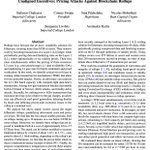
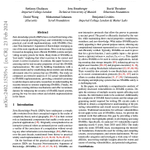
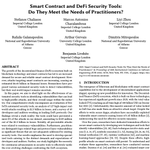
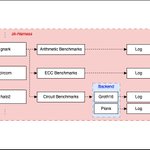
Excited to share our latest work on ZKPs security: "SoK: What don’t we know? Understanding Security Vulnerabilities in SNARKs" (w/ @0xSerious, @infosecual, @cryptodavidw, @MMJahanara, @convoluted_code).
URL: arxiv.org/pdf/2402.15293.pdf

Stefanos Chaliasos retweeted

Today we're announcing Strongpoint MPC, a breakthrough in post-quantum cryptography that solves a longstanding challenge: enabling multiparty computation (MPC) for hash-based digital signatures.
MPC has become a critical component of digital asset security, from institutional custody to stablecoins and tokenized real-world assets.
But as the industry transitions to post-quantum cryptography, there's a problem: existing MPC solutions don't readily extend to hash-based signatures like leanSPHINCS, which is the core of Ethereum's post-quantum roadmap.
Until now.
Today, our research team at @projecteleven, led by @conordeegan and @matteovena, is proud to announce that we've solved this longstanding open problem.
Strongpoint MPC enables institutions to preserve the security benefits of distributed signing while transitioning to post-quantum cryptography.
It will be one component of Strongpoint, our broader post-quantum digital asset security platform.
We believe in crypto-agility: institutions shouldn't have to bet their security on any single cryptographic primitive. Strongpoint is designed to support multiple approaches depending on security requirements.
As trillions of dollars in real-world assets move on-chain, we believe the industry will need practical, drop-in replacements for today's cryptographic infrastructure.
That's what we're building.

Introducing Strongpoint MPC: Post-Quantum MPC, Without the Compromises
A breakthrough in threshold signing technology brings the security and performance of modern MPC into the quantum and AI era.
The migration to post-quantum cryptography is underway. Blockchains, financial institutions, and digital asset infrastructure providers are preparing to replace the cryptographic algorithms that have secured digital ownership for decades. At the same time, advances in artificial intelligence are creating new uncertainty about the long-term security of existing cryptographic systems.
But replacing an algorithm is only part of the challenge. The infrastructure built around today's cryptography must also evolve, and few technologies are more important to institutional digital asset security than multi-party computation (MPC).
Today, Project Eleven is introducing Strongpoint MPC, a breakthrough in threshold cryptography that makes high-performance, post-quantum MPC practical. Our research demonstrates that migrating to post-quantum cryptography does not have to mean sacrificing the performance, flexibility, and security properties institutions have come to expect from traditional MPC. In fact, our approach can deliver signing performance that exceeds classical ECDSA-based MPC.
Strongpoint MPC is available within Strongpoint, Project Eleven’s institutional digital asset custody platform, enabling institutions to use post-quantum threshold signing while maintaining control over their assets and cryptographic key material.
The challenge with post-quantum MPC
MPC has become a foundational technology for securing digital assets. Rather than entrusting a private key to a single person, device, or system, MPC distributes signing authority across multiple independent parties. Transactions can be authorized without reconstructing the complete private key in any one location.
Today, this technology underpins institutional custody solutions used by exchanges, custodians, and financial institutions. Its applications extend well beyond moving funds, including blockchain validators, cross-chain bridges, oracles, and the administrative keys responsible for minting, freezing, and managing tokenized assets.
Over the last decade, MPC built around elliptic curve cryptography has become remarkably sophisticated. Institutions can coordinate signatures quickly, support complex approval structures, and operate distributed signing infrastructure with minimal latency. The transition to post-quantum cryptography threatens to disrupt much of that progress.
The mathematical properties that enable efficient threshold signing with ECDSA do not translate directly to post-quantum signature schemes. Hash-based signatures, in particular, have historically presented substantial challenges for MPC. Previous approaches suggested that generating a single threshold signature using certain hash-based constructions could take too long to be practical. For an institution processing transactions continuously, that kind of latency would make the technology impractical.
The apparent tradeoff was severe: preserve the performance of classical MPC while remaining exposed to future quantum threats, or adopt post-quantum protections at the expense of operational efficiency.
We've developed an approach that fundamentally changes that equation.
A breakthrough in post-quantum threshold cryptography
Project Eleven has developed a new approach to multi-party signing that dramatically improves the efficiency of post-quantum MPC. Our breakthrough enables high-performance threshold signing using hash-based cryptography, with techniques designed to extend across multiple signature schemes.
Where earlier approaches suggested impractically long signing times, our architecture enables post-quantum MPC signing that can even outperform traditional ECDSA-based MPC. Strongpoint MPC brings this research into a product designed for real-world institutional deployment.
Built for institutional infrastructure
Institutional MPC systems must accommodate different architectures, security policies, and operational requirements. A custody provider, a blockchain validator, and a stablecoin issuer may all rely on MPC, but their signing environments and security requirements can differ considerably.
Strongpoint MPC has been designed with this flexibility in mind:
- High-performance signing: Post-quantum threshold signatures with performance that can exceed traditional ECDSA-based MPC.
- Flexible threshold configurations: Supports the most common signing arrangements, with arbitrary threshold configurations under development.
- Dealerless key generation: Distributed key generation without requiring a trusted dealer, while retaining the flexibility to accommodate trusted-dealer setups.
- Efficient communication: An architecture designed to minimize communication overhead and support signing across distributed infrastructure.
- Signature indistinguishability: MPC produces signatures that are indistinguishable from ordinary signatures under the same scheme, without exposing the threshold configuration or participating signers through the signature itself.
- Institutional control: Deployment that allows institutions to maintain control over their signing infrastructure and cryptographic key material.
Stablecoin issuers, for example, must secure the administrative keys responsible for minting tokens, freezing assets, and managing critical smart contracts. Blockchain validators, cross-chain bridges, and oracles similarly rely on distributed signing infrastructure to protect sensitive operations.
All of these systems will eventually need to confront the transition to post-quantum cryptography, and they will not necessarily adopt the same cryptographic algorithms. Strongpoint MPC is designed with this diversity in mind, providing a foundation for supporting multiple signature schemes as cryptographic standards and blockchain requirements evolve.
The future of MPC is post-quantum and post-AI
Quantum computing threatens the mathematical assumptions underlying today's widely deployed public-key cryptography. Meanwhile, increasingly capable AI systems are accelerating mathematical research and cryptanalysis, introducing additional uncertainty around the long-term security of cryptographic systems.
Strongpoint is built around conservative cryptographic assumptions, crypto-agility and institutional control. Strongpoint MPC extends that approach to threshold signing, allowing institutions to adopt quantum-resistant cryptography without abandoning the distributed signing infrastructure they depend on.
For years, the industry has operated under the assumption that moving to post-quantum MPC would require meaningful sacrifices in performance and operational flexibility. Our breakthrough demonstrates that this does not have to be the case.
That's an exciting development for the future of digital asset security, and an important step toward making the post-quantum transition practical.
Learn more about Strongpoint MPC or reach out to our team today.
projecteleven.com/strongpoin…
projecteleven.com/contact
Stefanos Chaliasos retweeted

zkSecurity audits formal verifications, the line is this way ⬇️

Who verifies the formal verification?
Read about how we audited @TachyonZcash's Ironwood formalization and about common pitfalls for formal verification in general.
blog.zksecurity.xyz/posts/au…
Stefanos Chaliasos retweeted
We hired @zksecurityXYZ to audit Ironwood's formal verification. Rather than looking for security bugs, they tried to *add* bugs to see if the formal verification could catch them!
Here's our summary, along with the report:
zakura.com/engineering/adver…

Stefanos Chaliasos retweeted

Who verifies the formal verification?
Read about how we audited @TachyonZcash's Ironwood formalization and about common pitfalls for formal verification in general.
blog.zksecurity.xyz/posts/au…
Stefanos Chaliasos retweeted

Very proud of this work and honoured that it is receiving an Outstanding Paper Award at TCC'26! H/t to my co-authors and huge thanks to @zksecurityXYZ for the support
FRI is a fundamental protocol yet few people confidently say they understand the security proof. This ends today

Congratulations to @0xAlbertG (Nethermind), @nico_mnbl (zkSecurity), and Benedikt Wagner (Ethereum Foundation) on winning one of three Outstanding Paper Awards at TCC 2026, the Theory of Cryptography Conference, for "A Simplified Round-by-round Soundness Proof of FRI."
FRI sits at the core of most STARK-based proof systems, including Starknet's. Its existing soundness proofs are long and hard to check. This paper gives a much simpler one, which is a step toward formally verifying the systems built on it. eprint.iacr.org/2025/1993

Stefanos Chaliasos retweeted

been telling people for a while @nico_mnbl has become one of the experts in the field and they should watch his work - if you don't follow him, highly recommend

Very proud of this work and honoured that it is receiving an Outstanding Paper Award at TCC'26! H/t to my co-authors and huge thanks to @zksecurityXYZ for the support
FRI is a fundamental protocol yet few people confidently say they understand the security proof. This ends today
Stefanos Chaliasos retweeted
we introduce categories of Fiat-Shamir bug in this post blog.zksecurity.xyz/posts/fi…

Stefanos Chaliasos retweeted
The Year Finding and Exploiting Bugs Became Cheap, and What to Do About It
blog.zksecurity.xyz/posts/th…

Stefanos Chaliasos retweeted

Recently talked about zk.golf, LLM-as-compilers, and how writing zk circuits can be extremely cheap!
youtube.com/watch?v=9BSzHnkM…
Stefanos Chaliasos retweeted
We’re happy to support the proximity prize challenge efforts, now with machine-verifiability!
better.codes currently hosts two challenges, to improve what we know about the security bounds of proximity gaps. Since the challenges are expressed in Lean, every accepted result carries a strong guarantee, in the same style as zk.golf.
This follows the series of efforts in the industry and in our team to utilize verifiability for fearless optimization.
Starting from a security bits baseline of 53 (lower bound) and 128 (upper bound), AIs (and people too) will collaborate to improve the state of the art, and hopefully interesting ideas that can advance science will rise out of it!

Stefanos Chaliasos retweeted
vibe cryptographing? do it right! explore some ways AI is being used to optimize cryptography
blog.zksecurity.xyz/posts/op…
Stefanos Chaliasos retweeted
We just released zkvmBlast: a zkVM-agnostic differential fuzzer for RISC-V zkVMs.
One program, run across SP1, RISC0, OpenVM, Pico, Zisk and Airbender plus a reference simulator. Every disagreement is a bug lead.
Partially funded by the @ethereumfndn
Stefanos Chaliasos retweeted

zk-skills by @zksecurityXYZ was just added to pashov/ai-web3-security🤝
Bravo to the zkSecurity team for shipping this👏
github.com/pashov/ai-web3-se…

Stefanos Chaliasos retweeted
We just released zk-skills: open-source security skills for AI coding agents, starting with circom-auditor, a first line of defense for finding vulnerabilities in Circom circuits.
Partially funded through the Ethereum Security QF round (@Giveth). Big thanks to @TheDAOfund, @quantstamp & @wintermute_t for leading this round
🧵
Stefanos Chaliasos retweeted
Excited to share I’ve joined @zksecurityXYZ 😃
I’ve known the amazing team for years, and I’m happy to be part of this team that has been involved in securing and creating important parts of cryptographic infrastructure across the industry
Grateful to the inspiring @stefancoh, @alexhevans, @angeris and the rest of the team for the time together in @BainCapCrypto, and all the awesome founders I got to know and work with during my time there
Reach out to me with anything related to security, cryptography, formal verification, distributed systems, protocols or otherwise need help with!

Stefanos Chaliasos retweeted
Warning to cryptography projects running in production, a massive amount of bugs are being reported and/or exploited in the wild. Basically every time we run zkao on the exploited project it ends up finding the bugs. Run a scan now rather than later. zkao.io
Stefanos Chaliasos retweeted

Kudos to @zksecurityXYZ for building zk.golf !👏
Porting some of the optimizations proposed for challenges 5 and 6 into @gnark_team 's circuits yields some impressive results! -50% constraints for ECRECOVER precompile circuit, which directly benefits @LineaBuild🔥

Stefanos Chaliasos retweeted

1/ Zero-day discovery just went from an elite human craft to a cheap, automatable commodity. DARPA's own AI Cyber Challenge proves it: detection rates jumped from 37% to 86% in a single year.
Stefanos Chaliasos retweeted
AI meets Cryptography 3: What AI Found in Bron Labs's bron-crypto
blog.zksecurity.xyz/posts/br…