

I like what I like, and what I like, likes me.
Orange County
Joined March 2010
- Tweets4.1K
- Following671
- Followers1.4K
- Likes13.2K






Pinned Tweet
$NWBO YouTube link to presentation.
youtu.be/qOaodW6oK_o

"Clearly, it would be nonsense to use a biomarker that is totally false from the outset. And based on this, we decided to change the endpoint from progression free survival to overall survival."
~ Keyoumars Ashkan
(neurosurgeon@KingsCollegeLon)
$NWBO
drive.google.com/file/d/1afp…
Right, well the time to “ensure” that action is taken as soon as possible is NOW.
Thanks for the clip, Mathias. :)
$NWBO

$NWBO “The Prime Minister has taken a personal interest in this and wants to assure an action is taking as soon as possible”
Let’s go Braelyn! @MHRAgovuk it’s time to take action.

Sentiment Stocks retweeted

🇺🇸❤️ BIG NEWS & A LITTLE EXTRA HOPE! 🙏
We’re headed back to London for Braelyn’s next DCVax treatment, but this trip feels different!
This past week, I had the incredible opportunity to speak personally with @DrOz!
He’s been discussing Braelyn’s case with the FDA, and we’re exploring possible pathways to bring her ongoing DCVax treatments HOME to America!
Could Braelyn’s next treatment in MARCH actually happen right here in the USA?! 🇺🇸
Nothing is finalized, but some very important doors may be opening!
Please watch, share, and keep praying! ❤️🙏
#DCvaxForBraelyn
#BraelynsFight
@DrOzCMS
Sentiment Stocks retweeted

This is great publicity! I hope Trump will get this going.
I wish they would mention $NWBO when they have these news clips about DCVax
I guess we have to be happy the momentum is building!

🚨🇺🇸 BRAELYN’S STORY JUST MADE FOX BUSINESS! 🇺🇸🚨
What an incredible moment for our family!
Today on Varney & Co., Stuart Varney brought up Steve Moore’s recent Rasmussen Reports article about Braelyn and the barriers seriously ill Americans face in accessing promising experimental treatments!
Steve shared Braelyn’s story and called out the FDA, saying it’s CRUEL to withhold promising investigational treatments from desperately ill patients.
Varney agreed, arguing that patients facing terminal illnesses should have the freedom to accept the risks of experimental treatments without liability concerns preventing companies from providing them.
Then Steve asked a powerful question:
“Whatever happened to my body, my choice?”
He also pointed out that President Trump supports Right to Try, yet significant barriers remain between patients and the treatments they desperately need.
THIS is the conversation we’ve been fighting to bring into the national spotlight!
Our 19-year-old daughter is attending college, and her latest MRI shows no evidence of cancer recurrence. Yet we still have to travel to ENGLAND for her ongoing DCVax-L treatments—developed right here in AMERICA!
We are so incredibly grateful to Steve Moore and Stuart Varney for bringing attention to Braelyn’s story and, more importantly, to the countless patients who deserve a fighting chance.
Patients facing life-threatening illnesses shouldn’t have to fight their own government for the opportunity to fight for their lives.
PLEASE WATCH AND SHARE! ❤️🙏
@realDonaldTrump @DrOzCMS @SecKennedy
#DCVaxForBraelyn #RightToTry #DCVax
#BraelynsFight
$NWBO
Sentiment Stocks retweeted
🚨🇺🇸 BRAELYN’S STORY JUST MADE FOX BUSINESS! 🇺🇸🚨
What an incredible moment for our family!
Today on Varney & Co., Stuart Varney brought up Steve Moore’s recent Rasmussen Reports article about Braelyn and the barriers seriously ill Americans face in accessing promising experimental treatments!
Steve shared Braelyn’s story and called out the FDA, saying it’s CRUEL to withhold promising investigational treatments from desperately ill patients.
Varney agreed, arguing that patients facing terminal illnesses should have the freedom to accept the risks of experimental treatments without liability concerns preventing companies from providing them.
Then Steve asked a powerful question:
“Whatever happened to my body, my choice?”
He also pointed out that President Trump supports Right to Try, yet significant barriers remain between patients and the treatments they desperately need.
THIS is the conversation we’ve been fighting to bring into the national spotlight!
Our 19-year-old daughter is attending college, and her latest MRI shows no evidence of cancer recurrence. Yet we still have to travel to ENGLAND for her ongoing DCVax-L treatments—developed right here in AMERICA!
We are so incredibly grateful to Steve Moore and Stuart Varney for bringing attention to Braelyn’s story and, more importantly, to the countless patients who deserve a fighting chance.
Patients facing life-threatening illnesses shouldn’t have to fight their own government for the opportunity to fight for their lives.
PLEASE WATCH AND SHARE! ❤️🙏
@realDonaldTrump @DrOzCMS @SecKennedy
#DCVaxForBraelyn #RightToTry #DCVax
#BraelynsFight
$NWBO
$NWBO Great analysis. :)

An important addition to my $NWBO DCF analysis involving $MRNA $BNTX given recent mRNA failures in oncology:
Crucially the October 2026 Cell paper "Cancer Plasticity and Histological Transformation as Adaptive Resistance Mechanisms in Precision Oncology" demonstrates that single-target drugs regularly fail in aggressive cancers like glioblastoma because tumor cells adapt, shed single protein targets, and undergo "histological transformation" to evade single-point antigen attacks. Targeting a static mutation overlooks what a dynamic tumor, through neoantigens or entire tumor morphology, will evolve into tomorrow. This validates everything Northwest Biotherapeutics have been presenting, as discussed above, since the publication of their 2022 JAMA paper. It also directly explains why BioNTech’s BNT113 failed its primary PFS endpoint in the Phase 2/3 AHEAD-MERIT trial for HNSCC. Relying on a fixed, narrow set of antigens (HPV16 E6/E7) creates an evolutionary bypass. An autologous whole-tumor platform captures the entire, evolving antigen repertoire deterministically.
This exact evolutionary trap is why Moderna and Merck’s recent Phase 3 INTerpath-001 trial for mRNA-4157 produced such disappointing incremental results. Charging upwards of $400,000 to guess a maximum of 34 static neoantigens, only to deliver a marginal hazard ratio that relies almost entirely on $180,000 worth of underlying Keytruda monotherapy, isn't personalized medicine. Picking 34 static targets while dynamic tumor plasticity triggers lineage transdifferentiation and antigen escape guarantees that un-targeted sub-clones will simply evolve, survive, and cause recurrence. You cannot out-compute a mutating tumor with stochastic AI guessing. Without broad, deterministic autologous whole-tumor presentation, you are merely paying half a million dollars to hand cancer a roadmap for adaptive escape. An autologous whole-tumor platform like DCVax-L captures the entire, evolving antigen repertoire deterministically, shutting down those escape routes before plasticity can occur.
lnkd.in/p/g5y7m5PZ

Sentiment Stocks retweeted

Amanda, I’m so glad you got that moment. You, Braelyn and Ben made those seconds count. ❤️
I’m sure @POTUS @realDonaldTrump sees the opportunity: a real DCVax cancer moonshot, making the pursuit of cancer cures a defining part of his agenda.
@DrOzCMS @SecKennedy @WhiteHouse @FDA, please grant DCVax-L a National Priority Voucher, extend the Plausible Mechanism Pathway to include it, and open compassionate access here in the United States.
Let’s bring Braelyn’s treatment home.
#DCVaxForBraelyn #DCVax
🙏🏻🙏🏻🙏🏻
Sentiment Stocks retweeted
🇺🇸❤️ WE MET PRESIDENT TRUMP TONIGHT! ❤️🇺🇸
What an extraordinary evening for our family!
Tonight, Braelyn, Ben, and I had the incredible opportunity to meet President Trump at the rally in Pendleton, South Carolina!
We had only about 20–30 seconds with him, and I knew I needed to make every second count.
I introduced him to Braelyn and thanked him for telling Dr. Oz about her brain cancer story.
I explained that Braelyn had been diagnosed with glioblastoma, the deadliest type of brain tumor, but that today she is CANCER-FREE after receiving DCVax-L, a personalized cancer vaccine developed right here in America!
Yet we must travel all the way to England for her ongoing treatments because we cannot access it here in the United States.
Then something pretty cool happened!
President Trump turned to one of his staffers and instructed them to get me in touch with Dr. Oz!
I also expressed my hope that we could connect with Secretary Kennedy.
As our brief time together came to an end, I made one final appeal:
“Please help bring this American-made treatment back home to America.”
President Trump was incredibly gracious to our family and very kind to Braelyn. We are so grateful for the opportunity to speak with him!
Earlier in the evening, I was also able to give a member of his staff a detailed packet about Braelyn’s journey, DCVax-L, and the obstacles American patients face in accessing promising investigational treatments.
Now we are praying that the connection with Dr. Oz comes through!
Three years ago, Braelyn was given just months to live. Today, she’s 19, attending college, and her latest MRI shows NO EVIDENCE OF DISEASE RECURRENCE!
Tonight, we had the opportunity to bring her story directly to the President of the United States. ❤️
My prayer is that this opens the door to a much bigger conversation—one that could change the future for countless American cancer patients.
📸 We were not permitted to bring our phones into the private meeting with President Trump, so we couldn’t take our own pictures with him. His staff took an official photograph of us together, which we’re told will be emailed to us. I can’t wait to share it! In the meantime, here are some pictures from our unforgettable evening.
Thank you to EVERYONE who helped make tonight possible and to all of you who continue to share Braelyn’s story. You helped us get this far, and we’re not stopping now! ❤️🙏
@realDonaldTrump @DrOzCMS @WhiteHouse
#DCVaxForBraelyn #DCVax


Sentiment Stocks retweeted

An activist at UCLA is urging students not to vote for Steve Hilton
Her arguments are all based on his policies
This is brilliant reverse psychology
@SteveHiltonx
@StreetSmart_x
That's wonderful! I'm so excited for you two! Let's hope this helps to bring attention to the #RightToTry, and its current problems (must go through #FDA or they'll withhold it coming from the UK in customs). You're looking lovely Braelyn! :)
$NWBO / #NWBO / #DCVax / #GBM
❤️ IT’S OFFICIAL! WE’RE MEETING PRESIDENT TRUMP TOMORROW! 🇺🇸
Braelyn and I have been invited to attend tomorrow’s rally for Darline Graham in Clemson! We’ll be seated in the VIP section AND have the opportunity to meet President Trump in the “click line”!
Ben is cutting his work trip short, and we’re hoping he’ll make it home in time to join us!
We’ll have only seconds with the President, but I intend to make every one of them count. I’ll also be bringing information for him and his staff about Braelyn, DCVax-L, and the barriers American patients face trying to access promising treatments developed right here in the United States.
This is an extraordinary opportunity, but we’re hoping it can become something even bigger.
PLEASE HELP US GET THE ATTENTION OF THE WHITE HOUSE PRESS TEAM! 🙏
We would love the opportunity for a longer conversation with President Trump or his administration about how we can make these treatments accessible to American patients.
Please SHARE, REPOST, and TAG anyone who might help get Braelyn’s story in front of the right people!
Three years ago, Braelyn was given just months to live. Today she’s 19, attending college, and her latest MRI shows NO EVIDENCE OF DISEASE RECURRENCE!
Her story deserves to be heard. And so do the stories of countless other patients fighting for access to promising treatments.
@realDonaldTrump @DrOzCMS @WhiteHouse
#DCVaxForBraelyn #DCVax #PresidentTrump

Sentiment Stocks retweeted

$NWBO
Let @HollensbeBrae get her DCVax treatments in the U.S.
“…But why not let the patient, not Food and Drug Administration regulators, decide the most important decision of her life: how to stay alive?…”
“..Her family has health insurance, but they must pay for every flight and every dose out of pocket, with help from money raised from strangers online through GoFundMe.
Why London?
Because in Britain, a licensed physician can prescribe a promising treatment that for no rational reason has not been approved even on a limited and trial basis in the U.S…”
- @Rasmussen_Poll
@HollensbeAmanda @BenHollensbe

Words spoken by a mother fighting not only to save her own daughter’s life, but the lives of so many others by bringing attention to the current drawbacks of the #RightToTry program here in the US. Amanda, you are an inspiration to all mothers, and sweet Braelyn, you are a brave inspiration to all daughters! :)
#NWBO #DCVax #GBM #CancerFree

$NWBO
A video letter to President @realDonaldTrump
@HollensbeBrae is the young woman whose Glioblastoma story you recently shared with @DrOzCMS.
Braelyn and her parents live ten minutes from Wednesday’s campaign stop in Clemson and would like to meet you.
“Today she’s 19 years old, attending college, living her life - and her latest MRI shows no evidence of disease.”
Braelyn receives DCVax-L, a promising personalized cancer vaccine developed by American scientists (@NorthwestBio).
But she can’t get it in the U.S. Her family has to travel back and forth to England for compassionate use.
“For three years I fought to save my daughter‘s life and along the way I’ve discovered just how difficult it is for American patients to access promising investigational treatments - even when those treatments were developed right here in their own country.
We need to ask some very serious questions about the barriers facing smaller biotechnology companies, the influence of the pharmaceutical industry, and why patients are left waiting while promising treatments navigate years of regulatory hurdles…
…You signed right-to-try into law and I tremendously appreciate what that legislation was intended to accomplish, but I’ve learned firsthand that having the right to request a treatment doesn’t necessarily mean a patient can actually obtain it…
An American family shouldn’t have to cross an ocean to receive a promising cancer treatment developed by American scientists…”
— @HollensbeAmanda
Sentiment Stocks retweeted

Peter, I have been asking @MHRAgovuk about the delay in evaluating $NWBO.
They only offer self-serving answers while being opaque on their own performance & the evaluation process.
Patients require an expeditious evaluation not posturing from MPs and Whitehall.


Sentiment Stocks retweeted
$NWBO 𝗗𝗖𝗩𝗮𝘅-𝗟: 𝗡𝗛𝗦𝗕𝗧 𝗖𝗢𝗟𝗟𝗘𝗖𝗧𝗜𝗢𝗡𝗦 𝗔𝗥𝗘 𝗟𝗜𝗩𝗘. 𝗖𝗨𝗥𝗥𝗘𝗡𝗧 𝗔𝗖𝗖𝗘𝗦𝗦 𝗔𝗡𝗗 𝗖𝗢𝗠𝗠𝗘𝗥𝗖𝗜𝗔𝗟 𝗣𝗥𝗘𝗣𝗔𝗥𝗔𝗧𝗜𝗢𝗡 𝗔𝗥𝗘 𝗠𝗢𝗩𝗜𝗡𝗚 𝗧𝗢𝗚𝗘𝗧𝗛𝗘𝗥.
I contacted NHSBT directly to clarify what is operational, how patients enter the pathway, and what the collaboration is intended to support.
Their response confirms:
“Yes, the service is currently live and collections have already begun.”
𝗟𝗲𝗲𝗱𝘀 𝗮𝗻𝗱 𝗢𝘅𝗳𝗼𝗿𝗱 𝗮𝗿𝗲 𝗼𝗽𝗲𝗻. DCVax-L patient collections through NHSBT are happening now.
𝗕𝗢𝗧𝗛 𝗕𝗘𝗙𝗢𝗥𝗘 𝗔𝗡𝗗 𝗔𝗙𝗧𝗘𝗥 𝗔𝗣𝗣𝗥𝗢𝗩𝗔𝗟
I specifically asked whether the collaboration supports existing compassionate-use/unlicensed treatment arrangements, preparation for commercial rollout following MHRA marketing authorisation, or both.
The answer:
“Both.”
That establishes the purpose of this infrastructure: serving patients under current access arrangements while preparing to support commercial use following an approval.
𝗘𝗫𝗣𝗔𝗡𝗦𝗜𝗢𝗡 𝗜𝗦 𝗣𝗥𝗢𝗕𝗔𝗕𝗟𝗘 𝗕𝗘𝗙𝗢𝗥𝗘 𝗠𝗔𝗥𝗞𝗘𝗧𝗜𝗡𝗚 𝗔𝗨𝗧𝗛𝗢𝗥𝗜𝗦𝗔𝗧𝗜𝗢𝗡
NHSBT’s exact wording:
“Expansion is probable in advance of marketing authorisation.”
Additional sites and potential start dates are already being negotiated. NHSBT said these details can be shared once confirmed.
This means network development can progress before a regulatory decision. Leeds and Oxford are the two locations confirmed operational today; further locations are being actively discussed.
𝗧𝗛𝗘 𝗦𝗖𝗔𝗟𝗜𝗡𝗚 𝗦𝗜𝗚𝗡𝗜𝗙𝗜𝗖𝗔𝗡𝗖𝗘
NWBO and Advent already have functioning collection services within established NHSBT clinical infrastructure. Additional locations would extend that pathway geographically, connecting more patients with an essential step in personalised vaccine production.
Current patient access, operational experience and preparation for broader commercial use are developing together.
The email establishes a live service and an active expansion process. DCVax-specific annual collection capacity and manufacturing throughput were not provided.
𝗔 𝗖𝗢𝗡𝗖𝗥𝗘𝗧𝗘 𝗧𝗜𝗠𝗘𝗙𝗥𝗔𝗠𝗘 𝗔𝗡𝗗 𝗥𝗘𝗙𝗘𝗥𝗥𝗔𝗟 𝗥𝗢𝗨𝗧𝗘
NHSBT says it can usually accommodate a patient within 𝟮 𝘄𝗲𝗲𝗸𝘀.
The referral pathway is:
𝗥𝗲𝗳𝗲𝗿𝗿𝗶𝗻𝗴 𝗰𝗼𝗻𝘀𝘂𝗹𝘁𝗮𝗻𝘁 → 𝗔𝗱𝘃𝗲𝗻𝘁 𝗕𝗶𝗼𝘀𝗲𝗿𝘃𝗶𝗰𝗲𝘀 → 𝗡𝗛𝗦𝗕𝗧.
The consultant contacts Advent, which then makes the NHSBT referral. Physicians have an identified route into the collection service.
The two-week timeframe applies to NHSBT’s stage. Advent’s separate waiting time was not confirmed, so the complete schedule through assessment, manufacturing and treatment still needs clarification.
𝗛𝗢𝗪 𝗖𝗨𝗥𝗥𝗘𝗡𝗧 𝗔𝗖𝗖𝗘𝗦𝗦 𝗜𝗦 𝗙𝗨𝗡𝗗𝗘𝗗
NHSBT confirmed that patients currently self-fund treatment because it is not commissioned by NHS England.
NHSBT is delivering services within that pathway. Its participation does not establish NHS-funded treatment. Patient charges and NHSBT’s financial terms were not disclosed.
𝗧𝗛𝗘 “𝗔𝗟𝗟 𝗦𝗢𝗟𝗜𝗗 𝗧𝗨𝗠𝗢𝗨𝗥𝗦” 𝗤𝗨𝗘𝗦𝗧𝗜𝗢𝗡
My question about this wording, current patient eligibility and its relationship to the MHRA application was referred to Simon Cliffe for clarification.
Her reply did not establish the scope of current eligibility across tumour types or a future approved indication.
𝗜 𝗛𝗔𝗩𝗘 𝗔𝗟𝗥𝗘𝗔𝗗𝗬 𝗦𝗘𝗡𝗧 𝗔 𝗙𝗢𝗟𝗟𝗢𝗪-𝗨𝗣
I am a physician and independent patient advocate. I do not work for NWBO or Advent. I am receiving substantial enquiries from patients and families, including people in the United States interested in UK access.
I have sent another email asking for:
• The appropriate Advent contact and a coordinator for the complete pathway.
• Whether US physicians can initiate referrals directly or patients first need a UK consultant.
• When NHSBT’s two-week timeframe begins, plus separate assessment and manufacturing waiting times.
• Whether eligibility, tumour-tissue suitability, costs and appointments can be confirmed before international travel, and how many UK visits are required.
• A written referral checklist that can be shared with patients and their physicians.
Jemima also offered a call, which I welcomed in my reply. My aim is to help patients and their doctors understand the complete process and coordinate access to this operating service.
Source: written correspondence with Jemima Churchhouse, Service Development Manager, NHSBT Therapeutic Apheresis Services, 12 October 2026.
#DCVax #GBM #CancerImmunotherapy #UKLifeSciences #DCVaxForBraelyn
Out of respect for the person who took the time to respond, I’m keeping direct screenshots of the email off X. I’m sharing the substantive information provided and am awaiting a response to my follow-up questions. I’ll share further clarification when I receive it.

$NWBO #DCVax #DCVaxForBraelyn #GBM #SolidTumors #CancerVaccines
𝗧𝗛𝗘 𝗡𝗛𝗦 𝗖𝗢𝗡𝗡𝗘𝗖𝗧𝗜𝗢𝗡 𝗧𝗢 𝗗𝗖𝗩𝗮𝘅 𝗜𝗦 𝗔𝗟𝗥𝗘𝗔𝗗𝗬 𝗢𝗣𝗘𝗥𝗔𝗧𝗜𝗡𝗚
A manufacturing bottleneck that affected patients now has a named NHS operating partner.
On April 21, Northwest reported difficulty obtaining timely leukapheresis appointments for its UK compassionate-use programme. Patients could deteriorate while waiting for the white-cell collection needed to manufacture treatment. The company announced a dedicated clinic at the London Welbeck Hospital to address that constraint.
On October 8, NHS Blood and Transplant (NHSBT) confirmed that its teams were collecting cells and providing specialist processing and handling for DCVax-L. The collaboration initially involves Leeds and Oxford, follows months of joint work and includes exploration of expansion to further NHSBT locations. Its Cellular and Molecular Therapies service has also acknowledged the contribution of its Stem Cell Processing Laboratories, naming Advent and Northwest.
For a therapy made from a patient’s own material, access to collection is part of access to treatment.
𝗔𝗡 𝗜𝗗𝗘𝗡𝗧𝗜𝗙𝗜𝗘𝗗 𝗕𝗢𝗧𝗧𝗟𝗘𝗡𝗘𝗖𝗞 𝗡𝗢𝗪 𝗛𝗔𝗦 𝗔𝗡 𝗡𝗛𝗦 𝗣𝗥𝗢𝗗𝗨𝗖𝗧𝗜𝗢𝗡 𝗣𝗔𝗥𝗧𝗡𝗘𝗥
NHSBT brings established expertise and facilities to the beginning of the production pathway. Its apheresis network spans ten English cities, with Leeds and Oxford named in this collaboration. Extending that starting model would give more patients a route into manufacture through existing services.
Personalised manufacture can fit inside care a patient is already receiving. In the phase III programme, the batch was produced during postoperative chemoradiotherapy and stored for later dosing. The April release identified an earlier bottleneck: obtaining the collection appointment needed to start that process. NHSBT adds capacity at precisely that entry point. Its practical value begins with getting the patient’s cells into the planned treatment sequence.
Properly authorised compassionate treatment can proceed before marketing approval through the applicable UK unlicensed-medicine arrangements. Advent holds a Specials licence for cell therapy products at Sawston. Northwest reported patient manufacture there from Q1 2022, following Specials and trial licences obtained in late 2021.
Access is assessed through the treating team, with individual arrangements for supply and funding. Marketing authorisation and routine NHS commissioning are separate decisions. The NHSBT partnership strengthens the production support needed for treatment plans that can be made now.
𝗡𝗢𝗪 𝗣𝗨𝗧 𝗢𝗖𝗧𝗢𝗕𝗘𝗥 𝟲 𝗕𝗔𝗖𝗞 𝗜𝗡𝗧𝗢 𝗧𝗛𝗘 𝗣𝗜𝗖𝗧𝗨𝗥𝗘
Two days before the production announcement, the conference programme placed the NHS Cancer Vaccine Launch Pad (CVLP) at 12:35 and Bosch’s personalised, multi-target immunotherapy keynote at 12:55.
The sequence brought the trial-access framework and the cellular platform before the same oncology audience, while a separate NHS operating relationship was already being developed.
CVLP’s protocol covers personalised cancer-vaccine trials requiring biological samples for manufacture and accommodates multiple cancer types, trials and partners. A DCVax-L trial proposal fits that category. CVLP can identify and refer patients into accepted studies; NHSBT can support collection and handling; specialist manufacture can supply the product. Formal DCVax participation in CVLP remains unannounced.
The October 8 agreement gives the conference positioning operational substance: a named NHS organisation is already doing essential work in the production pathway.
𝗙𝗢𝗟𝗟𝗢𝗪 𝗧𝗛𝗘 𝗧𝗪𝗢 𝗜𝗡𝗣𝗨𝗧𝗦
DCVax-L begins with tumour material obtained during surgery and monocytes collected from the patient’s blood.
The tumour supplies the antigen repertoire. The monocytes supply the cells developed into dendritic cells outside the body. Manufacturing brings the two together, preparing an antigen-presenting cell carrying information from that patient’s cancer.
The incoming material has a demanding journey. Northwest’s annual report describes fresh tissue and cells that must reach manufacturing within a defined window, in usable condition. Chain of identity keeps the material linked to its patient; chain of custody records the handoffs.
NHSBT’s announced contribution is collection and cellular handling. Advent supplies specialist manufacturing at Sawston. Every part has to work for the patient-specific batch to reach treatment.
𝗢𝗡𝗘 𝗠𝗔𝗡𝗨𝗙𝗔𝗖𝗧𝗨𝗥𝗜𝗡𝗚 𝗥𝗨𝗡 𝗖𝗔𝗡 𝗦𝗨𝗣𝗣𝗢𝗥𝗧 𝗠𝗔𝗡𝗬 𝗩𝗜𝗦𝗜𝗧𝗦
The published phase III process produced individual frozen doses from one patient-specific batch. A full batch supplied ten doses on the trial’s schedule.
That is a major logistical advantage. Repeat treatment need not require a new operation, a new collection and a new manufacturing run before every injection. The initial production effort creates a supply for later visits.
The company and Bosch describe about eight days for DCVax-L manufacture, followed by quality and release testing. In the phase III programme, production took place during postoperative chemoradiotherapy. Personalised manufacture was integrated into the existing treatment sequence.
Cryogenic storage then separates the production date from the treatment date, subject to validated stability and handling. The next dose can already be made when the next visit is due.
𝗧𝗛𝗘 𝗟𝗔𝗦𝗧 𝗝𝗢𝗨𝗥𝗡𝗘𝗬 𝗜𝗦 𝗕𝗜𝗢𝗟𝗢𝗚𝗜𝗖𝗔𝗟
The released dose is delivered frozen and prepared for an intradermal injection into the upper-arm skin.
The purpose is an immune encounter. Dendritic cells can migrate towards draining lymph nodes, present antigen and help organise tumour-directed T-cell activity. Antigen recognition, costimulation and appropriate cytokine instruction work together. Activated helper T cells can reinforce receptive dendritic cells through CD40L–CD40 licensing.
This explains why a living-cell product needs more than correct labelling and transport. The cells must retain the function needed to perform their part of the response. Bosch’s slides connect the argument to human observations: antigen display, expanded T-cell clones and T cells present in glioblastoma (GBM) tissue after upper-arm vaccination.
The logistics protect the biological work the treatment is intended to do.
𝗧𝗛𝗘 𝗖𝗟𝗜𝗡𝗜𝗖𝗔𝗟 𝗙𝗢𝗨𝗡𝗗𝗔𝗧𝗜𝗢𝗡 𝗙𝗢𝗥 𝗪𝗜𝗗𝗘𝗥 𝗗𝗘𝗩𝗘𝗟𝗢𝗣𝗠𝗘𝗡𝗧
The published phase III externally controlled analysis provides the principal clinical foundation for DCVax-L development. In newly diagnosed GBM, median overall survival from randomisation was 19.3 months with DCVax-L versus 16.5 months in the external controls; estimated five-year survival was 13.0% versus 5.7%. In recurrent GBM, the median comparison was 13.2 versus 7.8 months from recurrence.
An organised treatment service can also make future evidence stronger. Manufacturing records identify which product a patient received. Consented clinical follow-up records what happened afterwards. Connecting them prospectively would make compassionate-use experience more useful for subsequent development.
𝗔𝗗𝗩𝗘𝗡𝗧 𝗢𝗪𝗡𝗘𝗥𝗦𝗛𝗜𝗣 𝗖𝗢𝗡𝗡𝗘𝗖𝗧𝗦 𝗧𝗛𝗘 𝗧𝗘𝗖𝗛𝗡𝗢𝗟𝗢𝗚𝗬 𝗧𝗢 𝗜𝗧𝗦 𝗘𝗫𝗘𝗖𝗨𝗧𝗜𝗢𝗡
Northwest acquired all of Advent on October 24, 2025. Advent brought the organisation responsible for manufacturing, quality and release testing, storage, distribution and product-development work into the group.
Northwest already owned Flaskworks. Owning the automation technology and the manufacturing organisation puts the engineering and its implementation under one corporate owner. Staffing, facility investment, process changes and clinical supply can be coordinated inside that group.
The closing release explicitly connected this integration to additional applications, next-generation technologies and what Linda Powers called a “dominant franchise.” The repeatable asset is an organisation that can turn process knowledge into controlled production. That is why Advent matters beyond one site or one indication.
𝗧𝗛𝗘 𝗦𝗧𝗔𝗙𝗙𝗜𝗡𝗚 𝗦𝗛𝗢𝗪𝗦 𝗧𝗛𝗘 𝗪𝗢𝗥𝗞 𝗕𝗘𝗛𝗜𝗡𝗗 𝗧𝗛𝗘 𝗣𝗟𝗔𝗧𝗙𝗢𝗥𝗠
As of October 9, Advent was recruiting a Biobank Technician for its biological-sample storage services. The advert seeks biobank experience under good manufacturing practice (GMP), with cryogenic storage, laboratory information management systems (LabWare/LIMS) and regulatory audits among the desired skills. It also includes covering for the Biobank lead. Applications go directly to Advent by email.
Robert Ridenour has separately announced that he is starting as Northwest’s Director of Information Technology. That is a role at the parent company, distinct from Advent’s vacancy.
The connection is information continuity. Scaling an autologous therapy multiplies patient-specific identities as well as batches. The patient, the biological material and the records must remain linked through collection, processing, manufacture, storage and delivery.
The biobank role concerns Advent’s general storage business. Its relevance to this analysis is the operating discipline it makes visible: living material must arrive in usable condition with a trustworthy record of whose material it is and how it has been handled.
𝗘𝗗𝗘𝗡 𝗔𝗗𝗗𝗥𝗘𝗦𝗦𝗘𝗦 𝗧𝗛𝗘 𝗡𝗘𝗫𝗧 𝗖𝗔𝗣𝗔𝗖𝗜𝗧𝗬 𝗖𝗢𝗡𝗦𝗧𝗥𝗔𝗜𝗡𝗧
The Flaskworks team documented the EDEN name in a 2018 research paper. Northwest’s later DCVax-L automation programme aims to reproduce the relevant characteristics of the established product through a closed process. Its February 2024 update reported substantially comparable composition, function, purity and dose yield from the optimised prototype.
The proposed gain is more separate patient batches supported by the same laboratory space and specialist workforce, with fewer manual steps. Each patient’s material remains separate.
Deployment requires equipment qualification, process validation, comparability and acceptance for the intended manufacturing use. The 2025 annual report still described development and stated that the systems had not operated at commercial scale. Those steps establish the distinction between demonstrated prototype performance and accepted production capacity.
Existing manufacture already supports current supply. In the supplied December 2025 meeting transcript, management said it would “anticipate launching, with just the two existing Grade B suites,” with Grade C intended to add capacity. Eden’s significance is the capacity and economics of reproducing the product as the service grows.
𝗧𝗛𝗘 𝗙𝗜𝗟𝗜𝗡𝗚𝗦 𝗦𝗛𝗢𝗪 𝗔 𝗪𝗜𝗗𝗘𝗥 𝗖𝗔𝗣𝗔𝗖𝗜𝗧𝗬 𝗦𝗧𝗥𝗔𝗧𝗘𝗚𝗬
The June 2026 quarterly report describes several ways to expand the same pathway: obtain collection capacity through existing facilities without capital expenditure, explore additional tumour-lysate processing locations, discuss a second UK production operation and pursue grant funding for Sawston.
Each addresses a different constraint. More collection appointments supply starting material. Additional processing capability can release central capacity. Automation targets the labour and space required for manufacture.
The UK already has a relevant operating precedent. Autolus established company-controlled production inside Cell and Gene Therapy Catapult’s Stevenage centre, with Innovate UK project support, its own process and its own recruited team. Catapult also operates Braintree facilities. Northwest has not identified either as its second-site partner; its disclosed grant pursuit concerns Sawston.
NHSBT has four licensed advanced-cell manufacturing laboratories and expertise in development, technology transfer, manufacture, release, storage and logistics. Its reference to exploring broader laboratory collaboration therefore reaches well beyond the collection appointment.
𝗧𝗛𝗘 𝗖𝗔𝗣𝗔𝗕𝗜𝗟𝗜𝗧𝗬 𝗖𝗔𝗡 𝗧𝗥𝗔𝗩𝗘𝗟
The US disclosures show how that programme can expand. In late 2025, Northwest described site selection and recruitment for its in-licensed technologies. By June 2026 it reported completed DCVax-L technology transfer, engineering runs and validation at a US company. It was also considering a parallel transfer there for the Kalinski products while separate lease negotiations continued.
A company can carry process knowledge, specifications, training and quality oversight into qualified facilities without constructing and owning every building. Each product and site needs its own validation and permissions.
The non-binding SPIMACO memorandum adds a named regional route: discussions cover DCVax-L approval, supply and commercialisation in Saudi Arabia, with separately negotiated localisation and technology transfer. It starts with GBM and allows mutually agreed expansion.
This connects Advent, NHSBT and the Catapult precedent: retain control of the work that makes a personalised therapy reproducible, then use established infrastructure to extend the programme.
𝗧𝗛𝗘 𝗣𝗟𝗔𝗧𝗙𝗢𝗥𝗠 𝗢𝗣𝗣𝗢𝗥𝗧𝗨𝗡𝗜𝗧𝗬 𝗘𝗫𝗧𝗘𝗡𝗗𝗦 𝗕𝗘𝗬𝗢𝗡𝗗 𝗚𝗕𝗠
Bosch’s overview describes 16 tumour types treated in DCVax clinical trials, plus additional compassionate-use cases. The presentation includes ovarian-cancer observations and Direct’s phase I programme in 40 patients across 13 tumour types.
DCVax-L receives tumour material obtained during surgery. Direct addresses inoperable tumours by placing prepared cells into tumour tissue to acquire antigen there. They connect the patient’s cancer to the presenting cell at different points.
One of Bosch’s Direct slides follows five lesions in a clear-cell sarcoma patient after injection into only one lesion. Several uninjected lesions also fell below their screening measurements. The significance is activity beyond the injection site: an individual clinical observation supporting further investigation of systemic immune effects from local treatment.
Advent also solved a documented manufacturing problem for Direct after an earlier contractor failed to meet specification. Northwest reported completion of its Sawston transfer programme in 2025. Bosch describes Direct manufacture as closed and automated; this is distinct from proving deployment of the Eden implementation for L. The next clinical programme still requires its own authorisation, sites and funding.
The broader development opportunity is to combine complete compassionate-use records, prospective cancer cohorts and reliable supply to establish benefit in defined populations. Those data can support applications for additional indications.
There is a public-funding precedent: the National Institute for Health and Care Research (NIHR) funded ImmunoTACE, a different dendritic-cell vaccine programme in liver cancer. NHS England funds CVLP. NIHR’s Efficacy and Mechanism Evaluation (EME) researcher-led call is open as of October 9, with outline applications due November 25, 2026. An eligible team can develop a defined proposal this autumn, with a sponsor, supply arrangements and a budget.
𝗧𝗛𝗘 𝗟𝗜𝗖𝗘𝗡𝗦𝗘𝗗 𝗧𝗘𝗖𝗛𝗡𝗢𝗟𝗢𝗚𝗜𝗘𝗦 𝗚𝗜𝗩𝗘 𝗧𝗛𝗔𝗧 𝗔𝗥𝗖𝗛𝗜𝗧𝗘𝗖𝗧𝗨𝗥𝗘 𝗠𝗢𝗥𝗘 𝗧𝗢 𝗗𝗘𝗩𝗘𝗟𝗢𝗣
The Roswell Park and Pittsburgh portfolios extend the programme through enhanced dendritic-cell preparations, conditioning approaches and combination strategies. The Roswell licence includes antigen-loaded dendritic-cell therapies and versions intended to acquire antigen after intratumoral administration.
The biological task is coordinated immune instruction. The presenting cell needs suitable antigen information, the functional signals to direct a cellular response, and a route into the relevant immune encounter. Type-1-polarized preparations aim to preserve that instructional capacity. This is more than a question of how much cytokine a cell produces.
Bosch and Bhandary’s New York Academy of Sciences (NYAS) work on dendritic cells prepared for intratumoral injection shows why controlled preparation matters. Different combinations changed cytokine and migration-related profiles; the summary reported additive, complementary and antagonistic effects. Those laboratory findings guide clinical development of candidate preparations.
The September 2025 filing explicitly connects the licensed portfolios to new Direct trial designs involving conditioning, accompanying agents and additional administration routes. The company is developing a broader treatment programme around the cellular therapy.
𝗧𝗛𝗜𝗦 𝗛𝗔𝗦 𝗔 𝗣𝗥𝗘𝗦𝗘𝗡𝗧 𝗣𝗨𝗥𝗣𝗢𝗦𝗘 𝗔𝗡𝗗 𝗔 𝗪𝗜𝗗𝗘𝗥 𝗗𝗘𝗩𝗘𝗟𝗢𝗣𝗠𝗘𝗡𝗧 𝗣𝗔𝗧𝗛
The strategic asset is a controlled treatment process that can be repeated around different patients’ biological material.
NHSBT strengthens the route into production. Advent places manufacturing execution inside Northwest. Eden targets the next capacity step, and the licensed technologies extend the clinical-development programme. Existing compassionate supply gives that infrastructure a present purpose.
The October 6 conference placed the platform beside a national access framework. The October 8 announcement showed NHS teams already supporting its production. The opportunity is to extend that operating capability, generate the evidence for additional uses and secure the corresponding access and funding decisions.
The treatment is personal. The service has to be dependable at every handoff. That is the importance of the NHS connection.
Sources
NHSBT collaboration: prnewswire.com/news-releases…
April capacity statement: nwbio.com/northwest-biothera…
Bosch presentation: nwbio.com/wp-content/uploads…
CVLP: southampton.ac.uk/ctu/cancer…
MHRA access guidance: gov.uk/guidance/advanced-the…
NIHR funding call: nihr.ac.uk/funding/eme-progr…
Advent acquisition: nwbio.com/northwest-biothera…
June 2026 quarterly filing: sec.gov/Archives/edgar/data/…
Autolus precedent: ct.catapult.org.uk/resources…
Licensed portfolio: nwbio.com/northwest-biothera…
NYAS presentation: nwbio.com/wp-content/uploads…
September 2025 filing: sec.gov/Archives/edgar/data/…
Historical EDEN publication: doi.org/10.18609/cgti.2018.1…
Patient manufacture at Sawston: nwbio.com/northwest-biothera…
Advent employer recruitment: uk.linkedin.com/company/adve…
Saudi memorandum: nwbio.com/northwest-biothera…
Phase III publication: jamanetwork.com/journals/jam…
Direct clinical report: pubmed.ncbi.nlm.nih.gov/3001…
2025 annual report: sec.gov/Archives/edgar/data/…
December 2025 management discussion: supplied transcript; official meeting date verified at nwbio.com/annual-shareholder…
IT appointment: Robert Ridenour’s LinkedIn announcement, reproduced in the accompanying image; profile at linkedin.com/in/robertrideno…

Sentiment Stocks retweeted
$NWBO #DCVax #DCVaxForBraelyn #GBM #SolidTumors #CancerVaccines
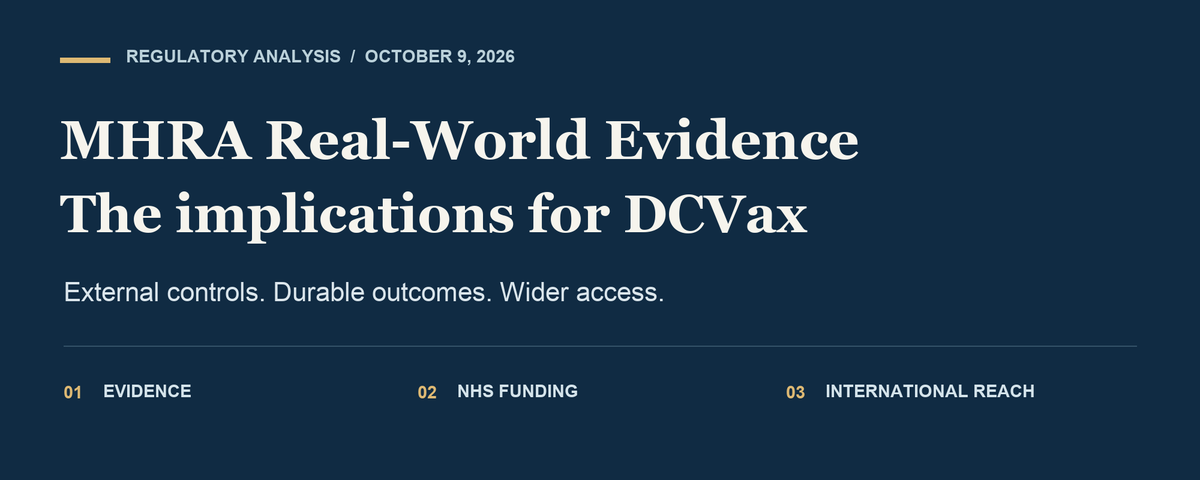
𝗠𝗛𝗥𝗔’𝗦 𝗢𝗖𝗧𝗢𝗕𝗘𝗥 𝟵 𝗨𝗣𝗗𝗔𝗧𝗘: 𝗗𝗖𝗩𝗮𝘅
𝗪𝗛𝗔𝗧 𝗖𝗛𝗔𝗡𝗚𝗘𝗗
On October 9, 2026, MHRA published its real-world evidence (RWE) hub and linked its July 2 data-requirements paper, which was not revised that day. The hub names no company or application, but it says many external-control principles would be relevant to completed-trial controls, the kind DCVax-L used.
The 2021 real-world-data (RWD) guidance is established; the May 2025 external-control guideline remains a draft, with consultation ending in July. The hub joins methods for assessing existing comparisons with requirements for the next evidence.
The July paper supports RWD for licensing where randomisation is impractical or unethical. It says linked data from the £600 million Health Data Research Service, announced in April 2025, could support earlier, more flexible approvals.
𝗖𝗟𝗜𝗡𝗜𝗖𝗔𝗟 𝗘𝗩𝗜𝗗𝗘𝗡𝗖𝗘
DCVax-L is under MHRA review, per Northwest. Its phase III randomised 331 patients 2:1 across four countries; 64 of 99 placebo patients crossed over after recurrence. The revised survival analysis used external trial controls: independent York Health Economics Consortium selected 1,366 newly diagnosed and 640 recurrent controls using 14 prespecified matching criteria, and substituting those controls into the 15 source trials reproduced whether each met its original endpoint.
In newly diagnosed glioblastoma (GBM), median survival from randomisation was 19.3 versus 16.5 months, and five-year estimates were 13.0% versus 5.7%. From recurrence, median survival was 13.2 versus 7.8 months.
The original randomised progression-free-survival comparison found no benefit: 6.2 versus 7.6 months, p=0.47. Readers disagreed on 256 of 494 possible-progression imaging time points, and investigators describe difficulty distinguishing progression from treatment-related changes. The survival case depends on a fair external comparison.
MHRA’s draft prefers randomisation where feasible and accepts convincing alternatives. Barriers, delay and objective endpoints matter; late controls need justified selection, and multiple comparators test robustness. Effect size matters too: large, durable effects are more interpretable than differences readily explained by selection.
Propensity-score matching (PSM) pairs patients with similar pretreatment probabilities of receiving treatment. INSIGhT tested it in newly diagnosed MGMT-unmethylated glioblastoma: external and randomised controls had comparable survival (HR 0.99; 95% CI 0.76–1.28). This tests the method, not DCVax’s effect, and needs adequate confounder data. In that setting, propensity-matched external controls recovered the randomised trial’s no-benefit result for three drugs.
Without individual control records, the original publication used matching-adjusted indirect comparison rather than PSM. Northwest’s July 8, 2026, report from the British Neuro-Oncology Society conference used newly obtained records: PSM and inverse-probability weighting produced survival differences of 3.4–6.3 months versus the original 2.8, with sensitivity analyses for unmeasured confounding. These are company-reported conference analyses, not a peer-reviewed paper. The signal persisted.
By June 2023, Northwest reported about 600 GBM patients treated, roughly 300 beyond phase III’s 296 in earlier trials or compassionate use, plus tens with other cancers. Its anecdotal compassionate observations cover patients into their late 80s, new batches after re-resection and continued use of an original batch after recurrence.
At the December 29, 2025, annual meeting, management cited hundreds of compassionate-use patients and their growing RWD value, and planned access across most solid tumours, later with Direct. Those records can inform safety, durability, re-treatment and further uses. Evidence work starts with patients already treated.
𝗧𝗛𝗘 𝗡𝗛𝗦 𝗦𝗘𝗤𝗨𝗘𝗡𝗖𝗘
Two NHS developments came just before the hub. On October 6, 2026, Jessica Curtis’s 12:35 Cancer Vaccine Launch Pad (CVLP) talk preceded Marnix Bosch’s 12:55 keynote; CVLP refers NHS patients into supported vaccine and immunotherapy trials.
On October 8, NHS Blood and Transplant (NHSBT) and Northwest announced a collaboration after months of joint work. NHSBT teams collect immune-cell starting material and support processing and handling, initially in Leeds and Oxford, with phased expansion explored.
Northwest had reported leukapheresis delays and announced a dedicated clinic in April. NHSBT addresses that bottleneck; timely collection and treatment are measurable gains.
𝗧𝗛𝗘 𝗕𝗜𝗢𝗟𝗢𝗚𝗬
DCVax puts the patient’s cancer into the treatment’s design. DCVax-L loads prepared dendritic cells with broad patient-derived tumour antigens; presentation, costimulation and cell function shape the T-cell response. DCVax-Direct is designed to acquire tumour information within inoperable tumours, which can be unsuitable for surgery yet reachable by an image-guided needle.
Each product and indication establishes its clinical case. Tumour information changes with the patient; manufacturing knowledge and delivery infrastructure can carry across uses.
𝗧𝗛𝗘 𝗗𝗔𝗧𝗔 𝗚𝗔𝗣
The July paper identifies missing hospital prescribing, including personalised medicines, in linked Clinical Practice Research Datalink health records: a death may be recorded while the treatment is missed. All-cause mortality is potentially measurable, directly relevant to DCVax-L’s survival outcome.
Collection, release and administration records distinguish cells obtained, product available and treatment received. Link them, with process version and dosing, to baseline health, other treatments and follow-up, in complete, dated cohorts with comparators. Patient-reported outcomes, imaging, tumour response and service use complete the clinical and economic record; collect missing quality-of-life and cost measures prospectively.
MHRA assesses fitness for the question: no universal regulatory-grade threshold exists, and imperfect records can support decisions. Establish what the evidence answers and collect what resolves uncertainty.
Retain patients who deteriorate before treatment and align survival starting points to avoid selection and immortal-time bias. Measure waiting times, geography, collection and manufacture, and the proportion reaching treatment.
Lawful basis, health-data protections and access controls govern linkage. The Data (Use and Access) Act 2025’s data-protection provisions, all in force by June 19, 2026, clarify commercial research and broad research consent.
𝗤𝗔𝗟𝗬𝘀 𝗔𝗡𝗗 𝗗𝗨𝗥𝗔𝗕𝗜𝗟𝗜𝗧𝗬
A quality-adjusted life year (QALY) combines survival and quality of life: one year in full health or two years at a health weight of 0.5 equals one QALY. NICE compares added QALYs with added NHS costs against usual care, including add-on treatment.
Hypothetical, not DCVax data: 2 years × 0.6 = 1.2 QALYs; 4 × 0.8 = 3.2, a gain of 2. At £40,000 added NHS cost, one extra QALY costs £40,000; two cost £20,000 per QALY.
SI 2026/202, effective March 24, 2026, enabled ministerial direction of NICE’s thresholds, and on April 2 NICE implemented £25,000–£35,000 per QALY for new and ongoing medicines evaluations. That range is a value benchmark, not a product price, and greater benefit carries the example below it.
A median captures one point on a survival curve. Long-term survivors add QALYs beyond a modest median difference, so model DCVax-L’s five-year estimates alongside its 2.8-month median difference, with credible controls and complete follow-up.
Severity weighting measures future health lost under current care against people of the same age and sex without the condition. Eligible populations receive QALY weights of 1.2 or 1.7: £40,000 for one added QALY becomes about £33,333 or £23,529 per weighted QALY. Establishing the applicable weight belongs in the GBM value case.
The DCVax-L paper reports five possibly treatment-related serious adverse events across 2,151 doses. An appraisal models the full balance: longer survival can add care costs, while demonstrated tolerability and fewer admissions or later treatments can improve quality of life and reduce costs.
NICE discounts costs and benefits at 3.5% yearly. It may consider 1.5% for both for sustained restoration of full or near-full health in people otherwise facing death or a very severely impaired life, with highly plausible long-term durability and irrecoverable costs addressed. Durable benefit changes how future gains count.
𝗡𝗛𝗦 𝗥𝗘𝗜𝗠𝗕𝗨𝗥𝗦𝗘𝗠𝗘𝗡𝗧
MHRA assesses quality, safety and benefit-risk; NICE assesses comparative benefit and value. DCVax-L’s ID836 appraisal for newly diagnosed glioblastoma is listed in progress, with publication to be confirmed. The company submits clinical and economic evidence to NICE and negotiates NHS England terms, often a confidential effective price.
Licensing runs one clock; funded access runs a second. Northwest reported contracted reimbursement consultants and first-stage work by November 2024, and its annual report identifies upfront per-patient manufacturing costs and potentially different reimbursement arrangements. NICE can publish draft guidance before authorisation; aficamten’s cost-comparison appraisal produced final guidance alongside licensing, even outside formal aligned scheduling. ID836’s latest note records Northwest’s focus on the MHRA application and gives no completion date, and management’s stated launch plan did not wait for reimbursement. Evidence, terms and delivery can advance together during MHRA review.
A routine-use recommendation normally creates a funding duty within 90 days. Cancer Drugs Fund (CDF) interim funding can begin after authorisation and a positive draft recommendation, whichever is later; transfer to routine budgets normally follows positive final guidance by 90 days, or 30 for specified Early Access to Medicines Scheme (EAMS) or cost-comparison cases.
Missing training, facilities, materials or staff can justify longer funding implementation, so NHSBT’s operational role matters to how quickly a favourable decision reaches patients.
𝗙𝗨𝗡𝗗𝗘𝗗 𝗘𝗩𝗜𝗗𝗘𝗡𝗖𝗘
Managed access funds medicines with plausible cost-effectiveness potential and important uncertainties that further evidence can resolve, including outcomes collected during clinical practice. England’s CDF combines a data-collection agreement with commercial terms, collecting for the shortest sufficient period, up to five years, before reassessment. An unfavourable result ends new-patient managed access, while existing patients follow agreed continuation arrangements; successful reassessment supports routine funding.
TA872 is an autologous cell-therapy precedent: axicabtagene ciloleucel moved into routine NHS use for a defined lymphoma population after assessment of trial follow-up, NHS Systemic Anti-Cancer Therapy (SACT) outcomes, costs and commercial terms. NHS outcomes were comparable with the trial.
A treated/untreated registry supported Soliris expansion within paroxysmal nocturnal haemoglobinuria; Yescarta’s SCHOLAR-1 pooled two trials and two observational studies; Kymriah used three external datasets. A DCVax trial, registry or managed-access programme can connect access, production and evaluation, building the evidence for the later funding decision.
𝗛𝗢𝗦𝗣𝗜𝗧𝗔𝗟 𝗣𝗔𝗬𝗠𝗘𝗡𝗧
Hospital payment requires an eligible medicine and indication, Blueteq patient approval, and complete monthly costs through the Drugs Patient Level Contract Monitoring dataset (DrPLCM). Missing or late required SACT records can block cancer-drug payment, while prior-approval forms enter the medical record and may inform later NICE evaluations: documentation supports both payment and future appraisal.
NHS systems link Blueteq and SACT by NHS number and check vital status. SACT’s wider collection includes EAMS, but the CDF evaluation cohort excludes treatment begun before CDF entry. SACT can answer agreed uncertainties when no trial continues.
Providers claim eligible costs at the NICE-approved price on NHS England’s portal; NHS England validates and reimburses, and supply contracts pay manufacturers. DCVax’s contract must define the unit: batch, course, doses or another basis.
Drug reimbursement excludes delivery, preparation on-costs, homecare handling and associated services, so assign funding for collection, processing, transport, administration and follow-up, accounting for what the product contract covers. A funded cell therapy needs a funded delivery pathway, and NHSBT and Advent make its capacity, responsibilities and costs assessable.
NICE counts relevant additional costs, with justified supplementary apportionment for established service-change plans, formal agreements or multi-use technologies. Demonstrated shared use and cost allocation matter to a platform’s economic case.
𝗥𝗔𝗥𝗘 𝗖𝗔𝗡𝗖𝗘𝗥𝗦
Without an established anticancer therapy, the comparator is best supportive care, existing management or relevant treatments. That care has measurable survival, quality of life and costs, and natural-history data and prospective follow-up can establish the comparison.
NICE’s Highly Specialised Technologies route starts at £100,000 per QALY but has narrow criteria: prevalence at most 1 in 50,000 in England, at most 300 eligible people, and additional disease and technology requirements. Repurposing and indication extensions face restrictions, so later platform uses cannot simply inherit this threshold. DCVax-L already has a standard appraisal route, where added health and the applicable severity weighting build its case.
𝗘𝗔𝗥𝗟𝗬 𝗔𝗖𝗖𝗘𝗦𝗦
DCVax-L received the first UK Promising Innovative Medicine (PIM) designation in September 2014, for all malignant gliomas, newly diagnosed and recurrent, including lower grades. PIMs reflect promise at designation but do not expire under current guidance, and a broad PIM within a defined condition can support successive scientific opinions for treatment lines or combinations without another PIM. Any new opinion follows current EAMS rules; DCVax-L’s malignant-glioma scope provides the starting point.
EAMS became statutory on April 15, 2022. SI 2022/352 regulations 167C and 167H permit quality, safety and efficacy data collection without separate trial authorisation where MHRA agrees and consent is documented. Refusing data consent must not cost treatment, and data protections and other approvals remain. EAMS generally expects six months’ supply before authorisation or indication extension; NHS services still need funding, but the company supplies free medicine, including agreed winding-down.
Other compassionate supply has distinct legal and payment routes, including Specials and hospital exemption. England’s Individual Funding Requests (IFRs) require clinical exceptionality, evidence of effectiveness and good resource use, and its commissioning list names murcidencel as not routinely commissioned, with access as per IFR approval: a named route for qualifying patients.
𝗢𝗙𝗙-𝗟𝗔𝗕𝗘𝗟 𝗨𝗦𝗘 𝗔𝗡𝗗 𝗡𝗘𝗪 𝗜𝗡𝗗𝗜𝗖𝗔𝗧𝗜𝗢𝗡𝗦
A first licence would open off-label prescribing beyond the approved indication where clinically justified. Prescribers need evidence or experience, informed consent, records, monitoring and adverse-reaction reporting. MHRA’s Specials hierarchy favours a suitable licensed product, even off-label, over an unlicensed alternative; cost or convenience alone cannot justify a Special.
Off-label prescribing concerns use of the licensed product: it does not waive manufacturing or quality requirements, Direct is separate, and it does not create routine NHS funding. Reliable outcomes can support the next indication. Under current trial-specific risk rules, MHRA recognises robust RWD randomised trials for label changes, where a known safety profile can keep safety-data collection minimal.
A new indication uses a Type II variation under a 120-day assessment procedure, with calendar timing affected by validation and responses. With the holder’s agreement, a standard authorisation can become conditional where benefit-risk is positive, need is unmet, comprehensive data are expected later, and immediate-access benefit outweighs evidential risk; obligations and annual reassessment then focus on the new indication. Unmet need includes major advantage over an existing therapy, so better outcomes matter to conditional authorisation as well as reimbursement.
For a qualifying use, the sequence runs: optional EAMS access and data → an indication variation with conditional obligations → NICE appraisal and possible managed access. EAMS ends or winds down on the licensing decision. Guidance added the new-indication section in January 2026 and clarified procedures later that year. The May 2026 Investigational Marketing Authorisation proposal still requires legislation; conditional authorisation already exists.
𝗦𝗔𝗨𝗗𝗜 𝗔𝗥𝗔𝗕𝗜𝗔
The Saudi Food and Drug Authority (SFDA) issued its final RWD/RWE framework on April 20, 2026, and implemented it on July 20. It recognises propensity scores, external comparators and transportability: local covariate data can support transferring effects from multi-regional trials to Saudi patients.
SFDA’s New Accelerator Program for Drugs in Rare Diseases (NADR), implemented September 5, 2026, covers pharmaceuticals and biologics for rare, life-threatening or seriously debilitating conditions affecting fewer than 5 in 10,000 Saudi residents, with unmet need or significant clinical benefit. Products can qualify during development, and UK approval is not required to seek designation.
SFDA states it will assess a complete designation submission within 20 working days. Designation comes first; the framework calls for the marketing application within six months. NADR recognises prior platform knowledge, natural-history comparators where concurrent controls are infeasible, and priority, rolling and conditional review options, and its form expressly asks for compassionate/specials-use history.
For unregistered UK sites, inspection will not bar registration when specified GMP documents, reports and fees are supplied. Ordinary FDA/EMA reliance routes exclude advanced therapies; NADR has its own eligibility and quality requirements. The clinical records and UK manufacturing dossier have a defined Saudi role.
EU orphan designation dates to 2007, with sponsorship transferred to Northwest’s German subsidiary in 2012, and EMA’s historical EU glioma estimate was about 1 in 10,000. SFDA judges Saudi prevalence and unmet need; that designation history, with the 2014 UK PIM, belongs in the dossier.
Northwest’s non-binding August 6, 2026, SPIMACO MOU contemplates DCVax-L’s Saudi application, commercialisation, supply, revenue sharing and separate technology-transfer/local-manufacturing agreements. Northwest retains IP; additional indications and Gulf Cooperation Council territories are contemplated. Definitive agreements and Saudi approval and payment decisions are required. A prospective partner connects the evidence strategy to commercial expansion.
𝗠𝗔𝗡𝗨𝗙𝗔𝗖𝗧𝗨𝗥𝗜𝗡𝗚 𝗔𝗡𝗗 𝗧𝗥𝗜𝗔𝗟𝗦
Advent brings manufacturing inside Northwest. Management said Sawston’s two Grade B suites could support initial launch before Grade C expansion. Changes and in-licensed technologies need traceability and comparability; Eden aims to expand capacity and reduce manual work.
Since July 23, 2025, SI 2025/87 provides for eligible point-of-care and modular manufacture with a licensed control site and product-specific master files. Point-of-care requires a need to manufacture near use; modular deployment requires relocatable units and an MHRA determination. NHSBT collection and Eden automation alone do not establish eligibility. Wider deployment can retain central quality accountability.
Clinical-trial reforms from April 28, 2026, provide combined MHRA and ethics review, normally with an initial decision within 30 days of validation; requests for information or conditions can follow. Advanced therapies retain full review and are excluded from automatic authorisation. Prior UK dossiers for the same product can be cross-referenced, retaining trial-specific manufacturing and labelling documents, so knowledge carries forward within each distinct L or Direct programme.
UK law requires ICH GCP principles with regard to relevant annexes, including trial-system and laboratory oversight. E8 covers quality by design; E6(R3) Annex 2 covers pragmatic, decentralised and routine-data elements (EMA from January 15, 2027); M14 covers non-interventional safety studies; E23 effectiveness work continues.
Integrated MHRA–NICE Scientific Advice joins regulatory and economic planning. The separate RWE Scientific Dialogue excludes products already in UK regulatory or health technology assessment.
𝗙𝗢𝗨𝗥 𝗡𝗛𝗦 𝗦𝗬𝗦𝗧𝗘𝗠𝗦
Since January 1, 2025, MHRA licensing is UK-wide under Windsor arrangements, but NHS funding remains nation-specific. Wales normally implements positive NICE recommendations within 60 days of final draft guidance. Its individual funding policy excludes retrospective funding and applies a different-circumstances test to rejected or out-of-policy uses; unappraised interventions need likely significant clinical benefit and reasonable value.
Scotland uses Scottish Medicines Consortium appraisal, with patient and clinician engagement for rare or end-of-life conditions and interim acceptance routes; Northern Ireland endorses NICE appraisals.
𝗥𝗘𝗦𝗘𝗔𝗥𝗖𝗛 𝗔𝗡𝗗 𝗗𝗔𝗧𝗔 𝗜𝗡𝗙𝗥𝗔𝗦𝗧𝗥𝗨𝗖𝗧𝗨𝗥𝗘
Public research funding has its own role: NHS England funds CVLP infrastructure, NIHR funded ImmunoTACE’s dendritic-cell study, and NIHR’s Efficacy and Mechanism Evaluation (EME) programme accepts eligible proposals.
Cell and Gene Therapy Catapult leads the advanced-therapy Centre of Excellence in Regulatory Science and Innovation. The September 2026 next-generation competition prioritises personalised care and novel platforms; any Northwest award or partnership would require its own agreement.
A UK Study-A-Thon demonstrated distributed analysis, shared formats and the importance of coverage and local knowledge. MHRA’s data strategy and European and pharmacovigilance research reinforce the same requirements: governance, access, expertise and resources.
𝗧𝗛𝗘 𝗣𝗟𝗔𝗧𝗙𝗢𝗥𝗠 𝗜𝗠𝗣𝗟𝗜𝗖𝗔𝗧𝗜𝗢𝗡
Per-patient value and total budget are distinct, so align the evidence plan and the funding proposal: product, use, price, eligibility, delivery and service costs. Analyse independently and report transparently.
DCVax supplies the patient-specific antigen strategy; Advent supplies manufacture; NHSBT supplies collection and handling.
The paradigm shift: personalised treatment generates evidence, demonstrated benefit strengthens funding, and accumulated knowledge supports the next application for wider access.


Sentiment Stocks retweeted

$NWBO
Welbeck update of sorts....
How do you say approved without saying APPROVED!
lnkd.in/p/gK9GwMwY

Sentiment Stocks retweeted
The $NWBO #DCVax platform is antigen agnostic. It works on every disease.
Steinman spent a career proving that the elegant addressed vaccine was the answer. His own cancer proved he'd asked the wrong question. The cell that won't respond to the perfect address isn't broken, it's converted. Irreversibly. So the solution isn't to address it better. It's to replace it.
He discovered this by using manufactured cells on himself and getting four and a half years instead of six months. Then he refused to publish it as evidence, because one patient isn't a trial. He had spent decades arguing that mail delivery was the problem to solve. His own body proved the problem was that the recipient had moved and had no intention of moving back.
One platform. Any payload. Built outside the field, delivered inside the body, instructing once.
#DCVaxForBraelyn
nitter.gq/andrewcaravello/status…

Sentiment Stocks retweeted
I started finding more long-term survivors.
This was probably the biggest change in my thinking.@ThomasOwenMcCa1 wasn’t alone.
Brad Silver received DCVax-L in one of the earliest trials after being diagnosed with GBM in his early 30s. He’s now a 23-year survivor.
Jamil Newirth was diagnosed at 32 and given approximately 17 months to live. He received UCLA’s personalized dendritic-cell vaccine and was profiled by UCLA more than a decade later, alive and thriving.
Sarah Rigby was diagnosed with GBM in 2011 and has been documented more than 15 years later as a long-term DCVax patient.
Nigel French was diagnosed with GBM in 2015, entered the DCVax-L trial at King’s College Hospital and was subsequently documented in long-term remission.
Kat Charles was diagnosed with grade 4 GBM in 2013 and at one point was told she had only three months to live. She later obtained a personalized dendritic-cell vaccine and continued receiving maintenance booster injections. More than a decade later, hers remains an extraordinary long-term-survivor story.
And I found other early UCLA dendritic-cell-vaccine survivors, including Jennifer Sugioka, Elijah Luyten and Gallia Kistler.
Suddenly Thomas didn’t look like one isolated anomaly anymore.
I was finding a group of people who had received this type of dendritic-cell vaccine and experienced extraordinary survival — 10 years, 12 years, 20-plus years — including patients with many years without recurrence.
And there is something especially important about these early survivors:
Many of them didn’t receive Hiltonol.
Some were treated years before the later UCLA study combining dendritic-cell vaccination with poly-ICLC.
In other words, the extraordinary long-term survivors already existed before these newer combinations were being used.
And that made the newer research even more exciting to me.
If some patients became 10-, 15- and even 20-plus-year survivors with the earlier vaccine approaches, what might be possible if researchers can now strengthen that immune response even further?
That’s the question that gives me hope.
Then came Marnix Bosch’s July 3, 2026 presentation.
At the British Neuro-Oncology Society meeting, Bosch presented new analyses using individual-patient data that hadn’t been available for the original Phase III analysis.
Researchers were now able to match DCVax patients much more precisely with patients from three randomized GBM trials based on important prognostic characteristics.
Across several propensity-score-matching approaches, the estimated survival advantage associated with DCVax-L was 3.4 to 6.3 months, rather than the original 2.8 months. Other statistical approaches produced similar results.
Their overall conclusion was that the original analysis had likely underestimated the survival benefit associated with DCVax-L.
Was that encouraging to me?
Absolutely.
But I want to be honest: an extra handful of months still isn’t what gives me hope.
Whether the median advantage is three months or six months, I don’t want six extra months for my daughter.
I want her to live a long, full life.
What the newer analysis did was strengthen my confidence that DCVax has a real treatment effect and that its original benefit may have been underestimated.
But my hope comes from the long tail.
At five years, 13% of newly diagnosed GBM patients receiving DCVax were alive compared with 5.7% of the external controls — more than double.
And now I know of some of the people represented by that tail.
Brad.
Thomas.
Jamil.
Sarah.
Nigel.
Kat.
Jennifer.
Elijah.
Gallia.
Those are the people I think about.