

Asst Prof @UConn, PhD @psupolisci. Research on affective polarization, intergroup relations, state/local politics. Nutmeg State native. 🗽 🗳️ ⚾
Storrs, CT
Joined September 2018
- Tweets2.9K
- Following360
- Followers558
- Likes7.5K






Pinned Tweet
🚨 New article alert! 📈
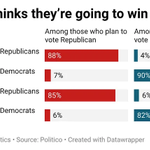
"Partisan Wishful Thinking in Polarized Times" is now out at @PolBehavior. Nearly 90% of today's voters expect their party to win, a sharp increase from two decades ago. Rising partisan animosity can explain much of the increase!
link.springer.com/epdf/10.10…

Excellent thoughts and write-up from @carlislerainey. Pretty much captures everything I'd say about AI!

This semester, I challenged my students to reflect on AI use in their research. This short essay sketches my own thinking.
PDF: carlislerainey.com/on-ai/car…

At first, agentic AI did not make me much faster bc it was mostly just good for data cleaning.
Now, I'm not faster because it's smart enough not to let me run cheapjack regressions w/o 400 careful robustness checks (and I'm smart enough to consent!).
Still, great for science!
Inspired by @DaveAHopkins' excellent post last week. When voters rate "performance" issues as more important than ideological issues, Congressional elections are less nationalized. This year is average historically, but more performance-oriented than 2024 or Trump's first term.

Excellent write-up of my new piece at @PolBehavior from @WakeUp2Politics. The title is particularly apt: "Everyone thinks they're going to win!" Link to the research below...
wakeuptopolitics.com/p/every…

"Partisan Wishful Thinking in Polarized Times," now online at @PolBehavior:
link.springer.com/epdf/10.10…

There is an epidemic of partisan wishful thinking.
More and more people expect their party to win.
Is that a problem?
Read the latest from @johnmsides: goodauthority.org/news/the-e…

My first national media quote, on the convicted CT bribe-guy who drove down to FL before sentencing, took a boat to the Bahamas, flew to London and then his native Greece and won't stop talking about it. (He is now angling for a Trump pardon, obviously.)
wsj.com/us-news/the-convicte…

Seth Warner retweeted

Today we're sharing some initial data on how Americans use Claude for politics, based on aggregated conversation data analyzed with differentially private methods. A couple interesting takeaways:
*Almost no one asks AI how they should vote*
About ~5.75% of conversations in the US touch on some kind of political or social issue in a recent one-week period, and less than 0.01% of conversations involve asking how to vote.
*Political conversations have many goals*
These conversations have wide-ranging goals, everything from research and writing assistance to learning, fact-checking, and arguing.
We are continuing to make progress on improving how Claude talks about these topics---steadily increasing our performance on our even-handedness evals and partnering with a range of outside organizations to develop new measures of political bias---and I hope that sharing information about the shape of these conversations will help people outside the company evaluate AI's political bias, accuracy, and other criteria in ecologically valid ways. I'd love to discuss this with people who are interested, as it was a huge priority for me before joining.
This was a big joint effort as part of our work preparing for the midterm elections @AnthropicAI.
Full post is here: anthropic.com/news/2026-us-m…


Seth Warner retweeted

PhD is learning that “open problem” can mean either “exciting research opportunity” or “people smarter than you already gave up.”
Partially related, but now that AI is producing more reviews, they really capture the cadence of a typical "rigorous" review...
Paragraph of qualified compliments, followed by two excoriating pages on small-to-trivial items before recommending revise.

Having reffed a dispiritingly bad AI slop paper, my bold/impractical suggestions are:
- As much AI as you want
- But 1 submission per year to a journal, so make it good
- A third-party org that gets reviews and "shops" qualified papers to appropriate journals

Very cool and interesting work!!

👵 Do pension expansions mobilise older voters?
➡️ @GanslmeierM, M. Klymak & T. Vlandas find that a 36% pension increase in Illinois had no effect on turnout, challenging expectations that material gains increase political participation doi.org/10.1017/psrm.2026.10…


Surprisingly easy to pick out political scientists from others at the Prudential Center. Older than the teens, poorer than the fin bros, richer than commuters.
Also s/o to all my colleagues trying to find something healthy from the protein bar/dried fruit aisle in CVS.
Glad we're talking about this. In addition to down-weighting homework, I am also reluctantly returning to pop quizzes.😥


Delighted to share my new work on issue ownership in @PRQjournal.
Issue ownership fascinates me b/c it's a partisan bias, just not THE partisan bias.
Here, I share evidence that when Rs (Ds) are in power, people think crime and fiscal (public health) conditions are better!


I've been thinking along these lines in light of Arday's tragic death, plus @Tyler_A_Harper's piece, and @AOC's comments on "Woke 1."
What is the best way to support equality, and acknowledge diversity, when the primary thing we should be doing is *our jobs*?


Notably, academic jobs are implicitly (just not explicitly) aligned w/ DEI principles. We consider varying perspectives, and try to articulate their value!
So, if we prioritize something over simply *doing that job,* we may inadvertently undermine diversity and equality!
