

Wait, why is it like that? 🤔 Everyday things you never questioned, explained in one post. New "why" every day.
Joined April 2010
- Tweets1K
- Following2.3K
- Followers1.9K
- Likes610





Pinned Tweet
Wait, why is it like that? 🤔
Every day I take one thing you've seen a thousand times and answer the question you never thought to ask.
Like: why do jeans have that tiny front pocket?
It was made for pocket watches. ⌚
Follow for a new "why" every day.
What should I explain next? 👇
🍔 Food Why
Wait, why does honey turn white and solid in the jar? Did it go bad?
Nope! Honey is packed with more sugar than the water in it can really hold. One of those sugars, glucose, slowly comes out as tiny crystals, and the jar turns thick and cloudy.
Honeys with more glucose set fast, and some barely set at all.
It crystallizes fastest at cool room temps, around 55–63°F (13–17°C).
To fix it, set the jar in warm water and stir. Go gentle, because too much heat can scorch it!

🌍 Nature Why
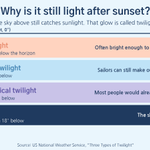
Wait, why is it still light out after the sun has already set?
Because the air high above you hasn't "seen" the sunset yet.
Up there, the atmosphere is still catching sunlight and scattering some of it back down to the ground.
Weather services call this twilight and split it into 3 stages by how far the sun has dropped below the horizon:
Civil (0–6°): often bright enough to skip the lights
Nautical (6–12°): sailors can still make out the horizon
Astronomical (12–18°): most people would already call it dark
Only once the sun is more than 18° down is the sky truly dark!

💸 Money Why
Wait, why is the "family size" pack sometimes the worse deal?
Because bigger doesn't automatically mean cheaper per unit.
A study of 38 New Zealand supermarkets found about 1 in 4 products cost more per unit in the larger pack. Other studies land somewhere around 10–30%.
It even has a name: a quantity surcharge. A sale on just the small size can flip things too.
Quick fix: compare the unit price on the shelf tag, not the size of the box!

🔍 Everyday Mystery
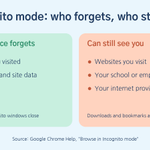
Wait, why doesn't incognito mode actually make you invisible online?
Because its job is only to forget things on your own device.
Once you close every incognito window, Chrome drops that session's history, cookies and site data.
But the websites you visit can still see what you do there. So can whoever runs the network, like your school, your employer or your internet provider.
And anything you download or bookmark stays put after you close it!

🧠 Body Glitch
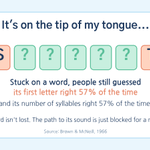
Wait, why can you feel a word "on the tip of your tongue" and still not say it?
The memory isn't gone. You know exactly what you mean, but the link from that meaning to the word's sound is briefly too weak to fire.
And you usually know more than you think. In a classic 1966 study, people stuck like this guessed the word's first letter right 57% of the time, and its number of syllables just as often. One person who blanked on "sextant" came up with "secant," "sexton" and "sextet" instead.
Those near-miss words are part of the problem. In diary studies, a wrong word that keeps popping back into your head made the real one take longer to show up.
It happens more often as we get older, but given enough time, almost every one gets solved!

🤯 Wait, What?
Wait, why do we wait for the tap to run hot before washing our hands? Does hot water actually get them cleaner?
Not really. In a 2017 Rutgers University study, 20 volunteers had harmless E. coli put on their hands, then washed in water at about 60°F, 79°F or 100°F (15, 26 and 38°C). The temperature made no real difference in how many bacteria came off.
Water you can stand just isn't hot enough to kill germs. The CDC says it would have to be hot enough to scald your hands. The real work is done by soap: it lifts oil, dirt and microbes off your skin, and scrubbing and rinsing carry them away.
So use whatever temperature feels comfortable, and spend the time on the lather instead. The CDC says to scrub for at least 20 seconds, including the backs of your hands, between your fingers and under your nails!

🔍 Everyday Mystery
Wait, why does your alarm still ring when your phone is on silent?
Silent mode isn't one master switch for every sound. Your phone keeps separate paths for calls, alerts, media and alarms. The silent switch and Do Not Disturb mostly quiet the ringer and notifications.
The built-in clock alarm is treated as the sound that has to get through, so on an iPhone it rings even with silent on. Android's Do Not Disturb usually lets alarms through too, unless you pick a "total silence" style mode.
One catch: third-party alarm apps don't always get that pass. And a dead phone won't wake anyone!

🍔 Food Why
Wait, why does popcorn jump out of the pot when it pops?
Each kernel holds a little water. Heat turns it to steam, and the tough hull keeps it trapped like a tiny pressure cooker. At about 180°C (356°F), almost every kernel gives way, and the starch puffs out into that white, fluffy shape.
The jump is the surprise. In 2015, French researchers filmed popping kernels with a high-speed camera. The kernel doesn't blast off on its steam like a rocket. A bit of puffed starch sticks out like a leg, presses against the pan, and springs it into the air!
And the "pop"? It isn't the hull cracking. The sound came a split second after the crack, so the team thinks it's the trapped steam rushing out.

🔢 Number Why
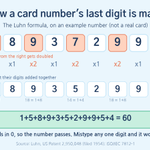
Wait, why can a checkout page tell you mistyped your card number before it even checks with the card company?
Because the last digit isn't random. It's a check digit, worked out from all the digits in front of it.
The recipe is the Luhn formula, from IBM researcher Hans Peter Luhn, who filed the patent in 1954. Starting from the last digit and moving left, double every second digit. If that gives a two-digit number, add those two digits together. Then add everything up. On a valid card number, the total always ends in 0.
Type one digit wrong and the total stops being a multiple of 10, so the page can flag it right away. It also catches most swaps of two neighboring digits (but not 09 typed as 90).
The front of the number has a job too: a 4 at the start usually means Visa, and 34 or 37 means American Express.
One catch: it's a typo check, not a lock. The formula is public, so passing it says nothing about whether a card is real!
Your phone's 15-digit IMEI number gets its last digit the same way.

Each part of a card number, broken down here 👇
gklibraryannex.com/en/p/card…

🧠 Body Glitch
Wait, why do you suddenly need the bathroom after being out in the cold, even when you didn't drink anything extra?
It has a name: cold-induced diuresis.
When cold air hits you, the blood vessels in your skin, hands and feet narrow so warm blood doesn't lose its heat. That's why your fingers go pale.
But that blood has to go somewhere. It crowds into your core, and the pressure in there rises a little.
Your body reads that as "too much fluid" and has the kidneys let some go. So they make more urine, and it's paler than usual.
That's why the urge hits right after you come in from the wind!
Two tips: keep your hands, feet and neck wrapped up, and don't cut back on water to skip bathroom trips. You still lose water in the cold, you just feel less thirsty.

The full explainer, with a couple more cold-weather tips 👇
gklibraryannex.com/en/p/cold…

🌍 Nature Why
Wait, why is there frost on the grass when the forecast low never hit freezing?
Because the forecast isn't measuring the grass. Official air temperature comes from a shaded box well above the ground: about 1.25 m (4 ft) up in the UK, and about 2 m (6.5 ft) at most US weather stations.
On clear, calm nights, the ground and grass pour their heat straight up into the sky. No clouds send it back, and no wind stirs in milder air. So a thin layer right at the surface ends up several degrees colder than the air at thermometer height, sometimes by as much as 10°F (about 5.5°C).
That's how the thermometer can read 36°F (2°C) while the grass blades drop below freezing. Water vapor touching them turns straight into ice, skipping the liquid step. That's frost!
It's also why many US weather offices issue frost advisories for lows in the mid-30s °F, and why a car parked under a roof stays clear while one out in the open turns white.

🔍 Everyday Mystery
Wait, why do people say to unplug your phone charger? Is it secretly eating power?
Barely. With no phone attached, the little circuit inside stays on standby, so a tiny trickle still flows. In the EU, small chargers have been capped at 0.1 watts with nothing connected since 2020.
Do the math: 0.1 watts for all 8,760 hours of a year is under 1 kWh. That's pocket change on a power bill, well under a dollar.
The better reason to unplug is dust. When it builds up between the plug and the outlet and soaks up moisture, tiny sparks can slowly char a path across and start a fire. It's called tracking. Pull the plug now and then and wipe it with a dry cloth.
And if a charger feels warm with nothing plugged into it, or the cable is frayed, swap it out!

🤯 Wait, What?
Wait, why do people bury a wet phone in rice? Does that actually help?
Not really. In a 2014 test, the phone-resale company Gazelle soaked sponges with 5 mL of water and left them for 24 hours in containers of different household drying materials. Uncooked rice pulled out the least water of the bunch: 4.0 mL. Silica gel got 6.1 mL.
The winner? A sponge just sitting out in the open air, at 7.6 mL!
A closed container traps the moisture, so the air inside gets damp and drying slows down. Apple's own support page also says not to put an iPhone in a bag of rice, because small rice particles can damage it.
What Apple suggests instead: unplug it, tap it gently against your hand with the port facing down, and leave it somewhere dry with some airflow. Wait at least 30 minutes before charging, and up to a day if it still shows a liquid alert.
🍔 Food Why
Wait, why does a tomato straight from the fridge taste so bland?
The sweet and sour part is fine. Cold barely touches a tomato's sugars and acids. What fades is the aroma: the smell compounds that drift up to the back of your nose as you chew and make it taste like a tomato.
A ripe tomato keeps making those aromas even after it's picked, but below about 12°C (54°F) that slows way down.
In a 2016 study, University of Florida and Zhejiang University researchers kept ripe tomatoes at 5°C (41°F). After one or three days, not much changed. After about a week, the aroma compounds were down roughly 65%, and a 76-person taste panel liked them less. A day back at room temperature only brought part of it back!
So whole tomatoes belong on the counter. If one is about to go soft, a couple of days in the fridge is fine.


🌍 Nature Why
Wait, why does the moon seem to follow your car?
It's not following you. It's just ridiculously far away, about 239,000 miles (384,000 km). Drive 100 miles in a straight line and the direction you see the moon in shifts by only about 0.02 degrees, a tiny sliver of its own width.
Nearby things are different. Roadside trees zip backward, faraway hills slide by slowly, and the moon barely moves at all. It's called motion parallax: the closer something is, the faster it seems to slip past as you move.
So your brain sees everything flowing backward except the moon, and decides the moon must be keeping pace with you!
Try it: hold up a finger and close one eye, then the other. Your finger jumps sideways, but the moon doesn't budge.


🧠 Body Glitch
Wait, why does your foot "fall asleep" when you sit on it too long?
The blood in your whole leg didn't stop. Your weight is squeezing a nerve, along with the tiny blood vessels that feed it, so the signals from your foot keep cutting out. That's the numb, is-this-even-my-foot feeling.
The prickly part starts when you move. Pressure off, blood back, and the nerve wakes up firing a flood of signals that your brain reads as pins and needles.
It even has a technical name: obdormition.
Fair warning: don't stand up on a foot you can't feel. Wiggle your toes and roll your ankle first, or you might twist it!
