
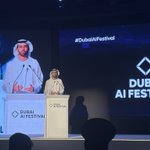




#DubaiAIFestival - kept the best post for the last. The first ever Federal Minister for AI appointed in 2017 that provided the political and strategic vision layer for UAE’s AI development - HE Sultan Al Olama highlighted how the AI focus in the UAE has moved from:
Computer vision and self driving cars to LLM and general purpose intel to now Agentic and Advanced intel.
From importing solutions to building Infra and now deriving economic value and exporting AI infra, solutions and sovereignty.
So Habibi if you have anything to do with AI - builder, investor, smart user - come to the UAE


The UAE was the first country to give AI an independent, federal portfolio with structures then developing across various ministries, Emirate level governments and the commercial sector. Minister of State’s portfolio was then expanded to include Digital Economy and Remote Works and now the National Data Office also is his remit.
Now several other countries have federal/high level AI officials but the UAE like integration is still WIP globally.
Good weather, silent nature, slow mornings and awesome food - all I need to get over the stress and anxiety of the last few months. And of course a shout out to #ArabianTeaHouse awesome hospitality.
#DubaiDiaries


Action packed next week…
27 October Israeli parliamentary elections - I will be watching the coalition arithmetic and Netanyahu’s ability to form the government
Iran-Mecca Pact diplomacy – Coming together with Israeli elections, are these negotiations a sign of a post-US-Israel-Netanyahu regional security architecture? As they say in the ME….Inshallah
Jordan - Syria dispute: Watch for the reopening of the strategic Nassib border crossing and formation of a joint security committee following Jordanian airstrikes in southern Syria. A key test of cross-border security cooperation and Damascus's efforts to reassert sovereignty over its fragmented south.
The Federal Reserve's decision on the inflation outlook and interest rates.
Alphabet, Microsoft and Amazon earnings - will demonstrate whether AI trade still remains marketable…
An overlooked event is the Chinese Communist Party’s (much delayed) last plenum before the leadership reshuffle in 2027.
The future stage is being set for …….Anthropic IPO. Will positive news from the Middle East, combined with the Fed keeping rates intact and the Mag 7’s strong earnings, boost market momentum in the next few weeks, much like the SpaceX run-up?
GCC Diaries:
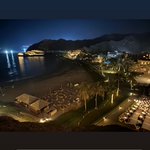
From dramatic mountains to stunning coastlines, my Dubai–Muscat road trip was a revelation! Three takeaways:
Inter-GCC travel is smooth, harmonised and super safe, especially for women travellers
The UAE and Oman’s natural beauty is stunning and underrated. From dolphin watching to snorkeling to beaches and hiking, we did all
As the world frets about a possible war, explore the GCC! And right now it’s not crazy touristy, so you get the history, culture, nature and hospitality at reasonable rates:).
Next stop is road trip to Doha. Any recos, please do message.


#DubaiAIFestival An interesting session with the rather elusive CEO of the UAE's AI giant, Group42, Peng Xiao. His points reinforced what I see as the UAE's future AI priorities: Sovereign, Scalable, Safe and Secure AI
Three trends stand out:
1. Sovereignty across the AI stack: From data and compute to chips, foundation models and applications. The federal target to transition 50% of government services and operations to agentic AI within two years creates enormous opportunities for innovation. So do mandates like AI-native governance within Abu Dhabi or the DIFC.
2. Exporting AI: The UAE is moving from building AI capabilities at home to exporting compute, infrastructure and sector-specific solutions. AIQ's (a JV between Presight and ADNOC) energy AI and G42/Khazna's international data-centre and AI hub partnerships illustrate this ambition. So does G42, Cerebras and MBZUAI (an AI university) partnership in developing NANDA, the largest Hindi-focused LLM.
3. Resilience and diversification: Geopolitical risks will drive distributed compute, trusted sovereign corridors, defence and space-tech protection, and greater overseas investment.
UAE is not aiming for technological autarky; rather, its aim is 'speed to market' - to assemble, connect, finance and export the AI stack' - quickly and efficiently.

While the world builds doomsday theories around the Gulf collapse, the UAE continues to proceed with its technology and AI agenda. Dubai AI Festival starts off with Head of Dubai Intentional Financial Centre talking about how DIFC will be AI-native by 2027.
#DubaiAIFestival


Gulf’s spirit of ‘every risk is an opportunity’ and every moment is to be lived is amazing. Here in Oman while tourism of course suffers and uncertainty prevails, service, hospitality and welcoming spirit has not dimmed a bit. It’s the same in the UAE.
They are not sitting and crying about the war and conflict - instead they are diversifying, making the most of it and believing and praying that this will soon be over.


This is a war crime. Who should be directly held responsible for it?

Residents across several UAE districts, including Dubai (Deira, Al Nahda, Mirdif, Al Mizhar, and Mudon), reported noticing again an unusual fuel-like smell, with some comparing it to petrol, diesel, or kerosene. This situation coincides with maritime intelligence Windward indicating that the damaged VLCC-size tanker Gem No. 2 is leaking oil 25 km off Umm Al Quwain, sending an oil slick drifting toward the Ajman and Sharjah coastline that risks reaching desalination intakes and ports by October 22 to 23 if the leak is not contained.
We are finally getting to our better weather in the GCC…..
Buckle up - here start the road trips.
First up - the beautiful city of Muscat this weekend….
In 2021, I wrote an article titled “U.S. Withdrawal from Afghanistan: Will Anything Collapse,” drawing on years of consulting work in Afghanistan.
I made three predictions that earned me considerable criticism (and sleepless nights:). Five years later, they are worth revisiting.
1. From sub-state militancy to state consolidation.
For decades, Afghanistan was a breeding ground for militant proxies, used as instruments of foreign policy and destabilisation by global and regional powers. Taliban's return marked the beginning of a shift towards consolidating state authority over sub-state groups, and potentially from forever wars to strategic peace in the Middle East
This was not endorsement of the Taliban's domestic governance or its treatment of women. It was an assessment of the changing geopolitical utility of the Afghan state.
2. The beginning of the US military-industrial complex's regional retrenchment.
It was Afghanistan in 2001 that started the new era of American military interventionism in the region, a decade after the Cold War ended. Its 2021 withdrawal signalled the beginning of the end of the forever-wars model. This was based on three trends that were then just consolidating
a) US’s (Western Hemisphere’s) growing energy self-sufficiency – meant that the ME’s hydrocarbons were no longer existential for the United States
b) US’s constrained ability to guarantee its global security architecture due to escalating debt levels, rise of China and outsourcing of critical manufacturing
c) Global order evolution from US-led unipolarity to China and multiple 'Global South' mid-power nodes
3. A tacit convergence of great-power interests.
My most controversial proposition was that major global and regional stakeholders had effectively reconciled to Taliban rule, viewing it as the only force capable of consolidating authority across Afghanistan and containing cross-border militancy.
I now see extension of Afghanistan across the Middle East.
· Syria: An insurgent movement transitioning into state authority, integrating or marginalising rival armed groups.
· US military posture: Growing pressures on America's regional military footprint.
· Strategic convergence: A convoluted alignment of interests around stabilising the Middle East, South Asia and Africa - not through ideology, but economic necessity.
After all, these regions are becoming central to the next economic order: AI, energy, critical minerals, data centres and trade corridors.
That’s why I always say that Nothing in geopolitics happens in isolation. The butterfly effect is real. Follow the direction of changes, not individual events.
Link in the comments.....

A few people have asked me about the protests in France. I generally avoid commenting on Europe because any structural critique is immediately labelled left, right, Islamist or conspiratorial.
But my controversial hypothesis is that France is only the beginning of prolonged civil unrest across Western Europe, representing a global power transition. Europe is increasingly becoming a battleground for three powerful, interconnected forces:
1. Transnational financial capital: The progressive vassalization of Europe by global financial interests, including those centred in America. From self-defeating energy and industrial policies to immigration and China relations, European governments have increasingly compromised their own economic sovereignty.
2. The military-industrial complex: As the Middle East's decades-old forever-war model faces pressure from resurgent nation-states and growing 'Global South' power, Europe is emerging as a new centre of gravity for militarisation, rearmament and prolonged security confrontation with Russia.
3. The tech-industrial complex: Technologies of surveillance, digital control and algorithmic influence could increasingly be brought home into Europe's own civilian structures. Add platforms like Musk's X, which can amplify polarisation, and the potential for social fragmentation becomes enormous.
My thesis: Europe's coming unrest is not left versus right, or natives versus immigrants, though it will be projected like this. It is symptomatic of a much larger global power reset - from decades of US-led unipolarity towards an emerging, contested multipolar order. AND Europe is the biggest battleground.
France may be the opening chapter, not the exception.
US and China have far more to lose from a global financial crash than from a gradual transition to a multipolar world order. I suspect there's more tacit cooperation between their elites than we acknowledge.
Look at the semiconductor sell-off.
China's CXMT announces denser memory chips. Micron, Samsung and SK Hynix tumble. Korea's KOSPI plunges over 6%. Nvidia and Cisco's optical-networking announcement adds to the rout.
Ironically, even CXMT's own shares fell 5% on its own news.
Meanwhile, memory makers' record profits rest on shortages that aren't disappearing overnight.
I believe China has the rug pull to collapse the US AI-led stock market, bond markets and even the commodity ecosystem. But China is deeply exposed to the same financial and tech complex as the US.
My bet: A messy, managed transition to a multipolar, nodal world order rather than an all-out financial collapse.
The rivalry is real. So is the mutual dependence
What I admire about the UAE’s tech ecosystem is its regulatory sandboxing approach: test technologies in controlled environments, learn from real-world deployment, and adapt regulations as innovation evolves. Unlike the EU’s tendency to regulate upfront, often stifling innovation, or countries that react too late with knee-jerk legislation.
Dubai’s experiments with autonomous electric passenger pods are an interesting example. Imagine small, on-demand, driverless vehicles using AI, cameras and sensors to move passengers along designated routes, bridging the gap between conventional mass transit and personalised mobility.
The larger point is about the evolution of Dubai as a global city.
No city can become truly global while relying overwhelmingly on private cars. Affordable, accessible and efficient public transport is essential, not just for sustainability, but for productivity, liveability and economic competitiveness.
The future of urban mobility isn’t simply more roads or more cars. It’s smarter ways of moving more people with fewer vehicles.
And Dubai appears to be experimenting with precisely that.
reuters.com/article/lifestyl…
