

Frontier Deployed Engineer & platform architect. 15+ yrs Node.js, React, TypeScript. RAG, AI agents, MCP, private LLMs, EV/OCPP billing.
Poland
Joined November 2010
- Tweets236
- Following69
- Followers43
- Likes13



Pinned Tweet
Hi, I'm Grygorii 👋 15+ years building Node.js/React/TypeScript systems: billing, EV charging (OCPP), solar IoT, video pipelines. Since 2023: RAG, AI agents, MCP and private LLMs.
Here: architecture, DB tuning, JS tricks.
Open to contracts → kylypko.com/en/

1
5
184
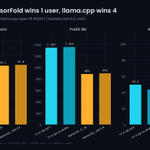
llama.cpp did 2x TensorFold's throughput on Hy4-flash.
Mac Studio M5 Ultra 256 GB, TF 4-bit vs llama.cpp Q4_K_M:
1 stream: 55.6 vs 42.2 tok/s
16K prefill: 1,342 vs 881
4 streams: 49.4 vs 95.0
TensorFold won every test on Qwen and GLM.
One user or several on your box?

2
2
66
Remix 3.3 is out: lazy frames, navigation events, a fake clock for tests
Released Nov 19. Frames get most of it: defaultResolveFrame lets you override fetch and commit, so apps can cache responses and animate navigations, redirects included. A new rmx:navigation event gives the initiating element, the destination and one completion promise through redirects, scroll and focus.
Below-the-fold frames can now load lazily near the viewport, with the fallback rendered on the server. prefetch() takes anchors and cancels stale prefetches, and updateUrl() puts local state in the URL without a fetch.
Outside the UI, remix/data-table rows have the same shape on every adapter (json parsed, booleans true/false, timestamps as Date), and t.useFakeTimers() now also fakes Date and performance.now().
𝚗𝚙𝚖 𝚒 𝚛𝚎𝚖𝚒𝚡@𝟹.𝟹.𝟶
My take: check data-table before bumping. If you worked around per-adapter row shapes, those workarounds may now break.
Would lazy frames replace client-side fetching for you?
#javascript #webdev

12
Same Mac, same model, 2.7x the speed.
Qwen3.8 Flash-Next 4-bit on a Mac Studio M5 Ultra (256 GB):
TensorFold (MLX): 154 tok/s
llama.cpp Q4 GGUF: 56 tok/s
16K-token prefill: 3,931 vs 1,400 tok/s.
Which engine runs your local models?
nitter.gq/smartyByte/status/2124…


4 local LLMs, 2 engines, one 256 GB Mac Studio.
Fastest: Qwen3.8 Flash-Next on TensorFold, 154 tok/s single, 237 across 4 streams
Biggest: Hy4 770B on llama.cpp, 17.7 tok/s at 209 GiB RSS
Every run, the method and the caveats: nitter.gq/smartyByte/status/2124…
2
3
100
Solid 2.0 is stable: 23 release candidates in 14 weeks, 971 PRs merged
Shipped Nov 17, five years after 1.0. The big change is async in the reactive graph: a computation can return a Promise or an async iterator, and everything downstream handles it. Race conditions are handled, optimistic state rolls back so the server stays the source of truth, and live() streams server functions over persistent connections.
The API got smaller: createResource, batch, startTransition, on, produce, createComputed and createMutable are gone. Dev builds report reactive mistakes with a stable code, source location and fix, and flag waterfalls and runaway effects. Router and cache are your choice, via framework-agnostic Vite plugins.
Try it:
𝚗𝚙𝚖 𝚌𝚛𝚎𝚊𝚝𝚎 𝚜𝚘𝚕𝚒𝚍@𝚕𝚊𝚝𝚎𝚜𝚝
My take: dropping createResource means every 1.x data-fetching path gets touched, so read the migration guide before bumping. 1.x stays on npm as solid-js@v1-latest, so there's no rush.
Would async in the graph change how you fetch data?
#javascript #webdev

19
Clef ran faster, then matched my labels on 27.5% of one field
M4 Max 64GB, 50 real prompts, req/min at 1 / 2 / 4 parallel:
Clef 7.2 / 7.37 / 7.16
Qwen3.8-27B 5.56 / 7.48 / 5.90
Interim label match: role 92%, seniority 74%, remote scope 27.5%.
Do you score quality per field?
2
39
Half my long translation requests returned only the title
Hy-MT2-7B, a 1,550-word article as one request: 40 of 80 came back with just the title. Every de→fr and en→ja stopped after 21 to 28 tokens.
Same text in 16 chunks: zero cut-offs.
Chunk by tokens or by paragraphs?
14
Rewrite it in Go? Only if RAM is the bill
Same JSON API, Node vs Go, 300 connections:
𝚊𝚞𝚝𝚘𝚌𝚊𝚗𝚗𝚘𝚗 -𝚌 𝟹𝟶𝟶
Throughput: tie. p99: tie.
RSS after load: Go 32 MB, Node 84 MB.
A scary 230 ms Node max? The memory sampler stealing CPU.
Would you port for 2.6x less RAM?
1
18
Full breakdown with code: reactapp.top/en/articles/nod…

12
5 dev roles I spotted this week (remote-friendly, mostly JS/TS + AI)
Railway — Senior Full-Stack Engineer · Remote, worldwide
jobs.ashbyhq.com/railway/6dd…
Mercury — Senior Full-Stack Engineer · US remote · $166.6K–$208.3K
job-boards.greenhouse.io/mer…
Netlify — Senior Software Engineer · Remote · $148K–$180K
job-boards.greenhouse.io/net…
ClickUp — Senior AI Engineer, Multi-Agent Frameworks · US remote · $200K–$250K
jobs.ashbyhq.com/clickup/b8f…
Ema — Full Stack Software Engineer · London (hybrid)
jobs.ashbyhq.com/ema/8207a75…
Not my openings, just a curated list. Which one would you apply to?
136
I benchmarked my local LLM stack on Mac Studios.
Hy-MT2-7B, 16 requests at once: llama.cpp 680 tok/s, LM Studio 520, mlx-lm 434, Ollama 170.
Qwen3.8-27B JSON, 8 at once: TensorFold 160.3 vs llama.cpp 87.1.
Charts and raw numbers in the article. What do you serve with?
9
6
231
full article with all the charts: nitter.gq/smartyday/status/21227…

34
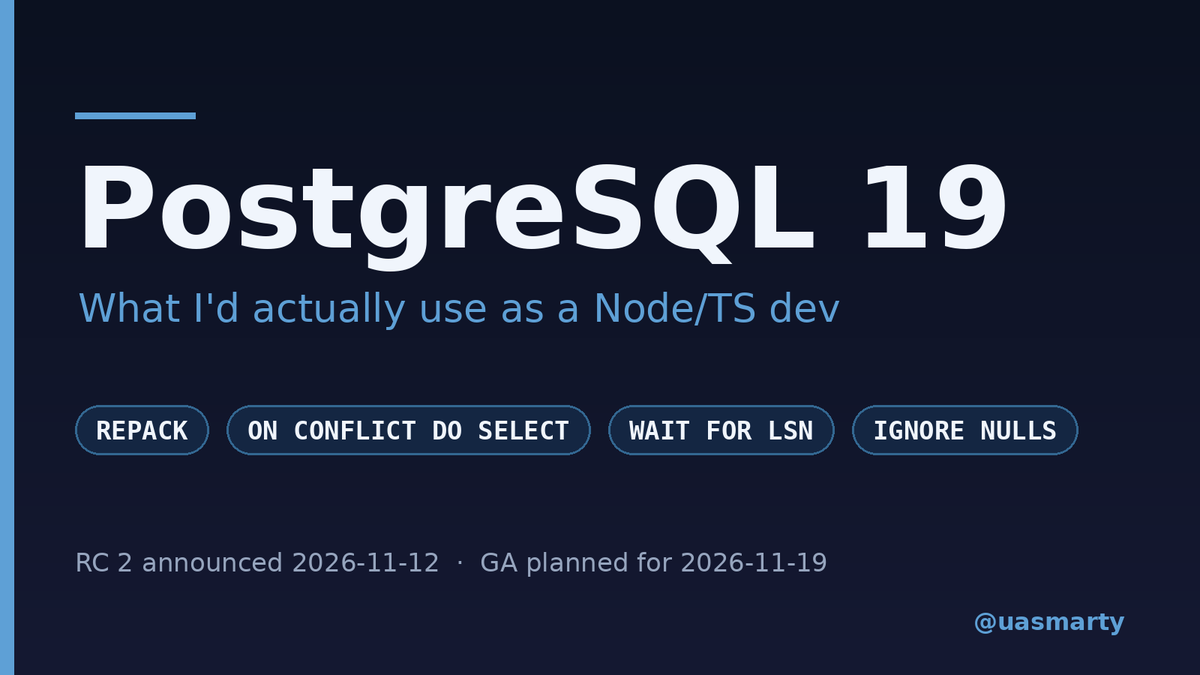
Every major Postgres release ships a long feature list, and most of it is for people who run the database for a living. I run Postgres for my own projects, and my day job is Node, TypeScript and React.
1
1
2,623
The scariest AI bug isn't a crash
30 days of AI-only code on a real SaaS. Its Stripe webhook:
𝚛𝚎𝚜(𝟸𝟶𝟶); 𝚍𝚋.𝚞𝚙𝚍𝚊𝚝𝚎(...).𝚌𝚊𝚝𝚌𝚑(𝚕𝚘𝚐)
Card charged. DB write times out. Account never upgraded. Stripe never retries.
Tests: green.
Would your review catch it?
2
28
Full breakdown with code: reactapp.top/en/articles/30-…

11