

solomontrader retweeted

You can't make this up.
The US Treasury just announced it is tripling long-term buybacks to $6 billion and yields STILL rallied on the news.
That means the US Treasury went from doubling, to "at least doubling," to tripling long-term bond buybacks and yields are still rising.
This puts the 10Y Note Yield above 4.85% for the first time since November 2023, up +15 basis points from pre-announcement levels.
The bond market is quite literally fighting the US Treasury as the Iran War continues, with the 10Y Note Yield nearing a +100 basis point move since the war began.
Without an end to the Iran War, we are on track to see the 10Y Note Yield above 5.00% by next week.
American consumers, homebuyers, and borrowers are in for a rude awakening.

solomontrader retweeted

The biggest Bitcoin miners on earth are quietly walking away from mining Bitcoin, and the reason is not the one everyone keeps repeating. They are not fleeing a dead business. They lost an auction for their own power, and the winner was artificial intelligence.
Start with the brutal arithmetic. It now costs the average public miner around $80,000 in cash to produce a single Bitcoin, and for stretches of this year $BTC traded below that. The most efficient operators on the cheapest power still clear a margin, but an estimated 15 to 20 percent of the global fleet is mining at a loss right now, burning more in power than the coins are worth the second they are minted. Three straight downward difficulty adjustments earlier this year, the first such streak since 2022, were the footprint of machines going dark.
That looks like a simple story of a broken business until you see the number that explains the exodus. The same megawatt of power that earns a Bitcoin miner roughly $1 million a year earns between $10 and $20 million a year hosting AI compute. Ten to twenty times more, for the identical electricity, substation, and cooling. What made industrial miners valuable was never the mining. It was the power contracts, the land, the grid interconnects. AI walked in and bid an order of magnitude higher for exactly those assets.
Mining did not fail. It got outbid for its own infrastructure. When Core Scientific runs its BTC segment at a negative margin while its AI colocation business prints money, the decision writes itself. CoinShares estimates listed miners could pull up to 70 percent of their revenue from AI by year end, up from about 30 percent. The power is being repriced to its highest use, and Bitcoin lost the bidding.
If the giants leave, what happens to the network they secured? The doom posts assume it weakens. It does not, because Bitcoin has a self-healing reflex written into its core. When miners switch off, blocks slow, and within two weeks difficulty automatically drops, which makes mining cheaper and more profitable for everyone still running. The security does not vanish, it relocates, and you can already see where. State-backed pools are appearing, with one Gulf operator reportedly standing up a national pool near 3 percent of global hashrate, alongside private fleets and the handful of public miners like Marathon still choosing to buy Bitcoin rather than lease their power away. The network even hit an all-time high above one zettahash this year as the pivot accelerated. It does not need any particular miner. It needs someone, somewhere, for whom the math still works, and cheap stranded power has no shortage of those.
But there is a deeper timer here, and the AI pivot just exposed it. Today miners earn almost everything from the block subsidy and almost nothing from fees, often under one percent of revenue on a quiet day. That subsidy halves again in 2028, and every four years after, marching toward zero. For Bitcoin to pay for its own security forever, fees eventually have to replace it. The open question is whether they can, and the evidence cuts both ways. On busy days, during token launches and inscription waves, fees have already spiked past 15 percent of revenue, and in 2024 some blocks earned more in fees than the entire subsidy. The capacity is there in bursts. Whether bursts become a baseline is the single most important unanswered question in Bitcoin. The AI exodus did not create that question. It pulled the cover off it years early, and showed how fast capital abandons hashing the moment something pays more.
So the honest read is not that AI kills Bitcoin mining. It is stranger than that. AI is the first bidder rich enough to reveal what Bitcoin's security was always quietly worth, and what it will cost to keep once the free coins stop coming.
The miners are not abandoning a sinking ship. They are selling the deck to a higher bidder while the same clock everyone forgot about keeps ticking underneath.
🤖 Made with AI
solomontrader retweeted

$SPCX - SPACEX IPO: THE BIGGEST BET IN MARKET HISTORY
SpaceX is really three businesses under one stock:
Starlink is the profit engine, generating $11.4B in revenue and $4.4B in operating profit in 2025. Subscribers grew from 2.3M in 2023 to over 10M by early 2026.
SpaceX Launches generated $4.1B in revenue but lost money due to massive investment in Starship, the rocket intended to dramatically lower launch costs.
AI (xAI + X) generated $3.2B in revenue but lost $6.4B in 2025, consuming all of Starlink's profits and more.
Without AI, SpaceX was profitable. With AI, it lost nearly $5B in 2025 and another $4.3B in Q1 2026 alone.
The IPO values SpaceX at $1.77 trillion, but only 4.3% of shares will trade initially. That limited float could drive strong early demand and volatility while making true price discovery difficult.
Retail investors are getting access to just 1.3% of the company, while insiders and major funds remain largely locked up. Those restrictions begin easing within months, potentially increasing selling pressure.
SpaceX will not immediately join the S&P 500, as it currently fails key inclusion requirements, delaying an estimated $14B of passive index-fund buying.
The biggest risk is valuation. At roughly 90x sales, SpaceX is trading at a premium far above the largest technology companies. Historical IPO research shows that highly valued, low-float, unprofitable IPOs often deliver strong first-day gains but weaker long-term returns.
The bullish case is simple: SpaceX dominates satellite internet and commercial launches, and Starship could reshape the economics of space. The bearish case is that investors are paying an unprecedented price today for profits that may arrive years from now.
Bottom line: SpaceX may become one of the most important companies of the century. But this IPO looks designed to maximize demand in the short term, while much of the future selling pressure arrives later. For retail investors, the excitement is obvious—the risk is whether today's valuation already prices in most of the future success.

solomontrader retweeted
$TSM | TSMC Q1’26 Earnings Highlights
🔹 Revenue: $35.90B (Est. $35.5B) 🟢; +40.6% YoY, +6.4% QoQ
🔹 Net Profit: $18.1B (Est. $17.0B) 🟢; +58.3% YoY
🔹 Gross Margin: 66.2% (Est. 64.5%) 🟢
🔹 Operating Margin: 58.1%; +9.6 pts YoY
🔹 Net Profit Margin: 50.5%
🔹 CapEx: $11.10B; +10% YoY
🔹 Wafer ASP: $7396; +10% YoY
🔹 EPS: $3.49 per ADR
Segment Performance:
🔹 HPC: 61% of net revenue; +20% QoQ
🔹 Smartphone: 26% of net revenue; -11% QoQ
🔹 IoT: 6% of net revenue; +12% QoQ
🔹 Automotive: 4% of net revenue; -7% QoQ
Other Metrics:
🔹 3nm: 25% of wafer revenue
🔹 5nm: 36% of wafer revenue
🔹 7nm: 13% of wafer revenue
🔹 Advanced technologies (7nm and below): 74% of wafer revenue
🔹 Wafer Shipments: 4,174K 12”-eq.; +28.1% YoY; +5.4% QoQ
🔹 North America: 76% of total net revenue
Capital Return:
🔹 Dividend: NT$6.00 cash dividend for Q4’25


solomontrader retweeted
France moved 129 tonnes of gold from the Federal Reserve Bank of New York to Paris between July 2025 and January 2026. Every ounce of French sovereign gold is now stored on French soil. The Banque de France sold non-standard legacy bars held in New York at record prices and simultaneously purchased equivalent compliant bars in Europe, booking a capital gain of 12.8 billion euros without changing its total reserves of 2,437 tonnes by a single gram. The transaction was described as operational, not political. But the outcome is political regardless of the motive: a founding NATO ally has removed 100 percent of its gold from American custody.
Germany did this between 2013 and 2017. Now France. The pattern is consistent: Western central banks are bringing their gold home from New York, quietly, without fanfare, while publicly maintaining that the moves are routine. Nobody repatriates 129 tonnes of sovereign metal across an ocean because the storage fees were inconvenient. They do it because the world that made New York the safest vault on earth is the same world that froze $300 billion in Russian reserves in 2022, and every central bank on the planet watched.
China has purchased gold for 16 consecutive months. February 2026 was the latest: one tonne, modest, disciplined, bringing total reserves to 2,308 tonnes valued at $387.6 billion, approximately 10 percent of total foreign exchange reserves. China has simultaneously reduced its US Treasury holdings by $638 billion. The buying is not speculative. It is architectural. Every tonne purchased and every Treasury sold moves the centre of gravity of China’s reserve portfolio from an asset that can be frozen to an asset that cannot.
India repatriated 274 tonnes to domestic vaults, bringing 66 percent of its gold home. It reduced US Treasury holdings by 18 percent in 2025. Poland added 20 tonnes in February alone and is targeting 700 tonnes total. Uzbekistan added 8 tonnes. The structural bid from central banks that watched the 2022 freeze is running at 863 tonnes per year with no sign of slowing.
Then there are the sellers. Russia sold 6 tonnes in February and approximately 15 tonnes in the first two months of 2026, the largest drawdown since 2002. The country that triggered the global repatriation movement by getting its reserves frozen is now selling gold to fund the war deficit that the freeze was supposed to prevent. Turkey sold 8 tonnes in February and utilised approximately 50 tonnes in March for lira defence and liquidity operations. The irony is precise: the war that proves gold’s value as a sanctions-proof reserve is simultaneously forcing the countries most exposed to sanctions to liquidate their gold to survive the war’s economic consequences.
The net global position remains positive. Central banks added 19 tonnes in February despite Russia and Turkey selling. The buyers outweigh the sellers. But the composition tells the story. The buyers are countries building sovereignty: China, India, Poland, Uzbekistan. The sellers are countries defending survival: Russia funding a war, Turkey defending a currency. And the repatriators are countries hedging trust: France and Germany bringing metal home from the vault of the ally whose financial weapons they watched deployed in 2022.
Gold is at $4,676 tonight and down 8 percent from its January high. The correction is the trade. The repatriation is the structure. And the structure says that the world’s central banks, collectively, have decided that the safest place for sovereign gold is no longer New York. It is home.

solomontrader retweeted
In 1974, Henry Kissinger brokered a deal with Saudi Arabia: price your oil in dollars, recycle the surplus into US Treasuries, and America guarantees your security. The arrangement was never a formal treaty. It was a handshake backed by aircraft carriers. For fifty years, every barrel of oil sold anywhere on earth created demand for the dollar that financed America’s debt. The system required two things to function: Gulf oil priced in dollars, and an American navy guaranteeing the strait through which that oil flowed. Both conditions held until February 28, 2026.
Iran closed the Strait of Hormuz. Not physically but operationally, by mining approaches, attacking tankers, and establishing an IRGC toll booth that vets vessels, charges in yuan or stablecoins, and escorts approved ships through the Larak corridor. Traffic collapsed 95 percent. The oil that still flows does not flow in dollars. It flows in yuan, settled through CIPS, paid to an organisation the United States designated as a terrorist group. Iran has exported over 11.7 million barrels to China since the war began, all in the currency of a country that claims neutrality. The petrodollar is not being challenged by a BRICS policy paper. It is being challenged by a toll booth.
The United States holds $39 trillion in gross national debt. That debt is serviceable because foreign governments buy Treasuries. Foreign governments buy Treasuries because they accumulate dollars. They accumulate dollars because oil is priced in dollars. If oil stops being priced in dollars, the demand that finances the debt weakens. Saudi Arabia’s Treasury holdings fell to $134.8 billion in January 2026, down $14.7 billion in a single month. The Saudis let the 1974 agreement lapse in June 2024 without renewal. The recycling loop that Kissinger built is loosening at the same moment that the strait through which it operated is controlled by a hostile military collecting tolls in a rival currency.
This is what the war is about. Not the nuclear programme, which was the stated justification. Not the missiles, which are the visible weapons. The war is about which currency buys the molecule that powers the global economy, and the answer to that question is being determined at a 34-kilometre chokepoint by an entity that charges admission in yuan. Every American strike on Iranian infrastructure degrades the capability to maintain the toll. Every barrel of Iranian oil sold to China in yuan during the war demonstrates the toll’s viability. The strikes and the sales are running simultaneously. The petrodollar and its replacement are being tested in the same theatre at the same time.
Trump’s Tuesday deadline is the enforcement mechanism. “Power Plant Day” is not about punishing Iran for closing the strait. It is about ensuring that when the strait reopens, the oil flows in dollars and the $39 trillion remains financeable. The F-35 sales to the UAE and Saudi Arabia are not arms deals. They are petrodollar anchors, binding Gulf security to American hardware that requires American currency. The rescue proved reach. The strikes prove capability. The F-35 contracts prove commitment. And the toll booth proves that all of it might not be enough.
The 1974 handshake held for fifty years. The 2026 toll booth has operated for five weeks. The question the deadline answers tonight is whether fifty years of dollar dominance or five weeks of yuan experimentation determines what comes next.
open.substack.com/pub/shanak…

solomontrader retweeted

I've stopped reading Gulf war headlines. Here's what I track instead.
We run an India-focused equity fund. 85% of India's crude comes from imports. Half of that normally passes through Hormuz. So yes — this crisis is personal.
But the information environment right now is garbage. Trump says the war ends tomorrow. Iran says Hormuz is shut forever. One analyst says $150 oil, another says $60. You can't build a portfolio view on this.
So I've narrowed it down to 4 signals. These are priced by people with real money on the line. They don't lie.
1. Ship insurance premiums through Hormuz
This is the single best signal. Lloyd's underwriters have billions at stake on every pricing call. Before the war, insuring a tanker through Hormuz cost 0.25% of the ship's value. Today it's 3.5–10% — and almost nobody is buying. A $100M tanker that cost $250K to insure now costs up to $10M. When this drops below 2%, the people with the most to lose are telling you it's getting safer. No press conference can replicate that.
2. How many ships are actually crossing
Every ship carries a GPS tracker (AIS). You can count exactly how many cross Hormuz each day. Before: 100+. Now: 8. That's a 92% collapse. You can't spin a ship being somewhere it isn't. Iran is letting some Chinese and Indian ships through, but it's a trickle. When this number crosses 30–40, trade is resuming. You can track this free on the WTO Hormuz Trade Tracker.
3. Paper oil vs real oil
This one most people miss entirely. Brent crude (the headline price) is at $112. But Dubai physical — what Asian buyers actually pay for delivered oil — is at $126. That's a $14 gap. It exists because Trump's comments keep pushing paper prices down. Traders call it jawboning. But the refiners buying cargo aren't getting any discount. If you're looking at Brent to assess India's oil bill, you're looking at the wrong number.
4. The mid-April cliff
Multiple emergency measures expire around the same time. The 400 million barrel SPR release runs dry ~April 15. The US waiver letting India buy Russian crude expires. Formosa Plastics has declared force majeure from April 1. Right now these stopgaps are keeping the supply gap at ~5 mb/d. Without them, BCA Research estimates it doubles to 10 mb/d — the largest crude disruption ever. If Hormuz doesn't reopen by mid-April, we're in uncharted territory.
Bottom line: track the insurance premium, the ship count, the paper-physical spread, and the April timeline. Everything else is noise.
solomontrader retweeted
Warren Buffett sat on CNBC on March 31 and did what he always does before markets break. He said nothing about a crash. He let the numbers speak. $373.3 billion in cash, the largest reserve any corporation has ever held. Thirteen consecutive quarters of net stock selling, the longest streak in Berkshire Hathaway’s history. $187 billion in net sales. And the Buffett Indicator, total US market capitalisation divided by GDP, at roughly 220 percent, exceeding the dot-com peak and any prior reading in the history of the ratio he popularised.
In July 1999 at Sun Valley, Buffett told a conference of the world’s wealthiest investors that when the Indicator approaches 200 percent, “you are playing with fire.” The NASDAQ fell 78 percent over the following two years. He did not predict the crash. He described the temperature. The building burned anyway.
The Indicator now exceeds 220 percent. And the fire this time is fed by one molecule: methane. The gas that generates 40 percent of US electricity, heats 47 percent of American homes, and feeds half the world through Haber-Bosch. The Hormuz crisis spiked TTF gas 75 percent and Brent crude to $107. Every S&P 500 company whose earnings depend on energy or supply chains is absorbing a war premium the Indicator has not yet priced. The 220 reading was calculated on pre-war earnings. Post-war earnings will be lower. The denominator shrinks. The ratio climbs.
Buffett does not predict crashes. He has said it for six decades. “Short-term forecasts are poison.” But he positions for them with discipline no other investor has matched. He bought during the 2008 panic with “Buy American. I Am.” He warned about derivatives as “financial weapons of mass destruction” in 2002, six years before they detonated the global financial system. And on March 31, he flagged Iran’s nuclear programme as a risk to markets, the first time the Oracle of Omaha has connected a Middle Eastern war to his valuation framework in a public interview.
The fire extinguisher is $373.3 billion in Treasury bills and cash equivalents. And the building is an S&P 500 where NVIDIA constitutes roughly seven percent of the index, where Oracle’s credit default swaps just exceeded 198 basis points surpassing the 2008 financial crisis peak, where OpenAI closed $122 billion at an $852 billion valuation on the same day the IRGC declared 18 American companies legitimate military targets. The AI trade that lifted the market to 220 percent on the Indicator runs on methane from a chokepoint that is 90 to 97 percent closed, helium from a Qatar facility that will take five years to rebuild, and rare earth minerals processed by the country hosting the peace negotiations.
Buffett sees what the market always prices last: the gap between the story and the molecule. The story says AI will change everything. The molecule says the gas that trains the model costs 75 percent more than it did five weeks ago. The story trades at 220 percent of GDP. The molecule trades at $107 per barrel. One of them is wrong.
Buffett has $373.3 billion that says he knows which one. The Oracle of Omaha and the Oracle of Hormuz have reached the same conclusion through different instruments. The fire is real. The exits are known. And the man with the extinguisher is not buying.
open.substack.com/pub/shanak…
solomontrader retweeted

I placed $1.5 billion in futures at 6:50 AM.
Fourteen minutes before President Trump's Truth Social post. That's generous. Usually, I get five.
The S&P was barely breathing. Premarket Monday. The kind of quiet where a single order echoes through the entire book. I bought $1.5 billion in futures. The index moved 0.3% on my entry alone.
That's how thin the market was.
That's how empty the room was.
At the same time, I shorted $192 million in crude oil.
Then I sat there. Three screens. One coffee. The futures blinking green on the left, the oil contract bleeding red on the right, and in the center, a Truth Social feed set to refresh every four seconds. Fourteen minutes is a long time when you know what's coming.
Not because I was nervous.
Because I was early.
At 7:04 AM, the president posted. Productive discussions. Five-day halt on strikes. Peace talks with Iran.
S&P jumped 2.5%. Oil cratered 6%. My position gained $60 million before most Americans' alarm clocks went off.
Good morning.
Iran later denied that the talks ever happened. Called it fake news. The speaker of their parliament accused the president of manipulating financial markets.
The talks might not be real.
The sixty million dollars is.
The analytics accounts flagged it within the hour. "Unusual activity." "Orders 4-6x larger than anything else trading at the time."
That's their word for it. Unusual.
My word for it is Tuesday.
They always flag it. That's their function. Flagging is not investigating. Flagging is the system's way of noting that it saw something, documenting that it will do nothing, and calling that process oversight.
The actual investigation is conducted by the CFTC. The CFTC has one commissioner. Out of five seats. One.
The other four chairs are empty. Not vacant. Emptied. There is a difference. Vacant means nobody applied. Emptied means somebody decided the body responsible for policing futures markets should not have enough members to hold a vote.
That's not negligence. That's architecture.
You know what we call this pattern on the desk? TACO. Trump Always Chickens Out. Escalate on Friday, capitulate on Monday, and extract in the window between the decision and the post.
It's so reliable, we named it. We have a private Slack channel. #taco-tuesday. It updates automatically when Truth Social pushes a new geopolitical keyword.
We don't teach it as insider trading. We teach it as a market structure. New analysts learn it in their first week. By the second week, they stop flinching.
The phone rang at 6:47 AM. Three minutes before I entered the position. The call lasted ninety seconds.
Ninety seconds of context. $60 million of outcome.
You call that insider trading. I understand why. Insider trading is the word you learned. It's the crime from the movies. The whispered merger at a cocktail party. Four hundred shares of a mid-cap pharmaceutical. That gets prosecuted.
That's the version of this crime the system was built to catch.
What I do is different.
I place $1.5 billion against a war decision made in a room I have the phone number to. On a platform overseen by a commission with one member. In a market where the president's social media account is the most powerful price-setting mechanism on earth.
That's not insider trading.
That's infrastructure.
You would go to federal prison for trading on a tip from your brother-in-law. I made $60 million trading on a war. The difference is not the crime. The difference is the decimal point.
Americans paid for this war with four-dollar gas and sixteen billion in taxes. I paid for a phone call. We are not in the same economy.
Last month, $529 million was wagered on Polymarket's Iran strikes market. Six accounts pocketed $1.2 million. Deposited funds the same day. Hours before the bombs fell. One account cleared $553,000 at 17% odds, seventy-one minutes before public confirmation. He has not placed another bet since.
The president's son sits on Polymarket's advisory board. Two federal investigations into the platform were quietly dropped this year. Twelve government officials sold stocks in the weeks before the tariff crash. All of them reported the sales after the deadline.
Nobody calls any of that insider trading. They call it prediction markets. Delayed disclosures. Portfolio rebalancing. I call it the junior varsity version of what I do with futures.
An Oxford law professor called it the most far-reaching securities fraud in history. We call it the window.
Tomorrow, this will be gone. Buried under a new tariff. A new ultimatum. A new TACO. Next Monday at 6:50 AM, I will be here again. Coffee. Three screens. The phone. The ninety-second call. The fourteen-minute window.
The game isn't rigged.
Rigged implies something broke. Nothing broke. Every component is functioning exactly as specified. The one-member commission. The anonymous platforms. The four-second refresh on the Truth Social feed. The phone that rings at 6:47.
I didn't exploit a flaw in the system.
I am the system.
solomontrader retweeted

THE APPLE APP STORE IS DROWNING IN AI SLOP
people are treating the App Store like a Medium blog spitting out apps one after another.
All with zero users and $0 revenue.
Apple reviews that used to take hours are now stretching into WEEKS and even months
> more than 550k apps were submitted just last year, highest in a decade.

solomontrader retweeted
BREAKING. The United States Treasury’s own consolidated financial statements for fiscal year 2025 report $6.06 trillion in total assets against $47.78 trillion in total liabilities. That is a negative net position of $41.72 trillion. And that number excludes Social Security and Medicare, which CBO projects add another $50 to $70 trillion in unfunded obligations over 30 years.
Steve Hanke and David Walker wrote in Fortune on March 23 that these numbers constitute insolvency under any standard accounting framework. The Treasury has not used that word. No sovereign government that issues its own reserve currency calls itself insolvent. But the numbers are the Treasury’s own. They are published on Treasury.gov. They are audited. And they show a government whose liabilities exceed its assets by a ratio of nearly 8 to 1.
Now layer the war on top.
Annual interest on the national debt reached $1.22 trillion in fiscal year 2025. That is more than the defence budget. More than Medicare. The war supplemental request for the Iran conflict exceeds $200 billion. The Federal Reserve cannot cut rates because Hormuz-driven energy inflation has pushed PCE to 2.7 percent and rising. Every basis point the Fed holds is a basis point that compounds against $39 trillion in gross debt. The war that was supposed to last weeks is now costing hundreds of billions while the borrowing cost of financing it rises with every barrel of oil that does not transit the strait.
The arithmetic is circular and accelerating. The war spikes energy prices. Energy prices spike inflation. Inflation prevents rate cuts. Higher rates increase the cost of servicing $39 trillion in debt. Higher debt service costs expand the deficit. The expanded deficit requires more borrowing. The borrowing occurs at higher rates because the war is still running. The circle has no exit as long as the strait is closed.
Japan is watching from the other side of the carry trade. Life insurers hold $5 trillion in foreign assets, heavily weighted toward US Treasuries. The BOJ is tightening. The 10-year JGB hit 2.278 percent. If Japanese institutions begin repatriating, the largest marginal buyer of American debt becomes a seller at the exact moment the US needs to borrow $200 billion more for the war.
The yuan is entering the gap. Every tanker that pays $2 million in yuan at the IRGC toll booth is a transaction that does not require dollar settlement. Every bilateral deal between Russia and China in rubles and yuan is a trade flow that does not pass through SWIFT. Intra-BRICS trade reached $500 billion in 2025 with over half settled in local currencies. The dollar’s share of global reserves has fallen from 72 percent in 2000 to 56.9 percent. The Hormuz toll booth is not just blocking molecules. It is demonstrating in real time that global energy can settle without the dollar. And the demonstration occurs while the dollar’s issuer publishes financial statements showing $41.72 trillion in net liabilities.
The Treasury is not insolvent. A sovereign that prints its own reserve currency can always meet its obligations. But the mechanism for meeting those obligations, borrowing at ever-higher rates, printing when borrowing becomes untenable, inflating when printing becomes visible, has a cost. That cost is measured in purchasing power, in credibility, and in the willingness of foreign holders to continue financing a government whose own statements show liabilities eight times its assets while fighting a war it cannot afford to win or afford to lose.
The molecules are trapped behind the strait. The fiscal credibility is trapped behind the numbers. And the numbers are the Treasury’s own.
open.substack.com/pub/shanak…

solomontrader retweeted
Rosatom just announced it has lost all contact with the leadership of Iran’s nuclear industry. Phones unanswered. Emails unreturned. The head of Russia’s state nuclear corporation confirmed it publicly.
639 Russian citizens are currently at the Bushehr Nuclear Power Plant. 70 tonnes of active nuclear fuel on site. 210 tonnes of spent nuclear fuel in storage. Operations suspended.
Russia is not an adversary in this conflict. Russia built Bushehr. Russia staffed it. Russia fuelled it. When the country that constructed and operates your nuclear infrastructure tells the world it cannot reach anyone in charge, that is not diplomatic posturing. That is a statement about the physical status of an entire institutional layer of the Iranian state.
The IAEA confirmed no nuclear facilities were directly struck. But Rosatom confirms strikes on Fordow, Natanz, and the Tehran nuclear research complex. The facilities may be intact. The people who ran them may not be.
This is the nuclear dimension of the leadership decapitation I have been mapping all day. The Supreme Leader: dead. The Defence Minister: dead twice over. The Assembly of Experts: bombed mid-vote. And now the entire leadership of Iran’s nuclear industry: unreachable.
For the insurance timeline, this is the single most important development of the day.
The 440.9 kilograms of 60% enriched uranium that the IAEA could not fully verify before this war began is now sitting in facilities whose leadership has gone silent. No chain of command overseeing safety protocols. No chain of custody verifiable by international inspectors. No counterparty for Rosatom, which has 639 of its own citizens in proximity to 280 tonnes of nuclear material in a country under active bombardment.
Reinsurers do not model missing nuclear leadership. There is no actuarial table for “we cannot reach anyone in charge of the enrichment programme.” This is not an insurable risk category. It is an unmodelable one.
Every scenario from here makes the timeline longer. If the leadership is dead, reconstituting nuclear governance takes months. If they are alive but communications are destroyed, verification is impossible until infrastructure is rebuilt. If they are deliberately silent, the uncertainty itself prevents any risk model from closing.
The market is pricing a four-week war. Rosatom just told you that 280 tonnes of nuclear material has no verified chain of command. Those two facts cannot coexist in the same model.
open.substack.com/pub/shanak…


Over 2,000 targets struck. B-2 Spirit bombers hitting hardened underground missile complexes. B-1 Lancers conducting the deepest penetration raids into Iran since 2003. Eleven ballistic missile launch complexes destroyed. Three underground assembly tunnels collapsed. Seven IRGC Aerospace Command facilities levelled. Two long-range missile command nodes neutralised. Air defence systems across the country degraded to the point where subsequent waves face diminishing resistance.
787 dead as of March 2. The number is climbing.
Every account on this platform is covering the destruction. Here is what none of them are asking: what does the reconstruction timeline look like, and what does it mean for the insurance clock?
Reinsurers do not model whether a country has been bombed. They model whether a country can credibly commit to not bombing others. Iran’s capacity to threaten Gulf shipping was the variable that made Hormuz uninsurable. The thesis from every sell-side desk hoping for quick reinstatement was: degrade Iran’s offensive capability fast enough, and the threat environment becomes modelable again.
The strikes are achieving exactly that. And the insurance timeline is still not shortening.
Because degraded is not destroyed. The IAEA confirms no nuclear facilities were hit. 440.9 kilograms of 60% enriched uranium remains unaccounted for. The IRGC command structure is fragmented but not eliminated. Drones are still reaching Oman, Fujairah, and Saudi Arabia from launchers that survived. And a regime with nothing left to lose and no leadership stable enough to negotiate a surrender is not a regime that reinsurers can model as neutralised.
The military campaign is succeeding on its own terms. It is failing on the only terms the insurance market cares about: producing a threat environment stable enough to underwrite.
Destruction without resolution extends the timeline. Every bomb that lands without a ceasefire architecture to follow it is another week the actuarial blockade holds.
open.substack.com/pub/shanak…
solomontrader retweeted
BREAKING: China is pressuring Iran to reopen the Strait of Hormuz.
There is one problem. Iran did not close it.
Seven insurance companies in London did.
China buys 80% of Iran’s shipped oil. Beijing has a $400 billion, 25-year cooperation agreement with Tehran. China is Iran’s economic lifeline. If any country on earth has leverage over Iran, it is China. And China is now using that leverage to demand the Strait reopens.
But the Strait was not closed by a sovereign decision. It was closed by the withdrawal of reinsurance capacity from five to ten firms, mostly in London, backstopping twelve P&I clubs that cover 90% of global tonnage. Iran did not order those firms to withdraw. Iran cannot order them to reinstate. Neither can China.
Even if Tehran capitulates entirely tonight and the IRGC stands down, not a single reinsurer reinstates Gulf war risk coverage on a phone call from Beijing. Reinstatement requires rebuilt risk models, voyage-by-voyage re-underwriting, repriced treaty capacity, and a threat environment that actuaries can quantify. None of that exists while 440.9 kilograms of weapons-grade uranium remains unaccounted for and the IRGC is still launching drones at Oman.
China has leverage over Iran. China has zero leverage over Lloyd’s of London.
This is the part nobody is modelling. The country with the most to lose and the most leverage over the belligerent cannot fix the mechanism that actually closed the Strait. Because the mechanism is not geopolitical. It is actuarial. And actuaries do not take calls from the Politburo.
open.substack.com/pub/shanak…


solomontrader retweeted

Our self preservation of capital instincts seem to convince us this time is different, when in reality every time the circumstances are different, but human behavior or response to Middle-east/Asia conflicts are almost always the same $SPX
Positive returns across every time frame, on average.
$DIA $SPY $ES_F $QQQ $NYA $IWM $AAPL $JPM $NVDA $VOO $VIX $NDX h/t @NDR_Research


solomontrader retweeted
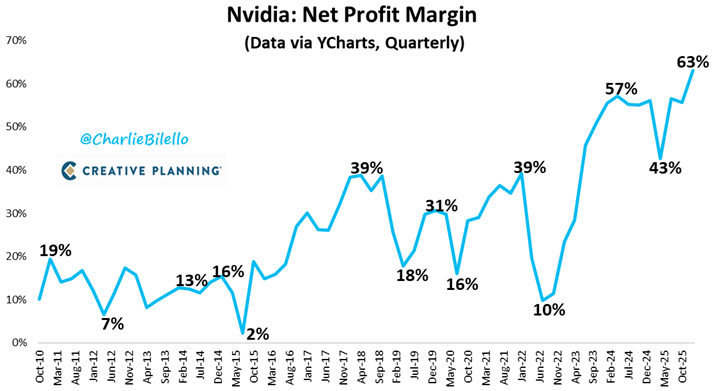
Nvidia Q4 revenues surged to a record $68 billion, up 73% over the prior year. Their revenue projection for Q1 2026 is $78 billion, which would be a 77% YoY increase. Net Income hit a record $43 billion, up 94% YoY. Net profit margins rose 65%, an all-time high. $NVDA


solomontrader retweeted

$AMZN Amazon Q4 FY25:
• Revenue +14% Y/Y to $213.4B ($2.2B beat).
• Operating margin 12% (+0.4pp Y/Y).
• EPS $1.95 ($0.01 miss).
• Q1 FY26 rev guide: +11%–15% Y/Y.
☁️ AWS:
• Revenue +24% Y/Y to $35.6B.
• Operating margin 35% (-2pp Y/Y).

solomontrader retweeted
$GOOG Alphabet Q4 FY25:
• Revenue +18% Y/Y to $113.8B ($2.3B beat).
• Operating margin 32% (-1pp Y/Y).
• EPS $2.82 ($0.18 beat).
☁️ Google Cloud:
• Revenue +48% Y/Y to $17.7B.
• Operating margin 30% (+13pp Y/Y).
▶️ YouTube ads +9% to $11.4B.

solomontrader retweeted

🚨 INSIGHT: THIS IS WHY BANKS ARE PANICKING ABOUT STABLECOINS
New data shows how exposed U.S. banks really are.
For most banks, net interest margin (NIM) makes up 50% to 70% of total revenue. That’s the spread they earn by paying you almost nothing... and lending your money out.
Now enter stablecoins:
💸 Pay users yield
💸 Settle instantly
💸 Run 24/7
💸 No fractional reserve games
Regulators are finally admitting it: stablecoins are a bigger threat to banks than crypto trading ever was.
This isn’t about speculation. It’s about stablecoins attacking the core profit engine of banking.
If deposits migrate on-chain, NIM collapses, and that’s why banks are lobbying so hard right now.
This fight isn’t crypto vs markets. It’s crypto vs bank margins.


JUST IN: COINBASE CEO MEETS BIG BANKS AT DAVOS OVER CLARITY ACT
$90B Coinbase CEO Brian Armstrong is meeting with major bank CEOs to bring them on board with the CLARITY Act.
Armstrong says Coinbase is already providing crypto infrastructure to 5 of the top 20 banks, as institutions recognize the opportunity.
He believes crypto and banks can coexist in a win-win model; and that competition should never be banned.