

The Open Fixed-Rate Origination Infrastructure Enabling instant, efficient, and flexible fixed-rate money markets.
EVM
Joined May 2024
- Tweets594
- Following193
- Followers1.3K
- Likes630







Pinned Tweet
Fixed-rate loans have arrived on Robinhood Chain.
Spine is the first protocol to bring fixed-rate borrowing to @RobinhoodCrypto, launching with a USDG market lending against PT-NVDA by @pendle_fi.
Introducing the Spine USDG Fixed-Rate Vault.
Resilience tends to come from small decisions made early: position size, repayment date, and collateral list.
All three sit within your control in any market, and each one costs less to set before the stress than during it.
A fixed rate shows you the total cost at origination, where a variable-rate loan reveals it at maturity.
A trade-off stays in place: when the variable average over the term lands below 4.25%, a variable borrower spends less, and if you fixed, you carry the difference.
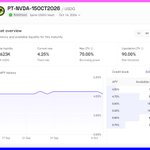
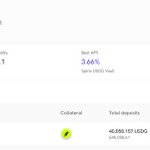
About 10% had been borrowed from the Spine USDG Vault.
One maturity at that size reflects a single rate environment, so later maturities should give you more to check.
Dated collateral you hold tends to suit fixed rates. What's your choice?
spine.finance

For illustration, simple interest at 4.25% on $10,000 for 30 days comes to $34.93.
With a fixed rate and a dated maturity, you can run that calculation before you open the loan.
Spine’s PT-NVDA Credit Book reaches its first maturity in less than a day.
If you borrow USDG against PT-NVDA there, the book quotes a fixed rate of 4.25%, with a maximum LTV of 70%.
What does this mean?

PT-NVDA by @pendlefi matures on Thursday, Oct 15, and each USDG loan in Spine's Fixed-Rate Vault falls due with it.
Borrowers, you have three steps to take this week.

Repay principal plus fixed interest before 15 October.
If you deployed borrowed USDG elsewhere, start unwinding now so the funds arrive in time. Unpaid positions go to post-maturity liquidation.
Once you repay, your PT-NVDA returns to your wallet. You can redeem it 1:1 for an NVDA Stock Token through Pendle at maturity, or sell it on Pendle's AMM before then.
Review your position: app.spine.finance
What are the two paths for lenders on Spine?
Lenders in Spine's USDG Fixed-Rate Vault hold capital in two places, and each place returns USDG on its own schedule.
Discover here.

1️⃣ USDG parked in the @SteakhouseFi vault on @Morpho comes back on request, subject to Morpho's available liquidity.
2️⃣ USDG lent to fixed-rate borrowers comes back as those borrowers repay, early or at tomorrow's maturity.
Good news: The majority of vault capital can be withdrawn on request today, and the rest returns by 15 October.
What's your planned path? app.spine.finance
A borrower in the Spine USDG Vault locks a rate until 15 October. Lenders on the other side earn a yield that moves. Both sides sit in one Credit Book, so the rate risk lands somewhere between them.
A locked rate moves rate-reset risk into lender yield. If variable USDG rates climb above the fixed rate, the Credit Book share of lender capital keeps earning the fixed rate, while the idle share in the Steakhouse vault on Morpho earns the variable one.
That blend shifts with utilization. Strong fixed-rate borrowing demand puts more lender capital into Credit Book interest, and weaker demand routes more of it to Morpho at the variable base rate. Lender yield varies by design.
Lenders weigh that yield against exposure to Spine's contracts, Steakhouse's vault on Morpho, USDG and PT-NVDA collateral.
Lend now: app.spine.finance/Robinhood/…

Want to borrow USDG against your PT-NVDA at a rate that holds until 15 October?
On Spine, you post PT-NVDA 15OCT2026 as collateral and lock the rate at entry. You'll need PT-NVDA from @pendle_fi, a @RobinhoodApp wallet, and ETH for gas.

NVDA's price still moves your collateral. If its value falls toward the liquidation threshold, you can add PT-NVDA or repay part of the loan.
At maturity, you owe principal plus fixed interest, and an unpaid position goes to post-maturity liquidation.
What happens at maturity:
After watching millions leaving DeFi in a month, people want boring infrastructure.
We're fine with boring, if boring means:
1️⃣ Fixed borrow rates.
2️⃣ Predictable repayment.
3️⃣Clean cycle.

ALT Flowchart outlining loan maturity process: borrower repayment, interest distribution, fund receipt, principal reallocation, and cycle restart.
One common use is looping: you buy more PT-NVDA with the borrowed USDG and post it again.
Your spread between PT yield and borrow cost is set at entry, while your NVDA price exposure grows with each loop.
October 15 is coming soon. Don't miss it.

Currently small, scaling up the liquidity from @spineprotocol as additional liquidity flows in for NVDA and PT NVDA on @pendle_fi


How to lend USDG on Spine for higher yields?
To lend USDG on Spine, you need a wallet on @RobinhoodApp Chain, USDG, and a little ETH for gas.
You deposit into the Spine USDG Fixed-Rate Vault, which lends against PT-NVDA 15OCT2026 collateral.

That routing means your exposure spans Spine's contracts, Morpho, Steakhouse's curation, USDG, and PT-NVDA as collateral.
Learn more about Spine's Credit Books:
Why settle for the uncertainty of floating rates and waiting rooms in credit markets?
Credit Books serve as the core exchange layer of Spine V2, replacing inefficient P2P discovery with a hybrid orderbook-AMM.
Bypass asynchronous matching and access instant, depth-based execution for term-based credit. 🧵

You can withdraw at any time, subject to vault liquidity.
Start lending today: app.spine.finance/Robinhood/…