



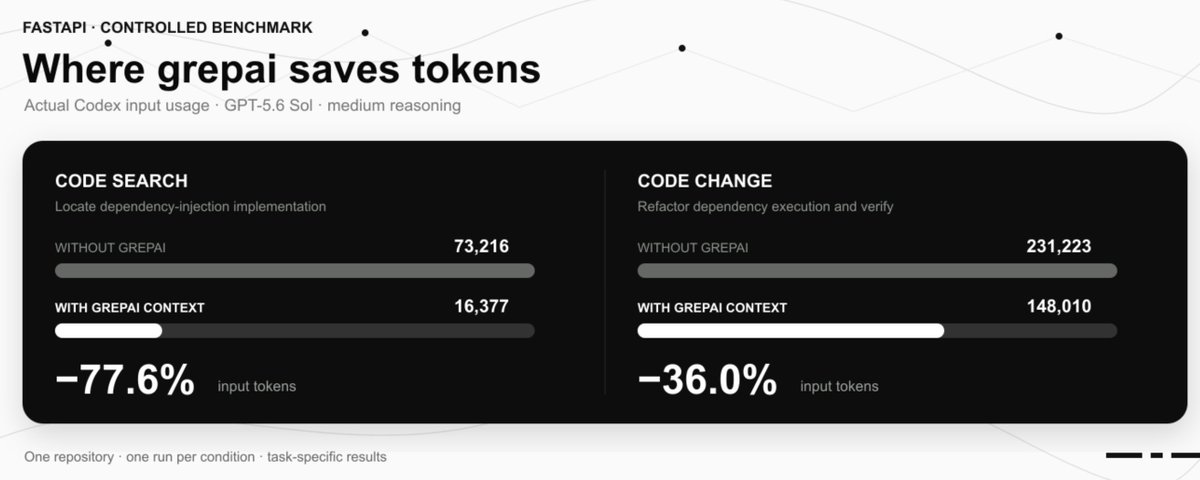
I tested grepai on two real Codex tasks in the FastAPI repository.
Input-token usage decreased by 77.6% for code discovery and 36.0% for a small code change.
Here is the methodology, exact usage data, and limitations:
Stufez.𝕏 retweeted

We promised open weights for Qwen3.8. Now, time to meet them! 🎉
⚡ Qwen3.8-27B:
- A native multimodal dense model. With just 27B parameters, it outperforms Qwen3.7-Plus overall and shines in real-world coding & office workflows.
- 262K native context, easily extendable to 1M tokens via YaRN.
- Built for builders. Highly efficient, high-quality, and licensed under Apache 2.0.
🚀 The open weights for Qwen3.8-2.4T-A95B (Max-level) have also been released recently.
Whether you're shipping lightweight applications with Qwen3.8-27B locally or building agents with Qwen3.8-2.4T-A95B, they're yours now!
Download, deploy, and build something we haven't imagined yet. 👀👇
- Hugging Face:
huggingface.co/collections/Q…
- ModelScope:
modelscope.cn/collections/Qw…

Qwen just dropped Qwen3.8-27B.
27B is where things get interesting: small enough to run locally, but potentially powerful enough for serious coding and agent workflows.
No API. No cloud. Your own hardware.
If Qwen delivers on reasoning and coding, this could become one of the most interesting local models right now.
Time to put it to the test.
huggingface.co/Qwen/Qwen3.8-…


I finished my first MCP server. It was pretty interesting to work with context logs but i think for regular users it might be a bit unnecessary.
Most people simple don`t need to go through huge amounts of logs. Any publicly agent can do it.
As experience it was good. I learned a lot from building but I think I`ll come back to this later.
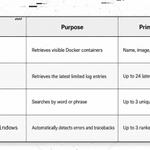
I would use 4 main tools for my MCP server
list_containers - show containers
get_logs - receive last logs
search_logs - find logs for context
extract_error_window - receive errors with nearby lines

Today I beat my own record, I did 25 pull-ups
Five years ago I couldn’t even dream of doing this. Back then I could do only one.
I’m really happy that over the past few years I have become stronger and healthier, I think it’s a good sign the I’m in the right path.



As i keep working on my app I decided to clearly split it into separate modules with each one responsible for a specific part of system. This should make the project easier to scale in the future and much easier to review.
The struct looks like this:

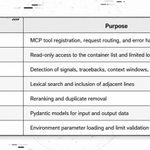
server - the central module that register tools and coordinate calls between components
docker_source - responsible for retrieving containers and logs
analyser - extract events and generates a probable cause
search - performs initial lexical search
reranker - select the most usefull
models - defines consistent responce schemas
But the module I want to focus in reranker
Reranker does something really important: it filters the logs so the LLM get most relevant pieces. Logs usually contain a lot noise. Reranker helps remove noise and keep useful info
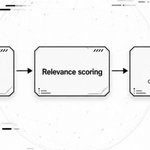
The pipeline looks like:
1. Up to 2.000 lines - take only 2.000 log liines
2. 20-60 candidates - extract 20-60 suspicious fragments like: errors, traceback, timeout, failed events and so on
3. Relevant scoring - find most relevant to the user question
4. MMR & deduplication - remove duplicates and select different but important fragments
5. Up to 3 windows / 24 lines - no more 3 context windows. Each containing roughly 24 lines around error
If say simple: less noise, more usefull info

Recently, I came across local LLMs that run directly on your phone.
At first, they seemed pretty useless to me. You can’t really give them heavy tasks or automate anything serious — a phone simply doesn’t have enough compute for that.
Sitting at the computer all the time takes a toll on your health.
That’s why I spend some time at the gym to stay in shape.
Today is back+biceps day.

Yesterday i posted my diagram MCP-server for logs but i forgot one important thing - Contextual analysis.
To avoid duplicates logs and extract only the information hat actually matters the data should be filtred sing contextual analysis


For logs this mean not sending thousands of lines to the model but instead finding events related to the error the traceback and the surrounding failure context. This makes it much faster to identify the root cause and figure out how to fix it.
The first thing i want to work is building an MCP agent for analyzing logs for containerized(Docker) applications
It is pretty common for developers dig through gig of stdout and traceback - nobody enjoys doing. Running LLM locally could make this process much more efficient