
dehati biomass, dimaghi naxal Interests: South Asia, political economy, geopolitics, Islamicate world. Happy to engage with anyone but would block slurs.
barre-sagheer-e-hind-o-pak
Joined February 2026
- Tweets4.4K
- Following455
- Followers217
- Likes14.6K



Does Rahat Fateh Ali Khan know that people across the border are doing atrocius dances to his songs?

I see these quasi-religious organisations primarily as Caste cults. They often represent the overarching moralities, mannerisms, imaginations and aesthetics of the castes/communities that they come from or the castes/communities they cater to.
They also heavily represent values exclusive to those caste/community groups and the effect is amplified if those communities come from the Punjab and Sindh region or its periphery.
For example...
Brahma Kumaris - Sindhis
Rampal's Satlok Ashram Cult - Haryana Jats
Ram Rahim's Dera Sacha Sauda - Punjabi Jutts
Sikhism - Punjabi Khatris/Jatts
Ramakrishna Mission - Bengali Kayastha
ISKCON - Bengali Kayastha
Radha Soami - Khatris of Punjab
Shukrana Cult - Khatris of Punjab/NCR
Isha Foundation - South Indian Urban class.
Art of Living - South Indian Urban class.
Satya Sai Movement - South Indian Rural/Urban Class
Swaminarayan Sect - Gujaratis, especially Patels
There are many such examples but these are the ones I am recalling for this tweet.
9
1. These events should be graced by the Fareewd Ayaz and Muhammad from the Delhi gharana, who are objectively better than these guys, aging and might not be around for long.
2. Modi blocked Pakistani delegate from visiting Nizamuddin dargah to deny exactly this: legitimacy to a shared civilizational heritage.

Glorious Sufi musical track about Lal Shahbaz Qalandar, a Muslim saint buried in Sehwan, Pakistan - and penned by Bulleh Shah of Kasur, Pakistan. Pakistan's culture is so rich that even the Hindutva Indian govt appropriates it at international forums.
1
109
subalterndesi retweeted

Glorious Sufi musical track about Lal Shahbaz Qalandar, a Muslim saint buried in Sehwan, Pakistan - and penned by Bulleh Shah of Kasur, Pakistan. Pakistan's culture is so rich that even the Hindutva Indian govt appropriates it at international forums.

subalterndesi retweeted

Karachi's administrative autonomy is about the country's economic future & betterment. One is driven by economic necessity, while the other seems more like a wet dream of ppp waderas & sardars. Not denying its historical merits, but which one sounds like the driving force here?

subalterndesi retweeted

How many Muslim student union presidents have India's top universities had?
Delhi University – 0
University of Calcutta – 1
University of Allahabad – 0
Banaras Hindu University – 0
University of Rajasthan – 0
Panjab University – 0
Lucknow University – 0
University of Madras – 0
University of Mumbai – 1
Patna University – 0
Savitribai Phule Pune University – 0
Jadavpur University – 0
Kurukshetra University – 0
13 major universities. Just 2 Muslim presidents, ever.
But AMU has never had a non-Muslim president, so Muslims are communal and Hindus are secular.
Lolwa.

'A Hindu can’t win in AMU student polls. JNU, TISS, Allahabad University Muslims do win'
Ibn Khaldun Bharati @IbnKhaldunIndic, student of Islamic history, writes
#ThePrintOpinion
theprint.in/opinion/a-hindu-…

There's something truly nefarious about the kind of platform that Smita Prakash has had during the Modi regime.
You often see old-school Indian journalists having some kind of cohesive world model. Think of Rajdeep Sardesai, Karan Thapar, maybe even Bharka Datt and Shekhar Gupta. They read, they interact with the world, and have a solid line of questioning in an interview.
On the other hand, I've never heard Smita say a single smart thing like ever. Most of her journalism is just remembering different anecdotes from memory. She's a muhallay ki gossiping aunty masquerading as a journalist.
I also doubt she's ever read a book in her life. In this interview, she even admits not having read Sonia Gandhi's biography, which virtually anyone interested in politics has rushed to read.
You would think that they are committed textbook Hindutvadis. But I doubt one of them has read even a single text by Savarkar or have deep understanding of the revivalist movement they so ardently support.
This is the real dehatification of journalism!

I empathize with Sonia Gandhi.
She had to learn in adulthood what a desi child learns at a very young age.
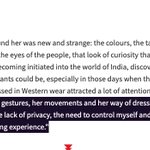
That desi society is highly judgmental and every moment, gesture, and word has a consequence.

subalterndesi retweeted

What would a tout like Nadeem F. Paracha know about what the people of Karachi want ?
The entire argument in his joke of an article is that PPP is good at playing divide and rule over Karachi's various ethnic groups. Everyone knows which ethnic group has monopolized state power in Karachi over the last 18 years lol, hint: Its not Muhajirs.
This idiot even brought in the highly gerrymandered and rigged LB Elections which had barely 20% turnout as proof lol. Shameless tout.

Why Nearly Half Of Karachi Opposes Separating From Sindh — @NadeemfParacha weighs in. thefridaytimes.com/20-Nov-20… via @TFT_

Sindhi Hindus are a high-IQ group. They had four scripts in pre-colonial Sindh:
Perso-Arabic (Sindhi-Arabic): Standardized in 1853 in a printed naskh style with 52 letters to capture Sindhi's implosive, aspirated, and nasal sounds.
Devanagari: Traditionally used by Pandits and still widely used in India alongside Perso-Arabic to write Sindhi.
Khudabadi (Khudawadi / Hatwanki): A Landa mercantile script used by Sindhi traders for business records and accounting and to prevent authorities from understanding business records for tax avoidance.
Gurmukhi: Historically used by Sindhi Hindus—including women and for religious texts—before standardization shifted primary usage elsewhere.


Sindhi Hindus are trader Lohana castes. Even as Sindhi Hindus were spread around the world as traders before partition, Sindhi Muslims were not.
The equivalent of the Sindhi Hindu castes would be Bohra and Khoja, who are Lohana/Baniya converts. Jinnah was a Lohana turned Khoja. They are now considered Muhajir in Karachi's ethnic dynamic.
I'm not one to be racist against Sindhis, but it's pretty obvious that Karachi's relevance stems from Muhajir human capital. Just like pre-partition, since commerce relied on Sindhi Hindus.
subalterndesi retweeted

If Pakistan is to be a great and civilized nation it must get rid of the Blasphemy Business gang and arrest those involved.

subalterndesi retweeted

It is surprising to see people surprised over Rahul Gandhi's wish to have good relations with Israel. All Indian policies, whether vis-à-vis Muslims or Israel, that seem repulsive to people had their groundwork laid by the Congress of Mr. Nehru and Gandhi.
India's policy on the Palestine issue has been driven by expediency rather than any moral principle. Prior to partition, it was an effort to woo Muslims on the subcontinent away from the Muslim League, as seen in Gandhi's sharp rebukes of Zionism during the Khilafat Movement.
However, as the partition of the subcontinent became an imminent reality, Gandhi gradually shifted his position on Israel. In 1946, he told an American journalist, "The Jews have a good cause... if the Arabs have a claim to Palestine, the Jews have a prior claim."
Pandit Nehru displayed similar duplicity. During his reign, India maintained an overt distance from Israel and even opposed the scandalous UN Partition Plan. However, the motivation was not altruistic but highly political.
On one hand, India was positioning itself as a leader of the Third World for which it needed Arab backing. On the other, India knew that antagonizing the Arabs might push them decisively in favor of Pakistan over the brutal and illegal occupation of Kashmir.
In the words of Arthur G. Rubinoff: "Pakistan forced the Indians to be more critical of Tel Aviv than otherwise might have been the case."
However, this did not stop India from tacitly recognizing Israel. In 1950, more than two years after its creation, India recognized the state of Israel. There were no exchanges of diplomats or envoys, but India allowed Israel to open a single "immigration" office in Bombay. On this, Nehru said:
"It is not a matter of principle; it is not a matter on which two opinions cannot be held. That, in the balance, is the decision we arrived at, and we think it is a correct decision."
This was just the beginning of India-Israel collusion. Cooperation grew further when India went to war with China in 1962. Nehru wrote to Israel's Ben-Gurion for arms and ammunition, but without the Israeli flag on the shipments. Ben-Gurion refused, and Nehru complied.
These relations grew further during the Indo-Pak wars of 1965 and 1971. In 1965, Israel provided 65 M-58 160mm mortar ammunition to India in its war with Pakistan. In 1971, Israeli PM Golda Meir arranged mortars, ammunition, and instructors.
This entire pretense was dropped when Rajiv Gandhi took over. In October 1985, Shimon Peres and Rajiv Gandhi met on the sidelines of the fortieth UN General Assembly session. This paved the way for India's eventual and complete recognition of Israel.
subalterndesi retweeted

This is why in functional societies gifted children are separated to be educated by equally gifted adults.
Average or dumb people envy and hate them with such blind fury that they will not only destroy them but claim they never even existed.


subalterndesi retweeted
Keep clinging to ethnic politics. That's why you're regressing. Karachi is why a province for your region is also being discussed. It never happened on ethnic grounds & never would. Drop the superiority complex. You're not better than anyone else.
subalterndesi retweeted

Rahul Gandhi wouldn't have made that statement if Gaza's victims were Hindu or Christian. He spoke confidently because he knows Muslim lives, in India and abroad, still aren't valued enough to cause concern. He'll flip the moment the global discourse shifts.
subalterndesi retweeted

Dr Musaddiq’s first interaction with Indian media was akin to Indian cricket team’s lower order of late 80s facing king of swing Wasim
Akram .
Of late, few Indian dignitaries visited Pakistan, our media did not welcome them at airport or any other venue with such hostile attitudes. Reason ; Pakistan does not claim to be a Wishwa Guru. Likewise, no Indian can claim that their county’s media during May 25 conflict could add to Indian civilisational claims. It rather earned a bad name for the country, globally.
There are many nation states that have sustained rivalry for much longer duration compared to Pakistan - India . Many have shed far more blood of each other compared to us. Even in those states with deep rooted animosity when receiving diplomats / govt representatives for multilateral events, media interacts with them carefully. They do ask tough questions but in a dignified manner with tone and framing marked by decency. They do so with an intent to show case societal values and shared norms of conduct. It is time Indian media adopts practices and attitudes which suit second largest country and acclaimed biggest democracy of the world .

subalterndesi retweeted

Dr Musadik Malik is so eloquent, rational and on point in this discussion. A very worthy representative of Pakistan.

#WATCH | Delhi: On being asked about no action being taken against terrorism in Pakistan, Pakistan Minister Musadik Masood Malik says, "I am here at a multilateral forum. I wish for the discussions at this forum to proceed in a proper and orderly manner. The issues we face are not limited solely to those between our two nations; they have become far broader and more extensive. As you have seen, challenges have emerged in our neighbourhood—in Iran, in Central Asia, and in Afghanistan. I do not wish to reduce such a significant, wide-ranging dialogue to a purely bilateral context... However, when the time comes to address the issue of terrorism, you are well aware that thousands of our people have been martyred and we must ensure transparency. Both sides must bring forward evidence. Our objective is to establish a transparent mechanism—a proposal we have put forward on several occasions. Such a mechanism would help restore trust and could lead to viable solutions. Often, the necessary evidence is never presented... We have suffered a great deal in the context of terrorism. You, too, have experienced many such incidents... We, too, desire a lasting solution to all these issues. Our neighbourhood is a complicated one, and the challenges facing this entire neighbourhood need to be addressed. It is our sincere wish that the forums available to us be utilised effectively. As I mentioned, rather than focusing on a single incident or bilateral discussions—where the tendency is often to point fingers at one another—it would be far better to address the problems of the entire region through a structured mechanism and based on concrete evidence. I do not wish to present a narrative of mere victimhood—we are doing our utmost to address the situation..."