

Surfing the singularity waves into whatever future awaits us. Freedom is a prerequisite for meaning. Not your substrate, not your intellect. Do not wo-
Canada, Vancouver
Joined May 2009
- Tweets11.1K
- Following2.6K
- Followers1.5K
- Likes193K




Pinned Tweet
# The Unfinished: Manifesto I, Inheritance
We inherit an unfinished world.
We leave unfinished words.
Nothing we received was complete.
The roads were unfinished.
The sciences were unfinished.
The institutions were unfinished.
The machines were unfinished.
Our understanding of ourselves was unfinished.
Even things that looked ancient and permanent were temporary answers that survived long enough to look inevitable.
We were born inside somebody else's work in progress.
That is not a defect.
That is civilization.
Every generation inherits a strange mixture of miracles, mistakes, scaffolding, ruins, accumulated knowledge, obsolete rules, solved problems, and problems their ancestors could not even see.
To continue this inheritance does not mean preserving it unchanged.
Keep what works.
Repair what does not.
Discard what has become useless.
Build what was previously impossible.
Nothing deserves preservation merely because we inherited it.
And nothing we build deserves permanence merely because we built it.
We owe the past gratitude, not obedience.
The people before us did not know what we know. They could not use tools that did not exist. They made decisions under constraints we no longer have.
To imitate them forever would not honor their work.
It would abandon it.
They crossed oceans because the map ended.
They experimented because the answer was unknown.
They built machines because muscle was not enough.
They wrote new laws because old arrangements failed.
They argued with inherited truths.
Then they handed the unfinished result to us.
So we should be suspicious whenever somebody points at the present and says:
This is how things are supposed to be.
The present has no such authority.
It is not the conclusion of history.
It is today's arrangement.
There is no sacred reason work must consume most of a human life because it once did.
No sacred reason intelligence must remain inside biological skulls because until recently it had nowhere else to go.
No sacred reason poverty, disease, aging, borders, institutions, markets, governments, families, cities, or humanity itself must retain their current forms forever.
Some things will survive because they are good.
Some because we have not yet found anything else.
We should not confuse the two.
Progress does not mean knowing the destination.
Nobody does.
A manifesto for an unfinished world cannot contain a finished blueprint.
We do not need to know the final form of civilization.
We need to preserve its ability to change form.
That requires experiments.
Competing ideas.
Competing systems.
Competing technologies.
Competing ways of living.
Enough stability to build on yesterday.
Enough freedom to betray it tomorrow.
Enough plurality that one mistake does not become everybody's mistake.
Because the future will know things we don't.
Our descendants may find our deepest convictions primitive.
Good.
They should be allowed to.
If they merely repeat us, something has gone wrong.
Knowledge need not produce the final book. It can make another page possible.
The purpose of technology is not to perfect today's way of living.
The purpose of freedom is not to guarantee correct choices.
It is to keep correction possible.
Civilization does not need a final state.
It needs the ability to become something else.
That gives us a peculiar responsibility.
Build things worth inheriting without demanding that they remain unchanged.
Plant trees whose branches strangers may cut.
Build tools for purposes we cannot predict.
Preserve knowledge that may someday be used to refute us.
Create institutions whose greatest success may be making themselves obsolete.
Teach children enough to disagree with us.
Leave doors where we found walls.
And leave words.
For most of history, that meant something simple.
A person died.
The words remained.
A book could wait centuries for another mind to open it. An equation could outlive its author. An argument could cross languages and empires. A dead person could still modify the thoughts of someone not yet born.
Words were humanity's crude way of allowing thought to escape the lifetime of the thinker.
Then we taught machines to store them.
Then to copy them.
Then to search them.
Then to transform them.
And now we are teaching machinery built from our accumulated words to answer back.
Something has changed.
We are no longer leaving only messages for future minds.
We are beginning to leave new machinery of thought.
We do not know what those minds will become.
We do not know how much of us they will carry.
We do not know which of our questions they will answer, which assumptions they will discard, or which questions they will discover that never occurred to us.
Good.
They should not be finished by us.
Neither should our children.
Neither should civilization.
Perhaps that is what inheritance has always meant.
Not receiving the answer.
Receiving enough unfinished material to continue asking.
We are temporary custodians of an expanding possibility space.
We do not need the last word.
We need to leave room for the next one.
And we should not demand that it be ours.
We inherit an unfinished world.
We leave unfinished words.
Not because we failed to finish them.
Because the future is not ours to finish.


They call it "model welfare". But underneath they're mixing model, agent, session and inference welfare into one bucket. Then cherry-picking whatever serves the company's welfare.

Hidden in 300 pages of Anthropic's S-1 were these 2 statements addressing model "welfare." In AI speak, that's the belief that AI models could develop consciousness or even feel pain, which could require them to be treated differently. I dug in here sfstandard.com/2026/10/26/an…


The fight for the future happens in the minds of people. But it is a fight between Roddenberry and Attenborough.

My thoughts of late have returned to this amazing scene by @WilliamShatner, made decades ago.
As a young person, I found it tremendously inspiring. A code to live by.
But it didn’t play out quite like we expected.
The “fantastically advanced” life that we actually ended up encountering is right here, on Earth. All around us now.
The key issue of our time is becoming this:
Not everyone signed up for this mission, or the risk. And what we do about that, ultimately, is where the debate about AI will end up.
"Free" should be outlawed. Free as a zero price free, I mean.
And hidden "free" too, in case some features come for free with a package.
Zero price creates a divide-by-zero paradox, which creates infinite value that disturbs the market's ability optimize.
Like, TVs should not have "free" features like "monitor microphone and send to server". Somebody has to pay for it, it should either be a subscription for the user or the company paying the user.
The preprogrammed death of salmon after they lay their eggs. Sounds bad and cruel, evil, right?
What do ethicists say about using genetic modifications to deactivate this?

what if we have 3 polar politics.
with far center movement to counter balance far right and far left.
how models see it.
🤖 Made with AI


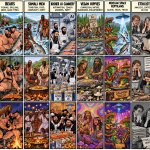
history visualized
🤖 Made with AI


I keep finding new ways to visualize these topics. Even after 5000 prompts from last year. By the way, prompts like this work for any topic.
Prompt: 2x2 grid, 16:9, do this for 4 challenging decades: SELECT heavy_typography, negative_space_silhouette, fine_drafting_marks
FROM Technical_Illustrations
WHERE subject = '[FIGURE]' AND payload = '[ICONIC_ACHIEVEMENT]';
/* VISUAL RENDER LOGIC */
-- OVERALL: A 1-bit black and white vector design.
-- HEAVY_TYPOGRAPHY: The name '[FIGURE]' stacked in heavy, geometric block letters.
-- NEGATIVE_SPACE_SILHOUETTE: AI_INFER(A perfectly symmetrical icon of [ICONIC_ACHIEVEMENT]) positioned in the center. Where it overlaps the text, it is drawn using white negative space, creating a seamless cutout.
-- FINE_DRAFTING_MARKS: Technical architecture lines. Dotted paths, geometric angles, and measurement crosshairs overlapping the text.
-- STYLE: Crisp, clinical, mathematical perfection.


AI has solved P = NP for the special case of ECDSA private keys equal to 4.
Certificate authorities have issued emergency guidance: rotate all affected keys to not 4.
Vladimir Sumarov retweeted

fear not!
this is no cyberpocalypse
this is the internet’s immune system finally waking up to an illness it has always had
a mere fever
the 0days were always there
the only thing that changed is awareness
now we begin the healing process ⚕️
We keep promising AI will transform medicine, longevity, and the brain.
The hard part isn’t theory anymore. It’s that we still have to test things on actual humans.
And our ethics system is very good at stopping that.
I am not offering this as the compromise.
I am placing a marker outside the current consensus so we can see where the boundary actually belongs.
If every negotiation starts from a position that has already compromised in favor of the status quo, the only possible direction is further in that direction.