

Inequality, economic history and policy. UU, SAIS, CUNY and UCONN. Also passionate fan of hopeless football/soccer team (no, not ManUtd).
Joined August 2017
- Tweets92
- Following2.5K
- Followers1.9K
- Likes298



Pinned Tweet
Social tables are a treasure trove of information - easy to fall into a Rabbit Hole. One example: Mean income of a forestry inspector was higher than for a banker in 1863 Prussia. See my new paper featuring German Social Tables: osf.io/preprints/socarxiv/2f…

Philipp Erfurth retweeted

Historical social tables: advantages, methodology, and problems
A new papee by Erfurth, Gomez Leon, Gabbuti and Milanovic
ehes.org/wp-content/uploads/…
Philipp Erfurth retweeted

📢 New III working paper:
This paper provides a methodological contribution to the study of historical income inequality by examining the construction and use of social tables for the nineteenth century.
@BrankoMilan @GGabbuti @Maria0zmg @theErforce
buff.ly/2LWqOwU

Philipp Erfurth retweeted
"Historical social tables: advantages, methodology, and problems",
a new paper by P. Erfurth, M. Gómez León, G. Gabbuti & B. Milanovic
researchonline.lse.ac.uk/id/…
Philipp Erfurth retweeted

Social tables are widely used 🌍but how comparable are they across countries and over time? 📚In a new working paper (with @theErforce @Ggabbuti @BrankoMilan) we explore social tables… methodology, advantages, and problems ehvalencia.es/wp-content/upl…
Philipp Erfurth retweeted
Just out.
New Working paper on the use social tables to study historical inequality; their advantages, problems, methodology;
by @theErforce , Maria Gomez Leon, Giacomo Gabbuti and myself.
stonecenter.gc.cuny.edu/publ…
Philipp Erfurth retweeted

How unequal was a rural society in the Roman Empire? A new WP by Philipp Erfurth @theErforce examines income inequality in rural Roman Egypt in 1st century using daily social tables that build on data from papyri.
bit.ly/4aniP7l

Publication alert🚨
Paper 2/3 of my PhD now out! How did unification in 19th century impact income inequality in DE and IT? Using new social tables for Germany, I study balance of power between core & periphery in newly unified states.
Find out more here: doi.org/10.1016/j.irle.2024.…

This was previously out as Stone Center Working Paper #46 - so many thanks to
@stone_lis as well as all colleagues providing invaluable comments and suggestions!
1
279
Philipp Erfurth retweeted
Delighted to give my first "foreign" talk on "Visions of Inequality" in Mexico City.

Fue un placer tener a @BrankoMilan presentando su nuevo libro en #SobreMéxico 🤓🤓 Pronto el video de la presentación


Philipp Erfurth retweeted
The 1848 Revolution is possibly one of the most interesting episodes for class/social analysis. It is not surprising that in the Cagé-Piketty book it gets much analyzed, incl. Tocqueville's and Marx's writings on it.
See this:
globalpolicyjournal.com/blog…


New WP alert 🚨 In new #LIS WP, I find evidence of regional inequality convergence using @lisdata disaggregated at subnational/regional level. Convergence is associated with unitary rather than federal state systems.
Check out the full paper here: lisdatacenter.org/wps/liswps…

Bracing for a summer-Twitter-feed full of: Shame on <insert airline name> for cancelling my flight to <insert destination>! Will never fly with <insert airline name> again!
1
3
Boxer at rest - Incredible ~4th century BC Bronze statue on Display at Palazzo Massimo in Rome. Visited the Massimo several times and never more than a few dozen people. When in Rome avoid the crowds at Trevi Fountain and go see the Boxer (and amazing Roman mosaics)..

Philipp Erfurth retweeted

📌Join us tomorrow at 5pm CET for a YSI #econhist discussion with @theErforce on the Income Inequality and Unification in 19th Century Italy and Germany
We are excited to welcome @GGabbuti as a chair for this session!
Registration: bit.ly/3tWiRRS
See you online!

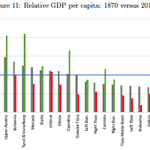
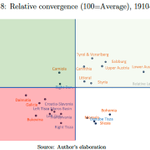
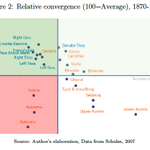
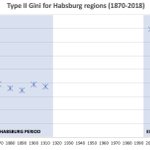
!New WP Alert! In my new Working Paper, I examine regional inequalities in Habsburg regions from 19th century until today. The findings provides a (small) glimpse at economic history of Central and Eastern Europe through lens of convergence in the past 150 years. A thread 1/n
Lastly, from 2000-2018 there is significant evidence of convergence. Yet despite convergence and EU cohesion policy, a large number of regions is still well below their relative levels of 1870 and overall inequality across regions today is still well above levels in 19th century.

1
5
Check out and download the full Working Paper here: osf.io/preprints/socarxiv/86….