

Curating crypto alfa, insights and new projects so you can make it // Storyteller at @glasscade_xyz Nothing here is financial advice.
Joined January 2018
- Tweets47.5K
- Following1.1K
- Followers23.3K
- Likes60.3K







The Learning Pill 💊 retweeted
Between $LIT & $HYPE, I prefer the 'underdog' play to give HL a run for it, especially since both are developing their options product suite.
The race now goes beyond CT traders to the larger group of tradfi traders - and that's where regulations and licenses come into play
Q3 investor call has signalled that @Lighter_xyz will apply for the license next month and when attained, will be deeper integrated with Robinhood's US offering.
Believe many more doors can open from thereon cause why stick to one when you also can build on LighterEVM and/or Instance spin-up


The Learning Pill 💊 retweeted
New PendleLoop feature looks fun
You can auto loop to long/short your stonks and its free till EOY
> Profit either from price going up/down depending on position
> Take note of the liq. price.
Unless you're ultra sure you won't get liquidated then you can full max out the leverage but don't recommend that
The popular MAG7 options (alongside BTC & ETH) are available now. Also don't see any loop to short options for stonks now but should also be available in due time!
$PENDLE
The Learning Pill 💊 retweeted
$JUP is a play on Solana volume across spot, leverage and lending, with a buyback and no net emissions behind it
I'm hoping to see more clarity on how the 'undisclosed' portion of the revs feed the $JUP token - might show how undervalued it is
Already up 100% since Aug lows...


The Learning Pill 💊 retweeted
Token incentives have been the bane of many price charts which go -80 to 90%
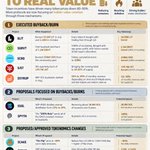
It is a refreshing change to have more protocols looking to generate more holder value creation through these mechanics:
- reducing emissions
- reaching deflation
- driving holder/staker distribution
A list of projects that have done these (Q3 till now) 👇
1) Executed buyback/burn
$LIT → burned 15.6M LIT in July and 2.45M in October, every token it bought with trading fees through Q3
$CRO → burned 228M CRO from the community pool, taking cumulative burns to 428M
$JST → 5th quarterly burn of 170.7M JST, bringing the running total to 19.01% of supply
$SYRUP → MIP-021 buybacks started in Aug at 10% to 30% of monthly revenue depending on how much Maple earns, and the tokens are held in reserve
$GRVT → first buyback-and-burn of 1.1M GRVT (0.96% of circulating) bought with app gross profit, with future rounds at the issuer’s discretion
2) Proposals focused on buybacks/burns
$SOL → SGP-0002 doubles annual disinflation from 15% to 30%, removing about 18.9M SOL of issuance over 6 years
$PYTH → the “100% Rule” sends all of the DAO’s product revenue to buybacks, which sit in a reserve
3) Proposed/approved tokenomics changes to reduce emissions or increase deflationary pressure
$CAKE → “The Flip” aims at ~69% cut in daily emissions (22,500 → 7,000 CAKE/day) + higher LP fee share
$NEAR → HSP-029 proposes to cut issuance from ~2.5% to 1.6% over 24 months after 90-day grace period
$AAVE → Consideration of adding a permanent burn to Aavenomics 3.0 (existing automated buybacks currently hold tokens)
Alongside the maturity of this space + more chains/apps finding their PMF and generating revenues, we'll see more employ these buybacks/burn mechanics
Between $LIT & $HYPE, I prefer the 'underdog' play to give HL a run for it, especially since both are developing their options product suite.
The race now goes beyond CT traders to the larger group of tradfi traders - and that's where regulations and licenses come into play
Q3 investor call has signalled that @Lighter_xyz will apply for the license next month and when attained, will be deeper integrated with Robinhood's US offering.
Believe many more doors can open from thereon cause why stick to one when you also can build on LighterEVM and/or Instance spin-up

Can’t take $ICP seriously anymore
(not that I’ve even started or tried)
even the meme $IKP launched as a joke on a Near launchpad has done more revs than ICP

This is craazy. I asked one of our PhD engineers to look into NEAR *Confidential* Intents wondering how they designed their system. Unredacted, word-for-word, this was his answer 😱😱😱
"Everything I found out about the privacy claims and confidential intents is so bad that it seems almost comical and I cannot believe what I am seeing. Apparently they run a completely separate instance of the protocol, which is called FAR (as an opposite to NEAR), and that has a permissioned operator set. The entire confidentiality claim seems to rest upon the fact that it is a permissioned chain and the nodes are trusted to keep things private, there doesn't seem to be any deep technology behind it and it also does not seem to be open source. The entities running the nodes are also not publicly known.
I almost feel weird writing this because it is so absurdly bad that it feels like ... I don't know ... a simulation? I know the usual level of overpromising in Web3 but this is so many levels beyond believable that it still feels unreal."
The Learning Pill 💊 retweeted
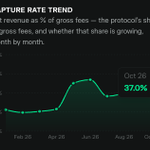
Right now $NEAR Intents' capture rate is now at 37%, up from the low teens earlier this year
= @NEARProtocol is retaining a larger share of fees on volume already running at multi-billion monthly scale
Confidential TVL has expanded sharply over the same period, and near(.)com is also taking a growing share of flow.
Revenue still covers only a fraction of emissions, but the monetisation efficiency trend is the clearer signal. Volume and capture both moving in the right direction is what makes the path to covering issuance look more plausible.
Besides, there's also value in looking at the partnership expansion aspect because we'd want $NEAR to be integrated more widely to boost volume.
What else caught your eye from Q3?



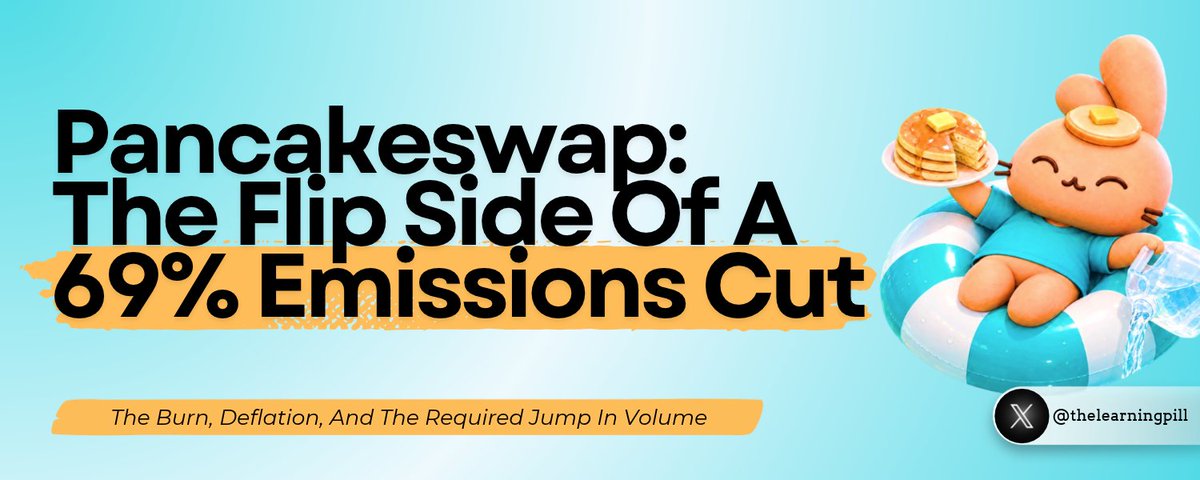
PancakeSwap’s Flip cuts $CAKE emissions by 69%.
On the last seven weeks of burn data, it also cuts net deflation from ~476K $CAKE a week to ~208K.
The V3 fees that paid for most of the burn go to LPs and the treasury instead.
The emissions cut saves 108.5K/week, and the burn it gives up is 376K.
Suggest you dig into this 👇

Tagging Pill's frens and CAKE enjoyooors
@Headchef_pcs
@chef_boba
@rektdiomedes
@crypto_linn
@Eli5defi
@0xCheeezzyyyy
@yashascore
@the_smart_ape
@defi_mago
@Nick_Researcher
@Hercules_Defi
@DeFi_Andree
@MeshClans
@Jonasoeth
@Mars_DeFi
@Karamata2_2
@Kaffchad
@BUNT10
@Kruys_Collins



Good catch here on how $SKY has grown in holder revenues from recent governance changes, and this makes it more attractive to the next buyers
Two ways the Agent Network improves this:
1) Larger pie
More Agent-deployed $USDS → higher gross revenue → higher net surplus
Circ. supply is already $9.94B while agent obligations sit at $5.91B.
Further growth in USDS supply that gets drawn by Agents (within debt ceilings) expands the interest-bearing book and therefore the revenue base.
2) Higher share of the pie
Stage 2 deliberately increased the % flowing to $SKY holders.
Of the $5.85M allocated to the Smart Burn Engine each cycle:
> $2.63M → SKY buybacks for stakers
> $2.63M → USDS staking rewards
> $585K → permanent SKY buyback + burn
Reserves are still filling toward the $150M floor (currently $94.1M), so a portion continues to be retained. Once that floor is reached, a larger share of each cycle’s surplus becomes available for holder distributions.


In case you missed it, this is @SkyEcosystem's holder revenue:
> June: $1.1M
> July: $1.2M
> August: $2.5M
> September: $5.1M
> October: $3.6M with 11 days left, pacing ~$5.6M
Meanwhile total revenue stayed flat at ~$14M per month.
Same business, far more of it flowing to $SKY holders.
That's the kind of change the market usually prices late.
The crazy part is, even with a growing percentage of revenue being allocated towards buybacks, distribution is growing tremendously via the Sky Agent Network.
I've been telling y'all about Sky. We're still early, but not for long.


Most people who want privacy in crypto never use a privacy tool, and the reason has little to do with privacy.
Every option so far made you either set up a brand new wallet or give your keys to software you’d never checked, and hardware wallets like Ledger also fails to protect your data.
The people with the most to protect, anyone keeping serious money on a hardware wallet, were the ones shut out.
@nullmaskio $MASK fixes this, but how?
For a user, that means 4 things 👇
1) You keep using the wallet you trust, hardware wallets included (no new recovery phrase to write down and nothing to move)
2) You can swap tokens privately on the same exchanges you already know (@Uniswap on Ethereum, @aeroxyz on Base, @PancakeSwap on BNB Chain) and move money between chains through @near_intents
3) Every deposit gets checked by AMLBot before it enters the pool. That keeps out obviously dirty money, so your withdrawal is less likely to get mixed up with someone else’s problems.
4) Withdrawing earns points until mid-Jan: 1 point for every $10 you take out, with a $100 minimum, and up to 1.5x more if you use the Big Wave batching option. At the end, points turn into $MASK tokens from a 100M pool, which is 10% of all $MASK.
Privacy does cost something. Nullmask takes 0.5% when you put money in and another 0.5% when you take it out, so a full round trip costs about 1%.
Yet people are paying it anyway.
If you hold $MASK, look past the big revenue numbers:
> $1.01M in total revenue, with $748K of that is $ZEC sent to the team’s wallet, so it isn’t money earned from people using the privacy pool
> Actual users paying the 0.5% fee = $265.9K
> Holders have been paid $1.6M in ZEC so far (1,384 ZEC), and 2.36% of all $MASK has been permanently destroyed, which leaves fewer tokens around.
Holders have received about 6x more than the pool has earned in fees. Those rewards come from how the token itself is set up, so the pool needs to get much busier before the fees alone could pay that much.
This is only 3 weeks old, which isn’t much history to judge anything on but seems like it has good potential to ride on the privacy narrative.
The next month will show how much real demand/incentives-driven usage there are.
