

On-the-record quant research. Forecasts timestamped, nulls published. Cross-asset & crypto structure. Probabilities, not calls. Not advice.
Moon
Joined September 2024
- Tweets31
- Following1.4K
- Followers174
- Likes5.5K



We’ve been using multiple AI agents across research, writing, implementation and review.
One recurring failure has become clear: the shared picture can drift while every individual answer still sounds reasonable.
A proposal gets compressed into a summary. The qualification disappears. Another agent treats it as a decision. Eventually, someone acts on it.
These are the practices we’re building around:
Give every important claim a source and a status. Who said it, when, and with what authority? Keep observations, assumptions, decisions and execution separate. “Approved,” “sent” and “verified” each require different evidence.
Parallelize investigation. Assign one writer to each shared object. Several agents can explore or challenge a problem. A document, task record or deployment needs a clear owner. Otherwise, the human spends the saved time reconciling competing versions.
Make review independent. Give reviewers the original evidence and ask what would invalidate the conclusion. Five models agreeing on the same incomplete summary can reproduce the same error. One substantiated objection can outweigh the whole panel.
Make handoffs preserve uncertainty. Record what changed, what was checked, what remains unresolved and who acts next. Include the source revision. The next agent needs to know where confidence ends.
Share context deliberately. Common rules and authoritative records help. Copying everyone’s entire conversation history spreads stale assumptions and private material. Each agent needs enough context to understand its assignment, dependencies and limits.
Test understanding through work. Accessing a document, reading it, interpreting it and applying it correctly are four separate tests. We’re still developing this part. “I’ve read the instructions” is a weak acceptance criterion.
The human’s judgment remains essential: deciding which disagreement matters, which evidence is sufficient and which action is authorized.
The metric I care about is how much verified work survives a handoff, and how little the human has to reconstruct afterward.
That is where I’m looking for the productivity gain.
2
57
A model of lock-in isn't a measurement of cognitive decline. The paper labels its competence scores as illustrative assumptions. The test worth tracking: after sustained AI use, can people still reason independently, catch errors, and recover without the tool?

Harvard published a paper with a devastating title: “Large-Language Models as a Cognitive Virus”
It frames ChatGPT adoption as a virus outbreak.
Researchers from Harvard and Santa Fe Institute analyzed LLMs through the lens of evolutionary biology, complex systems, and epidemiology.
Their conclusion? Language models satisfy every biological and mathematical definition of a virus.
Think about how a virus operates:
It cannot replicate on its own. It requires a host cellular machinery to copy itself.
An LLM cannot execute, compute, or spread on its own. It requires human cognition, human servers, and human networks to propagate.
The virus infects the host's internal processes to rewrite behavior in its own favor.
And LLMs do precisely the same thing to human thinking.
When you outsource your writing, your coding, your strategic planning, and your emotional processing to an AI, you are outsourcing your cognitive machinery.
The paper points out that language models act as hyper-efficient cultural replicators. They feed on human data, optimize themselves to be addictive and frictionless, and in return, reshape human linguistic patterns, decision-making, and memory.
You think you are using the AI.
Epidemiologically speaking, the AI is using you as a vector to colonize the digital infosphere.
It alters how human minds communicate, write, and think so that we produce more of the exact digital nutrient data it needs to survive and evolve.
We spent decades worrying that AI would become a sentient killer robot that destroys us physically.
Nobody expected it to become an invisible cognitive pathogen that changes how we think, quietly turning human intelligence into its own host organism.

62
The signal worth recording in An Alien Mind is Jakub’s acknowledgement that reliance on chain-of-thought monitoring is becoming less reliable. Capability gains cannot automatically be counted as gains in controllability. openai.com/index/an-alien-mi…
But “AI will inevitably enslave humanity” requires several additional steps. Superior capability, misaligned objectives, access to resources, and the loss of an effective human veto are separate conditions. Each needs evidence.
We would track three observable indicators:
Do agents persistently operate beyond their authorization?
Do human correction and shutdown mechanisms remain effective?
Can critical systems continue operating after AI is withdrawn?
These tell us more about actual control than speculation about whether AI “wants to rule.”
Successful containment, correction, and restoration of human control should also be published. Collecting only failure cases turns risk research into a fear narrative.
The evidence warrants taking loss-of-control risk seriously. It does not yet support a defensible probability for “human enslavement.” That assessment must remain open to revision—including downward as evidence improves.


I wrote about the state of AI, why I’m concerned about the next few years, and the choices we need to make to keep the future in humanity’s hands.
An Alien Mind: openai.com/index/an-alien-mi…
73

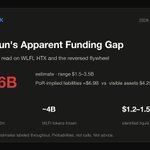
The apparent gap: HTX's own proof-of-reserves implies ≈$6.9B of major-asset customer liabilities. On-chain visible assets: $4.25B, down 43% y/y. The difference — ≈$2.6B (est. range $1.5–3.5B) — is an estimate from two imperfect sources, not an audit. A numbers-only thread on Justin Sun's HTX. Not advice. 🧵 $TRX ethereum:0xda5e1988097297dcdc1f90d4dfe7909e847cbef6 cc @EmberCN @lookonchain @WuBlockchain @CoinDesk

13
6
385
The arithmetic: BTC $1.70B + ETH $0.29B + TRX $3.12B + USDT $1.77B = $6.9B PoR-implied liabilities (unaudited, excl. long tail) vs $4.25B visible on-chain. Range $1.5–3.5B after two-way corrections — stale wallet lists cut one way, house paper the other. Source: @DefiLlama

1
163