




Pinned Tweet
🚨 [BREAKING] Billion Dollar Toad Venom
The Phase 2b results for Intranasal 5-MeO-DMT for depression were JUST published in @JAMA
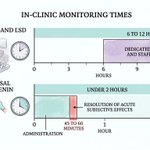
Mebufotenin produced rapid, durable symptom reduction, with patients ready to go home in under 2 hours.
For context: $LLY bought Atai for 3 BILLION dollars this summer on this readout.
The era of the "short trip" psychedelic is here. 🧵

🔎 Patients and clinicians saw right through the blinding
Like almost every psychedelic trial, functional unblinding was rampant. The Bang Blinding Index confirmed the 0.3-mg subperceptual control failed to hide the assignment.
When a drug alters reality for 45 minutes, everyone knows who received the 8-mg or 12-mg doses.
This introduces massive expectancy bias, though the study explicitly measured pretreatment expectancy and found no correlation with actual MADRS symptom reductions. While independent raters were kept in the dark, patients were aware of their arm.
Additionally, assessing monotherapy required an antidepressant washout, and mid-trial changes shrunk the 8-mg group's sample size, limiting power.

💡 Takeaways
5-MeO-DMT is a rapid treatment for severe depression that has the potential to change psychedelic medicine's logistical nightmare.
It matches psilocybin's efficacy with less overhead, and only requires one dose for lasting efficacy up to 8 weeks.
It’s no wonder $LLY bought out Atai Beckley for $3 BILLION dollars earlier this year.
Source: Feifel et al. JAMA 2026 — doi.org/10.1001/jama.2026.18…

Excited to continue sharing evidence-based psychiatry on X and beyond!
@npp_journal is one of the leading journals on drug discovery in psychiatry.
As its Editorial Intern, I’ll continue distilling what I think are the coolest findings in psychiatry.
And as part of the Special Projects team, we’ll be cooking up some new initiatives that will be quite different from my usual Articles and Threads 🧑🏻🍳
Stay tuned!

BIG news #ThisWeekInNPP: we are excited to introduce the 2027 NPP Editorial Intern @therealRYC
Dr. Chen will support the NPP co-Principle Editors, Special Projects & Social Media teams for the next year. We are all excited to work with him, so congrats again, Dr. Chen!

Being at Pareto for one model across multiple design tasks and substrates is pretty stacked ngl

Avengers assemble: 1 year BakerLab + NVIDIA GenAIR = 🔥 rfd4-proteina.org
Presenting RFD4-Proteina, our latest protein design model, significantly better and faster than everything we compared against, both in silico and in the lab! 1/30
💊 ATTENTION ALL DOCTORS 🤖
If you haven’t become AI native yet, here is my plea to you.
Start now.
It might feel overwhelming.
It might feel unethical.
It might feel existential.
But it is not.
It is the greatest enabler we have ever experienced in our lifetime 🧵
📝 Literature
I have a daily scraper for new papers, posts on X, or blogs on topics to learn about.
I have one for:
- AI x Bio
- Psych drug discovery
- Psych news
- Macroeconomics
- AI fundamentals
I have a daily feed that tells me one concept to go deep into, and then a news brief. That way I’m learning stuff to build my foundations and also what’s cutting edge. Super important for me on the AI side where I’m still new and learning. Same for macroecon.
How to set this up? Copy paste this and tell Grok Bot to do this for you.
I’m honestly so worried that the PRIMARY zeitgeist in medicine is one of skeptical resistance to being AI native.
Most faculty are still unclear about the different models, their strengths and weaknesses, and how to integrate AI effectively.
It’s now easier than ever to do so.
So my plea is this: learn how to use AI because it will make you the best clinician you can be. For yourself. For your peers. And for your patients.
🚨 [BREAKING]
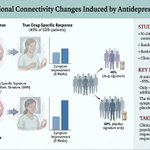
Brain scans now show that for ~60% of patients taking sertraline, their brain network changes and clinical responses are purely PLACEBO-driven.
We might be giving SSRIs to 60% of people who don't need it 🧵

🔎 The replication cohort lacked a placebo control
To prove these brain signatures weren't just a one-off, the authors validated them in the CAN-BIND-1 escitalopram cohort.
But because CAN-BIND-1 lacked a placebo arm, we cannot definitively confirm if escitalopram induces the exact same ratio of placebo-to-drug responders as sertraline.
We also only have 1-week and 2-week snapshots. We do not know if the 60% of patients who looked like placebo responders at week one eventually developed the true drug-specific brain changes by week four.
Finally, the study failed to identify an early fMRI signature that reliably predicts continuous individual-level treatment response to sertraline.

💡 Takeaways
The modest benefit SSRIs have over placebos in major depression trials isn't just because the drugs are inherently weak across the board.
It is because clinical trials are blending two entirely different biological subpopulations: a minority having a potent pharmacological response, and a majority having a placebo response to an active pill.
This paper provides strong evidence that we can see that divergence in functional brain networks within seven days of the first dose.
If we can develop pre-treatment fMRI signatures to identify that 40% before prescribing, we stop relying on trial-and-error and move toward actual precision psychiatry.
But this harder than it sounds, because it seems like you need to "give" the treatment first and measure a week later to know. We still don't yet have a way to do a single scan and predict placebo response characteristics with any certainty.
Solving the challenge of the placebo effect will truly be field-changing for psychiatry.
Source: Tong et al. bioRxiv 2025 — doi.org/10.1101/2025.08.22.6…
