

Head of Engineering @varickagents, building Agents enterprises can trust with real work • Prev: eng leadership @Dropbox • 🇫🇷 in the Bay
Joined August 2026
- Tweets76
- Following37
- Followers7.3K
- Likes38
Thomas LJ retweeted

There is way too much noise in AI right now.
Every day there's a new technological advancement.
- Should you switch from Claude Fable 5.2 to Gemini Neon?
- Should you build a company brain or a company 2nd brain?
- Should you build a software factory or an agent factory?
Varick helps you cut through the noise.
The team is hosting its first ever AI Transformation Office Hours, a series meant for enterprise executives to better understand how AI should be used in their departments.
This first session is all about AI in the Office of the CFO. If you're an enterprise CFO, CAO, VP of Accounting or related finance operation, this session is meant for you.
Here, we'll answer questions like:
- Which parts of the close can agents run today, and which parts still need a person to sign off?
- Where do you start with finance agents: AP, AR, reconciliations, or FP&A?
- How do you get from a 20-day close to a 5-day close without adding headcount?
- How do you keep your auditors comfortable when an agent prepares the work-papers?
- How do I earn the buy-in of finance operators when building agents to handle manual work?
Every attendee leaves with their team's Finance AI Maturity Score (AIMS).
Thursday, December 10, 2026, at 2pm ET / 11am PT.
Register in the link below; seats are limited to ensure high quality.

Thomas LJ retweeted
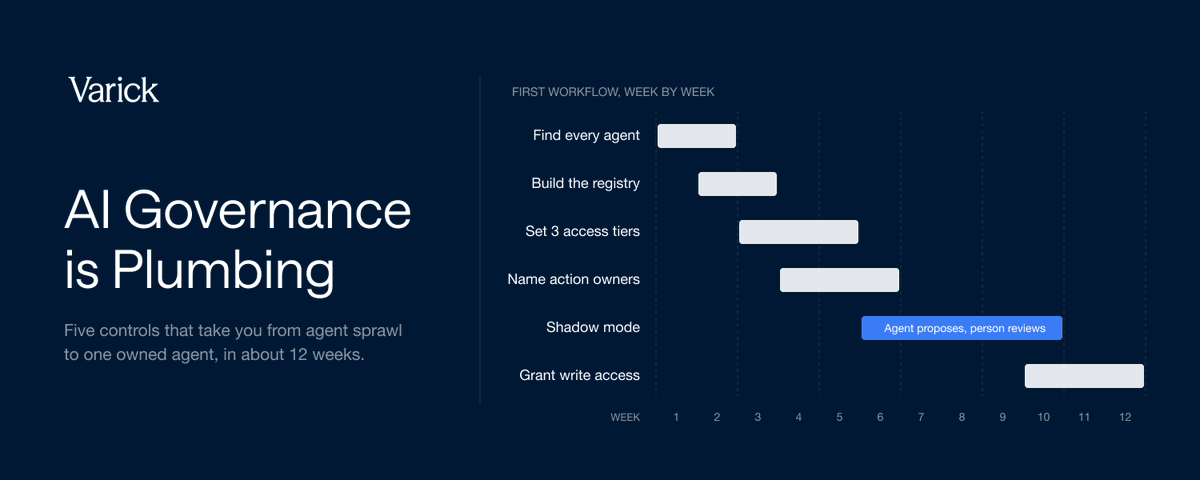
Every CIO in the country has been tasked with AI governance, a buzzword that deserves a proper explanation.
The below article is a must read.
Simply put, if you want to build agents that move the needle for large companies, you have to handle concerns around governance, auditability, and evals, you will fail.
There will be 1000x more agents deployed as time goes on, meaning this issue compounds if not handled correctly now.
Thomas was an early Dropbox engineer, is top 0.01% in terms of AI understanding and ability, and is now Head of Engineering at Varick.
There is no one more qualified to speak on the topic than him!

Thomas LJ retweeted
What does AI for PE firms actually look like?
We've been on calls with a handful of PE operating partners over the last 2 weeks. Their #1 issue is that portcos' AI efforts are stuck in the IT org.
These companies have scaled and some have moats, but they are not sophisticated from a technology standpoint. Some have large engineering teams, some have a help desk and an outsourced MSP, but regardless, AI efforts get stuck as a side-of-desk activity or with the "3 guys in the closet upstairs."
Meanwhile, there is a ton of work that needs to get done. One portfolio company is a distributor where the inside sales team gets orders scribbled on a whiteboard and then re-enters them into the ERP. It takes an hour to enter a 100 item order, and when a contractor sends work to 3 distributors, the first quote back generally gets the work. If you can get the order entered quicker, you get the work.
So portfolio companies are struggling with:
1. Hiring: Should we hire someone on the business side to lead AI, or an AI-aware accounting lead? (Good luck hiring these people…)
2. Build vs Buy: There are a ton of "AI for X function" companies out there, and a ton of noise, how do you even begin to navigate?
3. If we build, how do we get the capacity in a portfolio company without issuing an RFP for every use case? (A couple wanted to sign a contract at the fund level, "almost like a captive capability")
4. Are we doing this for labor takeout or to increase the exit multiple? (You can push EBITDA up 5 points, but it doesn't increase the value of the company unless you have a new narrative. "Nobody wants it unless you can show that you have an agentic offering")
5. Should we do outcome-based pricing? (Generally bogs down in contract negotiations - what does it mean to save an hour and is it really worth $17?)
6. Who will do the work? "Everybody has a story to tell, and the sales pitch was great, but the project was terrible. It comes down to who you have walking in the door."
7. What is the business case? We've seen AI briefs that show a function can be 40% automated that were written by someone that never talked to the function.
We do this for PE-backed companies every day at Varick. Work with us below:
Thomas LJ retweeted
Here's where AI agents for finance workflows break in large enterprises, and why:
1. More than 25% of invoices a company receives don't have a PO. The coder using Coupa doesn't find a PO to match to, clicks a box saying "there's no PO", and the invoice goes into their ERP to get paid without being checked against the budget. Sometimes this happens for the same vendor for six months in a row.
2. Partner billings are initiated with a ticket that's free-form text. If the business owner doesn't put the GL string on the ticket when he files it, it doesn't get coded properly. One of the tickets said the partner was crediting $3M to a customer, when in fact it was something like $360K. It went to the customer like that.
3. The folks providing data for the close don't know when the deadlines are. Accounts Receivable needed the data by the second business day of the month in order to bill it in that cycle. They didn't get the data until the 4th business day, so Revenue had to accrue it and bill it later.
4. Fixed Asset retirements: there are 500-700 per month. For each one, the team looks up the asset in the ERP, opens up a template, and manually types in three columns of data per asset. If you get one digit wrong, you retire the wrong asset. Their words: "Very manual clicking. Clicking. Nothing to do."
5. Every time a customer set up a new invoice group, the company set up a new customer account in the ERP. They had a CRM integration, but they couldn't turn it on because their customer list was so messed up. They couldn't tell me how many B2B customers they had.
6. The procurement process has 11 segments in the chart of accounts, and each segment sends the request to a different reviewer. Users override the default segments 10-15% of the time, and the last step (done by FP&A) sends the request back to start over. Each request takes two days to more than two weeks to complete.
7. When setting up approval thresholds (say $5,000, $10,000, $100,000, $1M, $10M, $25M), each threshold adds an approver but doesn't remove the previous ones.
8. There are two systems involved in intake and approvals. One routes to legal, sourcing, risk management, etc. The other (the ERP) is used for budget approval and the PO. Their words: "Users are always confused... what's a source system."
9. Contract terms changed from what was quoted. Legal redlined the contract, which removed the metadata that would have flagged the non-standard discount the customer negotiated. It passed Finance's review and Sales ops review, because they thought it was the standard discount. It was only caught by the system when it calculated the discount.
10. Project accruals: each month end, they email every project manager asking if they've done any work over $5,000 that hasn't been invoiced yet. Then they chase down the replies and calculate the accrual (e.g. the project is 60% complete but only 50% billed, so they need to accrue 10%) in Excel.
11. Contracts are billed on a schedule, not based on what was delivered. For example, an ad deal will bill the same amount each month. If they don't deliver what was sold, they have to get the customer to sign new paperwork.
12. Pass-through costs: the customer contract and the PO to the vendor are in two different parts of the ERP. They do have a wash account to record it, but whether anyone is reconciling it, "I doubt it."
13. Order entry is still done from a photo or PDF of the customer's order. It takes an hour to type in an order with 100 lines, and the customer submitted the same request to three competitors at the same time.
14. There's no tool for coding transactions to the GL, so they don't know how similar transactions have been coded in the past. One of their business lines issues credit memos, which have a whole other list of GL accounts, which almost doubles the size of the chart of accounts.
15. There's no API for downloading bank recs or vendor portals, so somebody does it by hand every month.
If you'd like to fix any of these in your existing ERP, that's what we do at Varick. Work with us below:
Thomas LJ retweeted
Hiring:
1 Engineers: to join our Platform team, built the agent operating system that powers the world’s largest companies.
2 FDEs and 2 FDSs to join our Delta team, interface with C-Suite executives, redesign entire departments, and build agents to deliver millions in value.
Guarantee this will be the most fun company you will ever join, and you’ll learn a ton.
Everyone wears multiple hats, everyone comes in early and stays late, and we’re growing 100% month over month.
Up to 250k base plus Equity.
DMs open.
Thomas LJ retweeted
This article articulates the issue with enterprise AI so clearly: the main reason AI pilots fail isn't even because of the AI.
Most enterprises have piloted 3 or more AI projects in the last 12 months. Yet, you won't find any of them on their P&L. Why?
- They built the AI model based on the SOP, but real processes have exceptions that can be 40% of the volume.
- They thought a quicker W-9 review would improve vendor onboarding. It didn't. That process still takes 22 days.
- There wasn't a clear owner for the AI agent 7 months in, after the innovation budget ran out and the consultants left.
Fantastic article by the former COO of Citadel Securities in the EMEA region. If you've piloted AI projects that never made it to your P&L, read this before piloting another.


Thomas LJ retweeted
We're still in the early innings of AI transformation. Varick estimates the market for AI transformation will grow 100x over the next 3 years.
Finance is one of the best places to start, for a few reasons:
- Most of the time is spent waiting. One invoice exception takes 25 minutes of work, but 11 days to clear.
- Finance leaves a better data trail than any other function. Every invoice, approval, and journal entry is timestamped somewhere, even if half of it lives in Excel.
- Much of the work is rule-based. You can't afford for agents to hallucinate in the finance function, and by incorporating heavy determinism, you de-risk the agents.
In the article below, our COO Eyad breaks down the exact playbook we've used to roll out AI in finance at some of the largest companies in the world.
If you're working on agents in finance, or you're an FDE, this playbook is a gold mine.


Thomas LJ retweeted

Buckle up because this is some LinkedIn-quality bullshit.
There's a cliche story that goes like this:
Henry Ford had a problem with a generator no one could fix so he called in an engineer Charles Steinmetz. Charlie studied the machine for a while, made a chalk mark on it, workers adjusted that spot, the generator sprung back to life, and he handed over a bill for $10,000.
Ford was shocked and demanded an itemized invoice.
Steinmetz replied:
Making a chalk mark: $1
Knowing where to make the mark: $9,999
(and that's what I learned about B2B SaaS)
Anyway cool story but the point is that this is the same for software engineering! Code is getting cheaper by the second. Who gives a shit how many PRs you can generate? Any idiot can do this now. The real skill is knowing *what* PR to generate.
As of 2026, I think sufficiently hard engineering projects still require these skills that you can only acquire by actually understanding what code is doing.
Thomas LJ retweeted
What has to go right for AI to actually show up as positive in your P&L:
- Having the right sponsors: someone from the C suite, with a budget that they can spend and, very importantly, the involvement of the owners of the processes that you're going to be automating. And, also, the early involvement of key stakeholders, like legal, information security, IT, and finance.
- Really understanding the as-is processes that you're going to be automating: this requires process mining of the systems of record, and an understanding of the detail of each process, who's involved, all of the variations, and the volumes and the cycle times.
- Understanding the baseline of the process and the metric that you're going to measure to understand how much value you're creating: are you looking at time saved, cost saved, revenue increased after spending the tokens, or risk reduced, and agreeing the key KPIs that you're going to measure.
- Re-engineering the processes, as you automate them. Usually, you'll end up with about five steps, of which four of them will be automated using AI. And use plain code wherever plain code works.
- Building AI agents that work with all of the systems that you've already got in place, like Salesforce, NetSuite, SAP, ServiceNow, Dynamics, et cetera, so that you don't have to move to a new system, or have people log into a new system. And having one architecture layer underneath all of those AI agents.
- Deciding which decisions that the AI agent can make versus where you need human input, and making that decision based on both the risk and the cycle time to make the decision. The agent proposes, a person makes the call, and every action is reversible and traceable.
- Running the AI agents in shadow mode, in live with your volumes, and comparing their output to the people doing the process now. And not paying out anything they produce until you're absolutely sure that the AI agents are doing what they're supposed to be doing.
- Identifying the 5% to 10% of your people who are already using AI, and getting them to be the AI ambassadors and evangelists, and then training all of your people on how they work with the AI agents, and explaining how their jobs will change.
- Having a plan for 7 months from now, where you own all of the AI agents that have been developed, all of the data, all of the evaluations, all of the logs, they're all in your cloud, and they're built to be agnostic to any particular AI model.
We do all of these at Varick. Partner with us below:
Thomas LJ retweeted
C Suite executives around America are eagerly awaiting Opus 6 and GPT 7 so that they may finally one-shot the agent-ification of their company.
By then it will be too late. A fascinating analysis by Daniel, former COO of Citadel Securities EMEA.

Thomas LJ retweeted
"AI and jobs is a complex equation". No kidding.
Great prescriptive analysis for enterprises, based on real client engagements.


Thomas LJ retweeted
HIGH PRIORITY HIRE @ VARICK: Forward Deployed GTM Engineer
We have ~$600M in pipeline and not enough people to close it. New leads come in every day from a mix of sources (X, our newsletter, email, DMs, etc.).
You'll be responsible for wrangling this pipeline: outbound, inbound, and even outbound on hiring (an extension of selling). You'll also have a huge impact on our messaging, marketing, design, and product roadmap, since you'll be on calls every week with dozens of the largest companies on earth, from the Fortune 500 up to the Fortune 10.
Applied AI is still early, and we're going to dominate it. You'll be central to driving the next 9 figures of revenue at Varick.
Comp: $150K-$200K base, up to 1% equity, and commission on every deal you work, up to $1M a year.
Have you done at least one of the following?
- Finished top 10% of your SDR, BDR, or AE team for 2+ quarters
- Spent 2+ years at a top bank, consulting firm, or PE fund with strong performance
- Started something of your own that made $100K+ in revenue
- Built your own outbound engine (Clay, scrapers, agents) and can show the reply rates
If you're a mercenary who's ready for long, intense hours, apply below or DM me.
$20k bonus if we hire someone you send my way.
Thomas LJ retweeted

Before we automate a workflow, we always audit the client's current process.
This client used 17 steps to pay one invoice. For them, that was a simple workflow.
The audit took 2 to 3 weeks of interviews and process mining.
After the redesign:
- 17 steps to 7
- 24 days of cycle time to 6
- 6 exception loops to 1
- 18% straight-through rate to 87%
- $31 per invoice to $6
At 18%, most invoices went through an exception route.
We fixed that with process reengineering. Agents were only one part of it.
Show the client the full mess first. It breaks their heart, but they need it.

Thomas LJ retweeted
We spent the day with ~20 CHROs and Chief People Officers from some of the largest companies in the world (collectively responsible for millions of employees) in Napa this week.
Here’s what they asked, what we told them, and where they are in their adoption of AI.
1. Do we need to train everyone on how to use AI? Is that even HR’s job?
Partly. Most companies are a barbell in terms of AI adoption. Roughly 5-10% of employees are using it already (on their own). Most aren’t using it at all. Focus on empowering the first group and running a short training program for the second group. Even spending 1 day, or 1 hour per day for 1-2 weeks on how to prompt effectively is extremely valuable. Create a leaderboard for the skill files that save people the most time, but don’t create one for tokens used.
2. Should we let everyone build agents? How do we prevent sprawl?
Let everyone build agents, but do it all on the same layer with the same context, and owned by the same person. If you let 400 people build agents in 400 different places, you’re going to have a) tech debt, b) a crazy token bill, and c) 6 agents all trying to do the same thing. Let everyone use sidekicks (Microsoft Copilot, ChatGPT, Claude, etc) to do their work, but have a small group of people take the work off of everyone’s plate with agents that work in the background, built on top of the systems of record.
3. How do we re-engineer processes in HR?
The first step is to map out how the process actually works - not how it’s supposed to work. For example, when a new employee is onboarded, the date they start in the ATS may be different than the date they start in the HR system. This almost always results in an email from someone in HR ops to the hiring manager to confirm the start date, which then almost always results in a late order of the laptop, which then results in the new employee not having access on day 1. And none of that is documented in the process. Once the process is mapped out, a process that has 15 steps can be reduced to 5, and 4 of those 5 steps can be handled by agents. This works for anything: payroll corrections, benefits, leave requests, employee tickets, etc. We’ve seen payroll corrections drop by 90% this way.
4. How do we make people feel like AI isn’t going to take their job?
Be honest about what changes. Agents take the 90% of the work that repeats, and people keep the 10% that needs judgement, which is usually the part they got into HR for. One of the best ways to sell the implementation is to show the teams what their job will look like when the agent is live. This is another reason to include key stakeholders, who are currently running the process, from day 1. If the plan is to capture all of their tribal knowledge into the agent, they need to see something in it for themselves.
5. What steps of the process should be human-led vs. fully agentic?
This decision comes down to two key factors: risk and cycle time.
If a step in the process is low risk (think answering a question based on an HR handbook) but high volume, it makes sense for the process to be fully agentic. On the other hand, if the step is high risk (terminations, investigations, comp exceptions, etc.), it should be led by a human, though there may be opportunities for agents to help with the prep work. Most steps, however, fall in between these two extremes and should be built as agents propose + human approves, with full traceability and reversibility.
6. Who on our team should be our forward deployed engineers?
Forward deployed engineers should be big picture thinkers who aren’t stuck in the ways things have been done at your company for the past 10 years. They should be knowledgeable on AI and at least a little bit technical. In an HR department, these people often are your HRBPs or your HR ops-minded folks who have already automated much of their job through spreadsheets and macros. Give these folks real problems to solve. You don’t need them to become certified.
7. How can we keep up with the latest in AI?
You can’t, really. It changes too fast. Subscribe to some newsletters, but know that most things break on X before anywhere else.
That being said, you can get 99% of the value from AI agents with models that are a year old. You don’t need to have the shiniest, most up-to-date model to build valuable agents for your HR team.
Key takeaways from the session:
1. Nobody in the room was asking if they should be using AI. Every company in the room had rolled out a copilot or ChatGPT to the whole company, so the question was more around why it hadn’t changed anyone’s week.
2. HR is being tasked with training the rest of the company on AI, often without adequate budget or authority, so the first question is often “Is this even our job?”
3. Despite #2, HR’s own jobs are often the last to be tackled, as teams are focused on rolling out AI to the rest of the company while still running their own processes (even simple ones like onboarding) through email and spreadsheets.
4. There is fear on both sides: employees are worried about how AI will impact their jobs, and CHROs are worried about what they’ve empowered their teams to build.
5. Most people in the room thought they needed to keep up with the latest in AI. They don’t.
We solve these every day at Varick. Work with us below:

Thomas LJ retweeted
Top 25 questions the world's largest C-Suite executives ask us re: AI transformation in the enterprise:
1. Are AI transformation firms more like McKinsey or Palantir?
2. We launched Copilot for everyone to use, but why hasn't it changed anyone's week?
3. We've done training, custom GPTs, enablement. What's next?
4. Where do we even start with AI?
5. How do we choose the first workflow to AI-enable?
6. Should AI be owned by IT or the business?
7. Do we really have to train all 10,000 people in the company?
8. How do we enable everyone to build agents, without ending up with agent sprawl?
9. Why are our token costs increasing?
10. How do we know if using AI is really cheaper than just hiring another person?
11. Which steps should remain human?
12. How do we communicate AI won't replace our team's jobs? (Will it?)
13. Will we own the agents you build for us?
14. What does maintenance look like in 6 months?
15. Will our data leave our environment?
16. What models should we be using? What do we do when they're deprecated?
17. Can we run these agents inside our ERP, or will people have to use a new tool?
18. Do we need to clean up our data first?
19. How long until we start seeing ROI?
20. When you talk about ROI, do you mean headcount?
21. How do we keep growing our business without increasing headcount?
22. Why did our last pilot project die in POC purgatory?
23. Our process documentation doesn't match what our team actually does – how do you know what to automate?
24. How do we keep up with how quickly AI is changing?
25. If AGI becomes a reality tomorrow, where should we point it?
We solve these every day at Varick. Work with us below:
Thomas LJ retweeted

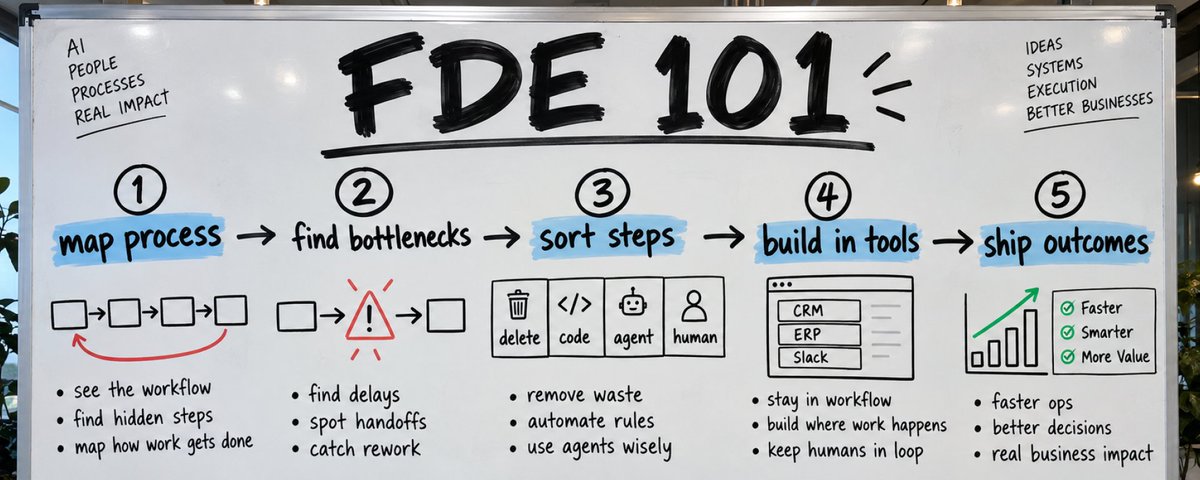
HOW TO BECOME A FORWARD DEPLOYED ENGINEER (53 MIN MASTERCLASS)
Some forward deployed engineers are getting PAID $1M+/year (kinda crazy, I know)
And I REALIZED almost nobody talks about HOW they do it in any detail. It's basically nowhere online.
So I asked someone who does it ALL DAY LONG for Fortune 500 companies to walk me through it, step by step. and he shares EXACTLY how he does it
youtube.com/watch?v=1a5HxU52…
Here's what I learned:
1. They start by listening, not building. They interview the people doing the work and let agents quietly read the company's data for a few weeks. The real process is almost always 3x longer than the one on paper.
2. They sort every step into four buckets: delete it, automate it with a simple rule, give it to an AI agent, or keep a human on it. A surprising amount ends up in the first bucket.
3. They build inside the tools the company already uses. Nobody has to learn a new app. When a human needs to sign off, it's just a Slack message.
4. They use the cheapest model that gets the job done. Most of this work doesn't need the most expensive AI.
5. They measure everything before and after, then come back 6 months later and prove it worked.
This + concrete client examples + way more on today's episode of @startupideaspod (thanks to @vasuman)
A full course pretty much on the topic aivalable to you 100% for free.
This episode is for ANYONE who wants to be a FDE or who wants to make their company AI-native by deploying agents.
Watch
Thomas LJ retweeted
My interview with Celonis on the state of Applied AI in the Enterprise, below.
Thanks for having me on, @billdetwiler!

AI layered over a broken process doesn't pay back.
@vasuman of joined @billdetwiler to explain why.

Thomas LJ retweeted
The biggest damage AI is doing right now is making you want to multitask in the name of productivity.
You enjoy each task less. If you're watching a movie, might as well prompt Claude every few minutes. If you're given 10 tasks, just open 10 terminals.
It's impossible to focus. Focusing feels unproductive. It's TikTok for work.
They got you when you're off the clock, and now they've got you when you're on it.
In a few years your brain will be liquid.
