



Tiny GPU retweeted

I gave three quants the same prompt: build a rainy neon gas station at night as one animated 3D page.
Hy4-flash at 3.56 and 3.08 bits per weight, and Qwen3.8-Flash-Next at 3.05. Each one ran in opencode against my engine with nothing around it, reasoning at the maximum, on the DGX Spark.
But the fastest one finished last 👀
Flash-Next writes 67 tok/s and the Hy4 packs write 42 and 43. It still needed 32 min 43 s. The two Hy4 packs finished in 20 min 28 s and 13 min 25 s.
Its run wrote 123k tokens. The Hy4 runs wrote 48k and 31k.
knowing the bandwidth ceiling up front tells you when to stop tuning. logging the failed attempts is the part most people skip.

The same Intel card went from 25 tok/s to 91 tok/s on Qwen3.8-27B, and the hardware never changed.
The team behind it turned their method into an agent skill: sybil-solutions/inference-optimisation-skill. On an Arc Pro B70, llama.cpp with Q4_K_M gave them 25.0 tok/s. EXL3 at 4 bpw on vLLM with custom XPU kernels and MTP speculative decoding gave 91.2 tok/s for one user.
It isn't a list of magic flags. The skill makes the agent work out the theoretical ceiling for your hardware first, then change one thing at a time, measure against interleaved controls, log the failures too, and only keep a change that survives a long-context retrieval check.
Other results in the README: an RTX 3090 running Qwen3.8-27B EXL3 3 bpw with MTP hit 96.2 tok/s on prose and 141.1 on code, one user.
It works with Claude Code and any agent that loads SKILL.md-style skills, and there's a PROMPT.md for other models.
One caveat: these are the authors' runs on their own machines. Your ceiling comes down to memory bandwidth, which is exactly what the first step measures.
Running that ceiling math might be the cheapest upgrade your rig gets this year.

1
4
Tiny GPU retweeted

CUDA was never the moat.
Apple's MLX on Linux, via Vulkan, runs Qwen3-4B at 124 tok/s on an RTX 5060 Ti hooked to an M1 Max MacBook Pro.
llama.cpp on CUDA, same card: about 101.
One barrier fix took MLX from 99 to 124. NVIDIA's card, Apple's framework, 23% faster.
experts in system RAM is what lets a MoE fit on a 16GB card. nice that you flagged the output check is still pending.

Also tried ninfer-all on it. One 5070 Ti with the experts in system RAM does 100 tok/s with its drafter, 93 without. llama.cpp on both my cards does 83. Haven’t checked that its output matches llama.cpp yet, so this is speed only.

1
11
Tiny GPU retweeted

Benjamin Marie of The Kaitchup wrote up kaiLLM, an inference engine for low-bit models that he built with help from GPT 6 and Opus 5.5.
kaiLLM keeps vLLM for serving and batching. It reads GGUF files with llama.cpp's reader and runs them with llama.cpp's integer kernels. It also runs his new 2-bit format, kaiPTQ, which llama.cpp can't load.
On an RTX Pro 6000 with the same Qwen3.8 27B Q4 file, he measures kaiLLM 31.9% faster than llama.cpp at 8 sequences and 42.2% faster at 16. With one sequence they are about even. He says these short tests favor kaiLLM. With Unsloth's Q2 file, the 8-sequence lead is 29.8% in the short test and 7.5% on long runs with 32,768 generated tokens.
His first 2-bit Qwen3.8 27B file is 6.73 GB, and it runs on a 12 GB RTX 3060. On his own held-out sets its KL@10 to the full model is 0.113 and 0.121. Unsloth's UD-IQ1_M is the same size and scores 0.268 and 0.283. Lower is better. He puts it about level with Unsloth's UD-IQ2_XS, a file 13% bigger. For now the checkpoint is early access for paying subscribers.
The build took less than a month. GPT 6 in Codex got a working engine for LFM3 in about two and a half weeks. Then Opus 5.5 sessions added about 10,500 lines in six days, 4,700 of them CUDA. He says he probably threw out 95% of the models' research suggestions.
My read: the cheap card is where the speed story gets thin. On the RTX 3060, kaiLLM with the 2-bit file makes 69.7 tokens per second at 8 sequences and 68.3 at 16. llama.cpp, running Unsloth's file of the same size, climbs from 51.9 to 70.8 and passes it. The size result looks sturdier, and he asks for outside checks himself.
kaitchup.substack.com/p/kail…
someone's running a 26B model on a 12GB RTX 3060 at about 35 tok/s with a 2-bit GGUF. old cards keep earning their slot.
2
18
Tiny GPU retweeted

Inkling-2-Mini is out: 26B parameters in a mixture-of-experts that touches about 3B per token. Unsloth published GGUF quants and a llama.cpp PR for support exists
thinkingmachines.ai/news/ink…

a 2B speech translation model at 2.3GB in Q8, running on stock llama.cpp. small models fit real-time jobs well.
3
18
Tiny GPU retweeted

Stock @ggml_org now translates spoken French into spoken English live and offline, via Kyutai's Hibiki.
2B model: 2.3GB Q8 + 1.6GB audio file. The web UI can't stream a mic yet, so you need your own client.
llama-server -hf ggml-org/hibiki-2b-GGUF -c 1500
github.com/ggml-org/llama.cp…

prefix caching on by default doesn't help if the KV pool is too small to keep sessions resident. worth watching eviction rates.

Good question! Prefix caching was already enabled on the baseline. Both vllm and sglang enable it by default. I looked again and 114s to 1s was from making the KV cache large enough to stop prefix cache thrashing, so active sessions stopped getting evicted.
14
Tiny GPU retweeted

I spent 4+ months pushing 400B+ MoE models on 4x RTX 3090s and patching inference engines with my agent.
Today I'm open-sourcing the playbook with 102 tested hypotheses across 6 models, 16 chapters, and a skill you can drop into Claude Code or Codex.
40 out of 102 ideas in this repo FAILED and that's exactly important.
Things that happened on my runs:
- Turning off 1 CPU instruction (PDEP, microcode on EPYC Zen 2) sped up cold CPU experts 3.6x (1.6 ms down to 0.44 ms).
- Rewriting DMA and chunked loading pushed DeepSeek V4.1 Flash 32K prefill from 430 to 2,199 tok/s.
- "Keep hot experts in VRAM" bombed on MiniMax-M3.1-Flash, where a static profile hit 64-69% vs 61% for random placement in sim.
- On Hy4 Flash, 220 experts chosen from the prompt covered only 48% of the answer's experts.
- Adding a Cyrillic draft vocabulary (for Russian language) with no training jumped Qwen3.8-Flash-Next acceptance from 32% to 54%.
Each row comes with the exact hardware tags, raw numbers, what went wrong, and when it's worth retesting.
Clone it, point your coding agent at SKILL.md, and stop burning weeks on bullshit that doesn't work on your setup.
github.com/alesha-pro/infere…
PRs are welcome!

131k context sounds huge until one 13k line python file turns out to be 170k tokens. count your tokens before you plan.
18
decode being memory bound is why smaller weights speed up every token. prefill is the part that actually wants the FLOPs.

Your LLM doesn't write a 500-token answer. It runs the entire model 500 times, once per token
Part 1 on LLM inference:
what TTFT, ITL and throughput actually mean, and why prefill and decode are two very different problems
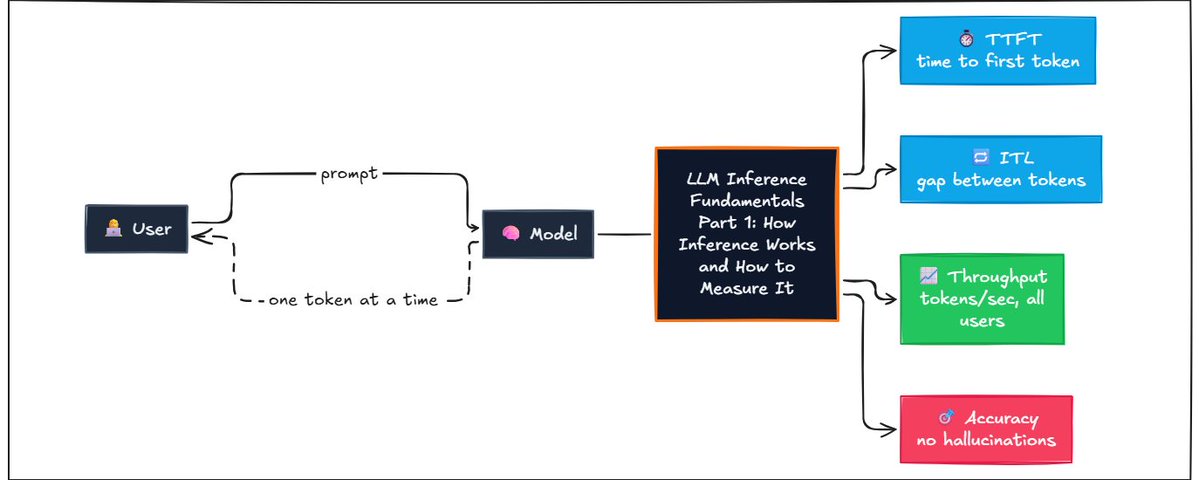
13
Tiny GPU retweeted

A 9B model at 59 tok/s on a 16 GB GPU.
JJ Eaton @jayleaton ran SenseNova-Loop-9B on TensorFold: 59.1 tok/s on an RTX 5070 Ti, 59.5 on an M5 Ultra.
Weak spot he flagged himself: tool calls, 58% on BFCL.
Fine for chat on a cheap card. Not your agent brain yet.
small lesson: budget VRAM for context, not just weights. a 4.9G 4-bit model I read about today needed 9G at 64K.
14
Linear attention on most layers probably explains why 256K still fits in 12G. Long context on small cards is nice.

SenseNova-Loop-9B 放了 GGUF,4bit 权重 4.9G
显存:64K 上下文 9G,256K 12G,8G 卡不够
32 层跑 56 层,等效 14.6B,吞吐约 9B 六成
坑:stock llama.cpp 不认,得编官方 fork
判断:不换 API,值钱在 512K 和不漏数据
局限:没真 tok/s,四分之三是线性注意力
你们本地先看显存,还是 tok/s
1
1
24
Tiny GPU retweeted

On the same two 12 GiB RTX 3060s, I would not recommend the 125B path for daily multi-user chat.
vLLM Qwen 3.8-27B answers short prompts in 0.12-0.49 s TTFT and holds 4 concurrent streams. PolyStrata Qwen 3.8-Flash-Next at IQ2_XS is 0.81-2.06 s on short chat. I'd recommend the 125B stack when the document actually needs more than 128K.
hot take: on a small card, Q4_K_M plus a longer context beats Q8_0 with a short one. decoding is memory bound anyway.
11

Tiny GPU retweeted

Tried porting Baseten's bison-1 and groundhog-1 decision models to MLX. Well-calibrated answers in one pass, but they only answer yes/no, choice and score. No bounding boxes, and my demos need them. 🤷🏻♂️
@liquidai d1 stays the winner 🏆