

Pol Theory Prof @Politics_Oxford & author of Mere Civility (2017) and First Among Equals (2026). Essays @ NYT, Atlantic, WaPo, &c. Writing on equality.
Oxford, United Kingdom
Joined January 2016
- Tweets4.4K
- Following2.4K
- Followers11.4K
- Likes8.8K






Pinned Tweet
Is it too soon to re-up this?
ted.com/talks/teresa_bejan_i… via @TEDTalks

Teresa M. Bejan retweeted
The first review of First Among Equals is live, from the indomitable @DavidWootton69
“Teresa Bejan…has fundamentally re-conceptualised the history of equality; for an historian of political theory there could hardly be a more important achievement.”
Thank you, David!


Teresa M. Bejan retweeted

"One rarely finishes a book wishing it had been longer, but this is an altogether exceptional work"
@DavidWootton69
@tmbejan has "fundamentally re-conceptualised the history of equality"

Teresa Bejan’s history of equality before egalitarianism locates the origins of a modern conviction in the England of the 1640s. It is an exceptional work that marks a new beginning.
The invention of equality | @DavidWootton69
engelsbergideas.com/reviews/…

The first review of First Among Equals is live, from the indomitable @DavidWootton69
“Teresa Bejan…has fundamentally re-conceptualised the history of equality; for an historian of political theory there could hardly be a more important achievement.”
Thank you, David!
Teresa M. Bejan retweeted
I’ll be giving the autumn Pharos lectures on one of the central puzzles in my new book, First Among Equals: “How did equality become an egalitarian ideal?”
The first lecture will take place tomorrow (Tuesday, 26 Oct) at 5pm in New College. Full details and registration below!

The Pharos Autumn Lectures 2026:
Professor Teresa Bejan (Oriel College) - 'First Among Equals: How Did Equality Become an Egalitarian Ideal?'
Tuesdays 27 October, 10 November and 24 November, 5pm, Noel Salter Room, New College.
eventbrite.co.uk/e/teresa-be…
@tmbejan

I’ll be giving the autumn Pharos lectures on one of the central puzzles in my new book, First Among Equals: “How did equality become an egalitarian ideal?”
The first lecture will take place tomorrow (Tuesday, 26 Oct) at 5pm in New College. Full details and registration below!
The Pharos Autumn Lectures 2026:
Professor Teresa Bejan (Oriel College) - 'First Among Equals: How Did Equality Become an Egalitarian Ideal?'
Tuesdays 27 October, 10 November and 24 November, 5pm, Noel Salter Room, New College.
eventbrite.co.uk/e/teresa-be…
@tmbejan
Teresa M. Bejan retweeted

If anyone's at a spare end tonight tune in to @BBCFreeThinking at 9pm where I'll be discussing democracy with @DrMatthewSweet, @tmbejan, @Melissa_S_Lane and others! bbc.co.uk/programmes/m00333t…
Teresa M. Bejan retweeted

Recently had the opportunity to attend a fascinating panel discussion about @tmbejan's new book. It promises to be a critical intervention in both political theory and intellectual history, challenging us to rethink past and present meanings of 'equality' and 'hierarchy'.

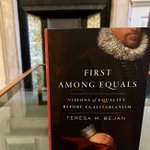
Today is the official release date for my new book, First Among Equals: Visions of Equality before Egalitarianism (Belknap, 2026).
It explores how and why “equality” became, rather suddenly, a basis on which ordinary men and women could make political demands in early modern England.
hup.harvard.edu/books/978067…

And with the incomparable @DrMatthewSweet at the helm!
I’ll be on BBC Radio 4 Free Thinking live this evening at 9 to discuss ‘Democracy’ with @HDrochon, Melissa Lane, and others—please tune in!
Teresa M. Bejan retweeted

It's a great mail day when I receive a beautiful new hardback by @tmbejan. I'm glad to see Gerrard Winstanley and the Diggers finally getting their due!

I’ll be on BBC Radio 4 Free Thinking live this evening at 9 to discuss ‘Democracy’ with @HDrochon, Melissa Lane, and others—please tune in!
Teresa M. Bejan retweeted

This will be amazing.
Today is the official release date for my new book, First Among Equals: Visions of Equality before Egalitarianism (Belknap, 2026).
It explores how and why “equality” became, rather suddenly, a basis on which ordinary men and women could make political demands in early modern England.
hup.harvard.edu/books/978067…
Also if you’re an academic or journalist interested in reviewing, please do get in touch!
Today is the official release date for my new book, First Among Equals: Visions of Equality before Egalitarianism (Belknap, 2026).
It explores how and why “equality” became, rather suddenly, a basis on which ordinary men and women could make political demands in early modern England.
hup.harvard.edu/books/978067…
Teresa M. Bejan retweeted

David Armitage: "In this reflective essay marking the 25th anniversary of The Ideological Origins of the British Empire (2000), David Armitage reconstructs the intellectual genesis of his book and reassesses its arguments in light of subsequent scholarship." tandfonline.com/doi/full/10.…

Teresa M. Bejan retweeted

Can't wait to read this.
Today is the official release date for my new book, First Among Equals: Visions of Equality before Egalitarianism (Belknap, 2026).
It explores how and why “equality” became, rather suddenly, a basis on which ordinary men and women could make political demands in early modern England.
hup.harvard.edu/books/978067…
Teresa M. Bejan retweeted
As with everything @TMBejan writes, this will be excellent.
Today is the official release date for my new book, First Among Equals: Visions of Equality before Egalitarianism (Belknap, 2026).
It explores how and why “equality” became, rather suddenly, a basis on which ordinary men and women could make political demands in early modern England.
hup.harvard.edu/books/978067…

Teresa M. Bejan retweeted
It’s a good book! Well worth reading. A major contribution.
Today is the official release date for my new book, First Among Equals: Visions of Equality before Egalitarianism (Belknap, 2026).
It explores how and why “equality” became, rather suddenly, a basis on which ordinary men and women could make political demands in early modern England.
hup.harvard.edu/books/978067…
Teresa M. Bejan retweeted
Today is the official release date for my new book, First Among Equals: Visions of Equality before Egalitarianism (Belknap, 2026).
It explores how and why “equality” became, rather suddenly, a basis on which ordinary men and women could make political demands in early modern England.
hup.harvard.edu/books/978067…