



AI getting cheaper may make compute more expensive.
Dylan Patel says Anthropic has reached $50M revenue per MW against $10–15M of compute cost. Reinvesting the spread into training lets labs outbid others on power.
Better models → more revenue → higher compute prices.
I counted 1.05 million lines in a simulation I built with AI. About 242,000 are tests.
At 100 finished lines per hour, that is 10,500 hours. I spent roughly 20–30 active hours steering it.
The comparison is crude. A 350–500× difference is still hard to ignore.
Jalapeño makes NVIDIA’s OpenAI investment look smart.
If recursive self-improvement happens and most economic activity shifts to frontier labs, OpenAI could be worth more than companies selling hardware.
NVIDIA’s OpenAI stake could eventually be worth more than NVIDIA itself.
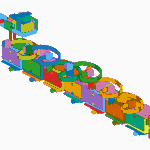
Sol working on a design for a worm robot that can be 3D printed. Told it to color parts differently and use lines so that it can find defects (of which there are still many).

software moats are dying faster than physical moats
if everyone gets the same reasoning models, the edge moves to things the model cannot instantly copy:
owned experiments
messy data
robots
lab throughput
weird supplier relationships
actual products in the world
i believe the biology restrictions in frontier models are honest signal, not just pr
when labs start gating capabilities by domain, the useful thing is no longer “can it answer bio questions?”
it is “can this system help run discovery loops that touch the physical world?”
the next biotech company might look less like a traditional lab and more like a recursive machine
ai chooses targets
ai designs candidates
ai designs the lab and robots
robots run experiments
data comes back
ai iterates
humans mostly choose taste, constraints, and ambition
Fable 5 blocks everything that could be related to bio work. In this case the word "lab" seems to be the issue.

openai + ginkgo running 36,000+ experiments is the part people should stare at
not because 40% cheaper protein synthesis is the final product
because the unit is becoming:
ai searches the experiment space
robots hit reality
new data trains the next move
biology is probably where ai stops being just software
because the data you need does not already exist on the internet
you have to manufacture it in cells, assays, robots, failed experiments, weird measurements
that makes the lab part of the model
ai biology is crossing a weird threshold
not “a model reads papers and suggests ideas”
more like:
model proposes
robot tests
data comes back
model updates
company learns
at that point the biotech company is less an org chart and more a closed loop
Fable 5 just one-shotted a robot design that can pick and place plates in a lab. Something Codex didn't get right even after a week of running.

the important thing about the mythos release is not just "ai got better at biology". it is that biology/chemistry is now a frontier capability category. general model gets safety rails. trusted version gets the lab-useful thing. probably the shape of the next few years
models can help you realize almost any idea now
which makes it more obvious how surprisingly uncreative many people are once they get unlimited options


if you actually believe agi is coming, it is weird to keep building strategies for the world where it does not
that is the trap. intellectually price in the fast world, then emotionally act like the slow world is safer
i like the idea of ugly robots more than perfect humanoids sometimes
robots built from whatever parts are available, for dark factories nobody has to look at, redesigned by ai every week
not elegant. useful