

Satellite Communications. GOES (HRIT/GRB/SUVI), HRPT, Inmarsat, L/S/X/Ku-Band, DSN, Astronomy, Whiskey, Endurance Running, Adventure Racing, Climbing.
USA
Joined October 2011
- Tweets10.6K
- Following445
- Followers13.5K
- Likes12.7K


Pinned Tweet
Here is just the eruption and slowed down to about 4 FPS... You can see some gravity waves.
Added some nighttime city lights to fill the void. Red dots are fires detected by GOES-19. And of course Tropical Storm JD Vance in the lower left.

Here is a look back to Tsuchinshan-ATLAS comet transit along wit Mercury from October of 2024 as a test of the new SUVI Viewer. Pretty cool if you ask me!
Added CCOR-1, LASCO-C2 and C3 along with NOAA WSA-ENlil model to my new SUVI Live viewer! And I got lucky to find Venus making a transit in the field of view on LASCO-C3!!

This is an X Class flare from 2025 to test all 6 wavelength playback along with flare intensity graph synced to video. SUVI via GOES-19.
Hurricane Vance! Testing out some new storm tracking capabilities - following the in footsteps of @coyotefxl
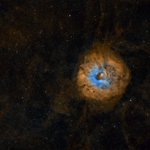
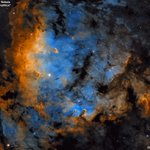
This is known as Little Rosette Nebula. Located in the constellation Cassiopeia located 7500 light-years away. About 27 hours of light to make this. This is part of a larger object known as the Question Mark Nebula, which I will try to capture next. This is the dot.

Teddy Bear Nebula (sorta hard to find the bear). Also known as "Pillars of Cepheus". About 3000 light-years away. The pillars are dense columns of gas and dust carved and sculpted by intense stellar winds and radiation from hot, newborn stars. 35 hours of light to make this image

Fish Head Nebula. 6000 light-years away in the Constellation Cassiopeia. 16 hours of light on this one.

The Cocoon Nebula. 3200 light-years away in constellation Cygnus. Both an emission and reflection nebula. 18 hours of light collected over 3 weeks.

Bubble Nebula is the main attraction, but there is no much more going on here. 7100 light years from Earth. The “bubble” is created by stellar wind from the central massive hot star. 17 hours of light collected.

Flying Dragon Nebula in HSS - 22 hours of integration. A very faint target in constellation of Cygnus. Rarely imaged due to time commitment. 4000 light-years away.

The Tulip Nebula. 6,000 light-years away. It's Nebula season again. Foraxx palette. Approximately 13 hours of integration. Quite a bit of OIII and Ha in this emission Nebula.

The Wizard Nebula. 7,200 light-years away. Approximately 4 million years old. Rich in Ha and OIII. Captured with 1000mm scope with approximately 13 hours of exposures. Foraxx palette.

Whirlpool Galaxy. 25-30 million light-years away. 13 hours of integration time. Some nice Ha star forming regions and interstellar dust.

M106 and NCG4217. About 20 hours of light but ended up with about 11 hours due to wind and clouds. So many other galaxies in this image.

Messier 94 (M94), often called the Cat's Eye Galaxy or Croc's Eye Galaxy, is a spiral galaxy roughly 16 million light-years away in the constellation Canes Venatici. It has an unusual outer ring. There are many other galaxies visible in this image. About 18 hours of exposures.

Pinwheel Galaxy along with some other galaxy friends. 21 million light-years away. 27 hours of data. 1000mm focal length.

Here is the "Butterfly Nebula". A not too often imaged Emission Nebula in the Cygnus area of the night sky. Also known as IC1318. 4900 light-years away. 10 hours of narrowband light collection over the last month. @zwoastro FF130
