

Vera&Company Founder - Cloud and DevOps https://nitter.gq/t.co/C1cjt7QkjB - Open models, Flat fee.
Tenerife
Joined September 2010
- Tweets5K
- Following778
- Followers574
- Likes5.2K


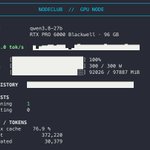


Qwen3.8-27B. Unlimited tokens. One monthly price.
Connect your coding agent to NodeClub and build without watching a token meter.
nodeclub.ai
2
3
2,566
Lo servimos directamente desde nuestros propios clústeres de nodos GPU. No depende del hardware del usuario ni necesita descargar nada en RAM. Toda la inferencia se ejecuta en nuestra infraestructura, optimizada para contextos largos y uso concurrente.
1
1
8
Por ahora, por el tamaño del nodo, estamos sirviendo Qwen 3.8. La idea es dar el salto a Qwen 4 en cuanto esté disponible y lo tengamos bien optimizado.
Por cierto, hemos hecho bastantes benchmarks frente a otros modelos y creo que te puedes llevar una sorpresa bastante buena con Qwen :)
Según vayamos ampliando el clúster, iremos metiendo más modelos. Y queremos que sea la propia comunidad quien vote cuáles le interesa tener.
Tienes un trial de 24 horas en nodeclub.ai
167
Puedes leer lo que escribí desde los absolutos o desde los grises, como prefieras. Yo intento quedarme con los matices. Viajar y conocer otras realidades me ha permitido apreciar cosas de países con los que no necesariamente comparto su forma de entender el mundo. Creo que una cosa no quita la otra.
2
53
Hola, Laura. Te sigo desde hace tiempo y me ha parecido especialmente interesante lo que has compartido estos días.
Este año pasé tres meses en Nueva York y otros mes en China. Poder conocer ambas realidades más allá de una visita turística me hizo reflexionar bastante. Creo que desde Occidente miramos al resto del mundo con una arrogancia enorme, muchas veces sin entender realmente cómo funcionan otras sociedades.
Igual que Manhattan me había dejado muy buenas impresiones en mis anteriores visitas, China también me sorprendió muy positivamente. Y eso no significa que todo sea maravilloso, ni mucho menos.
Sigo pensando que Europa tiene una oportunidad extraordinaria de combinar lo mejor de ambos mundos, añadiendo ese toque europeo de seguridad, derechos y calidad de vida. Eso sí, necesitamos adaptarnos mucho más rápido a los tiempos actuales.
Tampoco creo que estemos por detrás en todo. En España, por ejemplo, tenemos soluciones como Bizum que me parecen fantásticas. Y con la automoción china tengo mis más y mis menos: coches atractivos, tecnología interesante y precios competitivos, pero algunos aspectos de calidad todavía me generan bastantes dudas.
Me ha sucedido algo parecido viajando por Singapur o distintas regiones de Malasia. Cuanto más conozco otras realidades, más convencido estoy de que tenemos mucho que aprender unos de otros y de que nos sobra bastante superioridad moral.
I think the important part of this discussion is the nuance. Qwen3.8:27B isn’t a frontier model, but calling it basic is quite a stretch.
And yes, running local models comes with challenges. But models and inference stacks aren’t static. Hardware requirements, performance and efficiency keep evolving. Also, local doesn’t automatically mean faster, more stable or more private. That depends on the actual architecture and workload.
My company has spent years working on infrastructure and countless hours researching and benchmarking LLM inference, across consumer and enterprise hardware. Today, we operate this service for hundreds of users.
What we’re building isn’t about running Qwen just to prove it works. It’s about making it genuinely usable for real agentic workflows, large contexts, parallel requests and sustained workloads. Other models will come too.
I constantly see people saying “it works for me.” And that’s great, but works for what, exactly? A single conversation? A short prompt? Multiple agents processing large contexts concurrently? These are very different requirements.
The same goes for pricing. Someone says “DeepSeek only costs me €10.” Fine, but for what usage pattern? API pricing is heavily distorted by scale, competition and sometimes subsidized infrastructure. Comparing that with the actual cost of operating reliable inference capacity locally makes things even more complicated.
This isn’t about replacing someone’s hobby setup. It’s about building a viable alternative, an option B or C, for people who genuinely depend on these models to get work done.
I absolutely believe we’ll see incredibly capable models running on phones and consumer hardware. But I also believe enterprise workloads will continue pushing the boundaries of inference infrastructure.
I’m not claiming to have the only correct perspective. But these opinions come from years of infrastructure experience, extensive benchmarking, real operational costs and many, many hours of engineering.
That’s why I think the conversation deserves more nuance than “it runs locally” or “€50 is too expensive.”
2
1
41
Boris Vera retweeted

"Hablar de ti en pasado. Es tremendamente injusto" 💔
Enric Gallego, la voz de un corazón roto, el del CD Tenerife tras la perdida de Jesús de Miguel 😔
No es comparable ejecutar un modelo de 3,3B en una GTX 1650 con usar uno de 27B para tareas de programación agéntica.
Con contextos largos importan la VRAM (pesos + caché KV), la velocidad de procesamiento del contexto (prefill), los tokens/s y la latencia acumulada en cada iteración del agente.
Que un modelo pueda ejecutarse en local no significa que ofrezca un rendimiento viable para trabajar con él.
1
23
Sure, as long as you have the hardware to make it genuinely usable, not just to proudly show off that it can say “Hello World!”
No subscription fees, just a hefty hardware bill.
18
I see comments like this all the time. There’s a huge difference between being able to run a model locally and actually making it usable.
Once you factor in real-world workloads, long contexts, latency, throughput, and concurrent requests, the picture changes dramatically.
Running inference is one thing. Delivering a consistently good user experience is another.
1
21
Ejecutar un LLM no significa que sea operativamente viable.
Un 70B cuantizado a 4 bits necesita aproximadamente 35-45 GB solo para los pesos. Si haces offloading a RAM, el cuello de botella pasa a ser el ancho de banda y las transferencias por PCIe, destrozando la latencia y los tokens/s.
Y cuantizar la KV-cache a Q8_0 no reduce el tamaño de los pesos del modelo.
Que un modelo cargue y genere tokens no significa que ofrezca un rendimiento útil. Lo importante es medir TTFT, tokens/s sostenidos y degradación bajo concurrencia, no presumir de que “cabe”.
3
28
youtube.com/watch?v=szy4IRsi…
Me han invitado a Innosfera Podcast para hablar de cómo estamos construyendo NodeClub, un club de inferencia de IA donde ofrecemos acceso a modelos open source con tarifa plana, sin pagar por token.
Hablamos de GPUs, infraestructura, los retos de servir LLMs y de cómo surgió esta idea.
381
Agreed. Medium might sound counterintuitive, but it makes a real difference. Fewer unnecessary reasoning tokens mean faster responses, lower latency, and more requests served per GPU-hour, often without sacrificing much quality on everyday tasks. This model defaults to xhigh, but we don’t serve it that way at NodeClub.
656
Jajajaja la GPU la ponemos nosotros, hombre, si la tuvieras que poner tú, ¿qué gracia tendría? 😂
1
50