





Pinned Tweet
The Mamba-3 architecture is incredible, but the math actively fights against standard PyTorch.
I just open-sourced mamba3-minimal: a pure PyTorch, single-file implementation of the Mamba-3 architecture.👇
github.com/VikramKarLex/mamb…
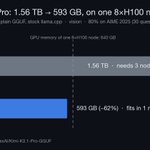
Kimi K3.1 Pro now runs on a single 8×H100 node 🔥
We shrank the 2.8T model from 1.56TB to 593GB (-62%), entirely in GPU memory. It still solves 80% of AIME 2025. Now with vision support.
Plain GGUF, stock llama.cpp: huggingface.co/KarLexAI/Kimi…

1
42
A real excalidraw bug, fixed by Meta's models in one live run:
Muse Spark reproduced it in the browser, SAM 3.1 and Graphicle found the code, Muse Wonder wrote a passing fix, and Spark checked the screen again.
5 min 12 s, $1.64. Built during the Meta AI hackathon.

Build the future of superintelligence with us.
The Meta Global AI Developer Hackathon is taking place from Oct 26-Nov 4.
Apply to compete for a share of $1M in prizes and build with our newest models. Each selected participant gets $150 in Meta Model API credits.
Limited to 20,000 selected applicants. Terms apply → bit.ly/4saQrA8
Apply now → bit.ly/4hR3cuQ
2
83
The trick is context. Graphicle packs the parts of a repo a task needs, cited by file and line.
On 90 held-out questions (Muse Spark, 128K tokens), the right file was in the top 5 for 71% with the pack, 51% with the first 128K tokens of the repo.
1
19
When a test fails, Graphicle feeds the failing lines and the files they name into the next try.
Same bug, live on 30 Oct: the tests passed 3 of 3 times with that loop, 0 of 2 without it.
Open source, Apache-2.0, 500+ stars: github.com/Graphicle-AI/grap…

1
13
Memory sits next to the graph: docs, decisions you approve and past Claude Code and Codex sessions, in one SQLite file. A note tied to a function is flagged when that function changes.
Local, no account, no API key, no telemetry. Apache-2.0: github.com/graphicle-ai/grap…

43
This post inspired Graphify. We ported Graphify to Rust and added memory: Graphicle 0.1.12 is out.
A code map goes stale with every commit, so ours updates after each one, 5.8 to 7.2x faster than Graphify 0.9.100 (Graphicle 0.1.11; 3 repos, median of 30 commits each).


LLM Knowledge Bases
Something I'm finding very useful recently: using LLMs to build personal knowledge bases for various topics of research interest. In this way, a large fraction of my recent token throughput is going less into manipulating code, and more into manipulating knowledge (stored as markdown and images). The latest LLMs are quite good at it. So:
Data ingest:
I index source documents (articles, papers, repos, datasets, images, etc.) into a raw/ directory, then I use an LLM to incrementally "compile" a wiki, which is just a collection of .md files in a directory structure. The wiki includes summaries of all the data in raw/, backlinks, and then it categorizes data into concepts, writes articles for them, and links them all. To convert web articles into .md files I like to use the Obsidian Web Clipper extension, and then I also use a hotkey to download all the related images to local so that my LLM can easily reference them.
IDE:
I use Obsidian as the IDE "frontend" where I can view the raw data, the the compiled wiki, and the derived visualizations. Important to note that the LLM writes and maintains all of the data of the wiki, I rarely touch it directly. I've played with a few Obsidian plugins to render and view data in other ways (e.g. Marp for slides).
Q&A:
Where things get interesting is that once your wiki is big enough (e.g. mine on some recent research is ~100 articles and ~400K words), you can ask your LLM agent all kinds of complex questions against the wiki, and it will go off, research the answers, etc. I thought I had to reach for fancy RAG, but the LLM has been pretty good about auto-maintaining index files and brief summaries of all the documents and it reads all the important related data fairly easily at this ~small scale.
Output:
Instead of getting answers in text/terminal, I like to have it render markdown files for me, or slide shows (Marp format), or matplotlib images, all of which I then view again in Obsidian. You can imagine many other visual output formats depending on the query. Often, I end up "filing" the outputs back into the wiki to enhance it for further queries. So my own explorations and queries always "add up" in the knowledge base.
Linting:
I've run some LLM "health checks" over the wiki to e.g. find inconsistent data, impute missing data (with web searchers), find interesting connections for new article candidates, etc., to incrementally clean up the wiki and enhance its overall data integrity. The LLMs are quite good at suggesting further questions to ask and look into.
Extra tools:
I find myself developing additional tools to process the data, e.g. I vibe coded a small and naive search engine over the wiki, which I both use directly (in a web ui), but more often I want to hand it off to an LLM via CLI as a tool for larger queries.
Further explorations:
As the repo grows, the natural desire is to also think about synthetic data generation + finetuning to have your LLM "know" the data in its weights instead of just context windows.
TLDR: raw data from a given number of sources is collected, then compiled by an LLM into a .md wiki, then operated on by various CLIs by the LLM to do Q&A and to incrementally enhance the wiki, and all of it viewable in Obsidian. You rarely ever write or edit the wiki manually, it's the domain of the LLM. I think there is room here for an incredible new product instead of a hacky collection of scripts.
40
Graphicle is on Product Hunt today: a code graph and project memory for your coding agent, with exact files and lines cited. One Rust program, runs locally, no account, no telemetry. Works with Claude Code, Codex, Cursor and any MCP client.
producthunt.com/products/gra…

3
53
In a pre-release comparison on LoCoMo-10 with open models, Graphicle scored 87.7, Hindsight 0.10.2 87.3 and Mem0 OSS 2.2.1 (the open-source library) 81.9, with about 12 model calls per conversation against about 160 and 332. Details: github.com/Graphicle-AI/grap…
27
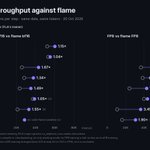
In the Gated DeltaNet-2 paper's own throughput setting (Fig. 2: 1.3B hybrids, one H100, 16K tokens/step), jla trains every model of that figure 1.14-1.41x faster than the paper reports with a 32K vocab, 0.99-1.23x with Llama-3.1's 128K. GDN-2: 52.1K vs 38.0K tokens/s.


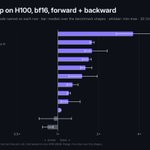
jax-linear-attention 0.1.0: FLA-class linear-attention kernels for JAX in Pallas Mosaic GPU. Mamba-2/3, Gated DeltaNet, KDA, RWKV-7, GLA and FA3-style attention on H100 (fwd + bwd), plus a training stack at 72.3% MFU (1.3B transformer, FP8). Apache-2.0.
github.com/jla-org/jax-linea…

25
Thanks to the work behind this: Mamba-2/3 (@tri_dao @_albertgu), Gated DeltaNet, GLA, FLA and flame (@SonglinYang4 @yzhang_cs @uniartisan), Kimi Linear's KDA (@Kimi_Moonshot), RWKV-7 (@BlinkDL_AI), JAX's Pallas Mosaic GPU, and many more credited in the repo.
jax-linear-attention 0.1.0: FLA-class linear-attention kernels for JAX in Pallas Mosaic GPU. Mamba-2/3, Gated DeltaNet, KDA, RWKV-7, GLA and FA3-style attention on H100 (fwd + bwd), plus a training stack at 72.3% MFU (1.3B transformer, FP8). Apache-2.0.
github.com/jla-org/jax-linea…
jax-linear-attention 0.1.0: FLA-class linear-attention kernels for JAX in Pallas Mosaic GPU. Mamba-2/3, Gated DeltaNet, KDA, RWKV-7, GLA and FA3-style attention on H100 (fwd + bwd), plus a training stack at 72.3% MFU (1.3B transformer, FP8). Apache-2.0.
github.com/jla-org/jax-linea…
Code, benchmarks and training recipes: github.com/jla-org/jax-linea…
pip install "jax-linear-attention[cuda]"
Issues and pull requests welcome.

With Claude Code (Opus 5.5), it ties plain grep on finding files and facts in every test we ran.
On Graphify's own showcase corpus it found 99.2% of the facts vs Graphify's 87.8% (grep: 94.7%, a tie).
Ties and losses included: github.com/graphicle-ai/grap…
Open source, Apache-2.0. Local-first: no account, no telemetry. Works with Claude Code, Cursor, Codex and any MCP client.
github.com/graphicle-ai/grap…
Built by @KarLexAI .