Vincent Madiard (@vmadiard) header
Vincent Madiard (@vmadiard) profile picture

Politique & éco • Auteur 🇫🇷 🇨🇭 Livre : Brivael Le Pogam - Du code à la tribune https://nitter.gq/t.co/i0IG6yMxIx Série Christine Lagarde #parasilagarde

Joined February 2025
Photo by Vincent Madiard (@vmadiard)Photo by Vincent Madiard (@vmadiard)Photo by Vincent Madiard (@vmadiard)Photo by Vincent Madiard (@vmadiard)Photo by Vincent Madiard (@vmadiard)Photo by Vincent Madiard (@vmadiard)Photo by Vincent Madiard (@vmadiard)Photo by Vincent Madiard (@vmadiard)Photo by Vincent Madiard (@vmadiard)
POLOGNE le volcan explose. Explications 🔥🔥🔥🔥🔥🔥 Ce qui se passe en ce moment à Varsovie n’est pas une guerre entre Polonais. C’est l’éruption finale d’un conflit qui couve depuis des années : celui entre une Cour constitutionnelle polonaise qui défend encore la souveraineté de son pays, et une Europe qui exige que son droit passe toujours au-dessus. Regardez ça : 👇 Police déployée autour du Tribunal constitutionnel. Le vice-président de la Cour se voit refuser l’entrée. Le président de la République (Nawrocki) interrompt son voyage au Sénégal et rentre d’urgence. L’opposition parle de coup. Le gouvernement Tusk et ses alliés disent qu’ils « restaurent l’État de droit ». Voici ce qu’il faut comprendre, clairement : Depuis 2015, l’ancienne majorité conservatrice polonaise a nommé la plupart des juges du Tribunal constitutionnel. Cette Cour a plusieurs fois dit non à la primauté absolue du droit européen sur la Constitution polonaise. Elle a refusé que Bruxelles et la Cour de justice de l’UE puissent défaire les nominations et les règles nationales comme elles l’entendent. Résultat : la Commission européenne et la Cour de justice de l’UE ont déclaré ce Tribunal « illégitime ». Pas parce qu’il serait corrompu dans le vide, mais parce qu’il refuse de s’effacer devant le droit de l’Union. Depuis que Donald Tusk est au pouvoir, le gouvernement veut reprendre ou neutraliser cette Cour. Aujourd’hui, on envoie la police, on annonce des suspensions, on bloque les accès. Le message est simple : une Cour constitutionnelle qui ne se soumet pas à la primauté européenne n’a plus le droit d’exister en l’état. Ce n’est pas un détail technique polonais. C’est le schéma qui se répète : un gouvernement très européiste + Bruxelles d’un côté, une institution nationale qui résiste de l’autre. Et quand la résistance devient trop gênante, on la traite d’illégitime et on la démonte. Le feu couvait. Là, il explose. 🔥🔥🔥🔥 La question n’est plus seulement « qui contrôle le Tribunal en Pologne ». C’est : jusqu’où l’Europe est prête à aller pour imposer sa primauté, et jusqu’où un pays peut encore dire non sans se faire qualifier de putschiste. À suivre de très près. #Pologne #Souveraineté
Shocking scenes in Poland. Police, dispatched by the Tusk government, have forced their way into the independent Constitutional Tribunal. Security personnel guarding the building and the Tribunal’s documents have been removed. The Vice-President of the Tribunal is being denied entry to the premises. This is a violation of all democratic principles.
5
2
10
442
🍩 Urgence Info On apprend que Gérard Larcher malgré sa résolution d'attaquer le régime depuis ce matin aurait déjà commis une entrave et engouffré 4 pains au chocolat pour le gouter. Pourra-t-il devenir notre prochain président ?
🚨 DERNIÈRE MINUTE 🚨 Présidentielle 2027 : Gérard Larcher aurait sollicité les conseils de François Hollande. Satire politique · Image IA
1
31
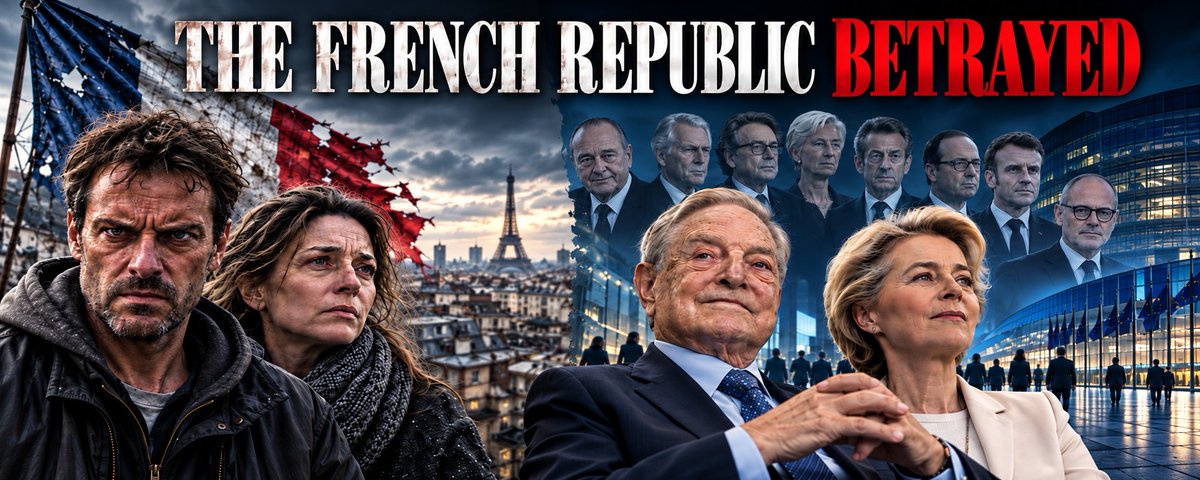
THE FRENCH REPUBLIC BETRAYED (5/5) The Cost of Inaction What It Costs, and Why Action Can No Longer Wait These leaders knew what they were doing. They did not transfer governing powers, commit billions, or accept supranational frameworks by mistake or because outside forces compelled them to. Across the political spectrum, they made those choices knowingly, for decades. The results are now plain to see. French and European public finances are in critical condition. Deficits have piled up as governments have lost control over budgetary and monetary policy levers. France now stands on the brink of being placed under the financial oversight of the European Central Bank or the International Monetary Fund, with finances that no longer add up and a diminished ability to act at the national level. Meanwhile, energy has become a source of vulnerability, prices remain high, and Europeans, starting with the French, are growing poorer. The justice system, health care, and public services are deteriorating. Billions have been spent on priorities set elsewhere, including support for Ukraine, without the French people having the final say on either the amounts or the objectives. War is drawing closer. National freedom of action has been curtailed at the very moment it would be needed most. This is not a situation these leaders were forced to accept. It is the product of repeated choices by people who moved in the same circles, shared the same way of thinking, and continued to invoke the Republic while hollowing it out. They allowed the center of decision-making to move further away. They accepted that French votes would carry less and less weight on the issues that mattered. They preserved the rhetoric. They hollowed out the principle. Today, the country faces diminished sovereignty, deteriorating public finances, a population under pressure, and mounting external risks. Discontent is already there. It could become explosive. When the people see that so much is taken from them, so little is given back, and they no longer have the means to decide matters that affect them, the question is no longer whether anger will rise. It is what will set it off. For the French people, the question is simple. How long will they keep funding a system that strips them of the power to decide? What will it take for their response to go beyond isolated complaints? A further deterioration in public services? Formal outside oversight of their public finances? A war they had no say in? Every passing day brings closer the moment when this accumulation of deliberate decisions produces a clear response. The leaders who engineered this shift will not change course on their own. For thirty years, they have shown where they stand. The constitutional principle that sovereignty belongs to the French people still exists on paper. It has force only if those who fund the system decide that it must be upheld again. That day will come. Every day that passes without a response makes the cost of inaction clearer and brings closer the moment when the French people refuse to keep paying for a model of governance that takes power out of their hands.
19
Bon ben de quelque bord politique de droite que l'on soit, je trouve l'idée de Retailleau excellente. Un compte sociale par Français, qui regrouperait tout j'imagine et dont le montant ne pourrait pas excéder un certain montant en proportion du SMIC. Fini le maquis sans fin des dispositifs kafkaïens. Bien instrumenté et conçu, cela permettrait de fusionner de nombreux guichets et faire des économies en fermant de nombreux guichet sociaux redondants et couteux. Vous voyez qu'il y a des bonnes idées dans tous les recoins de la politiques et qu'il serait temps que certains partis se mettent d'accord sur des minimas de bon sens et se regroupent.
Replying to @Ad_Vitam44_
Je vais faire mon rabat-joie mais je trouve ce questionnaire complètement nul et non avenu. Il enferme la réflexion dans des schémas de pensés complètement manichéens et ne laisse aucune place à ce qui manque le plus dans le débat politique, la nuance. J'ai commencé le questionnaire des 100 questions mais me suis arrêté genre à la 20ème parce que j'estime, ce n'est que mon avis, que c'est parfaitement inadapté. Je fais parti de ceux qui considère que nul programme politique n'est parfait, qu'il y a des éléments intéressants dans presque tous les partis (vous noterez le presque) et qu'un des problèmes majeur est justement que dans une période si tendue pour notre pays, je serais partisan de programmes minimalistes pour rassembler des forces politiques sur quelques sujet à traiter en priorité, trouver des consensus sur ce qui compte vraiment et épargner aux français ces listes à la Prévert qui noyent les sujets importants et à traiter en priorité avec tout un tas de thèmes tellement secondaires que les mettre de côté pendant une période de 10 ans n'aurait que peu d'incidence sur la société dans son ensemble.
45
💥 Alerte Info Sur les consieils de Hollande, Gérard Larcher annonce commencer un régime. Yaël Braun-Pivet fait part de sa satisfaction à l’AFP #gerardlarcher #YaëlBraunPivet
🚨 DERNIÈRE MINUTE 🚨 Présidentielle 2027 : Gérard Larcher aurait sollicité les conseils de François Hollande. Satire politique · Image IA
1
1
142
🚨 DERNIÈRE MINUTE 🚨 Présidentielle 2027 : Gérard Larcher aurait sollicité les conseils de François Hollande. Satire politique · Image IA
2
237
THE FRENCH REPUBLIC BETRAYED (4/5) The Choices That Hollowed Out Sovereignty The Actions That Hollowed Out the Principle Political leaders did not have this shift in power forced upon them. They engineered it. Maastricht was negotiated and defended with a full understanding of what it entailed. So were the treaties that followed. Successive leaders knew that each new commitment narrowed the French government's room to act on monetary policy, the budget, trade, and a growing range of regulations. They pressed ahead. François Hollande had been a Young Global Leader. Once elected president, he did not slow the process. He implemented European rules, accepted the budget constraints set in Brussels, and allowed France to fall in line with priorities that did not come from French voters. Emmanuel Macron, also a Young Global Leader, accelerated the process. He expanded France's international commitments, strengthened the role of European institutions, and presented every transfer of authority as the obvious course of action. Gabriel Attal and Édouard Philippe, both of whom had moved in the same circles, continued down the same path once in office. Christine Lagarde moved from a French cabinet post to the International Monetary Fund, then to the European Central Bank, and has served for years on the board of the World Economic Forum. Thierry Breton championed the Digital Services Act (DSA), which imposes content moderation requirements on platforms. Those requirements are set in Brussels and apply to content accessible in France. Nicolas Sarkozy participated in Davos networks and allowed private investors to acquire stakes in state-owned companies. None of them discovered only afterward that their hands were tied. They chose to sign agreements, appoint officials, sit on boards, and defend arrangements in which the French people no longer have the final say. The results can be measured. Budget deficits have widened as successive governments have lost control over policy levers. Billions have been committed to Ukraine through bilateral aid and European mechanisms, without the French people having voted on either the amounts or the objectives. Meanwhile, the justice system, health care, and public services are deteriorating. Energy taxes remain high. Purchasing power is under pressure. Public assets have been opened to private investment or sold off in the name of reducing debt, yet the debt has kept rising. When U.S. intelligence agencies intercepted the communications of Chirac, Sarkozy, and Hollande, the protests were muted. When Morocco targeted French phone numbers with Pegasus spyware, including those of Macron and several ministers, the response was restrained. In each case, the instinct was not to safeguard the French people's ability to make their own decisions. It was to accept arrangements that diminished that ability. These choices were not imposed from outside on reluctant leaders. They were made by officials who moved in the same circles, shared the same way of thinking, and continued to invoke the Republic while hollowing it out. The French people are paying the price: less control over matters that affect them, deteriorating public finances, and important decisions made elsewhere. This is not the result of constraints reluctantly accepted. It is the result of repeated, deliberate actions by people who knew what they were doing.
1
1
1
215
Quand la réalité biologique devient un sentiment, les règles du jeu changent. L’empathie mal dirigée ne se contente pas de protéger. Elle peut aussi exiger que l’on relativise des réalités physiques au nom des sentiments d’un groupe. Dans le sport, des compétitions féminines accueillent des athlètes biologiquement masculins au nom de l’inclusion. L’équité et la sécurité des femmes passent au second plan. Dans l’enfance et certains espaces réservés, le sexe biologique est traité comme une variable interchangeable, y compris lorsque cela concerne des mineurs. Dans ces cas, l’intention est présentée comme de la compassion. Le résultat est une redéfinition de catégories qui existaient pour protéger certains groupes. Dans deux jours : comment ce type de dérèglement se propage. #EmpathieSuicidaire
1
120
Une grande fierté et un immense privilège d'avoir été depuis 40 ans la pire des globalistes, JAMAIS ÉLUE, dans tous les sales coups qui ont fait souffrir des centaines de millions de citoyens sur terre. (Voir ma série premier commentaire👇) Je vais maintenant prendre la tête de l'organisation la pire qui soit, le WEF, ou venir achever mon pays d'origine pour mettre fin à son agonie lente et finir sa destruction dans le globalisme. Retrouvez toutes les gentillesses qu'a fait Christine Lagarde à l'humanité, la série se poursuit la semaine prochaine et le bilan est déjà TRÈS LOURD #parasilagarde #christinelagarde
I have just informed my colleagues that I will step down as @ECB President on 7 February 2027. It has been a source of great pride to serve this institution. I thank all of those who have supported me on this journey over the past seven years.
1
3
9
487
L’encyclopédie #ParasiLagarde : le parcours complet de Christine Lagarde, décision après décision. Chronologique, factuel, sans concession.
1
59
« Les emmerdes, c’est comme les cons, ça vole toujours en escadrille. » Jacques Chirac. En une dizaine de jours, Emmanuel Macron a accumulé une série de difficultés qui se renforcent mutuellement. Le 18 octobre, après les violences du 17, il s’est adressé aux Français. L’allocution a été jugée par de nombreux commentateurs comme trop générale, sans mesures concrètes immédiates, et a laissé le sentiment d’une incompréhension face à l’ampleur des débordements. Quelques jours plus tard, il a lui-même reconnu que le 17 octobre n’avait « pas du tout été anticipé ». Le 23 octobre, à Trappes, après l’attentat terroriste raciste (un mort, plusieurs blessés dont une fillette de 12 ans), il a déclaré que c’était « la première fois » qu’un acte terroriste planifié visait des personnes « en raison de leur couleur de peau ou de la religion qu’on leur donne ». Cette formulation a été immédiatement contestée comme factuellement inexacte, au regard de précédents connus (Merah, Hyper Cacher, etc.). Il a dû préciser le lendemain qu’aucune douleur ne devait être hiérarchisée. Le 27 octobre, un juge du Delaware a estimé qu’il n’avait pas de compétence personnelle sur Candace Owens (résidente du Tennessee). La plainte en diffamation des époux Macron se poursuit uniquement contre les sociétés de l’influenceuse immatriculées dans le Delaware. La plainte vise notamment les allégations selon lesquelles Brigitte Macron serait née homme (sous le nom de Jean-Michel Trogneux), aurait usurpé une identité et transitionné, ainsi que d’autres accusations (liens familiaux, MKUltra, dissimulation). Enfin, The Economist, qui avait autrefois présenté Emmanuel Macron comme le « sauveur de l’Europe », le décrit désormais comme un président lame-duck en fin de mandat, confronté à une impasse politique, budgétaire et sociale. 👇 Ces épisodes se succèdent sans pause. Pour un président à six mois de la fin de son second mandat, l’accumulation est particulièrement nette.
203
THE FRENCH REPUBLIC BETRAYED (3/5) The Rhetoric That Masks the Shift The Language That Conceals the Shift in Power French political leaders did not discover after the fact that their hands were tied. They knew what they were signing. Maastricht left no ambiguity on this point: it transferred governing powers, created a single currency managed beyond national control, and established rules that limited an elected government's ability to act on its own. The treaties that followed continued in the same direction. Those who negotiated, defended, or implemented them understood the scope of those commitments. Yet they continued to speak of the Republic, sovereignty, and defending French interests. That language has not disappeared. If anything, it has grown more insistent over the years, precisely as real power has moved further away. We still hear the same refrains today: “The Republic is under attack.” “We must defend the values of the Republic.” “That goes against the Republic.” Leaders across the political spectrum repeat them, including those who contributed most to the transfer of governing powers. The Socialists were no exception. François Hollande, who had been a Young Global Leader, continued down the same path once he became president. During his presidency, France continued to accept European rules that bound national decision-making, even as its leaders repeatedly invoked the Republic and its values. The same pattern appears among those who claim to uphold de Gaulle's legacy or defend national sovereignty: the rhetoric remains, but their actions follow the logic of the other model. This contradiction is not the result of constraints imposed on reluctant leaders. It is the product of repeated choices. The politicians who ratified these treaties, appointed officials to European institutions, and participated in networks discussing governance beyond nation-states knew that the center of decision-making was shifting. They chose to preserve the language of the Republic rather than tell the French people plainly that the principle of government “by the people and for the people” applied less and less to the issues that mattered. That choice has a direct consequence. Citizens keep hearing that the Republic is being defended. At the same time, they see their votes carry less weight on monetary policy, some budget rules, trade policy, and a growing range of regulations. The results of thirty years of this practice are plain to see. Budget deficits have widened without successive governments being able, or willing, to regain full control over the policy levers that matter. The purchasing power of French citizens has come under pressure from decisions made within systems where they do not have the final say. France's public services have deteriorated while billions have been committed to priorities set elsewhere. The sovereignty proclaimed in the Constitution has not prevented entire areas of policy from slipping beyond the control of the French people. This is no accident. It is the logical consequence of a philosophy that holds that the people of a nation should not have the final say, put into practice by leaders who have continued to speak the language of the Republic. The familiar warnings that “the Republic is under attack” do not describe what is happening. They conceal it. What is under attack is not an abstract principle. It is the French people's actual ability to decide matters that affect them in their own country. The leaders who repeat these lines know it. They helped engineer the shift. Yet they continue to speak as though the Republic defined by the Constitution were still the framework within which power is actually exercised. Citizens, meanwhile, bear the cost: less freedom of action at the national level, deteriorating public finances, and a growing sense that the decisions that matter are being made elsewhere. What was defended was not the Republic. It was a different model of governance, one that kept the Republic's language to advance its own agenda.
1
2
3
337
THE FRENCH REPUBLIC BETRAYED (2/5) nitter.gq/vmadiard/status/211513…
THE FRENCH REPUBLIC BETRAYED (2/5) How Power Shifted Beyond France How the Second Model Took Hold in France The constitutional principle remained on the books. In practice, however, France began moving sharply away from it in the early 1990s. The Maastricht Treaty, signed in 1992 and entering into force the following year, marked the point at which this shift became structural. The treaty did more than deepen cooperation among European states. It created the European Union, established the framework for a single currency among participating member states, and expanded the areas in which decisions could be made at the European level rather than the national one. The currency, trade policy, parts of fiscal policy, and gradually other powers came under a system in which the French people no longer had the final say on their own. This was no minor technical adjustment. Under the logic of the open society, an overly rigid national framework is an obstacle. Nations can make mistakes, elect “closed” majorities, or reject solutions that others consider necessary. The Maastricht Treaty addressed this concern by establishing mechanisms that restricted national freedom of action. The convergence criteria, the future independent European Central Bank, and the primacy of European law over national law all made it harder for a French government to act on its own, even when French voters had elected it to do precisely that. Citizens still cast their ballots. But those ballots carried less weight in the areas where authority had been transferred. French political leaders did not present this shift as an abandonment of the republican principle. They often described it as modernization, a necessity in the face of globalization, or even a continuation of Charles de Gaulle's legacy. Jacques Chirac, who claimed to stand in the Gaullist tradition, campaigned for a “yes” vote in the 1992 referendum. Later, during his presidency, France adopted the euro. Successive governments, on both the right and the left, continued down the same path through the treaties of Amsterdam, Nice, and Lisbon. At every stage, the language of the Republic remained unchanged. Politicians still spoke of sovereignty, defending French interests, and republican values. In practice, however, an increasing number of decisions were moving beyond the direct control of the French people. This contradiction was not an accidental drift. It followed the logic of the second political philosophy described earlier. If no truth is final and the people of a nation can be wrong, then shifting some authority toward institutions less exposed to national electoral cycles becomes a rational choice. Maastricht and the treaties that followed provided the legal framework for that shift. The politicians who negotiated, ratified, or implemented those agreements continued to speak the language of the Republic. They did not rewrite the constitutional principle of popular sovereignty. They simply created, treaty by treaty, the conditions under which that sovereignty would carry less and less weight on the issues that mattered most. The consequences are plain to see more than thirty years later. A French government can still be elected on a national political platform. But once in office, it discovers, or pretends to discover, that large parts of its agenda are already constrained by rules established elsewhere, or that it must negotiate with institutions that are not accountable to the French people. The word “Republic” is still invoked. Yet the principle that the people should have the final say in their own country has gradually been hollowed out. What was defended throughout this process was not the Republic itself. It was a different system of government, one that still speaks in the Republic's name.
1
171
Pah Pah Sarah Knafo fracasse le service public, la punchline qu'elle envoie en toute fin de vidéo est magistrale, écoutez les 15 dernières secondes c'est juste 😆 👊 😂🤣
392
1,910
63
11,129
355,514
On a déclaré la guerre à un produit qui s’est amélioré pour l’acheteur. Plus pur, moins cher à quantité égale, et livré à domicile. Les tonnes montent. Les urgences aussi. Ce n’est pas une victoire. #cocaine nitter.gq/vmadiard/status/209884…
1
303
Quand l’empathie se dérègle, les priorités s’inversent. On ne se contente plus de protéger ceux qui en ont besoin. On finit par placer certains groupes au-dessus des autres, au détriment de la réalité et de ceux qui subissent les conséquences. Les clandestins avant les citoyens. Les criminels avant les victimes. Les sentiments avant la réalité biologique. « Ma vérité » avant la vérité. Ce ne sont pas des accidents. Ce sont les résultats logiques d’une empathie qui a perdu ses repères. Parmi ces inversions, laquelle vous semble la plus flagrante aujourd’hui ? Dans deux jours : ce que ça produit concrètement. #EmpathieSuicidaire
1
1
74
L’empathie mal placée a un coût. Et ce sont souvent les mêmes qui le paient. Quand on place systématiquement la situation d’un groupe au-dessus de celle des citoyens ou des victimes, les conséquences ne restent pas abstraites. En matière d’immigration, des politiques facilitent l’arrivée et le maintien de personnes en situation irrégulière. La capacité d’accueil, la sécurité et les citoyens qui respectent les règles passent au second plan. En matière de justice, des peines allégées ou des libérations anticipées donnent parfois la priorité au profil du délinquant plutôt qu’à la protection des victimes. Dans les deux cas, l’intention affichée est la compassion. Le résultat observable est souvent une plus grande insécurité pour ceux qui n’ont rien demandé. Dans deux jours : quand la réalité biologique est traitée comme un sentiment. #EmpathieSuicidaire
1
1
179