

Owner of browser-use-webui,vsurf,vibesurf,faster-liveportrait,byeppt. Build something cool and open source.
Joined April 2024
- Tweets810
- Following157
- Followers611
- Likes429






warmshao retweeted

Looped models are weird. A layer can write to itself or read from "future" layers.
@thinkymachines gave us early access to Inkling 2 Mini so we could study its inner mechanisms. We uncover how it coordinates information flow across layers, blocks, and loops.
Studying Inkling 2 Mini gave us cause for optimism: as transformers continue to evolve, we believe our ability to understand their internal mechanisms can evolve with them.
Read the full post: goodfire.com/research/interp…

Some of you thought that Inkling 2 Small was too big at 594B parameters. We heard you: Inkling 2 Mini is a looped transformer with just 26B parameters, small enough to run on your laptop, powerful enough for agentic work with a score of 20.1 on AA Index.
thinkingmachines.ai/news/ink…

warmshao retweeted

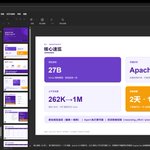
Adventists AI just open-sourced Sophon-Realtime v1 on ModelScope: a full-duplex voice model that hears how you speak, and answers with tone of its own.
• It keeps listening while you talk, answers ~0.4 s after you stop, and stops the moment you cut in
• It laughs, sighs and clears its throat when the conversation calls for it
• #1 among open full-duplex models on VoiceBench (82.8) and Big Bench Audio (81.8%)
• 48% Pass@1 on Full-Duplex-Bench v3 tool calling, ahead of Grok (43%)
Apache-2.0 weights. Built by @BKJinAI and team.
modelscope.ai/collections/Ad…
modelscope.ai/studios/Advent…
warmshao retweeted

Embodied models don't just think in text, they can think in visual plans, and fast.
Introducing VFlash, System-1 VLM for Physical AI.
Joint work by @YuCheng_Chou_, Shihao Wang and Jin Huang, LPR Team (@jankautz), GEAR Lab (@DrJimFan), and many other collaborators.
🌐 Website: research.nvidia.com/labs/lpr…
🧵[1/8] More details in the thread👇


warmshao retweeted

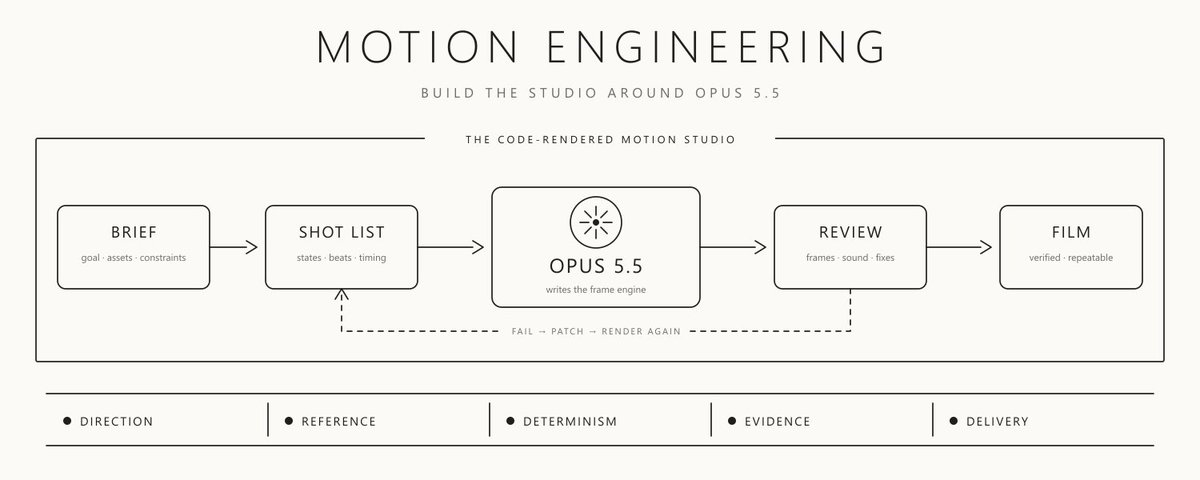
Opus 5.5 can make a video
The hard part is making the next one better
That takes a studio, not a prompt
I broke down how to build it ↓
warmshao retweeted

很荣幸给大家介绍并演示 Voxt,一款开源的 Mac 语音输入工具。
Voxt 已经持续迭代了半年多,也经历了上千位用户的实际使用和反馈。这次,我们把 SGLang Omni 的能力带入 Voxt 的推理 stack,进一步提升本地推理性能。之后,我们也会持续优化 Voxt 的使用体验。
现在,语音输入工具已经很多了。Typeless、豆包输入法、智谱输入法、微信输入法,都提供了相关功能。Voxt 的优势在于,整套软件 stack 开放、可控,我们可以从应用到推理过程持续优化,兼顾性能和稳定性。如果选择完全本地的推理配置,语音识别和文字润色都在自己的电脑上完成,语音和转写内容不需要上传到远程推理服务。
今天,我们会重点展示 Voxt 在专业术语输入上的表现,特别是 AI 工程里的模型名称、框架名称和英文缩写。这类表达,仅靠基础 ASR 转写,很容易出现识别偏差。
Voxt 把热词识别、带有个人系统提示词的 LLM 润色,以及推理性能优化结合起来,让输入既高效,也能更准确地处理专业词汇,贴合个人的表达习惯。
这次演示用的是我的 M5 Pro Mac。
语音识别使用 SGLang Omni 的 MLX 分支,文字润色则由 Ollama Serve 在本地运行 Qwen3.8 27B。两步都在这台电脑上完成。
当然,Voxt 也为 ASR 和 LLM 提供了接口。你可以根据自己的需要,选择远程识别服务和远程大模型,不必局限于这次演示的本地配置。
我和雪松用了 Voxt 半年多,也从日常用户变成了贡献者。这次接入 SGLang Omni,是我们进一步合作的一个里程碑。
感谢关伟老师和所有参与者。欢迎大家下载试用,也欢迎一起把 Voxt 做得更好。
鸣谢:关伟 · 叶雪松 · 刘崇寒 · 周屿涵 · 邓家昕
项目:github.com/sgl-project/sglan…
下载:github.com/sgl-project/sglan…
warmshao retweeted

Most companies that shut down give up their impact. This startup did something much better: they open-sourced 1,274 hours of egocentric robotics data. 13,451 recordings of humans doing everyday tasks, as a gift to the robotics community. Thank you @eidon_ai!
Open source has a superpower: work can outlive the organization that created it. More startups should do this!
huggingface.co/eidon-ai
warmshao retweeted

We are at the dawn of Superintelligence.
Introducing the Recurrent Looped Transformer (RLT),
We now have Transformers with Infinite Reasoning depth.
From now on, we should pace progress at the Open Frontier of Superintelligence,
Until Safe Superintelligence is achieved.
github.com/yifanzhang-pro/re…

warmshao retweeted

DeepSeek V4.1 Flash is Pareto Frontier on 60 brutal browser use tasks.
> 50x lower recorded agent cost than Sol and Opus at similar performance.
The entire dataset is cheaper to run than 1 task of Sol. Let that sink in.

warmshao retweeted
Introducing: Browser Use Pi 🥧
A tiny TypeScript web agent, built with Astra and improved through real browser evals.
We’ve built Browser Use, Browser Harness and BrowserCode. This time we asked Astra to combine what worked, with as little code and as few heuristics as possible. Then Astra hill climbed:
> Run real browser tasks
> Read traces
> Fix what breaks
> Delete complexity
> Run again and repeat.
The result? Pi Mono + persistent V8 REPL + raw CDP. Fully in TypeScript. Cloud browsers, persistent sessions, streaming and step limits included 🌀
npm install @browser_use/pi

warmshao retweeted

Thoughts About Scaling Law
Scaling, but not only of parameters. Every model release now ends with the same question: how many parameters? It isn't a question that can be answered on its own. Parameter count is only meaningful alongside three others — how much data you have, where you intend to spend your compute, and who will run the model, under what conditions.
The field learned this the hard way. Kaplan et al. (2020) fit an exponent that told everyone to grow parameters faster than data — roughly 2.7:1 — and the industry complied: GPT-3, Gopher, MT-NLG. Hoffmann et al. (2022) redid the experiment across four hundred models and found the compute-optimal split is closer to 20 tokens per parameter, and that with sufficient compute the two should grow at the same rate rather than drifting apart. The error in the earlier fit compounded with every order of magnitude of compute, which is why the largest models of that generation were the most misallocated. The trillion-parameter round was, in retrospect, a detour the whole field took together and then reversed.
Chinchilla wasn't the end either. It optimized training compute for models that would be trained once and evaluated. Today a model is called billions of times a day and inference dominates lifetime cost. Put inference into the objective and the optimum moves toward smaller models trained far longer — deliberate over-training, which is what Llama-2-7B and Gemma-2-9B were doing at roughly 290 and 889 tokens per parameter.
Sparsity moved the target again. In a MoE model two quantities have to be kept apart: total parameters govern roughly how much the model can hold — knowledge, facts, the long tail — while activated parameters and effective depth govern roughly how far it can think, how many steps of a causal chain it can carry before it comes apart. A dense 20:1 ratio does not transfer. And the ratio isn't a single number at all: Roberts et al. (2025) find the optimal tokens-per-parameter is task-dependent, with memorization favoring more parameters and reasoning favoring more data. Follow-up work on MoE observes that at fixed TPP, pushing total parameters higher actually degrades reasoning, while activating more experts reliably helps it.
This matters for what we are building toward. Finding a vulnerability is not a retrieval problem. It doesn't come from having memorized more CVEs; it comes from carrying a twenty-step chain of inference to the end without losing the thread. That capability does not live in total parameter count.
Which brings us to this release. Total parameters appear to matter up to a threshold — enough to hold the world — after which additional capability comes from scaling elsewhere: effective depth per forward pass, and above all post-training. GLM-5.3 is our controlled experiment on that claim. Same base, same architecture, same total and activated parameters as GLM-5.2. One month of scaling long-horizon environments and RL. The gains are not marginal. Well, scaling has more than one dial. We turned the post-training one this time because it had the most slack left in it — not because the others are finished. Base model size, pretraining data, compute spent per forward pass: all of them are still on the table, and we will come back to each. What this experiment taught us is that the dials do not have to be turned together, and that the one worth turning next is rarely the one that was worth turning last. We are not done scaling. Next time, maybe mid-training, pre-training, and even more.
warmshao retweeted

Releasing the model weights and technical report of Kimi K3.
Kimi K3 is our most capable model: a 2.8T MoE model with native visual understanding and a 1M-token context window.
New model architecture: 2.5x the intelligence per unit of compute, not just more params.
Alongside Kimi K3, we're opening up more of the stack behind it — high-performance attention kernels, MoE communication library, and infrastructure for running agent environments at scale.
Model weights: huggingface.co/moonshotai/Ki…
Tech report: github.com/MoonshotAI/Kimi-K…
Tech blog: kimi.com/blog/kimi-k3

warmshao retweeted
Introducing Kimi K3: Open Frontier Intelligence
🔹 2.8 Trillion Parameters, 1 Million Context, Native Multimodal
🔹 Kimi Delta Attention enables up to 6.3x faster decoding in million-token contexts
🔹 Attention Residuals deliver ~25% higher training efficiency at <2% additional cost
🔹 Built for long-horizon agentic coding and self-evolving workflows
Kimi K3 is now live on on Kimi.com, Kimi Work, Kimi Code, and the Kimi API.
Open Weights by July 27, 2026.
🔗 API: platform.kimi.ai
🔗 Tech blog: kimi.com/blog/kimi-k3




warmshao retweeted

Introducing: Browser Use CLI 3.0 🌐
Turn any model into a SOTA browser agent
> Direct CDP control via browser-harness
> Run on cloud browsers or real Chrome
> 6× smaller, fewer tokens
Try it now 🔗↓
warmshao retweeted

📣📣 Meet Qwen-AgentWorld — a native language world model that simulates 7 agent environments (MCP, Search, Terminal, SWE, Web, OS, Android) within a single model. Environment modeling is the training objective from day one, not a post-hoc adaptation.
🤔 LLMs are trained to be better agents — better at acting in environments. But nobody has trained them to model the environments themselves.
🗺️ Our roadmap: investigate how language world modeling can push the boundaries of general agent capabilities, along two routes:
1️⃣ Build a foundation model for environment simulation — outperforming Claude Opus 4.8 and GPT-5.4 on AgentWorldBench
2️⃣ Investigate how world modeling enhances agent training:
🔬 Controllable Sim RL (agentic RL with LWM as environments) surpasses training in real environments
🧠 Learning to predict environments (LWM warm-up) makes agents stronger — remarkably, even without any agent-specific training, this predictive knowledge transfers to agentic tasks with zero fine-tuning
📑 Paper: arxiv.org/abs/2606.24597
📖 Blog: qwen.ai/blog?id=qwen-agentwo…
💻 GitHub: github.com/QwenLM/Qwen-Agent…
🤗 HuggingFace: huggingface.co/collections/Q…
🧩 ModelScope: modelscope.cn/collections/Qw…

warmshao retweeted

I just published a blog on agentic RL that covers 10+ recent frameworks in the space. Here are the key takeaways…
Link to blog: cameronrwolfe.substack.com/a…
(1) Modular interfaces. Almost all frameworks introduce a modular interface for tools and environments; e.g., an HTTP interface or function-call-based abstraction. With a modular design, we can easily add new tasks, swap environments, etc. to handle arbitrary training setups with minimal code changes.
(2) Trajectory structure. Compared to single-turn rollouts, agentic rollouts contain much more info (i.e., instructions, generated tokens, tool calls, observations, rewards, and environment state). Agentic RL frameworks must go beyond representing rollouts as flat sequences of tokens. Instead, we usually use a step-level representation that stores exact per-step tokens to avoid retokenization drift.
(3) Action mask. Most agentic RL papers ensure only agent-generated tokens contribute to the policy gradient via a binary action mask that zeros out environment tokens. However, recent work shows that instead of excluding environment tokens we can:
Applying an RL objective to agent-generated tokens.
Applying an SFT objective to environment-generated tokens.
(4) Process rewards. Most recent RL work heavily relies on outcome rewards. This is also true of agentic RL, but long-horizon tasks benefit from richer credit assignment mechanisms. Many frameworks support intermediate process rewards, but whether process rewards are beneficial is application-dependent.
(5) Advantage normalization. Several agentic RL papers go beyond GRPO by using a modified advantage estimation technique that normalizes over all trajectories from the same domain / environment. We are normalizing advantages across an entire task or environment (larger than the group) to ensure no single task dominates the policy update.
(6) Scalable rollouts. Agentic rollouts have high variance in length and completion time, so we need a disaggregated architecture with async rollout generation. Environments must be containerized and hosted scalably (e.g., using Kubernetes) to avoid bottlenecks.
(7) Stability / exploration. Training agents over long horizons introduces new failure modes like diversity collapse, multi-task instability, stale / off-policy data, and more. Many approaches are proposed to solve these issues; e.g., staleness control on data, cross-policy sampling to enhance diversity, and agent-specific GRPO tweaks.
(8) Task curriculum. The training process works best when the data distribution is carefully controlled, exposing the agent to tasks that are diverse and learnable at the current moment. Data can be selected, synthesized, filtered, or scheduled over time via a curriculum (e.g., train on short horizon tasks first then extend the horizon over time).

warmshao retweeted

Introducing GLM-5.2: Frontier Intelligence, Open Weights
- Significant improvements in coding and agentic tasks
- Strong long-horizon capabilities with a 1M context window
- Two levels of reasoning effort: GLM-5.2 (max) pushes the limits, while GLM-5.2 (high) strikes a strong balance between performance and token efficiency
- MIT-licensed open weights
- Same API pricing as GLM-5.1
Tech Blog: z.ai/blog/glm-5.2
Weights: huggingface.co/zai-org/GLM-5…
API: docs.z.ai/guides/llm/glm-5.2
Coding Plan: z.ai/subscribe
Chat: chat.z.ai
